
Last updated on June 28, 2026
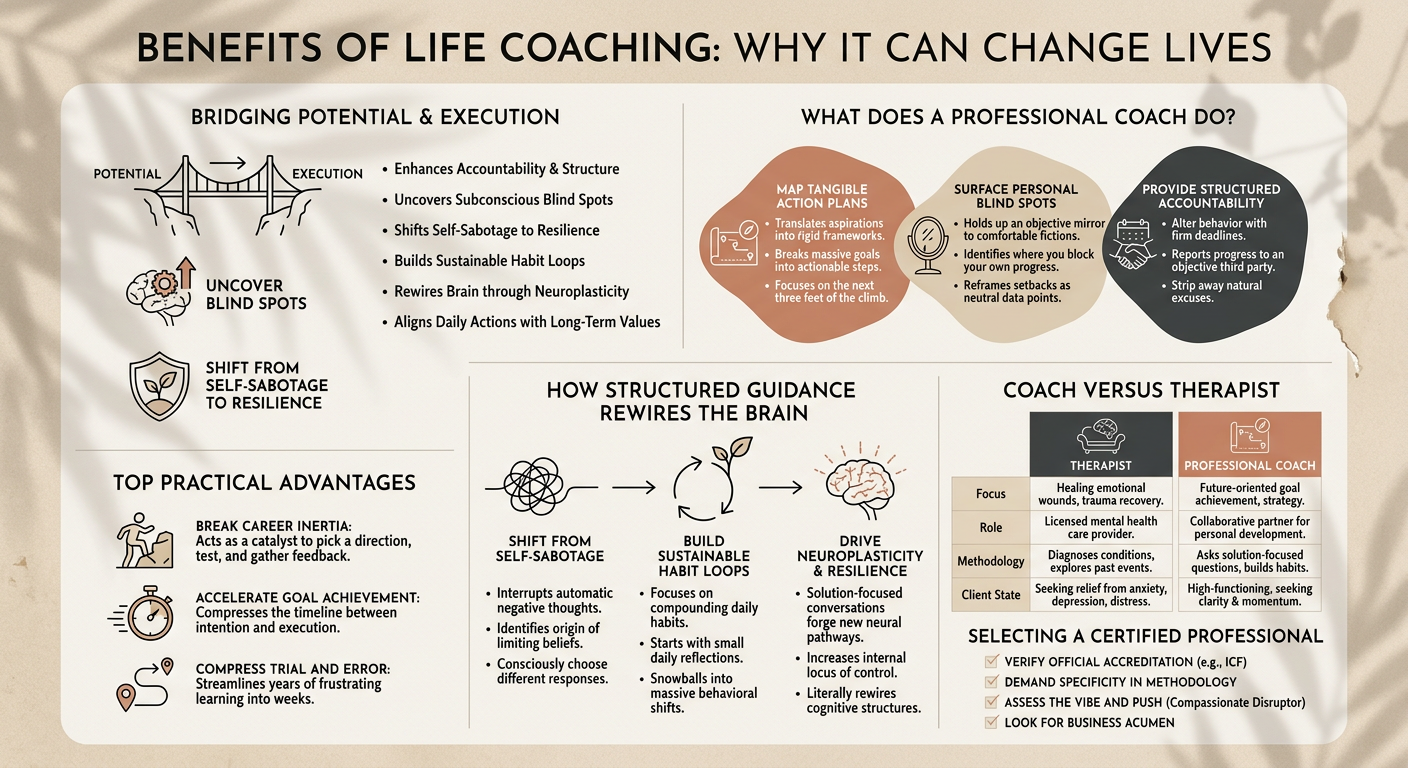
Life coaching transforms lives by bridging the gap between potential and actual execution. Key benefits include enhanced accountability, the ability to uncover subconscious blind spots, and a shift from self-sabotage to resilience. Structured guidance helps individuals build sustainable habit loops and rewire their brains through neuroplasticity. Ultimately, coaching aligns daily actions with long-term personal and professional values, often resulting in measurable improvements in well-being. They hit an invisible ceiling. The hours increase, the output scales, and yet, the underlying sense of alignment vanishes completely. We live in a society obsessed with relentless scaling at the expense of human connection. People assume the answer to this friction is just working harder. They attempt to optimize their routines until they resemble machines.
A professional coach steps into this exact intersection of high performance and quiet desperation. Coaching is not about fixing someone. It is a structured intervention designed to help an individual uncover their own internal operating system. By prioritizing curiosity over compliance, a life coach forces a confrontation with reality. They close the massive gap between what a person intends to do and what they actually execute on a Tuesday morning.
What Does a Professional Coach Actually Do?
Map Tangible Action Plans
People spend years waiting for an epiphany to strike. Epiphanies rarely handle the logistics of a career transition. A coach does not traffic in vague inspiration or motivational quotes. They build the necessary scaffolding for a client to move forward. If an individual wants to reshape their relationship with wealth, understanding what a money mindset coach really does (and why it works) involves translating that dream into a rigid framework of daily decisions. They break massive aspirations into an actionable plan. The client stops staring at the summit. They start looking at the next three feet of the climb.
Surface Personal Blind Spots
Humans are spectacular at lying to themselves. We call our fear of rejection “being highly strategic.” We mask our avoidance of conflict as “maintaining team harmony.” A good coach holds up an objective mirror to these comfortable fictions. Exploring who can benefit from confidence coaching often reveals that self-belief is not a static personality trait inherited at birth. It is a practiced skill. By surfacing these hidden narratives, coaches help individuals see exactly where they are blocking their own progress. Understanding how a confidence coach helps requires seeing them as an investigator of your blind spots, reframing setbacks as neutral data points rather than devastating verdicts.
Provide Structured Accountability
Support is pleasant. Deadlines alter behavior. When a client knows they have to report their progress to an objective third party, their entire orientation to the task changes. Accountability structures strip away the excuses we naturally grant ourselves. Industry research strongly supports this methodology, showing that individuals utilizing these structured professional relationships often report a 73% improvement in relationships and well-being. Goals without deadlines live in a dream world. A real coach pulls those goals down into reality using targeted support and firm boundaries.
How Structured Guidance Rewires the Brain
Shift from Self-Sabotage
The brain is remarkably efficient. It vastly prefers the familiar discomfort of a known situation over the terrifying ambiguity of a new one. This biological reality drives continuous self-sabotaging behaviors. Changing this requires active intervention. Many women rebuilding self-worth and finding confidence discover that their internal dialogue is running on an outdated script. A life coach uses evidence-based questioning to interrupt these automatic thoughts. They help clients identify the origin of their limiting beliefs and consciously choose a different response.
Build Sustainable Habit Loops
Nothing sustainable is built overnight. The practice of adopting abundance affirmations for wealth and success in various life areas only works when integrated into a compounding daily habit. Professional coaches understand that motivation is notoriously unreliable. They focus entirely on habit loops. A client might start with a simple ten-minute daily reflection. Weeks later, that tiny habit snowballs into massive shifts in how they communicate boundaries.
Drive Neuroplasticity and Resilience
Structured dialogue physically changes the brain. Experts at the Institute of Coaching observe that consistent, solution-focused conversations serve as a powerful catalyst for neuroplasticity. Gentle pressure forces the mind to forge new neural pathways. Data published in a recent peer-reviewed study confirms this, demonstrating a 13.1% increase in participants’ internal locus of control after working with a coach. People literally rewire their cognitive structures to become more resilient in the face of stress.
Top Practical Advantages of Expert Accountability
Break Career Inertia
Inertia is the quiet killer of potential. Professionals often spend years researching their options without ever making a choice. For those navigating the second half of their professional lives, exploring the concrete benefits of professional guidance becomes the exact mechanism needed to break this paralysis. The coach acts as a catalyst. They force the client to pick a specific direction, test it, and gather feedback, completely destroying the illusion that waiting will somehow yield a perfect answer.
Accelerate Goal Achievement
Time is the only non-renewable resource we possess. Compressing the timeline between intention and execution is the primary value proposition of this work. Individuals and organizations employing professional coaching frequently see a 7x average ROI, simply because they stop wasting months on the wrong priorities. A structured plan eliminates the constant second-guessing that typically derails goal achievement.
Compress Trial and Error
You can figure out almost anything on your own given enough time. The question is whether you want to spend a decade learning a lesson that could be absorbed in six weeks. A coach compresses years of frustrating trial and error into a streamlined process. They bring a fresh perspective to stagnant problems.
Real-World Scenarios That Accelerate Daily Progress
Negotiate Salary Increases
A client terrified of asking for a raise does not need a pep talk. They need a strategy. The coach requires the client to pull historical data on their project impact. They map out the precise financial value the client brings to the organization. Then, they role-play the conversation until the client’s delivery is entirely devoid of emotional pleading. Women navigating mid-life transitions frequently use a career coach for women over 40 to find their next path by building this exact type of evidentiary confidence.
Launch Viable Products
Founders are notoriously prone to chasing shiny objects. They build features nobody asked for. A business coach steps in to halt the scattered product experiments. They enforce a disciplined testing plan. The founder must hypothesize, launch a minimal viable product, gather harsh feedback, and iterate. This structured approach strips the ego out of the product launch.
Rebuild Daily Routines
Burnout is a systemic issue, not a personal character flaw. Yet the recovery always begins at the level of the daily routine. Understanding how coaching rebuilds your career after workplace burnout involves ruthlessly auditing a client’s calendar. The coach helps the client realign their schedule with their core values. Sleep is protected. Boundaries are enforced. The individual learns that saying no is a complete sentence.
Coach Versus Therapist: Who Should You Hire?
The distinction between these two professions is heavily regulated and deeply important. They address entirely different aspects of the human experience. The American Psychological Association notes that while therapists diagnose and treat mental health conditions, life coaches focus entirely on executing future aspirations.
| Feature | Therapist | Professional Coach |
|---|---|---|
| Primary Focus | Healing emotional wounds, trauma recovery. | Future-oriented goal achievement, strategy. |
| Clinical Role | Licensed mental health care provider. | Collaborative partner for personal development. |
| Methodology | Diagnoses conditions, explores past events. | Asks solution-focused questions, builds habits. |
| Typical Client State | Seeking relief from anxiety, depression, distress. | High-functioning, seeking clarity and momentum. |
Understanding why women leaders need confidence coaching rather than therapy often comes down to this distinction. If the block is rooted in deep trauma, a therapist is essential. If the block is rooted in a lack of strategic communication skills or executive presence, a coach is the right professional.
Steps to Evaluate and Select a Certified Professional
The coaching industry is rapidly expanding, with an estimated global revenue projected to hit $5.34 billion by 2025. With this massive scale comes a high degree of variance in quality. Selecting the right practitioner requires intense due diligence.
- Verify Official Accreditation: The industry standard is the International Coaching Federation (ICF). Practitioners who have undergone rigorous coach training alliance programs or hold ICF credentials have submitted to ethical boards and supervised practice hours.
- Demand Specificity: A good coach will clearly define what they do and do not do. Exploring what kind of problems NLP coaching can solve should yield highly specific answers about behavioral remodeling, not vague promises of universal happiness.
- Assess the Vibe and Push: You are not hiring a friend. You are hiring a compassionate disruptor. The initial chemistry call should feel slightly challenging. If the practitioner only agrees with your current worldview, they cannot help you change it.
- Look for Business Acumen: In corporate settings, organizations with strong developmental cultures report 27% higher year-over-year revenue growth. A qualified executive coach will understand the intersection of personal psychology and corporate metrics.
Critical Warning Signs of an Unqualified Practitioner
The internet is flooded with charismatic individuals claiming to be life coaches. Many of them are simply marketing experts selling toxic positivity. Authentic coaching is grounded in psychological safety and evidence-based frameworks.
Be highly suspicious of anyone who guarantees specific financial returns or uses high-pressure sales tactics. If a practitioner dismisses legitimate structural or psychological barriers as merely a “mindset issue,” walk away immediately. Real coaches understand the nuances of systemic pressure. They do not blame the client for systemic realities. Similarly, a practitioner who operates without a clear framework or verifiable coach training is just charging you to think out loud.
True holistic care respects the limits of the practitioner’s scope. If a coach attempts to treat chronic anxiety or trauma, they are violating profound ethical boundaries. The work is about fostering resilience and curiosity, not playing doctor with a client’s mental health.
FAQ
Is life coaching actually backed by science? Yes. Peer-reviewed research, including studies highlighting coaching-enhanced self-efficacy, shows that structured coaching conversations foster optimism, directly improving performance and emotional regulation.
How long does it take to see results? This depends entirely on the specific goals set. However, clients working on tangible shifts like rewiring self-worth with a body confidence coach often report significant behavioral changes within the first six to eight weeks of consistent, weekly practice.
Why is the industry growing so fast? The demand for personalized guidance is surging because traditional corporate structures are failing to provide mentorship. Nearly 85% of coaches handle requests related to mental well-being, acting as a proactive layer of support before employees hit full burnout.
Conclusion
We spend an enormous amount of time optimizing our software, our investment portfolios, and our supply chains. We spend very little time actively debugging our own internal operating systems. Unexamined beliefs dictate entirely how we move through the world.
Choosing to work with a professional coach is fundamentally an act of taking oneself seriously. It is a declaration that you are no longer willing to let your career, your relationships, or your well-being default to whatever the surrounding culture demands of you. It is about slowing down enough to define what actual success looks like, and then building the exact scaffolding required to go get it. The clarity that emerges from that process is profound. It changes how you show up for yourself. It changes how you show up for the people around you.