
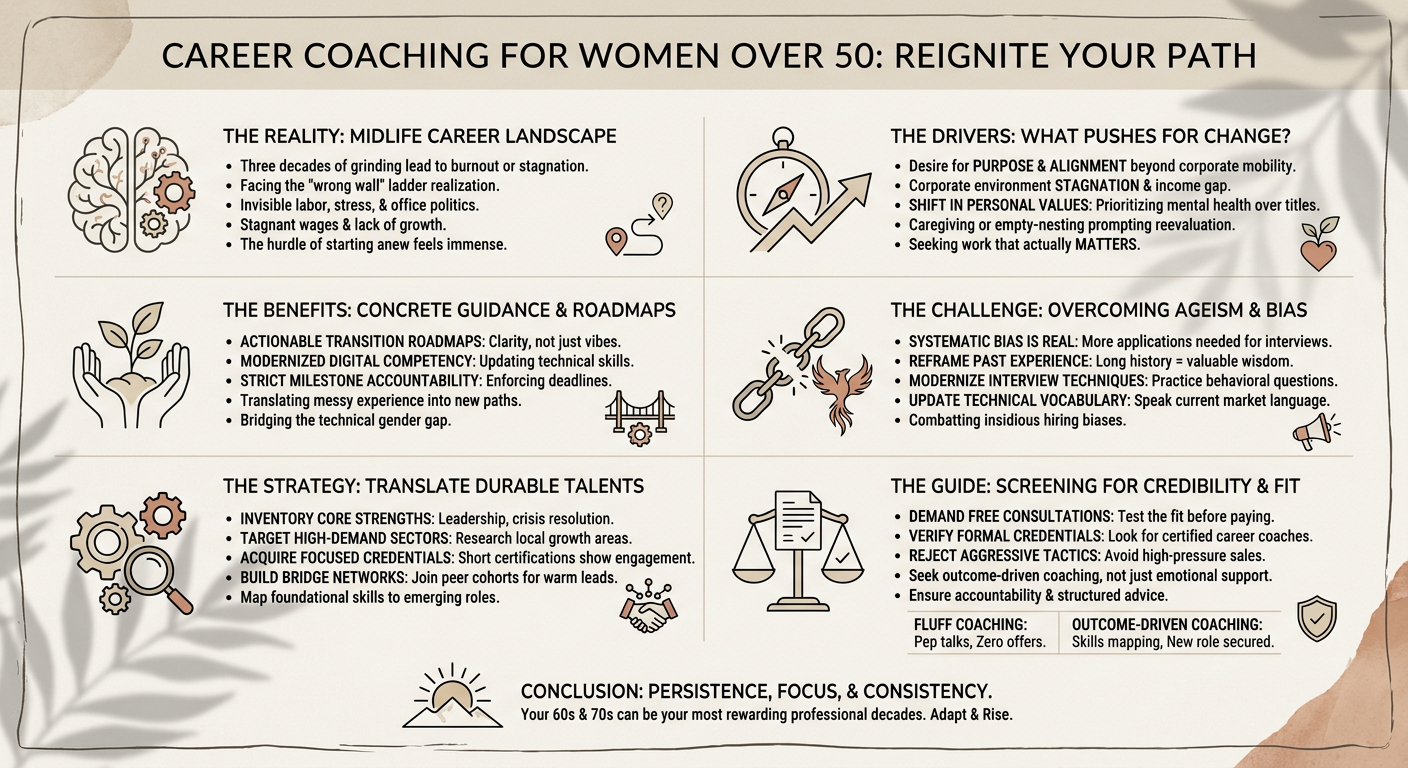
We sit in our ergonomic office chairs after three decades of grinding, staring at the screen and thinking, “Man, I wish I was doing literally anything else.”
Why not take the sheer grit you used to build your professional life and apply that intensity to your next chapter?
With enough structured focus, you can make your next career transition profoundly fulfilling.
Corporate career trajectories represent a marathon of endurance and compliance, with millions of professionals waking up at fifty realizing the ladder they climbed is leaning against the wrong wall.
The stress, politics, and invisible labor that go into the daily grind of most executives is difficult for an outsider to truly grasp.
From managing massive budgets year-round to navigating personality clashes that would make a reality TV producer blush, the dedication of women in the workforce is absolutely staggering.
Okay, so what does this have to do with hiring a career coach?
More than you might suspect.
While comparing your career path to an Olympic sport may seem like apples and oranges, consider the struggles that mature professionals face:
- Some days it just feels like we’re going nowhere, essentially spinning our wheels trying to support a stagnant steady job.
- Throwing in the towel can be incredibly tempting when we’re not seeing any real growth for our hard work and experience.
- Overcoming that final financial hurdle to start a coaching business or consulting gig can be like staring up at a giant, seemingly impossible to defeat.
Likewise, adults navigating late-career shifts face similar challenges in the midst of physical and mental roadblocks as they spend years preparing for opportunities that could vanish in mere seconds.
But do they give up?
No.
And neither should you.
It’s time to take your job search out of the kiddie pool.
What Drives Midlife Professional Shifts?
Older professionals aren’t simply born with an urge to uproot their lives: they’re pushed as a result of fierce internal shifts and external pressures.
Likewise, killer career paths don’t fall from the sky: they’re created as a result of intense research and a fool-proof career development strategy.
If your first corporate career falls flat after thirty years, does that mean you should give up altogether?
Of course not.
Instead, understand the forces actually pushing you toward a big change.
Desire for Purpose
Women over 50 are often looking for alignment, purpose, and balance rather than traditional upward corporate mobility.
We spend decades checking boxes for other people.
Eventually, the desire to do work that actually matters overrides the need for another meaningless title promotion.
Corporate Environment Stagnation
We know that women in their mid-to-late 50s experience a 5.6% drop in earnings from peak mid-career levels, whereas men’s earnings do not drop until much later.
That financial plateau breeds resentment.
You realize you are training younger executives to take your boss’s job while you stay stuck in the exact same role.
Shift in Personal Values
Life happens.
Caregiving responsibilities for aging parents or empty-nesting forces a brutal reevaluation of how we spend our hours.
You stop caring about impressing the CEO and start caring about your own mental health.
Concrete Benefits of Professional Guidance
Dozens of career norms have already been broken in the modern workplace.
In fact, it seems like rules are constantly being rewritten in the corporate world, year after year.
Why?
Markets evolve. As leaders and executives uncover new ways to work, professionals adapt accordingly to raise their own standards to match their competition.
You should constantly work to evolve your career counseling needs and professional development to meet the expectations of your target niche.
Actionable Transition Roadmaps
A genuine career coach possess credibility that matters.
Coaches that know what they do offer you clarity in the process, and not just vibes.
You want someone who can translate your messy experiences into actionable paths, not just someone giving you empty pep talks.
Modernized Digital Competency
The modern workplace runs on new software and digital communication styles.
A specialized transition coach helps you update those skills rapidly.
Interestingly, the global labor force participation rate for women is 47%, compared to 72% for men, reflecting a 25 percentage-point gender gap. Staying technically relevant is how you fight back against those terrible odds.
Strict Milestone Accountability
It can take some professionals years of rigorous planning before they make a successful move: earning a new position requires extreme patience and perseverance.
You can’t always expect your transition to kill it from the word “go.”
A structured coaching program enforces strict deadlines, so your dream job doesn’t remain just a dream.
How Do Mature Professionals Overcome Ageism?
Building.
Writing.
Testing.
Career transitions represent a lot of hard work, and there are no shortcuts.
Similarly, job seekers train their entire lives to reach executive levels, however, such glory can easily be stripped away by insidious hiring biases.
On a similar note, older candidates attempting to rely on outdated methods can lose their confidence and organic market value at little more than a moment’s notice.
Systematic bias is real. We know that older women (ages 50 to 62) must submit 42% to 46% more job applications than younger women to secure a single interview offer.
Reframe Past Experience
You have a multi-decade track record.
Stop apologizing for your age.
A good counselor helps you reframe your long work histories as valuable entrepreneurial wisdom and futuristic insights.
Modernize Interview Techniques
You must practice answering behavioral questions without sounding like you are lecturing the interviewer.
Fortunately, free virtual interview preparation and structured job coaching is offered to unemployed workers over 50 through the Back to Work 50+ program.
Take advantage of these coaching sessions to refine your delivery.
Update Technical Vocabulary
Speak the language of the current market.
If you are a retail executive or a biotech ceo looking to consult, your resume needs to reflect today’s terminology, not the jargon from ten years ago.
Translate Durable Talents to New Markets
Many successful women live by the mantra of “never give up.”
You should treat your new career the same way.
If you’re persistent, your trajectory has nowhere to go but up over time.
Perhaps the biggest mistake a career counseling client could make is dropping what they’re doing and simply giving up when the job search gets tough.
Yes, it can be frustrating to face rejection.
Yes, it sucks when we don’t see the opportunities we want.
Keep going and keep adjusting your approach.
Inventory Core Strengths
Take stock of your durable skills.
Leadership, budget management, and crisis resolution never go out of style.
Map these foundational talents onto emerging roles.
Target High-Demand Sectors
Go where the money and the need actually exist.
If you are leaving a dying industry, research local growth areas. For instance, the U.S. Department of Labor hosts a dedicated tool for older workers to research local job trends and evaluate remote working viability.
Acquire Focused Credentials
Don’t fear risk, but do build a bridge.
Enroll in an affordable 8-week certification in your new field.
This proves to employers that you are actively engaged in learning new things.
Build Bridge Networks
Networking is rarely fun, but it is entirely mandatory.
Join a virtual peer coaching group specifically tailored for female executives in transition.
Use these connections to harvest warm leads and practice your pitch.
Screen Practitioners for Credibility and Fit
There are so many pieces to what makes a successful career coaching engagement. For starters, let’s think about:
- The certified career coach having actual corporate experience rather than just a weekend certificate.
- The coaching practice relying on proven coaching tools rather than vague astrology or pure emotional support.
- The structure of the advice, specifically designed to encourage actionable steps to navigate forward.
- The presence of strict accountability to help you tackle new challenges.
Here’s a not-so-secret secret.
The success of your career change doesn’t lie within one single session.
It’s the elements combined that determine the potential of your move.
| Coaching Style | Approach | Typical Outcomes |
|---|---|---|
| Fluff Coaching | “Trust the journey” pep talks | High initial motivation, zero job offers |
| Outcome-Driven Coaching | Skills mapping, interview prep, hard deadlines | Clear transition roadmap, new role secured |
Demand Free Consultations
Always book a complimentary discovery session.
You must test the fit and ensure they understand your specific career counseling needs.
If they refuse to chat before demanding payment, walk away.
Verify Formal Credentials
Look for verifiable training or advanced degrees in career counseling if you are supporting transitions in the workforce.
A life coach is not necessarily equipped to handle complex executive career support or high-level resume restructuring.
Reject Aggressive Tactics
The coaching market is saturated with aggressive salespeople.
If a business coach pressures you to buy a ten-thousand-dollar package on the first call, hang up the phone. This is a major red flag.
Coaching is utterly ineffective if the practitioner relies on manipulation.
What Distinguishes Outcome-Driven Support Communities?
When guidance communities exist, they tend to deliver either emotional venting or practical scaffolding.
You want the latter.
The strongest communities aren’t just chat rooms; they are structured peer cohorts with mentors, accessible training options, and affordable entry points.
They provide the momentum needed to move from blind optimism to actual results.
Surround yourself with other driven adults who are actively landing jobs.
Book Your Initial Discovery Consultation
Your next step is incredibly simple.
Find three to four credible coaches who specialize in adult career coach services for women over 50.
Book a short introductory call with each of them.
Treat these calls like you are interviewing them for a critical vendor contract, because you absolutely are.
Pick the professional who offers a clear, tangible plan to jump start your next decade.
FAQ
Do I really need a coach at this stage in my life? If you are struggling to translate your thirty years of experience into a modern resume that gets callbacks, yes. A fresh, expert set of eyes saves you months of wasted effort.
How long does a typical career coaching engagement last? Most outcome-driven programs run between three to six months. It takes time to audit your skills, target a new sector, and secure a new role.
Is it too late to completely change industries at 55? Absolutely not. Data shows that 46% of workers aged 65 and older are women, up from 33% in 1964, with 42% holding a bachelor’s degree or higher. You have plenty of working years left to conquer an entirely new reality.
Conclusion
While navigating a midlife pivot isn’t exactly an Olympic sport, there are serious parallels between the struggles of star athletes and the challenges faced by mature women in the workforce.
The corporate world moves fast and is difficult to maneuver in the wake of evolving technologies and aggressive ageism.
Much like athletes, career counseling clients should consider patience, focus, and consistency as key virtues to help ensure their ultimate success.
If you are persistent, willing to train, and ready to accept professional guidance, your 60s and 70s could easily become the most rewarding decades of your professional life.