
Introduction
Corporate boardrooms often project an illusion of absolute certainty, with executives exchanging confident nods over quarterly projections and strategic realignments.
Many of us sit at those tables, nodding along, silently wondering when someone will finally realize we feel completely out of our depth.
Why not take the same rigorous intensity we apply to our financial models and direct it toward our own internal narratives?
With enough focus and brutal honesty, you can rebuild your professional self confidence and genuinely command the room.
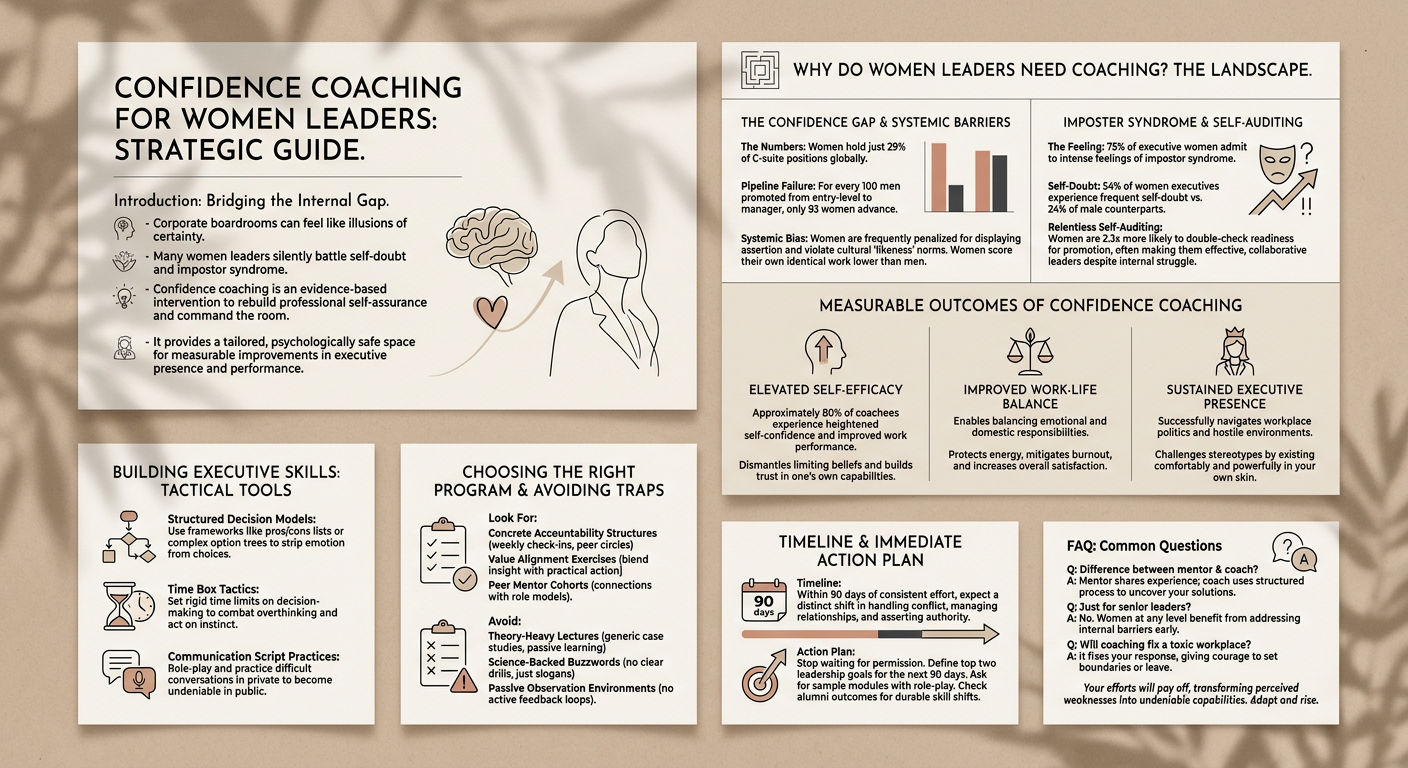
Confidence coaching for women leaders is an evidence-based intervention that effectively bridges the leadership confidence gap, mitigates impostor syndrome, and combats systemic gender bias and low self esteem in the corporate hierarchy.
It provides a tailored, psychologically safe space that translates to measurable improvements in executive presence and team performance.
Okay, so why exactly does a senior leader need a coach to feel competent?
More than you might think.
While comparing your career trajectory to a rigged game might sound cynical, consider the real, documented struggles that female leaders face daily. Every single woman leader faces this at some point.
Some days it just feels like we are spinning our wheels trying to support a team while drowning in our own insecurities. Overcoming that final mental hurdle into full ownership of your role can feel like staring up at a giant.
But do you give up?
No.
And neither should you settle for feeling inadequate.
Why Do Women Leaders Need Confidence Coaching?
Let’s look closely at the actual landscape of executive roles. Women, including LGBTQ women and women of color, navigate a maze of unspoken rules and misperceptions.
The Confidence Gap
The numbers are frankly staggering.
A comprehensive global study reveals that women hold just 29% of C-suite positions, and their career advancement continues to decelerate in our current corporate climate.
We aren’t just imagining the friction.
Historical pipeline research details a foundational barrier where, for every 100 men promoted from entry-level to manager, only 93 women advance.
This early-stage promotion imbalance creates a compounding pipeline failure that leaves women permanently behind, impacting everything from pay scales to gender equality initiatives across global organizations.
Imposter Syndrome Symptoms
You land the big promotion. You get the corner office.
But you still feel like a fraud.
This isn’t a personal failing or a permanent weakness. An in-depth survey of top-performing female business leaders found that 75% of executive women admit to experiencing intense feelings of imposter syndrome during their upward trajectory.
Cross-industry leadership statistics show that 54% of women executives experience frequent or intense self-doubt, compared to only 24% of their male counterparts.
Oddly enough, executive search research indicates that women are 2.3 times more likely than men to double-check their readiness for promotion.
This relentless self-auditing paradoxically makes them more interpersonally effective and collaborative leaders, even as they battle internal confidence struggles.
Systemic Gender Bias
Social science analysis challenges the popular assumption that women naturally possess lower self-confidence, pointing instead to institutional treatment rather than fundamental gender differences.
Workplace behavioral studies unpack how women are frequently told to “lean in” and display more assertion, only to be systematically penalized for violating cultural likeness norms.
Behavioral economics papers show that when evaluating identical performance test results, women score their own work significantly lower than men do.
It is the systemic context and deep-seated gendered perceptions driving these outcomes, not an individual lack of capability.
What Are the Measurable Outcomes of Coaching?
If you put in the hours with a dedicated confidence coach, what actually happens? Do your thoughts magically change?
Elevated Leadership Self-Efficacy
A recent meta analysis of empirical studies consistently connects executive coaching to substantial behavioral and cognitive changes. A qualitative study featuring structured interviews with senior leaders proves the impact.
Data provided by the International Coaching Federation demonstrates that approximately 80% of coachees experience heightened self-confidence and improved work performance following a structured reflective coaching process.
You start trusting your own capabilities. Limiting beliefs are dismantled. You stop apologizing for taking up space.
Improved Work-Life Balance
Industry experts suggest that a well-designed coaching program enables women to balance emotional and domestic responsibilities.
This significantly improves their overall satisfaction and builds the resilience needed to mitigate burnout. You learn to protect your energy.
Sustained Executive Presence
Coaching empowers female executives to successfully navigate workplace politics and hostile environments without losing their authentic leadership styles.
You learn to challenge leadership stereotypes simply by existing comfortably and powerfully in your own skin. The implications for your career are massive.
How Do Coaches Build Executive Leadership Skills?
A good confidence coach doesn’t just hand you a mirror and tell you your unique strengths are beautiful.
They give you tactical tools. Coaching plays a crucial role here.
Structured Decision Models
Programs that center confidence as a skill and teach decision-making frameworks tend to produce durable shifts in your leadership progression.
If you are battling indecision or second-guessing, pros and cons lists or complex option trees give you repeatable strategies you actually use at work. They strip the emotion out of the choice.
Time Box Tactics
We often overthink, paralyzed by the fear of making a mistake.
Setting rigid time limits on decision making forces you to act on instinct and existing data. It is a fantastic facilitator for rapid growth.
This builds rapid trust in your own abilities.
Communication Script Practices
You need to practice saying the hard things out loud.
Expect exercises, scaffolds, and some role-playing or scenario practice. Mastering these conversations in private makes you an undeniably effective leader in public.
Choose the Right Leadership Coaching Program
I suspect many of us have wasted money on generic courses. I have checked a mix of online options, and I strongly favor programs that combine leadership theory with concrete confidence-building and decision-making tools.
Concrete Accountability Structures
The difference between an average course and a transformational confidence coaching experience is accountability.
If you are juggling work, life, and growth, you need a program with weekly check-ins and peer circles that meets you where you are.
Value Alignment Exercises
The Yale School of Management online Women’s Leadership Program sticks because it blends personal insight with practical leadership action.
A standout program helps you name your core values, translate them into leadership behaviors, and then practice them in meetings. It bridges the gap between who you are and the leader you want to be.
Peer Mentor Cohorts
Look for cohorts that connect you with mentors, sponsors, and female role models you will stay connected with after the course ends.
The strongest outcomes come from people you can call on to navigate promotions or tricky conflicts.
Avoid Generic Leadership Certificate Traps
Not all programs are created equal. In fact, some are just expensive busywork.
Theory-Heavy Lectures
Generic leadership certificates that lean heavily on case studies and theory offer little hands-on practice for high-stakes moments.
If the course feels like a lecture hall, you will end up remembering slogans more than how you showed up in the room. Leadership development is lived practice.
Science-Backed Buzzwords
Programs that sell science-backed confidence without clear drills are a waste of time.
Confidence is a practice, not a hormone rush. You want coaches who give you repeatable steps and measurable growth.
Passive Observation Environments
Look for programs that guarantee time for applying learnings to your actual job.
Passive observation environments breed complacency. Active feedback loops are mandatory for genuine skill acquisition.
How Long Until You See Coaching Results?
You cannot always expect your confidence to skyrocket from the word “go.”
Remember: developing a dominant leadership style represents a marathon and not a sprint.
Think about how long-distance runners kick it into high gear at the end of the race. The fact that they were ever “behind” becomes irrelevant as long as they cross the finish line first.
Usually, within 90 days of consistent effort, female clients notice a distinct shift in how they handle conflict, manage relationships, and assert their authority. A recent report backs this timeline up for most individuals.
Set Your Immediate Leadership Action Plan
It is time to take your career out of the kiddie pool and get on the level of truly confident leaders.
How?
Stop waiting for permission.
- Define your top two leadership goals for the next 90 days, like making decisive calls in meetings without overthinking.
- Ask program providers for sample modules that include role-play or live scenario practice showing how you would apply the learnings to a real work situation.
- Check alumni outcomes or testimonials for evidence of durable skill shifts, not just basic satisfaction scores.
If you can’t find tangible progress stories, keep looking.
FAQ
Let’s clear up some common questions about hiring a confidence coach for women leaders.
What is the main difference between a mentor and a coach? A mentor shares their own experiences to guide you. A coach uses a structured, reflective coaching process to help you uncover your own unique strengths and solutions.
Is this just for senior leaders? Absolutely not. Women in leadership positions at any level, from mid-level managers to individuals stepping into their first executive roles, benefit massively from addressing their internal barriers early.
Will coaching fix a toxic workplace? Coaching fixes your response to the environment. It gives you the courage to set boundaries, demand gender equality, or the clarity to realize when it is time to leave a broken system.
Conclusion
Building a rock-solid sense of self confidence represents a lot of hard work.
There are no shortcuts.
Similarly, Olympians train their entire lives to relish a few moments of glory. Women leaders face immense pressure, shifting expectations, and deep-seated biases every single day.
But you always have the opportunity to adapt and rise.
Stay organized. Stay diligent. Stay hungry.
Your efforts will pay off, transforming your perceived weaknesses into undeniable capabilities.
So, what do you think separates a star female leader from the rest of the pack?