
Last updated on April 14, 2026
Key Takeaways
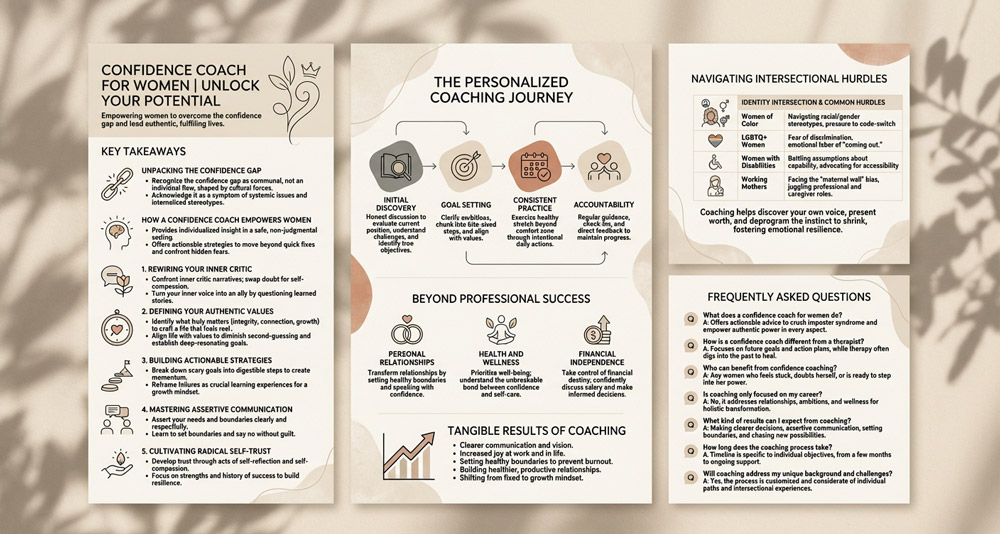
- That confidence gap you’re sensing is genuine and communal, typically molded by cultural forces, not individual flaws. Recognizing this is the first step to transcending it.
- You can silence your inner critic by confronting its narratives. I coach you to swap that doubt for self-compassion and turn your inner voice into an ally.
- True confidence accumulates by living in accordance with your values. When you know what really matters, choosing what to do and what to aim for is a clear and empowering process.
- Confidence sprouts from mini steps, not from stalling until you feel ready. We’ll deconstruct your goals into bite-sized blocks to gain momentum and demonstrate to yourself what you’re truly capable of.
- Learning to speak your mind with confidence is a must for establishing inner confidence. It is about asserting your needs and boundaries clearly and respectfully, and not feeling guilty about doing so.
- This path is about more than career achievement. The confidence we construct together will reverberate into your relationships, your wellness, and your power to craft a life you love on your own terms.
A confidence coach for women can help unravel the hidden wars that are frequently mistaken for character flaws. I used to think my burnout was evidence that I wasn’t good enough, a story many high-achieving women tell themselves.
This isn’t simply a personal failing; it’s a symptom of systems that reward unsustainable work. Real confidence isn’t about doing better; it’s about developing the grit necessary to be human in these brutal frameworks.
Let’s see how to get that work started.
Unpacking the Confidence Gap
The confidence gap is no urban legend traded in gossip sessions—it’s a real obstacle confronting women across the professional spectrum. It’s not a personal failing. It’s a systemic problem arising from cultural norms and entrenched gender stereotypes that demand women be cooperative but not too dominant, smart but not a smarty-pants.
We witness this actualized in real time. Research finds that most women will only apply for a position if they meet 100% of the criteria, whereas men apply feeling good about themselves at 60%. We’re not talking about competence here; we’re talking about a permission slip that men feel intrinsically entitled to and women sense they have to work for.
That gap has a deep ripple effect on careers and lives. It’s why women, even experts, tend to hold back in meetings. It’s the invisible war of self-doubt before a big presentation, a textbook symptom of imposter syndrome. The implications are stark.
The data shows women make up only 29% of C-suite roles and the path to economic parity seems infinitely extended. It’s not simply about personal insecurity. It’s about places of business where implicit institutional biases and constant microaggressions chip away at gifted individuals’ confidence, making leadership seem unattainable.
This is why it’s important to distinguish confidence from competence. I’ve encountered thousands of brilliant women who undervalue their skills, thinking they require full confidence before they can make their move. Confidence and certainty aren’t identical.
Confidence is faith in your capacity to deal with a result, even if you’re not certain what that result will be. It’s the bravery to move forward in the face of uncertainty. It’s this difference where the strength returns to you.
That trust is an inner work, frequently fortified through community and contemplation. In academic reviews, women in coaching and peer programs experience substantial, persistent gains in confidence and network.
It can begin small. Try closing your day by writing down one thing you handled well, one thing you would do differently, and one thing that scared you but worked out anyway. This small ritual of reflection goes a long way toward reprogramming the internal monologue, rooting your confidence in reality, in the proof of your own strength and ability.
How a Confidence Coach Empowers Women
A confidence coach offers individualized insight in a safe, supportive, non-judgmental setting, nurturing the self-exploration essential for authentic development. Her work centers on providing women with actionable strategies to develop confidence.
It is about transcending quick fixes to tackle the soul-crushing terror that haunts us, enabling women to lead lives that truly reflect their core values and aspirations.
1. Rewiring Your Inner Critic
That incessant inner chatter whispering that you’re not good enough? That’s the inner critic. It’s a pattern of negative self-talk and limiting beliefs that supplies self-doubt.
A coach assists you in recognizing these messages not as truths, but as learned stories. Together, we confront them and interrogate their legitimacy.
This rewires self-sabotaging beliefs into empowering ones, swapping ruthless critique for the self-kindness required to take courageous actions.
2. Defining Your Authentic Values
Identifying your values is key to crafting a life that feels real and is the foundation of confidence. We often function according to what others expect of us, pursuing what they want us to accomplish rather than who we truly are.
A coach helps you go inward and determine what really is important to you, whether that’s integrity, connection, or growth. When your life aligns with these values, it becomes like an internal compass that steers your choices and makes you feel purposeful.
This clarity diminishes the internal static of second-guessing and allows you to establish goals that resonate more deeply.
3. Building Actionable Strategies
Confidence, as I define it, is a muscle you build through deliberate effort, not affirmations. A coach helps translate scary goals into digestible steps.
This creates momentum and concrete proof that you can, which is crucial for silencing the voice of self-sabotage. This structure reframes your relationship to failure.
Setbacks are no longer indictments of your value but crucial learning experiences that cultivate a growth mindset welcoming challenges.
4. Mastering Assertive Communication
Assertive communication is the vital sweet spot between passivity and aggression. It is about communicating your needs and opinions assertively.
At most offices, women are subtextually encouraged to be “nice” and end up invisible. With a coach, you learn actual tools, such as how to set boundaries and say no without apologies, that allow you to manage hard conversations.
5. Cultivating Radical Self-Trust
After all, confidence is about trusting yourself, your judgment, and your abilities. This isn’t a natural-born gift.
It’s developed through repeated acts of self-reflection and self-compassion. A coach builds this confidence by focusing on your strengths and your history of success.
The Personalized Coaching Journey
Confidence coaching is not a canned program. The confidence-building process is different for everyone, so it needs to be a customized experience. It’s a joint effort to discover the source of the paralysis and break down the damaging self-narratives that hold you back.
It’s a journey of deep evaluation, strategic goal formation, action commitment, and continued guidance, making sure your growth is not just realized but maintained.
Initial Discovery
The initial phase is an honest discussion. This intake session is our opportunity to evaluate your current position, understand your unique challenges, and start to focus on your true objectives—not the ones you think you should have.
I apply a combination of incisive questioning and deep listening to really hone in on your strengths, your tendencies, and your unconscious self-beliefs. One of the primary elements affecting confidence is one’s beliefs about their ability, and our initial task is to expose those beliefs.
This phase demands sincerity to establish the rapport needed to do the work. It is a secure vessel for the brave dialogues that need to take place.
From there, we design a tailored coaching path together. It’s a flexible roadmap constructed entirely around your specific needs and goals, which ensures our efforts are both applicable and meaningful from the very first session.
Goal Setting
Taking the time to really identify your goals is all about clarifying what you want. We then chunk those large ambitions into smaller, bite-sized actionable steps that feel attainable.
The vital trick is matching these objectives with your fundamental values and passion, since this is the source of authentic desire and dedication. It helps you transition from a negative, self-defeating mindset to one that is focused on possibilities.
We will:
- Identify the values behind your goals and make sure they are really your own.
- What does success look and feel like to you?
- Define clear and achievable short and long term goals.
- Work with Chuck to craft an action plan with first steps to gain momentum.
- Include methods for visualizing triumph to bolster a constructive mission-focused mentality.
Consistent Practice
Confidence is earned by exercising a healthy stretch beyond your comfort zone through intentional, relentless action. It’s about weaving tiny confidence training practice sessions into your day until they’re automatic.
It’s this regular work that results in deep self-awareness, self-acceptance, and self-love.
- [ ] Daily Intention Setting: Face each morning by identifying a micro-action you are going to take that day to push your goal forward.
- [ ] Acknowledging Wins: It doesn’t matter how small. Write down three things you did well that day. This rewires your brain to observe improvement.
- [ ] Body Language Shifts: Try power posing or holding eye contact a little longer in conversations to develop physical presence.
- [ ] Challenging Negative Self-Talk: When a negative thought arises, actively question its validity and reframe it with a more balanced perspective.
We’ll monitor your progress to keep the momentum going and celebrate every achievement. Setbacks are not failures. They are recast as valuable learning opportunities that bolster your resilience for the road ahead.
Accountability
Regular guidance is the scaffolding that surrounds this path. It keeps you on track, inspired, and in control of your growth.
- Regular check-ins are scheduled to review progress, navigate obstacles, and adjust our strategy as needed.
- I deliver direct, empathetic feedback to open you up to new ways of seeing and disrupting confining habits.
- We can even look into establishing a broader support network, like an accountability buddy or group to bolster your dedication.
Ultimately, the aim is to develop strong self-accountability and train you to be your own best advocate.
Beyond Professional Success
We pursue confidence as a professional weapon—the promotion, the winning pitch, the seat at the table. That’s a narrow perspective. Real confidence isn’t just a career benefit; it is the key to a fulfilling life. It’s what enables us to create a world that tastes as delicious on the inside as it appears on the outside, well past the end of our workday.
Personal Relationships
Confidence transforms the way you relate with other people. It encourages you to set boundaries, not walls to keep people out but gates that you hold the key to.
When you have faith in your own voice, you can speak your needs and opinions clearly and compassionately. It’s not about winning arguments, but healthier communication and greater intimacy. You quit shrinking to fit in their comfort zone.
When you see conflict in this way, managing it becomes less about dread and more about insight. Disagreements are no longer a threat to the relationship but a chance to fortify it through respectful discussion.
Ultimately, this all begins with accepting yourself. A nurturing, secure relationship with yourself is the template for the healthy and satisfying relationships you construct with others.
Health and Wellness
The bond between confidence and our well-being is unbreakable. It prescribes what we do with our bodies and minds, from what we eat and how we sleep to whether or not we’re willing to address stress.
So when you think you’re worth caring about, you begin to make decisions with this in mind. It’s not about pursuing an aesthetic; it’s about respecting the body you inhabit.
Building psychological resilience via mindfulness or meditation enables you to experience life’s storms without absorbing their tension. You might be reading this and reflecting on the unseen struggles you endure.
Understand that getting professional help for anxiety or depression is not a failure. It’s an act of deep courage and an essential move toward creating a durable, healthy life.
Financial Independence
Confidence immediately puts you in the driver’s seat of your financial destiny. It turns your thinking from wishful to intentional, empowering you to take more intelligent action toward achieving stability and autonomy.
This includes the boldness to face your money, get a budget, and make decisions about saving and investing. It’s about understanding your worth as a professional and possessing the confidence to discuss salary and promotions.
Requesting what you’re worth is the most straightforward use of self-confidence. Don’t hesitate to ask for advice. Real confidence means knowing when to turn to trusted financial experts to guide you toward creating a secure future.
Navigating Intersectional Hurdles
Confidence is not a lingua franca. For women, the road to confidence is littered with intersectional hurdles. Self-doubt is crippling, particularly when your identity overlaps with issues like race, sexual orientation, or disability. This isn’t just me feeling this way; it’s reacting to a system where a woman’s name on a resume can be 60% less likely to be chosen for an interview than a man’s.
These aren’t simply hurdles; they’re intersectional walls. The struggles are intersectional and singular to your individual experience.
|
Identity Intersection |
Common Hurdles |
|---|---|
|
Women of Color |
Navigating both racial and gender stereotypes; pressure to code-switch. |
|
LGBTQ+ Women |
Fear of discrimination affecting career progression; emotional labor of “coming out.” |
|
Women with Disabilities |
Battling assumptions about capability; advocating for accessibility. |
|
Working Mothers |
Facing the “maternal wall” bias; juggling professional and caregiver roles. |
Confidence coaching steers women through these particular tides. It’s not a generic pep talk. It’s about discovering your own voice and how to present your worth, in particular when subliminal prejudices attempt to mute you.
It’s about the more tangible work of claiming physical space, employing assertive body language, and deprogramming the instinct to shrink. This path will take you out of your comfort zone, but above all, it requires emotional resilience and a growth mindset to reframe the self-defeating narratives these hurdles generate.
In the end, personal coaching is just half of the answer. The real work is in building spaces where all women can flourish. It’s an organizational issue, not merely an individual one.
When we cultivate environments of psychological safety, we enable women to support one another. This human-first approach is how we break down the intersectional barriers together.
Tangible Results of Coaching
The word ‘confidence’ can seem abstract in a world ruled by metrics and KPIs. You might be reading this and wondering how feeling better about yourself impacts the bottom line. It’s a good question. The key is to transcend the sensation and examine the tangible shifts that take place when an individual — especially a female leader — conquers the unseen wars of self-doubt and imposter syndrome. These results aren’t just personal.
We watch people change their careers. A senior manager who used to sit on her hands during board meetings now speaks up and clearly conveys her vision, resulting in promoted positions and impact. This isn’t magic; it’s the product of cultivating deep self-awareness of her strengths and values, so she could make more conscious, deliberate contributions.
We regularly observe coaching touching measurable numbers, from clients negotiating pay raises to reporting far greater joy both at work and in life. It’s about constructing the internal framework to approach such challenges with more facilitation, transforming your mindset from fixed to growth and resilience.
I recall coaching a director who, despite her role, felt like an imposter. She referred to her self-talk as a harsh critic. Through our work, she learned to set healthy boundaries, which not only put her burnout at bay, but made her team more productive because her communication became clearer.
She created healthier habits and began her day with purpose instead of stress. This is such a typical story. When others evolve a more positive self-image, they don’t merely do better work; they build healthier, more productive relationships, both at the office and at home.
Investing in confidence coaching is an investment in your organization’s most critical asset: its human beings. It shifts mental health from a “personal problem” to an “organizational responsibility,” spreading a ripple effect of psychological safety and courageous leadership.
The long-term payoff is a more flexible, resilient, and human-first culture where people are unafraid to innovate, to speak up, and to lead authentically. It’s about revealing the greatness that was always present.
The First Courageous Conversation — The Curious Bonsai
That voice that keeps telling you ‘you’re not ready’ or ‘someone else can do it better’ is usually a whisper. It’s simple to write off. Instead we’re told to just ‘be more confident’, like it’s a switch we can toggle.
This isn’t your fault. It’s a human reaction to systems that were never really designed for us. Reclaiming your confidence is not about becoming another person. It’s about carving out a safe space to reconnect with the woman you’ve always been. The decision to seek support is the initial brave dialogue with yourself. It’s a ripple effect kind of action, allowing the other humans in your orbit the right to discover their own voice as well.
Frequently Asked Questions
What does a confidence coach for women do?
We offer actionable advice to crush imposter syndrome, define your path, and empower your authentic power in every aspect of life.
How is a confidence coach different from a therapist?
Whereas therapy frequently digs into the past to heal, coaching looks ahead. As your coach, I work alongside you to establish goals, develop new skills, and generate action plans for the future you desire.
Who can benefit from confidence coaching?
Coaching is for any woman who feels stuck, doubts herself, or is ready to step into her power. It’s for you if you’re ready to stop doubting yourself and begin living a more genuine and satisfying life.
Is coaching only focused on my career?
Not even close. Lots of my clients come to me for professional development. Authentic confidence seeps into all areas. We can address your relationships, ambitions, and wellness as well to bring about transformation throughout your entire life.
What kind of results can I expect from coaching?
You will make decisions with more clarity, communicate assertively, and set healthy boundaries. Clients find the bravery to chase possibilities they once believed impossible.
How long does the coaching process take?
The timeline is specific to your individual objectives. Some women get the results they want in a few months, and some opt for ongoing support. We will design a plan that suits you and your path.
Will coaching address my unique background and challenges?
Definitely. Awesome coaching understands that your life and who you are is special. The process is customized to your unique situation, making sure our techniques are applicable and considerate of your individual path.