
Introduction
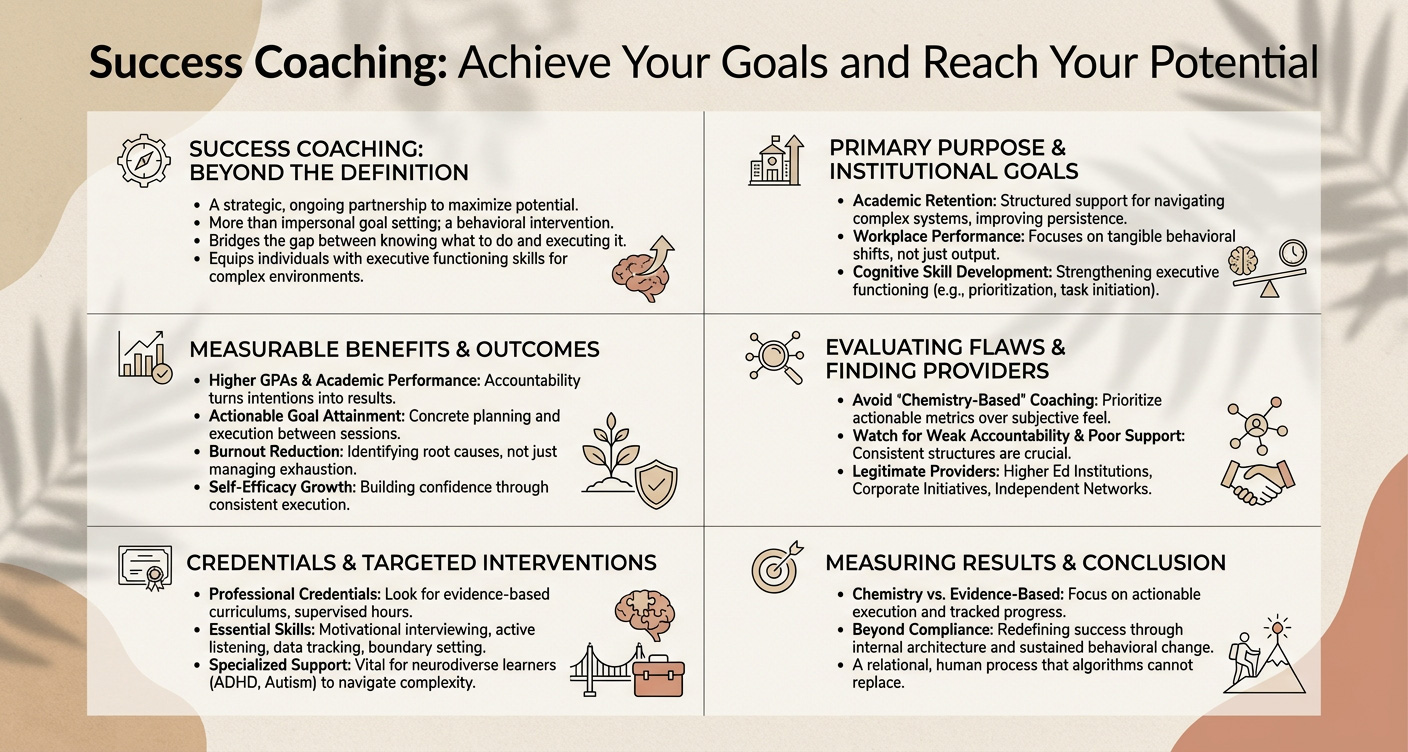
Success coaching is a strategic, ongoing partnership designed to maximize an individual’s academic, professional, and personal potential through evidence-based goal setting and performance tracking. It provides organizations and institutions with a measurable framework to improve retention, enhance productivity, and align daily habits with long-term institutional objectives.
That is the textbook definition. It is also overly impersonal.
We live in a culture obsessed with scale. Scale your business. Scale your platform. We optimize for output and gradually overlook the conditions that make people feel seen. Success coaching, when stripped of the corporate jargon, is actually a highly effective behavioral intervention. It bridges the challenging gap between knowing what you should do and actually having the practical support and structure to execute it. You do not need a cheerleader. You need someone to help you rewire your internal operating system. The core purpose is equipping a student or professional with the executive functioning skills necessary to navigate environments that often prioritize metrics over human connection.
What Is the Primary Purpose?
Let us look closely at why institutions actually fund these programs.
Academic retention rates
The modern university is a labyrinth. Without navigation, extremely capable students struggle to get the support they need. A student success coach approach is fundamentally about survival in complex systems. Broad independent literature reviews confirm that a structured success coach training program significantly improves persistence. Randomized controlled trials indicate coached students are up to 12% more likely to remain enrolled one year post-coaching compared to their non-coached peers. It keeps a new student anchored. When a university invests in an outstanding program, they are supporting student retention and progress by protecting the academic journey of their learners.
Workplace performance metrics
In the corporate sphere, professionals are drowning in busywork. They do not need another lecture on time management. They need behavioral change mechanisms. Success coaching redirects this scattered energy. It focuses on tangible behavioral shifts rather than just logging more hours at a desk.
Behavioral change mechanisms
We pretend that a single coaching appointment will instantly solve deep-seated procrastination. It will not. Coaching relies on repeated, small behavioral pivots. The progress often comes from consistent, everyday actions of translating insights into concrete steps.
Cognitive skill development
This is the quiet work. Strengthening executive functioning. Meta-analyses tracking coaching efficacy indicate that the intervention yields a moderate, highly meaningful effect size. Hedges’ g typically lands around 0.42 to 0.59. The data shows that coaching heavily impacts behavioral and cognitive outcomes over time.
Identify the Measurable Benefits
The data highlights an important reality that glossy marketing ignores. If you want results, you track the right variables.
Higher semester GPAs
Institutions track this relentlessly. A success coach provides the accountability structures necessary to turn intentions into improved academic performance. They help students map out a success plan that survives the mid-term slump.
Actionable goal attainment
Independent psychological assessments note a sharp divergence in how coaches and clients evaluate an appointment. Coaches often over-index on subjective session chemistry. The client felt heard, therefore the session was a win. Real goal progress relies heavily on concrete, actionable planning. What happens between the coaching conversations is what actually matters.
Executive function improvement
Time management. Prioritization. Task initiation. These are the scaffolds required to function in high-stress roles. Coaching tools are deployed specifically to build these mental muscles.
Burnout reduction
When executives hit a wall, they often internalize the exhaustion as a personal flaw. They think they simply need to work harder. They are actually just deeply dysregulated. Recognizing the physical signs of exhaustion is a massive part of recognizing when you need executive burnout therapy to recalibrate your career. By addressing the root causes of this exhaustion, professional staff members can help individuals regain clarity.
Self-efficacy growth
This is the belief that you can actually execute your own individualized plan. It is a quiet confidence built on a track record of kept promises to yourself.
Evaluate Real-World Program Flaws
I read the forums. I listen to the people who have struggled with these programs. When a successful platform suddenly fails its users, people care far more about repeatable flaws than rare edge cases. Reddit-style honesty beats polished testimonials every single time.
Actionable metrics versus chemistry
Chemistry is cheap. A good vibe in a person appointment does not guarantee you will pass your courses or secure a promotion. Clients need a practitioner who prioritizes evidence over empathy alone.
Repeatable setup friction
Real-world friction lives in small, repeatable moments. If a student has to navigate a clunky scheduling system just to get an appointment confirmation or figure out how to reschedule, they will abandon the effort. A tool that requires constant fiddling will be judged harshly.
Poor support responsiveness
People are absolutely ruthless about support experiences. Quick, clear, empathetic responses matter infinitely more than feature lists. A poor support thread becomes a self-fulfilling prophecy because users remember the lag and the canned replies.
Weak accountability structures
Third-party researchers repeatedly caution that success coaching is not an inherent magic bullet. A comprehensive review published in the International Journal of Mentoring and Coaching in Education notes a crucial detail. In 66% of empirical studies, coaching success was directly tied to rigorous coach training and institutional feedback. The mere presence of a student coach on staff means nothing if the underlying framework is hollow.
Find Legitimate Service Providers
Finding the right provider requires cutting through massive amounts of digital noise.
Higher education institutions
Many universities now embed student success coaches directly into the student affairs department. Places like Portland State University have developed specific models to support their student body. An academic advisor handles course registration, while a success coach handles the behavioral realities of the college career.
Corporate workplace initiatives
Companies invest heavily here as a preventative measure for leadership attrition. They deploy individual providers to work with management teams. Exploring the benefits of life coaching in a corporate setting often reveals a massive return on investment simply by retaining institutional knowledge.
Independent practitioner networks
For those outside institutional structures, independent coaches offer tailored coaching sessions. Look for professionals who demand as much accountability from you as you demand from them.
Obtain Professional Credentials
Anyone can print a business card and call themselves a success coach. The teaching profession requires strict licensing. Coaching often relies heavily on self-regulation and voluntary professional development.
Evidence-based program curriculums
A legitimate student success coaching certificate course is grounded in psychology and behavioral science. It is not just about giving advice.
Institutional feedback loops
Training must include supervised hours and deep mentorship. Programs like the sts success coaching team model rely on continuous peer review.
Skill requirement assessments
Certain skills are non-negotiable.
-
Motivational interviewing: Eliciting the client’s own internal drive rather than forcing external compliance.
-
Active listening: Hearing the unspoken anxieties beneath the surface complaints.
-
Data tracking: Measuring progress through objective metrics rather than subjective feelings.
-
Boundary setting: Knowing when to issue a referral to a licensed therapist for clinical mental health concerns.
Who Needs Targeted Interventions?
We need to stop pretending everyone operates with the exact same neural architecture. Specialized institutional studies highlight success coaching as a vital framework for helping courageous learners with ADHD, learning disabilities, or autism navigate highly complex environments.
It fosters self-determination, self-regulation, and crucial executive functioning skills. The Disability Resource Center at many schools acts as a primary referral point to connect these students with academic coaches. Without this wonderful support system, highly intelligent individuals frequently burn out due to a lack of structural support.
How Are Results Measured?
We measure what we value. If we value compliance, we measure attendance. If we value actual growth, we measure the implementation of the success plan.
|
Metric |
Chemistry-Based Coaching |
Evidence-Based Coaching |
|---|---|---|
|
Primary Focus |
Emotional validation during the session |
Actionable execution between sessions |
|
Key Indicator |
Client feels positive and heard |
Client completes agreed-upon behavioral steps |
|
Feedback Loop |
Subjective self-reporting |
Institutional data, GPA, or performance reviews |
|
Accountability |
Loose and highly flexible |
Structured and heavily tracked |
When we understand how coaching rebuilds your career after a massive crash, we look strictly at the right-hand column of that table.
FAQ
What is the difference between an academic advisor and a success coach? An advisor tells you which courses to take to graduate. A success coach helps you figure out why you keep skipping those courses and helps you build a system to actually attend them.
Do you need a certification to be a success coach? Legally, no. Ethically and practically, yes. Completing a rigorous coaching course separates the professionals from the hobbyists.
How often should coaching appointments occur? Most evidence-based coaching frameworks suggest bi-weekly sessions. This allows enough time for the client to execute their behavioral tasks while maintaining a tight accountability loop.
Can coaching replace therapy? Absolutely not. A success coach focuses on present behaviors and future goals. A therapist addresses clinical diagnoses and past traumas.
Conclusion
Compliance is not character. A student who only studies out of fear of failure has not learned how to learn. A corporate leader who only optimizes for output will eventually shatter their own team. We have to learn to redefine success on our own terms.
Success coaching is the practice of building the internal architecture required to actually sustain that new definition. It is hard, often unglamorous work. It requires staring down your own behavioral patterns and choosing a different path. It is also the exact kind of relational, deeply human work that no algorithm will ever be able to replace.