
Last updated on June 23, 2026
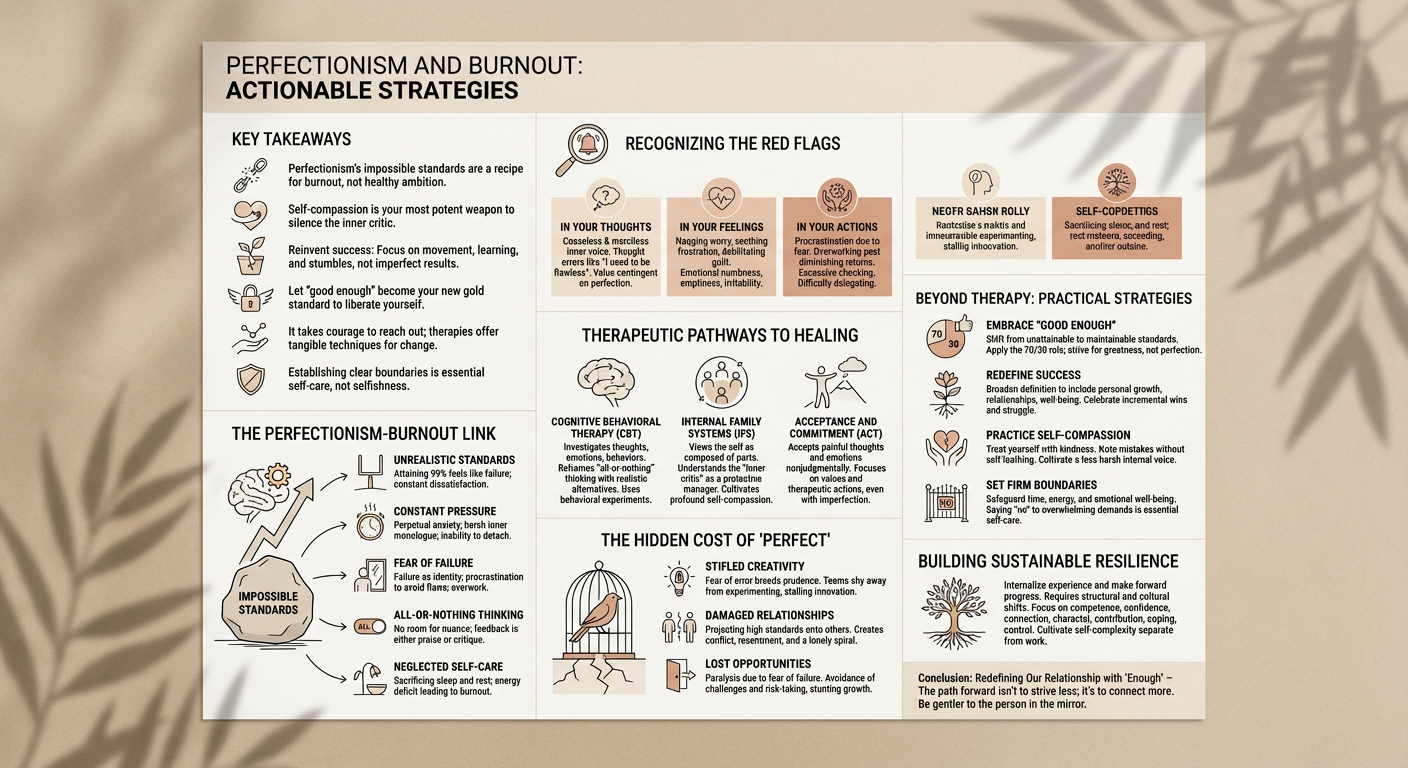
Key Takeaways
- Perfectionism isn’t healthy ambition. I’ve learned the hard way that its impossible standards are a recipe for burnout and exhaustion.
- You need to teach yourself kindness, particularly when you feel like you’ve screwed up. Self-compassion is your most potent weapon to silence that nasty inner critic and recover.
- Let’s reinvent your version of success. It’s not about imperfect results, but about movement, about straining, about gleaning from the whole experience, stumbles and all.
- The pursuit of “perfect” is exhausting and will keep you stuck. I dare you to let ‘good enough’ become your new gold standard and liberate yourself from perfectionism.
- It takes courage to reach out when you’re in trouble. Therapies such as CBT offer tangible and actionable techniques to reprogram perfectionistic thought patterns and develop a stronger you.
- Guarding your energy is imperative for healing. Establishing clear boundaries isn’t selfish; it’s essential self-care that enables you to show up as your best self.
Therapy for perfectionism and burnout is untangling your self-worth from your work output. For years, I thought my hard-charging impetus was my strongest trait until it burned me out.
This hidden war is not just an individual weakness; it is a habit our work culture rewards, distorting our finest humans. We need to begin a brave dialogue about how to break down this draining loop for us and our teams.
The Perfectionism-Burnout Link
Perfectionism isn’t a badge of honor or work ethic. It’s a rush-hour one-way street to burnout. Research on multidimensional perfectionism confirms what many of us feel in our bones: the relentless pressure to meet impossibly high standards is unsustainable. It’s a cycle in which accomplishment provides no respite, just a momentary breather before the next chase starts.
This isn’t healthy striving. It’s the inflexible conviction that we’re only valuable if we’re perfect, a cognitive and emotional tax that companies can no longer sustain.
1. Unrealistic Standards
At the heart of perfectionism is the establishment of unattainable goals, driven by a punishing inner critic and a work culture that rewards over-functioning. A perfectionist could view 99% as a failure, fixating only on the 1% that wasn’t. This ceaseless dissatisfaction generates chronic stress since the goalpost is forever shifting.
Even when a big project is completed, it feels hollow rather than joyful. This fleeting reparative pause is soon replaced by stress for the ensuing assignment which, in turn, ensures the student never really enjoys the satisfaction of his own effort.
2. Constant Pressure
This drive generates a sense of perpetual anxiety. It’s usually an internal monologue of harsh inner dialogue, where any small error is blown into a disaster. This merciless self-flagellation renders detachment out of reach.
Even away from work, the mind is busy replaying perceived mistakes or pre-planning to avoid future ones. It’s a round-the-clock “on” psychological state destroying mental health.
3. Fear of Failure
For many, perfectionism springs not from a desire to excel but from a crushing fear of failure. It’s the ingrained conviction that errors are not simply errors but marks of personal deficiency. Failure is not an event; it’s an identity.
Paralyzing in this fear, we procrastinate to sidestep the prospect of a flawed product. Instead, it can feed overwork, as you pour time and effort into making certain a project emerges faultless and it speeds you toward burnout.
4. All-or-Nothing Thinking
This cognitive distortion leaves no room for nuance. A task is all or nothing. Feedback is either glowing praise or a devastating critique. This all-or-nothing thinking stands in the way of flexibility and makes it hard to learn from failure since anything less than perfect is rejected as useless.
5. Neglected Self-Care
In the quest for perfection, yourself is frequently the initial sacrifice. Sleep, nutrition, and rest are luxuries, not necessities, for sustainable performance. This neglect results in a serious energy deficit, causing burnout to become nearly unavoidable.
Prioritizing self-care takes an act of self-compassion; understanding that you are a human being, not a human doing, and that your needs matter.
Recognizing the Red Flags
The indicators of perfectionist burnout usually start as whispers. They’re easy to shrug off as simply stress or the price of ambition. When we don’t listen, they get louder, until the exhaustion and cynicism become a roar. Awareness of these patterns is not a surrender; it’s the brave beginning of designing a work life where human beings, not just their units of output, can survive and maybe even thrive.
These aren’t character flaws; they’re typically organization problems showing up in your top talent.
In Your Thoughts
The voice of the perfectionist is ceaseless and merciless. It’s all those thought errors such as “I need to be flawless” or “If I mess something up, then I’m a failure.” This isn’t high standards; this is a story in which your value as a person is contingent on being perfect.
This crucial self-reflection becomes a petri dish for emotional turmoil, transforming something like high conscientiousness from a strength into a self-sabotaging tool. I’ve sat with leaders who admit their minds run amok with all-or-nothing thinking, where a project is either a home run or a disaster, with no space for learning or humanity in the middle.
The heavy lifting is to confront these irrational assumptions and substitute more tempered, kind, and reasonable viewpoints.
In Your Feelings
It takes an emotional toll. It usually begins with nagging worry—a low, ominous drone that you’re failing to live up to unrelentingly demanding expectations. This can be combined with seething frustration when things don’t go precisely according to plan and debilitating guilt over your own inadequacy.
That emotional drain eventually results in burnout, which consists of feeling emotionally numb, blunted, or just plain empty of motivation. You might feel like you’re not enough or that you’re a bad person — even when you do great things.
This emotional exhaustion doesn’t remain at your desk. It comes home with you, creating irritability that damages your relationships with family and friends. It’s a silent sickness that keeps you alone and disconnected to the point where being connected seems inconceivable.
In Your Actions
Perfectionism shows up in what we do and don’t do.
- Procrastination: Delaying tasks due to an intense fear of not executing them perfectly.
- Overworking: Spending excessive time on tasks long after the point of diminishing returns.
- Excessive Checking: Constantly reviewing emails, reports, or presentations for minor errors.
- Difficulty Delegating: Believing that no one else can do the job to the right standard.
This avoidance and hesitation stems from a fear of failure. You put off beginning a serious project because the need to produce something perfect is overwhelming.
This cycle has an immediate effect on performance and health. It damages professional relationships when you project your perfectionism on co-workers and it causes stress-related illness.
It is crucial to break these behavioral patterns. It means actively deciding that ‘good enough’ is better than hypothetical, likely unachievable, ‘perfect’.
Therapeutic Pathways to Healing
You don’t have to walk the road to recovery from perfectionism and burnout alone. The fight feels deeply individual, the route ahead lies in communion. Therapeutic avenues to healing. Therapy helps us trace the origins of our perfectionist beliefs, disrupt the habits that drain us, and ultimately revitalize our wellbeing. It’s about transitioning from merely surviving to truly thriving in our papers, as well as in our leadership.
Cognitive Behavioral Therapy
CBT is grounded in the here and now, a pragmatic, prescriptive methodology that invites us to investigate the direct relationship between our thoughts, emotions, and behaviors. For the high-burnout, this usually involves saying no to the ‘everything or nothing’ mentality that anything less than perfect is a complete failure. This distortion is a major source of the exhaustion we experience in burnout.
With tools such as cognitive restructuring, we train ourselves to intercept these faulty thoughts and reframe them with more realistic, compassionate alternatives. This isn’t just about mindset. It’s about behavior.
With strategic behavioral experiments, you can put your fears to the test in a safe way. What really occurs if you turn in a 95% report instead of a 110% report? Through accumulating real-world proof, you begin to chisel away at the doomsday thinking perfectionism is founded on, sapping the anxiety and tension that feed it.
Internal Family Systems
Internal Family Systems (IFS) provides a wonderful compassionate perspective, positing that we are all composed of many “parts.” Your relentless inner critic isn’t you; it’s a protective part of you, a “manager” pulling overtime to keep you from ever experiencing shame or rejection.
This section probably evolved as a reaction to prior experiences and, though well-intentioned, is destructive in its approach. In IFS, the aim is not to eradicate this part but instead to comprehend its function, hear its anxieties, and relieve it of the excessive role it has assumed.
This cultivates profound self-compassion, healing the relational wounds that frequently fuel perfectionism and opening space for your essential Self—the composed, assured leader inside—to surface.
Acceptance and Commitment
Acceptance and Commitment Therapy (ACT) takes a different path. It instructs us to cease struggling with painful thoughts and emotions. Rather than attempt to eradicate the fear of failure, we come to accept its existence nonjudgmentally.
This acceptance opens the room to concentrate on what’s actually important. ACT leads you to find your values, what sort of a human being do you want to be. It then guides you toward therapeutic actions that move you toward those values, even when pain and imperfection arrive.
This return of meaning is a potent cure for burnout, recentering your attention on something smaller and more satisfying than an outward pursuit of significance. It’s about becoming more psychologically flexible, so you can move toward what matters instead of being trapped by inflexible, perfectionistic standards.
Beyond Therapy: Practical Strategies
Therapy offers the essential room for working out the source of perfectionism and burnout. The true healing work occurs when we take that insight and convert it into our actual behaviors. They’re not magic bullets, but they’re habits you can use to win your life back.
Embrace “Good Enough”
The pursuit of flawlessness is fatiguing. Welcoming “good enough” means moving from an unattainable to a maintainable standard. This means consciously releasing the desire for perfection and embracing your imperfections as human.
Try the 70/30 rule: apply 70 percent effort to most tasks, reserving your full capacity for what truly matters. This isn’t about mediocrity; it’s about strategically choosing where to spend your effort that disrupts the either/or mentality that burns you out.
By striving for greatness, not perfection, you foster an environment where ingenuity and fulfillment can flourish, honoring the steps you take forward — not just the impeccable destination.
Redefine Success
Perfectionism shackles us to a limited identity focused almost solely on exceptional outcomes and external approval. This is a road to perpetual frustration.
We must consciously broaden our definition to include things that truly sustain us: personal growth, the quality of our relationships, and our mental and physical well-being. When we begin to appreciate the struggle and the insights gained from failures, our drive becomes more robust.
This shift enables us to frame realistic goals and celebrate incremental wins, developing momentum and belief that doesn’t rely on an unreachable ideal.
Practice Self-Compassion
Self-compassion is treating yourself with the kindness you’d extend to a friend in difficulty. It’s the immediate counter to the brutal inner critic that fuels insecurity and guilt.
When you screw up, self-compassion helps you note it without spiraling into self-loathing. It’s about insight not indulgence.
This practice is a resilience powerhouse. Research has found, for example, that mindfulness can dramatically reduce perfectionism scores by cultivating a less harsh and more accepting internal voice.
Embracing that to be human is to be flawed is a heroic step.
Set Firm Boundaries
Boundaries are critical when it comes to safeguarding your time, your energy, and your emotional well-being. They’re not about excluding others. They’re about designing an environment for you to show up as your best self.
Saying “no” to overwhelming demands is an essential skill for any burnout survivor. It’s a statement that you matter.
When you express your boundaries effectively, you do more than spare yourself stress. You help the people around you by providing clarity about what to expect.
It’s not just about professional boundaries. It’s about making them with yourself by pledging to quit work at a reasonable hour or to say no to another personal project when you’re already maxed out.
The Hidden Cost of “Perfect”
There’s a hidden cost to striving for ‘ideal’. We witness it in our top talent—the over-performers who, even though they’re thriving on the surface, are suffocating in stress and imposter syndrome. This drive for flawlessness isn’t a strength; it’s a silent drain on our most vital resources: creativity, connection, and the courage to grow.
Noticing these costs is the first step toward reclaiming a more sustainable and human way of working and living.
Stifled Creativity
The fear of error is the enemy of invention. When the aim is ‘perfect,’ we edit out our best concepts before they can even catch their breath. This breeds a culture of prudence, not boldness.
Teams shy away from experimenting, people are afraid to share a raw idea, and the whole machine of innovative work stalls. We swap authenticity for security. True creativity is unlocked by embracing imperfection.
It’s about the psychological safety to experiment with a new behavior, like handing in an assignment when it is 95% done, and believing that the learning is worth more than perfection. As leaders, it’s our job to create this safe container.
We need to model and reward the trying, failing, and iterating process, not just the shiny end deliverable.
Damaged Relationships
Perfectionism is a lonely quest. The impossibly high standards we impose on ourselves seldom remain internal. We start projecting them onto coworkers, spouses, and children.
This can look like relentless fault-finding or an intolerance of flaws in those around us, fraying the same relationships that should sustain us. At work, this corrodes trust and makes collaboration seem like a minefield.
At home, it breeds conflict and resentment as loved ones feel they can never live up. It’s a lonely spiral powered by a lifetime of over-functioning and people-pleasing tendencies, where we sense our worth is linked to our productivity.
The antidote is not to reduce our expectations but to increase our kindness, tolerance, and love for other human beings.
Lost Opportunities
The brain drain of perfectionism is paralysis. The fear of failure is so powerful that we steer clear of challenges and opportunities that aren’t accompanied by a promise of success.
This is how gifted people become bogged down, stunting their career and personal development because the possibility of imperfection looms too large. We witness this in chronic procrastination on significant work and a hesitation to leave a tight comfort zone, all with the internal story being one of insufficiency and shame.
Breaking this cycle demands a bold pivot. It means embracing strategic risks and recognizing that expansion occurs in the gritty middle, not in the sanitized setting of assured perfection.
Building Sustainable Resilience
We’re frequently advised to simply be more resilient, as though it’s a muscle we can flex upon demand. I’ve waded through the ravages of burnout and the mourning of suicide loss, and what it’s taught me is that resilience isn’t rebounding to who you were before. It’s about internalizing the experience and making forward progress.
The prevailing story that lays the burden of resilience entirely on the individual is a perilous simplification. It absolves systems and convinces individuals that their burnout is a character defect of fortitude. You might be reading this and carrying that same burden. You’re not alone.
The reality is any individual-level solutions have spotty and ambiguous supporting data. Building sustainable resilience is a multi-faceted challenge that spans the individual, the organization, and the culture at large. We can’t discuss coping strategies without discussing workload.
We cannot instruct on mindfulness while overlooking a poisonous workplace. True transformation requires us to get down to the source. Structural and cultural shifts are non-negotiable; they’re the best kind of prevention. In other words, establishing a context in which the “7 C’s” of resilience — competence, confidence, connection, character, contribution, coping, control — can organically thrive.
These aren’t employee checklist boxes; they are byproducts of a human-first workplace. This isn’t abstract. It’s about action. Think about the data that shows when doctors can spend at least 20% of their work week on something they find meaningful, their well-being improves and burnout declines.
That’s a systemic solution, not a wellness app. It’s a long-term commitment to people. On the individual side, this is supplemented by developing self-complexity. Cultivating a hobby or a community of interest entirely separate from your work is an incredibly strong protection.
It reminds you that you are more than your last performance review. This mix of systemic support and individual cultivation lays the groundwork to not simply confront adversity, but to welcome it as a source of development. Sustainable mental fitness requires this holistic perspective.
Redefine Enough With The Curious Bonsai
The idea of “recovering” from perfectionism can feel like just another thing to get right. I get it — for years, my self-worth was tied to my last accomplishment.
But this isn’t just a personal battle. Perfectionism quietly drains the vitality and creativity from entire teams. The path forward isn’t to strive less — it’s to connect more, build genuine resilience, and choose brave conversations over quiet despair.
The first step doesn’t have to be perfect. It just has to happen. Our licensed therapists work with high achievers navigating perfectionism and burnout — helping you become a little gentler with the person in the mirror.
Ready to start? Let’s talk.
Frequently Asked Questions
How are perfectionism and burnout connected?
Perfectionism’s relentless drive to achieve unachievably high standards is soul-sucking. This chronic stress and fear of failure drain your energy and send you straight into burnout.
What kind of therapy helps with perfectionism?
We have seen effectiveness in different therapeutic modalities. Top-down approaches like CBT assists with recognizing and modifying unhelpful perfectionistic thoughts and behaviors. Other methods, such as mindfulness, ACT and parts work assist in fostering self-compassion, self-acceptance and adaptability.
What are the signs of unhealthy perfectionism?
Telltale symptoms are a persistent fear of error, task procrastination, all-or-nothing thinking, and unyielding self-criticism. You might believe that your value as a person is tied completely to your accomplishments.
Do I need therapy to manage my perfectionism?
Although self-help techniques are a fantastic starting point, therapy provides professional support to tackle underlying issues. If perfectionism is ruining your life by bringing you significant distress, anxiety, or burnout, then professional support can help you craft lasting change.
Can therapy cure my perfectionism?
The aim isn’t to eradicate high standards, but to convert them into a healthier quest for greatness. It teaches you how to be more flexible, practice self-compassion, and separate your self-worth from your output.