
Last updated on May 23, 2026
Many of us sit in front of glowing monitors during yet another quarterly review, nodding along to the corporate jargon about productivity while thinking: “Man, I wish I could just walk away from, well, just about everything.”
Why not take that profound sense of exhaustion and actually do something structural about your mental health?
With enough intention and brutal honesty, you can build a recovery plan that actually pulls you out of the fire.
Burnout represents the absolute collapse of your physical and cognitive reserves, with millions of professionals and caregivers across the country running on empty just to survive the week.
The emotional strain and sheer exhaustion that go into the daily routine of a chronically stressed adult are difficult for a healthy person to wrap their head around.
From managing constant crises for ten hours a day, six days a week, to the insane caregiving demands that drain our souls, the dedication and intensity of simply getting by are absolutely staggering.
Okay, so what the heck does this have to do with logging onto an online therapy platform?
More than you might think.
While comparing your mental breakdown to an Olympic sport may seem like apples and oranges, consider the struggles that burnt-out humans face:
- Some days it just feels like we are going nowhere, essentially spinning our wheels trying to support an underperforming nervous system.
- Throwing in the towel can be incredibly tempting when we are not seeing any joy for our hard work and endless sacrifice.
- Overcoming that final emotional hurdle to ask for help can feel like staring up at a giant, seemingly impossible to overcome.
Likewise, caregivers face similar challenges in the midst of physical and mental roadblocks as they spend years preparing for days that offer zero rest.
But do you have to live like this?
No.
And you shouldn’t.
It’s time to take your mental exhaustion seriously and treat your recovery with the respect it deserves.
How?
What Separates Chronic Burnout From Everyday Stress?
Regular stress is a given.
It happens when you are facing a tight deadline or dealing with a flat tire.
Systemic burnout is an entirely different animal.
Honestly, the biggest thing I would tell any high-achiever dealing with this level of distress is to stop treating it like a moral failure you can just push through.
Burnout is your nervous system waving a giant red flag that you have been running without recovery long enough that even basic joy feels unavailable.
Severe Emotional Exhaustion
When people are burnt out, they rarely just mean they are tired. They mean they are fundamentally depleted.
The World Health Organization provides the formal framework clarifying that burnout is an unmanaged workplace stress syndrome rather than an internalized medical disease.
Therapists use clinical frameworks, tracking origins to the Maslach Burnout Inventory, to validate these specific metrics: exhaustion, cynicism, and reduced professional efficacy.
You are not crazy. You are empty.
Constant Responsibility Pressure
Caregivers and professionals alike suffer under constant responsibility pressure.
The work literally never stops on your schedule.
This is precisely why research isolates how modern socio-political climates directly compound individual burnout. We are carrying the weight of our own lives, plus the anxiety of the broader world, without a safety net.
You feel trapped because you are trapped.
Cognitive Resilience Depletion
Your brain stays on duty even when you are physically off the clock.
That is the core of mental fatigue.
If you evaluate your state using a perceived stress scale or a GAD 7 generalized anxiety disorder assessment, the numbers betray exactly how compromised your cognitive resilience has become.
Recovery is not just sleeping more.
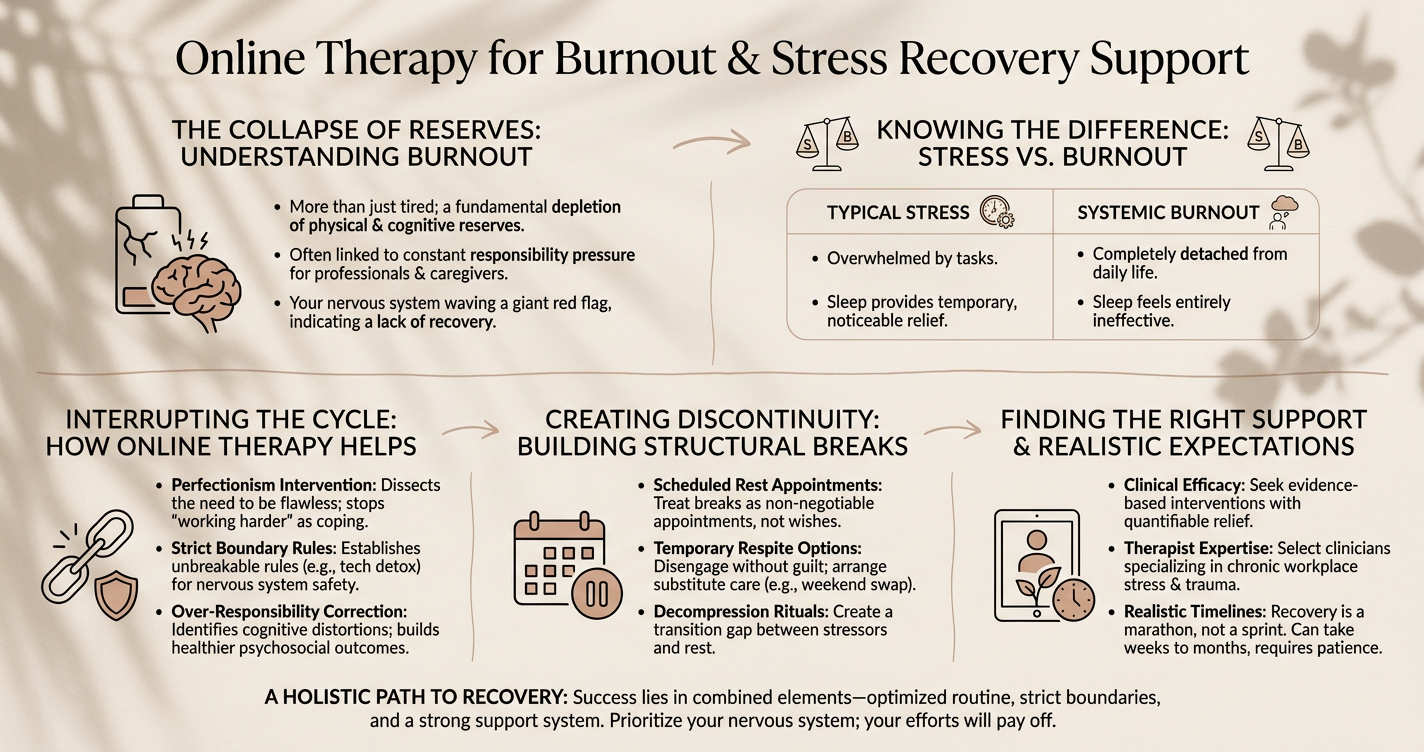
| Condition | Core Symptom | Response to Rest |
|---|---|---|
| Typical Stress | You feel overwhelmed by daily tasks. | Sleep provides temporary, noticeable relief. |
| Systemic Burnout | You feel completely detached from daily life. | Sleep feels entirely ineffective. |
How Virtual Sessions Target Overwork Patterns
Psychotherapy does not only offer a place to share your burdens.
Good clinical psychotherapy interrupts the machine.
Guidelines outline what the official classification means for professionals navigating systemic institutional exhaustion.
Virtual therapy allows you to access this help without adding another stressful commute to your already packed day.
Perfectionism Habit Interventions
You cannot self-care your way out of a system that never lets you off the hook.
If your coping mechanisms involve working harder to prove your worth, you will eventually crash.
Online therapy directly targets these perfectionism habits. A digital intervention can help you dissect why you feel the need to be flawless.
Some common pitfalls that keep people trapped in the burnout cycle include:
- Ignoring the elements of structural recovery, ultimately relying on vent sessions that fail to create change.
- Relying on unproven mental health apps as a means of cutting corners which therefore cuts your actual progress.
- Focusing too much on temporary fixes instead of implementing boundaries that grow your cognitive resilience.
You learn to dismantle the cycle of overwork that keeps you trapped.
Strict Boundary Rules
You need rules. Rigid, unbreakable rules.
A therapist will help you establish these boundaries.
They might prescribe a social media detox or mindful technology use to stop the constant influx of stressful situations.
Without boundaries, your nervous system never gets the memo that it is safe to power down.
Over-Responsibility Correction
Many of us assume everything will fall apart if we step away for five minutes.
This over-responsibility correction is a core focus of cognitive behavioral therapy.
Therapists work with therapy patients to identify these cognitive distortions and build healthier psychosocial outcomes.
Build Structural Breaks For Sustainable Recovery
You need to create discontinuity.
Burnout thrives on continuity. Same stress, same expectations, same lack of recovery.
If you merge the common advice strands from reputable sources, it becomes pretty clear: your job is not to endure longer. Your job is to stop the ride.
Scheduled Rest Appointments
I would schedule breaks like appointments, not like wishes.
If you hope to find time to rest, you will never rest.
You have to block it out on your calendar and defend that time with your life.
Temporary Respite Options
If you are doing nonstop caregiving, the fastest relief often comes from having a real substitute.
You need to disengage without guilt.
Consider the weekend swap. A friend of mine cared for a family member and kept saying they would rest when things calmed down. They finally arranged respite coverage for a consistent block of just a few hours one day a week.
The improvement was not instant euphoria, but they stopped looking like they were slowly disappearing.
Decompression Transition Rituals
You need a gap between your stressors and your rest.
Another person I know built a commute replacement ritual. It is basically a transition period between caregiving mode and home mode.
It sounds small. But when you do not have a boundary, you cannot switch off.
Choose An Effective Digital Mental Health Platform
Not all online therapy is created equal.
You need to find a digital therapeutic space that actually delivers results.
Clinical Efficacy Proof
You want evidence that this stuff works.
Research has proven online interventions hold equal efficacy to traditional face-to-face settings.
Extensive meta-analyses review digital interventions across thousands of participants to confirm quantifiable symptom relief.
The data is there. Digital intervention works.
Therapist Burnout Expertise
You need an online therapist who understands chronic workplace stress.
Psychotherapists and counsellors who specialize in burnout know exactly how to guide you out of the darkness.
They understand the specific challenges you face, from prolonged stress to dealing with PTSD symptoms related to traumatic workplace events.
Platform Communication Formats
Extensive reviews underscore why a live digital clinician is crucial for keeping patients engaged compared to self-guided mental health apps.
You need a human being on the other end of the screen.
These digital frameworks bypass systemic geographical and socio-economic treatment barriers, bringing expert mental health care directly into your living room.
Realistic Timelines For Systemic Burnout Recovery
Recovery can take weeks to months depending on how deep you are.
Mild burnout might start improving within a few weeks of targeted intervention.
More severe cases can take much longer, sometimes up to a year or more.
Do not gaslight yourself if it is slow.
Earning your health back requires extreme patience and perseverance.
You cannot always expect your mental health to completely bounce back from the word “go.”
Remember: recovery represents a marathon and not a sprint.
Think about how long-distance runners kick it into high gear at the end of the race: the fact that they were ever behind becomes irrelevant as long as they cross the finish line eventually.
When To Initiate Structured Professional Interventions?
A lot of people wait until they are fully crashing.
The better approach is catching the pattern early.
Intervene with the right support before you are at the “this is going to take a year” stage.
If you are persistent, your resilience has nowhere to go but up over time.
Perhaps the biggest mistake a high-achiever could make is dropping what they are doing and simply giving up when the going gets tough.
Keep going. Keep testing your boundaries. If your routine is broken, figure out why and do what you can to fix it.
FAQ
How do I know if I actually need a mental health professional?
If your daily life feels entirely unmanageable and sleep no longer restores your energy, you may require an intervention. I would treat isolation as a symptom, not a preference. Getting away from your routine is mood maintenance.
Is virtual therapy actually effective for severe burnout?
Yes. Multi-trial systematic reviews analyze clinical outcomes and patient satisfaction metrics, showing that internet-delivered cognitive behavioral therapy demonstrates structural cost-minimization benefits while providing excellent care.
What if I do not have time for therapy?
If you do not make time for your wellness, you may be faced with the truth to make time for your illness eventually. Remote, teletherapy group frameworks yield substantial mental health recoveries without the need for stressful travel.
Conclusion
Resting.
Recovering.
Transitioning.
Healing represents a lot of hard work, and there are no shortcuts.
Similarly, ambitious professionals train their entire lives to relish a few moments of success. Such success can easily be stripped away from those who neglect their own biology.
When it comes to treating your nervous system, you are on a relatively even playing field with human biology. In other words, there is no need to cheat.
Use the best tools in your toolbox to rebuild your energy rather than looking for the easy way out.
The risk simply is not worth it.
There are so many pieces to what makes a successful recovery. For starters, let’s think about:
- The design of your daily routine, optimized for recovery and pleasing to your nervous system.
- The strict boundary rules of your schedule, designed to encourage rest rather than bounce you back into work.
- The management of your various stressors, from constant responsibility pressure to everyday irritations.
- The performance of your chosen digital intervention and how you continue to bring new tools into your daily life.
- The strength of your support system, including your chosen online therapist who will help bring you back when you fall out of your routine.
Here is a not-so-secret secret.
The success of your recovery does not lie within one single element.
It is the elements combined that determine your potential.
Unfortunately, one weakness can hinder your progress.
Fortunately, you always have the opportunity to bounce back.
Stay organized. Stay diligent. Stay hungry for a better life.
Your efforts will pay off.
Much like athletes, caregivers and professionals should consider patience, focus and consistency as key virtues to help ensure their success.
What do you think separates a thriving professional from the rest of the pack?