
Last updated on August 26, 2026
Introduction
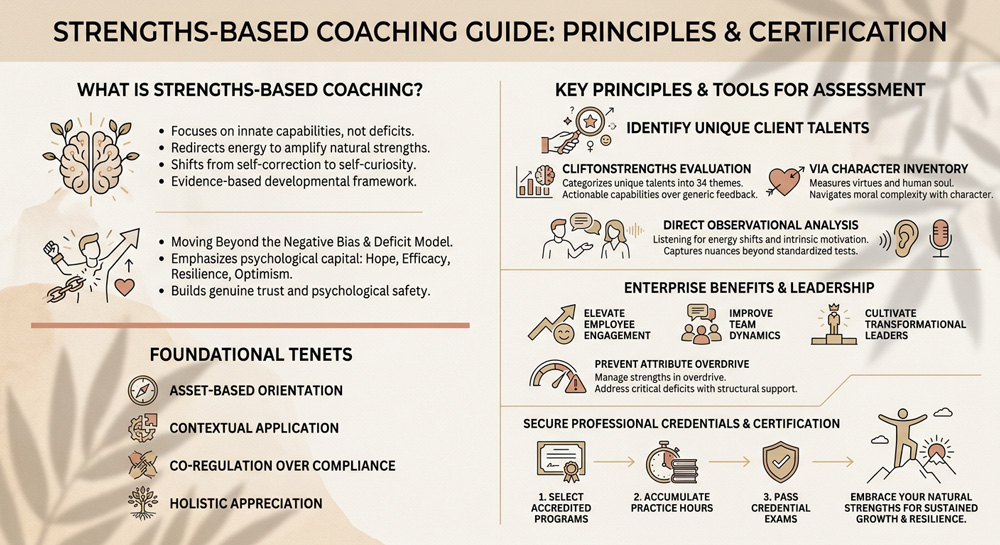
Our brain’s negative bias is conditioned early to focus for the inadequate parts of ourselves. Think about your last annual performance review. You likely skimmed right past the praise to fixate on the single paragraph detailing your perceived flaws, absorbing the corporate anxiety that you are somehow incomplete. Strengths based coaching dismantles this exhausting, perpetual cycle of self-correction. It is an evidence-based developmental framework that identifies a client’s innate capabilities and redirects their energy toward amplifying those specific natural strengths, rather than agonizing over what is missing.
Frankly, it is a massive relief. We spend decades in Singapore and globally chasing the next upgrade—from HDB to condo, from manager to director—often dragging our insecurities along for the ride under the guise of personal development. This coaching approach requires a radical shift in how we relate to achievement. You stop trying to install a completely new operating system in a leader. Instead, you help them code elegantly within their existing one, fostering genuine curiosity about their own potential.
What Defines the Positive Psychology Approach?
This methodology is deeply anchored in positive psychology, which moves the clinical lens away from pathology and deficit. I despise the superficial, toxic positivity that demands a smile during a crisis. True positive psychology is grounded in objective resourcefulness and psychological safety. It asks what raw materials an individual already possesses to navigate friction and uncertainty.
Instead of diagnosing a lack of skill, a strengths coach looks for psychological capital—hope, efficacy, resilience, and optimism. The mechanics of this shift are profoundly impactful. A deep dive into the utilization of solution-focused questioning and strength-use interventions in professional settings suggests that reorienting focus toward capability fundamentally alters the neural pathways associated with motivation. You aren’t ignoring reality. You are selectively funding the emotional and cognitive accounts that actually yield a return.
To truly understand this coaching model, consider its foundational tenets:
-
Asset-based orientation: Prioritizing the exploration of what is already working well.
-
Contextual application: Recognizing that a strength in one environment might be neutral in another.
-
Co-regulation over compliance: Using strengths to build trust rather than enforcing behavioral checklists.
-
Holistic appreciation: Viewing the client as a complete ecosystem rather than a machine needing repairs.
Assess and Identify Unique Client Talents
You cannot leverage what you have not accurately named. Identification within this practice usually blends formal psychometric assessments with deep, structured coaching conversations. The integration of active listening, psychometric tools, and developmental frameworks separates transformational insight from mere friendly advice.
CliftonStrengths Evaluation Tool
This is the heavyweight in the room. Some executives complain that the CliftonStrengths assessment is expensive upfront, viewing it as just another corporate expense. I suspect they are measuring the wrong timeline. When organizations commit to it, they usually see a durable shift in team dynamics that easily justifies the initial invoice. It categorizes unique talents into 34 themes. The data is compelling, especially when managers realize that implementing full 34-theme feedback generates a 7.8% increase in sales compared to just glancing at top-five traits. It moves the conversation from generic productivity to specific, actionable capabilities.
VIA Character Inventory
Where other tools measure workplace execution, the VIA Character Inventory measures the human soul. It looks at virtues like humility, appreciation of beauty, and social intelligence. This matters deeply to me because I believe behavioral compliance is a poor substitute for genuine character development. Knowing your signature strengths in this area allows you to navigate moral complexity with clarity and compassion, rather than just optimizing for output.
Direct Observational Analysis
No personality assessment replaces human intuition. An effective coaching session requires the practitioner to listen intimately for energy shifts. A client’s voice speeds up when they talk strengths and tasks they intrinsically love. They slump physically when discussing responsibilities that drain their life force. The strengths interview captures the messy, beautiful nuances a standardized questionnaire simply misses.
Foster Mental Toughness Through Core Traits
We have a terrible cultural habit of equating mental toughness with aggressive, teeth-gritting endurance. That model breaks people. It creates a culture of shame and burnout. Real resilience is contextual and deeply personal. When we frame mental toughness through a strengths model, clients develop significantly clearer action plans for handling pressure because they are using familiar, accessible tools.
A highly empathetic leader doesn’t need to suddenly adopt a cold, command-and-control persona during a corporate crisis. They can lean heavily into their natural relational strengths to co-regulate with their team, fostering empowerment and psychological safety when it is needed most. Acknowledging and nurturing this invisible motivational fuel for sustained leadership performance prevents the very exhaustion that traditional corporate scaling inevitably creates.
Why Do Enterprises Invest in Talent Development?
The corporate appetite for development usually begins and ends with the bottom line. Yet, the high demand for strengths coaches among high-pressure organizations remains entirely pragmatic, driven by a desperate need to retain talent in an economy that demands more, constantly.
Elevate Employee Engagement
When employees are given the unique privilege to use their natural strengths daily, they actually want to be at work. It sounds incredibly basic. Yet engagement metrics globally betray a different reality in most cubicles, where people feel disconnected from their daily tasks. Focusing on strengths rebuilds that lost connection.
Improve Team Dynamics
Friction frequently stems from profound misunderstanding. A team that understands each other’s profiles stops expecting a highly analytical peer to brainstorm wildly on the spot. Introducing a structured strengths-based measurement approach improves constructive communication by providing everyone with a shared, non-judgmental vocabulary. It replaces resentment with curiosity.
Cultivate Transformational Leaders
We constantly promote individuals for their technical skills and then punish them for lacking interpersonal finesse. Strengths-based interventions help leaders earn authority through trust and time rather than enforcing it through positional power. They learn to navigate their “Inner O.S.” to foster authentic impact.
Prevent Attribute Overdrive and Performance Gaps
Truth over harmony. This methodology has a shadow side, and critics are right to point out the blind spots. A dominant strength in overdrive rapidly becomes a liability. A leader with high “Achiever” talents will relentlessly drive performance, but left unchecked by mindfulness, they will burn their team to the ground in the pursuit of goals.
You also cannot simply ignore critical deficits. If an executive lacks basic financial literacy, no amount of positive feedback or “Positivity” talent will save the balance sheet. Effective managers understand the fine line between leveraging a strength and using it as a convenient excuse for bad behavior or laziness. Strengths based coaching is not a permission slip to avoid difficult growth. It is a lens for navigating it.
Secure Professional Credentials and Coach Certification
For those entering the field, simply slapping “strengths coach” on a LinkedIn profile is insufficient. The market demands rigor, evidence, and deep clinical understanding.
Select Accredited Programs
Quality dictates effectiveness. The baseline is a recognized coaching curriculum that does not promise quick-fix solutions. Immersing oneself in the core principles and talent discovery methods taught in professional environments ensures practitioners possess the depth required to actually help people, rather than just validating their egos. Whether becoming a Gallup global strengths coach or pursuing ICF credentials, the foundation matters.
Accumulate Practice Hours
Theory remains useless without messy, human application. Certification requires hundreds of logged coaching conversations. You have to learn, painfully sometimes, how to guide an individual without projecting your own biases onto their assessment results. Experience teaches you how to hold space for someone’s unique talents to emerge naturally.
Pass Credential Exams
A certified strengths coach must demonstrate mastery of the psychometrics, the specific coaching approaches, and the ethical boundaries of the practice. This ensures the protection of the client and the integrity of the profession.
How Does This Compare to Deficit Models?
Traditional corporate structures love a deficit model. It asks, “What is wrong with you, and how do we fix it?” It inherently assumes the individual is broken. It is an exhausting way to live and work.
|
Feature |
Deficit-Based Coaching |
Strengths-Based Coaching |
|---|---|---|
|
Primary Focus |
Gap analysis and perceived weaknesses |
Innate talents and unique strengths |
|
Motivation Style |
Fear of failure, compliance |
Curiosity, empowerment, intrinsic drive |
|
Expected Outcome |
Mediocrity in weak areas |
Excellence in natural capabilities |
|
Emotional Impact |
Shame, burnout, defensiveness |
Confidence, resilience, psychological safety |
Strengths coaching asks, “What is right with you, and how do we apply it to this problem?” It operates on the radical belief that a client’s greatest potential for growth exists in the exact areas where they already possess natural ability. One approach builds compliance out of fear. The other nurtures character through trust.
FAQ
Can you fail a strengths assessment? No. Tools like the CliftonStrengths assessment or VIA inventory are not pass/fail exams. They are mirrors reflecting your unique traits and capabilities. There are no “bad” profiles, only misunderstood ones.
Is strengths-based coaching only for corporate leaders? Absolutely not. While it drives tangible business results in boardrooms, it is equally transformative for couples seeking relationship counseling, new parents navigating identity shifts, or individuals seeking clarity in their personal development. The human need for appreciation crosses all boundaries.
What happens to my weaknesses? We manage them. Strengths coaches do not pretend weaknesses do not exist. We simply stop obsessing over them. We use resourcefulness, team development, or structural support to mitigate deficits, freeing up your energy to focus on what you actually do best.
Conclusion
We live in a culture obsessed with unquestioned scaling at all costs. Scale your business, scale your impact, fix your flaws, optimize your output. We are optimizing for efficiency while quietly eroding the conditions that make people feel seen as human beings.
Strengths based coaching offers a necessary pause. It is a compassionate invitation to stop wrestling with the parts of yourself that were never meant to carry the heavy lifting. By embracing our natural strengths and granting ourselves the grace to be imperfect in other areas, we create a spaciousness that allows for genuine, long-term growth. It reminds us that we are not broken machines in need of repair, but complex, capable individuals deserving of intentional connection and profound self-trust.