
Introduction
Navigating the complex emotion of shame requires a systematic approach to emotional health, focusing on evidence-based strategies that cultivate self-esteem and promote long-term psychological well-being.
A robust methodology for rebuilding self-worth hinges on identifying maladaptive cognitive patterns and deploying targeted therapeutic interventions to mitigate chronic inadequacy.
Alright, I am going to be real with you.
Most people do not build self-esteem like it is some cute little DIY project you wrap up on a Sunday afternoon.
It is much messier than that.
Self-esteem does not come from empty pep talks or standing in front of a mirror reciting affirmations you do not actually believe.
It comes from changing your relationship with the darkest parts of your mind.
You have to stop feeding the parts of your brain that keep bullying you.
Then you prove to yourself over and over that the bullying is entirely inaccurate.
Therapy can be an absolute game-changer for this process.
What Drives the Psychological and Physiological Roots of Inadequacy?
Ever feel a sudden wave of heat rush to your face when you remember an awkward conversation from five years ago?
That is your nervous system firing off alarm bells over a perceived threat.
Shame is a profoundly unpleasant emotion that digs its claws into your foundation early on.
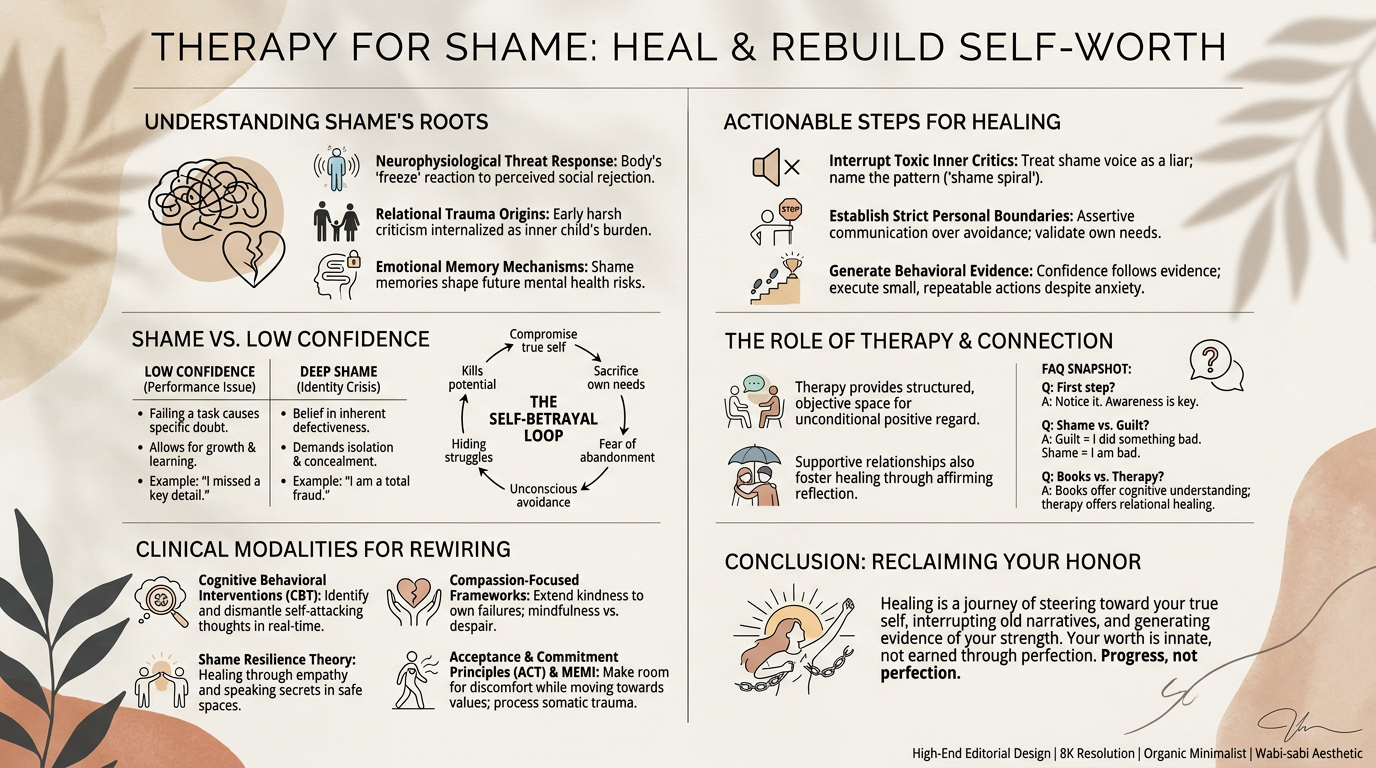
Neurophysiological Threat Responses
When you feel that hot flush of embarrassment, your body is essentially being hijacked.
We are talking about a very real physiological reaction where a medical breakdown mapping how chronic shame triggers the sympathetic nervous system and activates a parasympathetic freeze response leaves you paralyzed in the moment.
Your brain interprets social rejection as a literal threat to your life.
You freeze.
Your breathing shallows out.
The fear takes over entirely.
Relational Trauma Origins
A lot of this traces back to our early social groups or family dynamics.
Caregivers who relied on harsh criticism or outright abuse usually plant the seeds of worthlessness long before we can defend ourselves.
You internalize their voice.
Eventually, your inner child ends up carrying a heavy burden of disdain that was never yours to bear in the first place.
Emotional Memory Mechanisms
These past experiences do not just fade away with time.
According to a path analysis showing that shame memory functions as a significant positive predictor for severe depression, the way we remember humiliation literally shapes our risk for mental health struggles down the road.
The emotion gets locked in your neural pathways.
It waits for a trigger to flood your system all over again.
Recognize the Contrast Between Low Confidence and Internalized Defectiveness
Low self-esteem is thinking you are not good enough at a specific task.
Shame is believing something is fundamentally wrong with who you are.
Performance Versus Identity Conflicts
Let us look at how these two concepts clash in everyday life.
| Scenario | Low Confidence (Performance Issue) | Deep Shame (Identity Crisis) |
|---|---|---|
| Failing a work project | “I missed a key detail in my research.” | “I am a total fraud and everyone knows it.” |
| Romantic rejection | “We were clearly not a good match.” | “I am inherently unlovable and broken.” |
| Social awkwardness | “I stumbled over my words today.” | “I am repulsive and do not belong here.” |
One allows for growth.
The other demands isolation.
The Self-Betrayal Loop
You start compromising your true self to avoid judgment.
You sacrifice your own needs out of a fear of abandonment, hoping that altruism will somehow buy you a sense of belonging.
It never does.
Unconscious Avoidance Patterns
Eventually, you just stop trying.
This is where public health research showing that anticipated shame leads directly to concealment, treatment delays, and healthcare avoidance becomes terrifyingly relevant.
You hide your true struggles because the mere thought of exposing your flaws feels like a death sentence.
This avoidance kills your potential.
Which Clinical Modalities Effectively Rewire Self-Devaluing Cognitive Narratives?
Therapy can be an incredible engine for healing.
But only if it goes beyond simple venting.
Cognitive Behavioral Interventions
Cognitive Behavioral Therapy helps you catch the internalized critic in real time.
You learn to identify the exact moment your thoughts spiral into a self-attack.
You analyze those core beliefs and systematically dismantle them.
Compassion-Focused Frameworks
Treating yourself with basic kindness is absolutely mandatory.
As pioneering self-compassion researcher Dr Kristin Neff and Dr Christopher Germer suggests, extending care toward your own failures is required to counter harsh self-judgment.
Self compassion is not about letting yourself off the hook for bad behavior.
It is about maintaining mindfulness when you mess up so you do not spiral into despair.
Shame Resilience Theory
Healing happens in connection.
Based on the original 2006 qualitative grounded theory study on 215 women that built Shame Resilience Theory, building empathy actively diminishes the power of this dark feeling.
You learn to speak your secrets out loud in safe spaces.
You discover you are not uniquely defective.
Acceptance and Commitment Principles
This framework teaches you to make room for spectrum feelings without letting them drive the car.
You learn to accept the discomfort while still moving toward the life you want.
Multichannel Eye Movement Integration (MEMI) – Trauma Resolution
When traditional talk therapy feels like running in circles, MEMI helps process the raw, visceral trauma stored in your body in a neurological, somatic manner.
It bypasses the logical mind to soothe the physiological response directly.
Interrupt Toxic Inner Critics to Cultivate Authentic Self-Compassion
You have to stop debating the voice in your head.
Treat the shame like a liar with a megaphone.
Unconscious Pattern Identification
Naming the pattern strips away its invisible power.
The moment you can say “I am experiencing a shame spiral” instead of “I am a terrible person”, you win back your autonomy.
Identity and Failure Separation
An event that happened to you is part of your circumstances.
It is not a permanent tattoo on your soul.
Separating your worth from your accomplishments is the true art of emotional health.
Cognitive Lens Readjustment
You can shift your perspective by implementing a few highly specific habits:
- Interrupting harsh self-talk the exact second you notice your chest tightening.
- Tracking your small daily wins to build a physical record of your own competence.
- Replacing generalized self-insults with highly specific, fixable critiques.
Establish Strict Personal Boundaries to Counteract Chronic Intimacy Avoidance
When you feel unworthy of love, you naturally push people away.
Therapy helps you translate that urge to run into assertive communication.
You start setting healthy boundaries instead of ghosting your friends.
You communicate your limits with respect and humility, understanding that your needs are just as valid as anyone else’s.
You stop letting people trample over your expectations just to keep the peace.
Generate Behavioral Evidence to Prove Your Inherent Personal Capability
You cannot think your way into feeling confident.
Confidence follows evidence.
If you want to build genuine self-esteem, you need a track record of doing hard things.
Try focusing on these steps to generate undeniable proof of your worth:
- Pick one small, repeatable action that proves you are capable today.
- Execute that action even when your anxiety is screaming at you to stay in bed.
- Acknowledge the discomfort and do it anyway, showing your brain that you can survive feeling awkward.
Your reputation with yourself matters more than anything.
Does Unconditional Positive Regard Require Formal Psychological Intervention?
A skilled therapist provides a space where you experience total acceptance.
This creates a secure foundation to rebuild trust.
But healing also happens in the wild.
A deeply supportive friend or a mentor who sees your good qualities can offer that same affirming reflection.
Therapy just accelerates the journey by providing a structured, objective environment to test these new behaviors.
FAQ
Let us clear up some common confusion about navigating this emotional terrain.
- What is the first step to overcoming an internalized critic? You simply notice it. Awareness is always the prerequisite for change. You cannot fight an enemy you refuse to look at.
- Why does guilt feel entirely different than this? Guilt is feeling remorse for a specific action that caused harm. It prompts you to apologize and repair the relationship. Shame tells you that you are the mistake.
- Can reading books or watching videos replace therapy? They provide excellent cognitive understanding. But they cannot replicate the relational healing that happens when another human being witnesses your darkness and refuses to turn away.
Conclusion
Reclaiming your honor from the darkness of your own mind takes time.
You will absolutely face setbacks.
The goal is simply to steer the car a bit more accurately.
Keep generating evidence of your strength.
Keep interrupting what your trauma tries to tell you.
Your true self is waiting just on the other side of that discomfort.