
Introduction
Most of us stand in front of the mirror before a night out, tugging at the fabric of our clothes, thinking, “Man, I wish I could just feel comfortable in my own skin for once.”
Why not take the energy we spend constantly criticizing our reflections and apply it to actively rewiring how we see ourselves?
With the right guidance and enough internal focus, you can completely dismantle the mental roadblocks that keep you at war with your appearance.
We live in a culture that expects women to shrink. We are praised for taking up less space, both physically and metaphorically. The sheer amount of mental energy that goes into monitoring every bite of food or analyzing every angle in a photograph is difficult for the average person to fully wrap their head around.
From spending hours agonizing over an outfit to skipping social events just because we feel bloated, the unspoken nature of body image concerns dictates how millions of women navigate their daily lives.
Okay, so what does this have to do with hiring a coach?
More than you might think.
While comparing a body confidence coach to a personal trainer might seem like apples and oranges, consider the massive psychological struggles that women face daily. Some days it feels like we are completely spinning our wheels, trying to force ourselves into a mold that we were never meant to fit. Overcoming that final hurdle of self-acceptance can feel like staring up at a giant, seemingly impossible mountain.
It is time to step out of the cycle of self-loathing.
How?
By working with a professional who understands the specific terrain of women’s body perceptions.
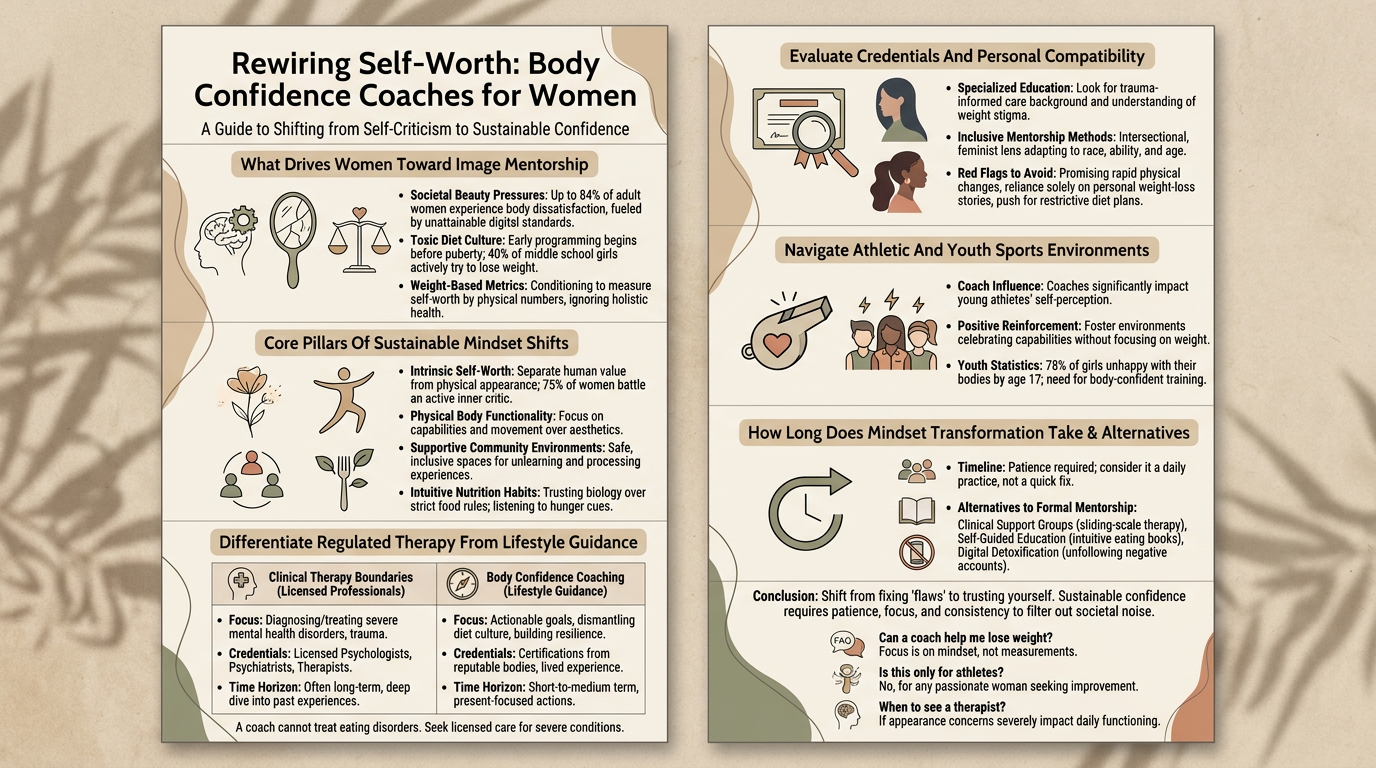
What Drives Women Toward Image Mentorship
True confidence isn’t simply born. It is forged through intentional practice and an understanding of the systemic strategies that keep us feeling inadequate.
Likewise, killer self-esteem doesn’t just magically appear overnight. It is created as a result of active unlearning.
Societal Beauty Pressures
We are swimming in a digital sea of filters and impossible standards. The sheer volume of women seeking mentorship isn’t a vanity project. It is a desperate need for a lifeline.
Data tracking psychological trends shows that up to 84% of adult women experience body dissatisfaction, leaving millions constantly favoring a smaller figure over their natural shape. Furthermore, corporate disclosures indicate that internal platform research found Instagram directly worsened body image issues for roughly a third of teenage girls.
The pressure is unrelenting. We are bombarded with images of a specific aesthetic that only a tiny fraction of the population actually possesses.
Toxic Diet Culture
Every January, the diet movement comes roaring back with a vengeance.
We are sold cleanses, wraps, and 30-day programs that promise to fix our lives by fixing our waistlines, completely ignoring the psychological toll of chronic restriction.
It is alarming how early this programming starts. In fact, research regarding middle childhood development establishes that weight concerns begin before puberty, with 40% of girls actively trying to drop pounds by the time they hit middle school. We are essentially teaching girls to prioritize their appearance over their actual lived experiences.
Weight-Based Metrics
We have been conditioned to measure our worth in pounds and inches.
A specialized personal coach steps in to flip this narrative entirely. Instead of focusing on shrinking, they help you focus on expanding your life. They challenge the simplistic perception that lower body weight automatically equals health or happiness.
Core Pillars Of Sustainable Mindset Shifts
Dozens of old habits have to be broken to build a healthy relationship with yourself.
You should constantly work to evolve your understanding of what your body actually needs.
Intrinsic Self-Worth
You cannot attach your value to how you look in a swimsuit.
Women systematically underestimate their own abilities across the board. A psychological survey reported by Stylist Magazine shows that 75% of women battle a vicious, active inner critic. A confident coach uses targeted mindset work to help you separate your fundamental human value from your physical body.
Physical Body Functionality
Think about what your physical frame allows you to do.
Can you pick up your kids? Can you hike a steep trail? Can you simply carry your groceries up three flights of stairs?
Many professionals in the field encourage clients to focus heavily on functionality over aesthetics. Celebrating athletic skill and the power of movement completely shifts the goalposts of success.
Supportive Community Environments
You can’t always expect to kill it from the word “go.”
Unlearning years of conditioning requires adequate support and a safe place to process your experiences. Community-based coaching often fosters inclusive spaces that champion sustainable lifestyle changes over rapid, fleeting results.
Intuitive Nutrition Habits
Funneling your energy into listening to your hunger cues pays off massively.
Dismantling strict food rules allows you to eat when you are hungry and stop when you are full. It sounds simple, yet it takes tremendous effort to quiet the noise of diet culture and actually trust your own biology.
Differentiate Regulated Therapy From Lifestyle Guidance
The coaching industry is entirely unregulated.
Anyone with an internet connection and a ring light can legally call themselves a fitness pro or a life coach. This creates a deeply dangerous landscape for vulnerable women seeking help.
Clinical Therapy Boundaries
Let’s get one thing absolutely straight: a body confidence coach cannot treat an eating disorder.
If you are dealing with severe anorexia, bulimia, or clinical body dysmorphia, you need a licensed therapist or a psychiatric professional. Relying on a coach to handle deep-seated psychological trauma is like asking a plumber to rewire your home’s electricity.
If you hope to heal effectively, you must understand the difference in competence levels.
| Metric | Clinical Therapy | Body Confidence Coaching |
|---|---|---|
| Focus area | Diagnosing and treating severe mental health disorders, navigating past trauma. | Actionable goal-setting, dismantling societal diet culture, building daily resilience. |
| Credentials required | Registered or state-licensed psychologists, psychiatrists, or clinical psychotherapists and counsellors | Certifications through private industry bodies or life experience. |
| Time horizon | Often open-ended, delving deeply into complex childhood experiences. | Generally short-to-medium term, heavily focused on present actions and future habits. |
Industry Credential Standards
Because the barrier to entry is virtually nonexistent, you must be ruthlessly selective.
Look for professionals who hold specialized education. Certifications from reputable organizations like the Institute for Body Confidence Coaching or the [body image coach certification program] provide actual, evidence-based toolkits rather than empty platitudes.
Harmful Comparison Risks
Some corners of the internet propagate deeply toxic advice under the guise of “empowerment.”
Certain niche femininity coaches actually enforce outdated external standards, adding subjugation to the female condition rather than relieving it. Professional forums frequently note that while coaching is great for achieving specific daily goals, bad advice from an unvetted trainer can actively trigger negative body image spirals.
Evaluate Credentials And Personal Compatibility
Finding the right mentor represents a lot of hard work, and there are no shortcuts.
You have to dig into their background and understand their specific approach to the work.
Specialized Education Credentials
Does your prospective coach have a background in trauma-informed care? Do they understand the nuances of weight stigma?
Some common red flags that even seasoned consumers miss include:
- Promising rapid, specific physical changes disguised as a “confidence journey.”
- Relying purely on their own personal weight-loss story as their sole qualification to teach others.
- Pushing you toward a free body confidence makeover that ultimately serves as a bait-and-switch for a highly restrictive diet plan.
Inclusive Mentorship Methods
A great coach views the world through an intersectional, feminist lens.
They understand that body politics are vastly different depending on your race, your physical abilities, and your age. They adapt their methods to meet you exactly where you are.
Navigate Athletic And Youth Sports Environments
Research shows that coaches in aesthetic team sports hold tremendous influence over how young athletes perceive themselves.
They often act as inadvertent body-image coaches, for better or worse. Negative practices, such as instructors openly critiquing a girl’s shape or emphasizing weight as a marker of athletic readiness, directly push young women out of the game.
The statistics are brutal. The National Organization for Women (NOW) shows a sharp confidence decline through adolescence, with 78% of girls reporting they are unhappy with their bodies by age 17.
Conversely, when trainers undergo specific body confident sport training, they foster environments that empower girls to celebrate their physical capabilities. Organizations like PCA champion positive reinforcement, proving that you can build highly competitive, body confident athletes without ever mentioning the scale.
How Long Does Mindset Transformation Take
Your self-esteem may not radically transform overnight.
Perhaps the biggest mistake a woman could make is dropping the internal work when the going gets tough. Yes, it is frustrating to catch yourself slipping back into old patterns of standing sideways in the mirror. Yes, it sucks when an off-hand comment from a relative ruins your day.
Keep going.
Earning genuine comfort in your own skin requires extreme patience and perseverance. Think of it as a daily practice rather than a final destination. The more time you spend actively challenging your negative thoughts, the more automatic that resilience becomes over the months and years.
What Are Alternatives To Formal Mentorship
If dropping hundreds of dollars an hour on a private coach isn’t in your budget, you have other options.
- Clinical Support Groups: Many community health centers offer sliding-scale group therapy focused heavily on body acceptance.
- Self-Guided Education: Books centered on intuitive eating and the fat acceptance movement offer incredibly dense, practical advice for a fraction of the cost.
- Digital Detoxification: Systematically unfollowing every social media account that makes you feel bad about your appearance is entirely free and yields immediate psychological relief.
There is no single key to success. It is the combination of these elements that determines your potential for healing.
FAQ
Can a coach help me lose weight? A true body confidence coach focuses on your mindset, not your measurements. If your primary goal is rapid weight loss, this specific type of mentorship is likely not the right fit for your current priorities.
Is this only for athletes? Absolutely not. While programs like the body confident sport initiative heavily target girls sport participation, general coaching is designed for any passionate woman looking to improve her daily life.
How do I know if I need a therapist instead? If your appearance concerns are severely impacting your ability to eat, socialize, or function at work, skip the coach and seek a licensed mental health professional immediately.
Conclusion
The marketing world moves fast, constantly promising the next big thing to “fix” our supposed flaws.
Much like athletes training for the big game, women must rely on patience, focus, and consistency to filter out the noise of a society obsessed with thinness.
A great mentor won’t hand you a meal plan or a workout schedule. Instead, they will hand you the tools to finally trust yourself. They will help you realize that you were never actually broken to begin with.
Your efforts will pay off. Stay grounded. Stay fiercely protective of your peace.