
Last updated on June 4, 2026
Introduction
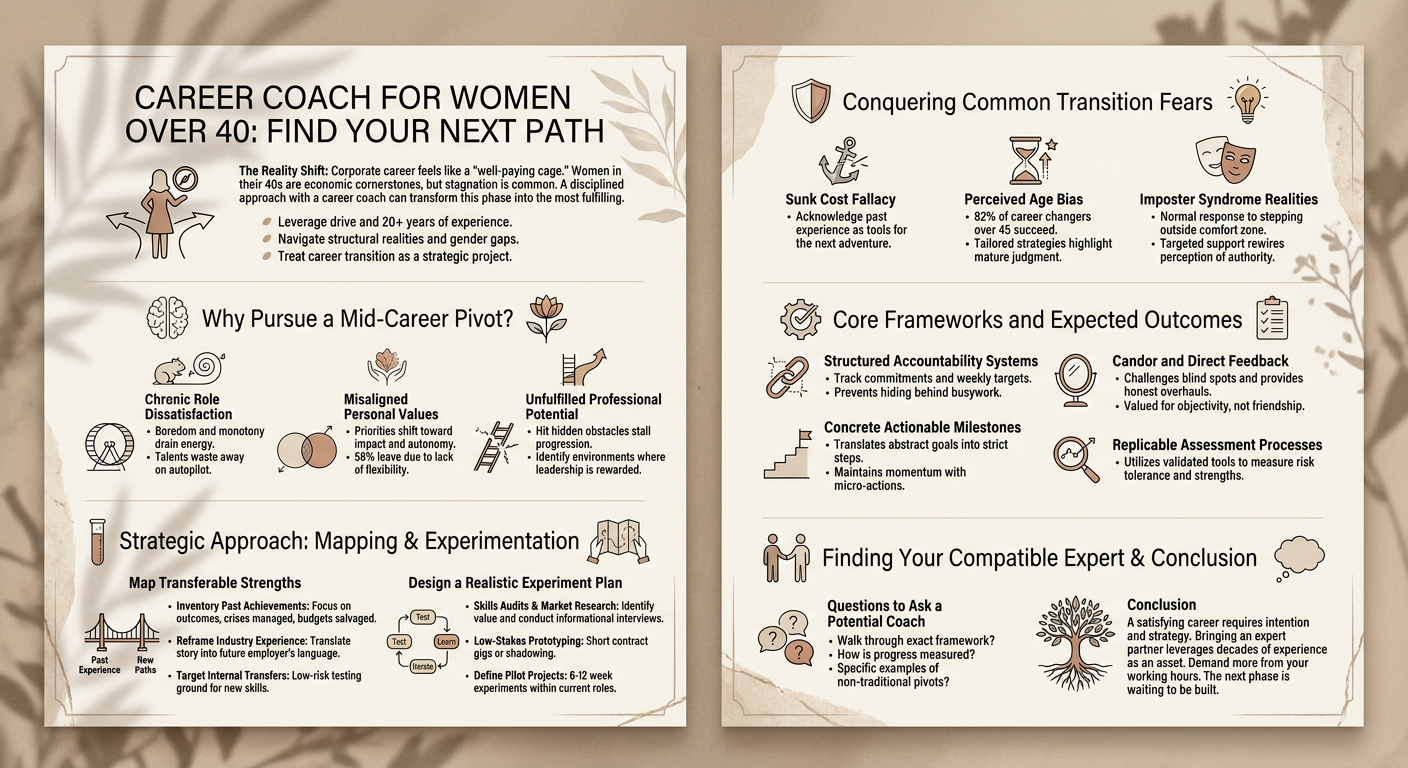
You wake up, pour a cup of coffee, and stare at your laptop with a distinct sense of dread. The corporate career you spent two decades building suddenly feels like a well-paying cage. It isn’t that you lack the skills to do the work. It is simply that the work no longer fits the life you actually live.
Many of us hit our 40s and realize we have successfully climbed a ladder leaning against the wrong building.
Why not take the drive and professional experience that got you to this point and apply it to an entirely new direction?
With a disciplined approach, your next career move can be the most fulfilling phase of your professional life.
The structural realities of the modern workforce are changing rapidly. Women in their 40s represent a massive economic force, and staying stuck is no longer the default expectation. According to a recent Center for American Progress analysis of prime-age women, the labor force participation rate for this demographic has grown significantly, cementing them as economic cornerstones.
Yet, the idea of a midlife career change feels terrifying to the average person.
What does hiring a professional coach actually do to solve this?
More than you might expect.
While asking a stranger to dissect your professional identity might seem intimidating, consider the chronic challenges that mid-career women face daily. We spin our wheels trying to adapt to roles we outgrew five years ago. Throwing in the towel feels tempting when the gender pay gap and hidden corporate barriers stunt our growth.
But do you just accept stagnation?
And neither should you settle for a career trajectory that drains your wellbeing.
It is time to treat your career transition process like a strategic project.
Why Pursue a Mid-Career Pivot?
Professionals evolve. As we navigate different seasons of life, we adapt to new responsibilities and shifting ambitions. You should constantly evaluate your professional goals to ensure they align with your current reality.
Chronic Role Dissatisfaction
Boredom is a highly valid reason to seek out new opportunities. You master a role, the challenge disappears, and the day-to-day operations become painfully monotonous. This kind of chronic dissatisfaction drains your energy and bleeds into your personal life. When you spend 40 hours a week performing tasks on autopilot, your talents waste away.
Misaligned Personal Values
The prestige and salary that motivated you at 25 rarely carry the same weight at 45. Your priorities naturally shift toward flexibility, impact, and autonomy. Recent Catalyst data on why women are exiting the workforce reveals that 58% leave traditional roles due to a severe lack of flexibility and caregiving support. If your current job demands sacrifices that clash with your core values, a career shift becomes an absolute necessity for survival.
Unfulfilled Professional Potential
We hit ceilings. A comprehensive McKinsey & Company analysis of early-career advantages confirms that women often face hidden obstacles that stall their progression just as their male peers are accelerated into leadership. You know you are capable of operating at a higher level. A career coach helps you bypass that broken rung by identifying environments where your leadership will be recognized and rewarded.
Map Transferable Strengths to New Paths
Successful career changers are not simply born overnight. They are made through intense self-audit and a foolproof translation strategy. If your first attempt at a pivot falls flat, you learn from the friction.
A major win from coaching is uncovering your hidden transferable skills and mapping them to concrete, tangible roles. Clients have unlocked entirely new industries simply by changing how they narrate their experience
Inventory Past Achievements
Stop looking at your job description and start looking at your outcomes. A certified career coach forces you to dig into the archives of your work history. You document the crises you managed, the teams you trained, and the budgets you salvaged. These achievements form the foundation of your new professional brand.
Reframe Industry Experience
You have to translate your past into your future employer’s language. If you want to move from logistics to a human resources leadership role, you must reframe your story. You are no longer someone who just “manages supply chains.” You are an executive who builds scalable processes and leads high-performing teams through complex transitions. This subtle shift in vocabulary opens doors that previously seemed locked.
Target Internal Transfers
Sometimes the best new career path is located down the hall. An internal transfer serves as a low-risk testing ground for new skills. You can leverage your existing reputation to pivot into a new department without losing your seniority or benefits.
Design a Realistic Experiment Plan
You cannot always expect a new career to fall into your lap immediately. Earning a rewarding career requires disciplined experimentation.
A coach should walk you through a replicable process that involves testing the waters before you completely jump ship.
Here are the critical components of a functional experiment plan:
- Skills Audits: Identifying exactly which competencies hold market value right now.
- Market Research: Having informational interviews with professionals in your target sector.
- Low-Stakes Prototyping: Taking a short contract gig or shadowing a leader to test the day-to-day reality of the profession.
- Resource Allocation: Determining exactly how much time and money you can dedicate to new training.
Define Pilot Projects
Good coaches help you design experiments you can run within six to twelve weeks. A mid-career professional might use a coaching engagement to design a three-month pilot project within their current company. You pitch a cross-functional initiative to your boss, allowing you to test out product management skills while maintaining your current salary.
Establish Weekly Milestones
Without milestones, a career plan is just a wish list. You need weekly targets to maintain momentum. This might look like rewriting two sections of your LinkedIn profile on Tuesday and sending three networking emails on Thursday. The staying power of a change journey relies heavily on these micro-actions.
Secure Internal Sponsorship
When making an internal move, you need advocates. A coach provides the strategic scripts necessary to secure leadership sponsorship for your transition. You learn how to pitch your new direction as a net benefit to the company, ensuring you have executive backing when a new role opens up.
Conquer Common Transition Fears
It can take years to build the confidence to finally make a big change. Mental roadblocks inevitably surface the moment you decide to pursue a new path.
Sunk Cost Fallacy
We obsess over the decades we invested in a specific industry. Leaving feels like throwing away that hard-earned equity. Acknowledging that those years equipped you with the exact tools you need for your next adventure neutralizes this fear. You carry your experience with you.
Perceived Age Bias
Age bias exists, but it does not have to dictate your future. According to a recent American Institute for Economic Research study on older workers, a staggering 82% of people who attempt a career transition after the age of 45 achieve a successful career change. Exploring specialized resources, like career coaching for women over 50, provides tailored strategies to navigate these demographic hurdles and highlight the irreplaceable value of mature judgment.
Imposter Syndrome Realities
You will feel completely unqualified on day one of your new pursuit. This is a normal psychological response to stepping outside your comfort zone. Working through these doubts often requires targeted support, and integrating tactics from confidence coaching for women leaders can quickly rewire how you perceive your own authority.
Core Frameworks and Expected Outcomes
Expensive coaching only makes sense if the value lies in accountability and a disciplined process. If you pay premium rates, you deserve rapid feedback loops and rigorous tracking.
Structured Accountability Systems
Your coach should track your commitments. If you promise to reach out to three former colleagues for informational interviews, your coach will ask for the results at the top of your next session. This structure prevents you from hiding behind busywork.
Concrete Actionable Milestones
Vague advice kills momentum. A reputable professional coach translates abstract goals into strict, actionable steps. You move from saying “I want to explore tech jobs” to “I will complete a foundational data analytics course by November 15th.”
Candor and Direct Feedback
The best coaches challenge you directly. They call out your blind spots and refuse to sugarcoat tough truths. If you sound arrogant in interview prep, they tell you. If your resume is a disaster, they give it a thorough, honest overhaul. You pay them for their objectivity, not their friendship.
Replicable Assessment Processes
A credible coaching practice relies on proven methodologies. A National Institutes of Health peer-reviewed study analyzes how non-linear career paths require highly structured social and instrumental support to succeed. Your coach should utilize validated assessment tools to measure your risk tolerance, core motivations, and operational strengths before formulating any strategic advice.
Payment Models and Engagement Terms
Understanding how the business of coaching operates protects you from sinking money into the wrong program. You need a payment model that aligns with your specific transition needs.
| Model Type | Best Used For | Risk Level |
|---|---|---|
| Pay-As-You-Go | Highly focused, short-term problem solving. Immediate resume audits or specific interview prep. | Low. You can pause or cancel the engagement at any time if you feel the ROI dropping. |
| Monthly Retainer | Mid-term exploration and active job searching. Allows for ongoing email support and weekly check-ins. | Medium. Requires a steady financial commitment but provides continuous accountability. |
| Upfront Bulk Package | Complete career overhauls. Deep foundational work, values assessments, and long-term pivot mapping. | High. You are locked in. Only commit if the discovery session proved absolute compatibility. |
The pay-per-session model feels incredibly effective if you value flexibility and blunt feedback. You tackle specific hurdles as they arise. Conversely, if you are completely lost and need someone to rebuild your professional identity from the ground up, a structured three-month package provides the necessary runway.
What Questions Reveal a Compatible Expert?
You must interview your potential coach just as rigorously as an employer would interview you. Use the initial discovery session to gauge their practical utility.
- Can you walk me through the exact framework we will use during our first four weeks?
- How do you measure a client’s progress if they are currently unsure of their end goal?
- What happens if I fail to complete the homework or hit my weekly milestones?
- Can you share a specific example of how you helped a client translate a non-traditional background into a corporate role?
If a coach cannot clearly define their process or relies heavily on inspirational platitudes, politely end the call. You need a strategist, not a cheerleader.
FAQ
Do I really need a coach, or can I just use free online resources? Free resources provide excellent information, but they cannot provide personalized accountability. A coach audits your specific situation, identifies your unique blind spots, and forces you to execute on the days you want to quit.
How long does a typical career transition take at this age? A realistic timeline spans anywhere from six to eighteen months. The process requires deep self-reflection, market research, skill acquisition, and a potentially lengthy interview cycle. Patience is mandatory.
What if my desired industry pays significantly less than my current job? You will face a period of financial recalibration. A coach helps you analyze whether the positive changes in your daily life, stress levels, and overall happiness outweigh the temporary dip in income. Often, exploring frameworks like those used by body confidence coaches for women can aid in rewiring your sense of self-worth so it is no longer strictly tied to your salary.
Conclusion
A satisfying career rarely happens by accident. It requires intention, strategy, and the willingness to dismantle a professional life that no longer serves you.
The modern professional landscape is complex and constantly shifting under our feet. Navigating it alone while managing a household, aging parents, and personal burnout is a recipe for disaster.
Bringing an expert into your corner changes the dynamic entirely. You gain an objective partner who views your decades of experience as an asset to be leveraged, rather than a heavy anchor holding you back.
Do the research. Challenge your own assumptions. Demand more from your working hours.
The next phase of your career is waiting to be built.