
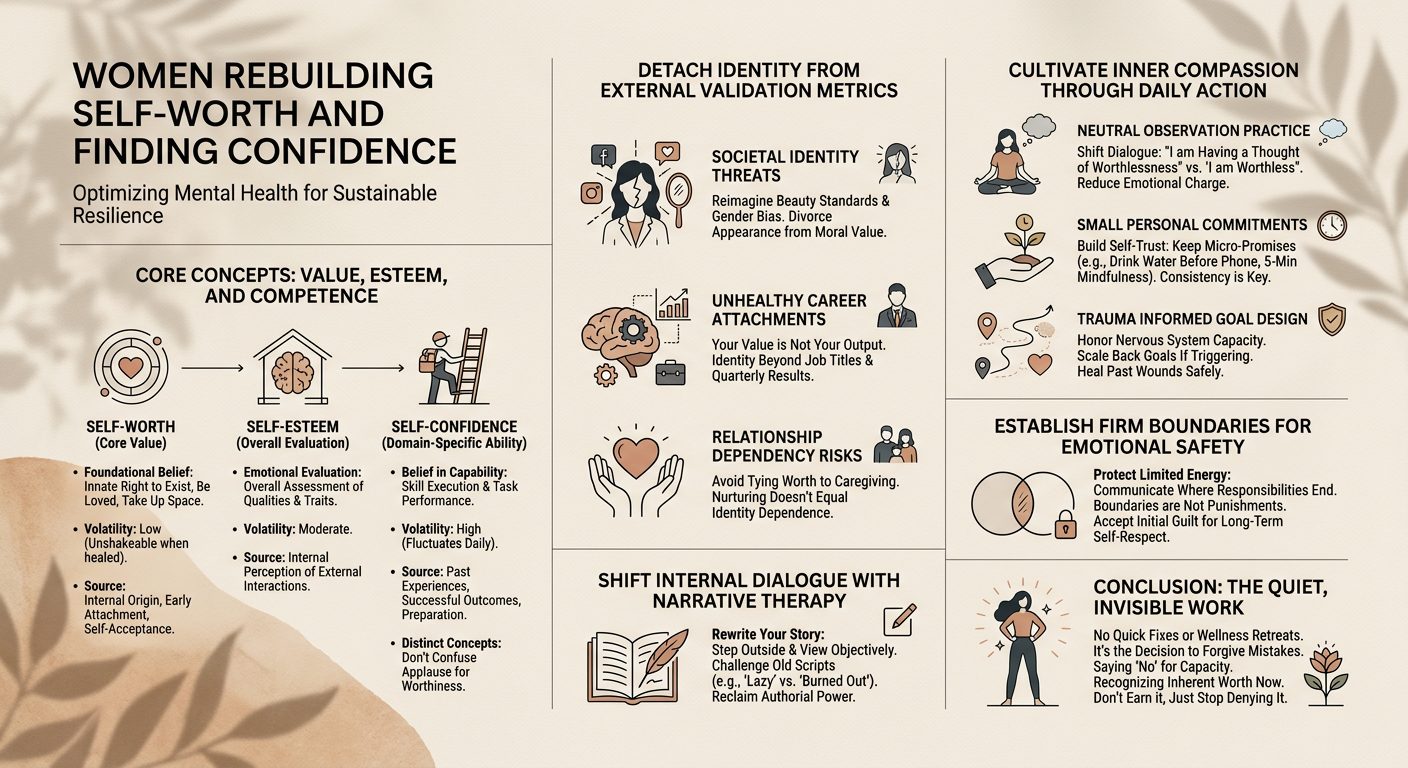
In today’s fast-paced professional landscape, optimizing mental health and establishing a resilient mindset are often touted as critical components for sustainable success. We constantly hear this exact corporate narrative in professional development workshops and wellness seminars, usually packaged with a mandate to “fake it until you make it.”
Or worse, we are instructed to stare into a mirror and repeat hollow affirmations until we magically believe them.
If building a healthy self was as simple as reciting a few positive things to your reflection, therapists would be entirely obsolete.
The reality is far messier. Women today are frankly exhausted. We are balancing societal expectations, career metrics, and relentless beauty standards, all while trying to maintain a positive sense of our own identity.
And when the dust settles? Many of us realize our self-worth is entirely propped up by external scaffolding.
When the job is lost, or the relationship ends, the entire structure collapses.
Why? Because we fundamentally misunderstand the difference between feeling good about what we do, and knowing we have intrinsic value simply because we exist.
It is time to stop confusing applause for worthiness.
Let’s dig into the actual psychological mechanics of rebuilding what gets broken.
What Separates Core Value, Esteem, And Competence?
These terms are frequently used interchangeably in popular psychology — they are not.
They aren’t.
Blending these concepts is precisely why so many women struggle with profound esteem issues even when they are meeting their professional goals by measurable standards.
If you want to heal, you have to know exactly what you are trying to fix.
Core Psychological Definitions
Think of your emotional wellbeing as a house.
Core value—or self-worth—is the foundational concrete. It is the unshakeable belief that you deserve love, safety, and respect regardless of your daily output.
Esteem is the framing. It is the overall evaluation of your qualities, traits, and unique strengths.
Confidence? That is just the weather-stripping. It fluctuates daily based on your domain-specific abilities and life experiences.
| Concept | Psychological Function | Volatility Level | Primary Source |
|---|---|---|---|
| Self-Worth | Innate right to exist, take up space, and be loved | Low (when fully healed) | Internal origin, early attachment, and self-acceptance |
| Self-Esteem | Overall emotional evaluation of the self and personal traits | Moderate | Internal perception of external interactions |
| Self-Confidence | Belief in one’s specific ability to execute a task or skill | High | Past experiences, successful outcomes, and preparation |
Global Esteem Vulnerabilities
Relying entirely on global self-esteem to get through daily life creates a massive vulnerability.
According to behavioral research, global self-esteem is highly contingent on feeling special or above average. When we inevitably fail or fall short of perfection, that esteem shatters completely.
Self-compassion acts as a much stronger buffer. It catches you when your esteem inevitably fails, offering a soft landing rather than a harsh judgment.
Domain Specific Competence
Ever noticed how you can present a killer slide deck in a boardroom with absolute authority, but experience significant anxiety when attempting to set a boundary with your mother?
That is domain-specific competence in action.
Your confidence in one area does not naturally bleed into another. Trying to use workplace success to patch poor self-worth is like using a band-aid on a broken bone. The underlying fracture remains entirely unhealed.
Detach Identity From External Validation Metrics
So, how do we end up building our identity on such shaky ground in the first place?
We are culturally conditioned from childhood to do it.
Societal Identity Threats
Western society subjects women to a constant barrage of identity threats.
There is a pronounced, well-documented gender gap in self-esteem, largely driven by deeply ingrained biases and the relentless commodification of female beauty. We are told our power lies in our youth, our aesthetic appeal, and our quiet compliance.
Developmental theories of embodiment highlight how early we learn to view our bodies as projects to be managed rather than vessels for experiencing life. Dismantling this requires a radical shift in perception. Engaging with body confidence coaches for women who specialize in breaking down these toxic frameworks often emphasizes the urgent need to divorce physical appearance from moral value.
Unhealthy Career Attachments
Then there is the seductive trap of the hustle.
When you tie your personal worth entirely to your job title, an unexpected layoff doesn’t just threaten your bank account. It annihilates your identity.
You are not your output. Your value does not fluctuate based on quarterly results or whether a manager recognizes your hard work.
Relationship Dependency Risks
Traditional social role theory highlights how women have historically been pushed into communal, caregiving roles.
Nurturing others is a beautiful trait. Letting your entire healthy sense of self depend on being needed by a partner or your children is disastrous.
When the kids leave for college or a romantic relationship sours, the sudden void can trigger immense psychological panic and a total collapse of personal worth.
Cultivate Inner Compassion Through Daily Action
Awareness alone rarely changes behavior. Action does.
True empowerment is incredibly gritty. Showing up for yourself when you are at your absolute worst, covered in the messy realities of life, is mandatory.
Neutral Observation Practice
Toss out the forced positivity.
If you are experiencing severe negative thoughts, forcing yourself to say “I am a radiant goddess of success” feels like a blatant lie. Your brain possesses an excellent radar for deceit.
Practice neutral observation instead.
Shift the internal dialogue from “I am worthless” to “I am having a thought that I am worthless, and my body is currently feeling overwhelmed.”
This slight linguistic shift strips the intense emotional charge from the negative beliefs.
Small Personal Commitments
Self-trust is the bedrock of genuine confidence.
How do you build trust with anyone? You make promises and you keep them.
Start absurdly small.
- Promise to drink a glass of water before checking your phone in the morning.
- Commit to a five-minute mindfulness meditation during your lunch break.
- Swear you will log off work exactly at 5:00 PM on a Friday.
When you consistently keep these micro-commitments, your brain stops viewing you as a flight risk to your own wellbeing.
Trauma Informed Goal Design
For women recovering from emotional neglect or past abuse, standard goal-setting advice can be wildly triggering.
Childhood trauma inherently damages our sense of personal worth, leaving us feeling fundamentally flawed at our core. When traditional positive psychology tools fail, pursuing therapy for shame to heal and rebuild self-worth provides a safe container to process past wounds before attempting to build new resilience.
Design goals that honor the current state of your nervous system. If a specific goal creates paralyzing anxiety, scale it back without a single ounce of guilt.
Establish Firm Boundaries For Emotional Safety
You cannot cultivate a healthy self in an environment that constantly demands you set yourself on fire to keep others warm.
Boundaries are not punishments inflicted on other people.
They are the ultimate resource for protecting your own limited energy. A boundary simply communicates the exact line where your responsibilities end and someone else’s begin.
Setting these lines will initially cause your heart to race. Your palms will sweat. You will likely feel a massive wave of guilt.
Let the guilt exist.
Guilt is just an emotion, not a stop sign. Eventually, that temporary discomfort fades, replaced by a profound, unshakeable sense of inner strength and self-respect.
Shift Internal Dialogue With Narrative Therapy
We all have a story we tell ourselves about who we are.
Often, that story was written by someone else entirely. A hyper-critical parent, an unsupportive teacher, a toxic ex-partner. They handed you a script, and you have been reciting their lines for decades.
Narrative therapy encourages you to step outside of that story and view it objectively as an editor.
Are you really “bad at relationships,” or did you just survive a series of mismatched, painful experiences?
Are you really “lazy,” or are you deeply burned out from functioning in a state of hyper-independence for a decade?
When you rewrite the narrative, you reclaim your power. You stop being the passive victim of your own mind and become the active author of your future.
What Triggers Sudden Loss Of Inner Trust?
Sometimes, you do the heavy lifting.
You read the psychology book. You practice the meditations. You feel grounded, secure, and proud of your progress.
And then, seemingly overnight, you crash right back into poor self-esteem.
Usually, an invisible trigger knocked you off balance.
- A perceived failure in a high-stakes environment: Missing out on a promotion or receiving harsh criticism can instantly reactivate dormant feelings of inadequacy.
- Boundary testing by a toxic person: When someone repeatedly ignores your clear “no,” it can make you question your own validity and right to take up space.
- Physical health fluctuations: Hormonal shifts, exhaustion, or chronic illness flare-ups drastically alter your emotional resilience and perception of your own body.
- Social media spirals: Spending forty-five minutes comparing your messy, unedited reality to someone else’s highly curated highlight reel is a guaranteed a reliable pathway toward diminished self-worth.
Expect the drops. They are a completely normal part of the process. The goal isn’t to never fall again. The goal is simply to shorten the recovery time.
FAQ
How long does it actually take to rebuild self-worth? There is no fixed timeline. It is a lifelong practice of unlearning bad habits and reinforcing healthy ones. Some days you take two strides forward, and on others, you slide one step back.
Can I possess high self-confidence but suffer from low self-worth? Absolutely. You can be the most competent, highly praised executive in the boardroom and still go home feeling completely unlovable. Exceptional skills do not automatically translate to a belief in your inherent value.
Do positive affirmations actually work for low self-esteem? Only if they are entirely believable to you. If your affirmations trigger your internal B.S. detector, they will backfire and make you feel worse. Stick to neutral, factual statements and tangible actions instead.
Conclusion
Rebuilding your self-worth is rarely a glamorous journey.
It certainly does not happen during a single weekend wellness retreat, and you will never find it sitting at the bottom of an expensive, beautifully packaged skincare routine.
It is demanding and unglamorous, repetitive, and often entirely invisible work.
It is the quiet, private decision to forgive yourself for a mistake instead of moving into a shame response”.
It is the terrifying moment you finally say “no” to a request you simply do not have the capacity to fulfill.
It is looking squarely in the mirror and deciding that the person staring back at you is worthy of love, kindness, and respect exactly as she is, right in this very messy moment.
You do not need to earn your worth.
You just have to stop actively denying it.