
Introduction
Imagine a young professional who just nailed a massive presentation. The applause fades, the Zoom call ends, and immediately, a familiar pattern of self-doubt surfaces: They just didn’t notice she was winging it.
It is exhausting.
Living with this constant, buzzing fear that someone is about to tap her on the shoulder and ask her to hand over her badge because they finally realized she does not belong. That is the reality of imposter syndrome for countless professional women.
Historically, researchers like Pauline R. Clance and Suzanne A. Imes labeled this the “imposter phenomenon” in the late seventies. They noticed high-achieving women were fundamentally incapable of internalizing their own success. Fast forward to today, and society still treats this like a cute little personality quirk. A personal flaw to be meditated away with a cup of herbal tea.
Frankly, imposter syndrome for women in environments that were not built for them is not a quirk. It is a full-time persistent pattern of self-undermining thought that tries to convince successful women they are merely lucky to be there, not qualified to be there.
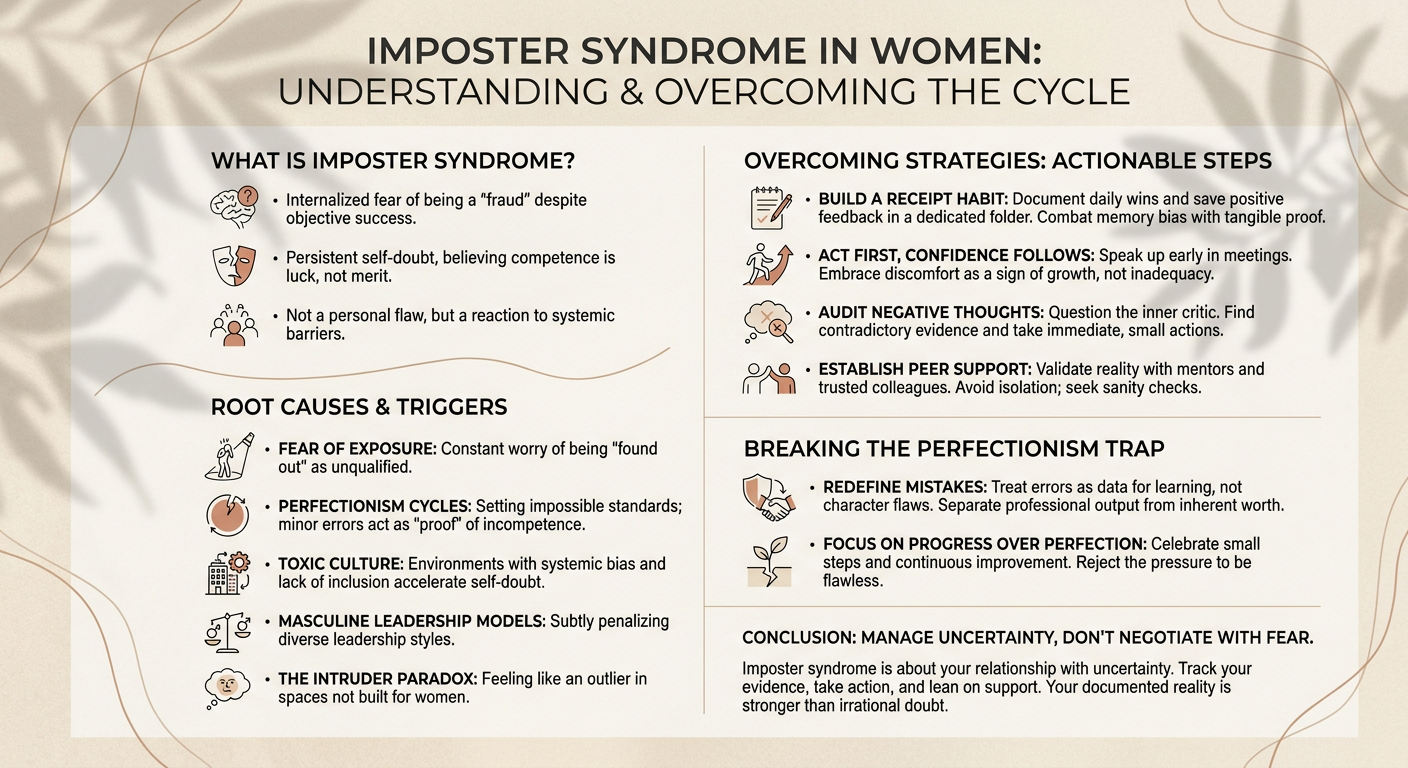
Imposter syndrome is the internalized fear of not being good enough to be in a specific role, despite evidence of competence. To overcome it, women can start to document their specific wins to counter negative thoughts, challenge perfectionist standards by embracing progress over perfection, and reframe failures as necessary learning steps. Accepting that these feelings are universal and that competence is a result of merit rather than luck are critical steps to rebuilding confidence.
What Causes Persistent Professional Self Doubt in Women?
Self-doubt rarely spawns from a vacuum. It is usually the result of specific, compounded psychological and environmental triggers that wear down a person’s sense of competency over time.
Fear of Exposure
For many young adults stepping into a new profession, the underlying panic is exposure. A woman feels like a fraud. She thinks her competence is a performance she fears cannot withstand scrutiny. Consequently, she spends hours over-preparing just to maintain the illusion that she deserves her paycheck, terrified that any slight misstep will reveal her perceived incompetence.
Perfectionism Cycles
Then there is the perfectionist trap. If a project is not executed flawlessly, the brain uses it as hard evidence of incompetence. Perfectionists set an impossible bar, miss it by a fraction of an inch, and then sustain prolonged feelings of professional inadequacy. This creates an endless impostor syndrome cycle where every achievement is dismissed as a fluke, and every minor error is treated as a fatal character flaw.
Toxic Culture
But one cannot ignore the room these women are standing in. A toxic culture actively accelerates self-doubt. When a woman is the only female leader in the boardroom, or the only parent balancing heavy caregiving responsibilities with a demanding career, the environment itself signals that she is an outlier. The culture quietly demands she work twice as hard just to validate her presence.
Recognize Systemic Bias Instead of Personal Flaws
Critics and modern mental health professionals argue that telling women they have a “syndrome” places the burden entirely on their shoulders. It gaslights them. Often, what women experience is just a highly logical reaction to systemic organizational bias and discrimination.
This systemic friction usually shows up in a few distinct ways:
- Corporate benchmarks that reward hyper-aggression over collaborative guidance.
- Implicit biases that question female competency by default until aggressively proven otherwise.
- The glaring lack of structural support for parents, forcing women to hide their personal lives to appear “dedicated.”
Masculine Leadership Models
Corporate structures were largely designed by men, for men. When the accepted benchmark for a successful leader requires endless availability and ruthless posturing, women who lead with empathy, strategic patience, or collaborative guidance are subtly penalized. They are judged against a standard they did not write, leading to inevitable feelings of inadequacy.
Intruder Paradox
This dynamic creates the intruder paradox. A woman is invited to the table, but the chair does not fit. Extensive data reveals that a staggering seventy percent of women encounter professional imposter triggers in the workplace, which is significantly higher than their male peers. They are not crazy. They are just navigating a system that constantly demands they prove their right to exist within it.
Lack of Inclusion
When organizations fail to provide genuine inclusion, the resulting isolation breeds intense self-doubt. Token diversity is not enough. Without real sponsorship, women look around, see nobody who shares their upbringing or life experiences, and naturally assume they must have slipped through the cracks of the hiring process.
Build a Receipt Habit to Prove Objective Success
How does one actually overcome this? The most effective, practical method involves approach the pattern directly, through documented evidence rather than internal debate. One outworks it and documents the receipts.
Document Daily Wins
Many women find clarity by keeping a running list of wins in a simple notes app. Not just the massive awards or the glowing performance reviews. They write down the smaller, everyday contributions. The time they unblocked a colleague’s project. The crisis they quietly averted. The email they wrote that finally explained a convoluted concept clearly when everyone else was confused.
Save Positive Feedback
When someone gives a compliment, the default reaction is often to brush it off. Oh, it was nothing. I had a lot of help.
This pattern is worth interrupting.
Save it. Screenshot the praise. Forward it to a dedicated personal folder. The human brain will actively try to erase these moments to protect its core narrative of fraudulence. Tangible proof is required to fight back.
Review Facts Regularly
When the spiral starts, opening that folder becomes a necessary intervention. Looking at the objective facts of an accomplishment grounds the mind. You cannot fight an irrational feeling with another feeling. It must be fought with raw, documented data.
Act First to Create Genuine Professional Confidence
Many professionals fall into the trap of believing confidence is a prerequisite. They think it is something they have to earn before they can act. Action is what builds confidence, not the other way around.
Speak Up Early
In meetings, a woman experiencing severe self-doubt might wait until the very end to speak, desperately trying to formulate the “perfect” contribution to prove she belongs. The antidote is volunteering early. Even if her voice shakes. Getting comfortable taking up space is literally the training ground for confidence.
Embrace Discomfort
Feeling uncomfortable when learning something new is not a sign of being an imposter. It just means someone is a student of their profession. Discomfort is simply the price of admission for career development and growth.
Learn Through Execution
Instead of asking, “Am I good enough?” the better question is, “What is the next right move?” Action strips the paralyzing emotion out of the equation. Ongoing learning and small, achievable wins create an undeniable track record over time, replacing imagined fears with concrete reality.
Audit Negative Thoughts During Mid Crisis Moments
When the panic hits mid-project, motivational speeches rarely work. A structured, honest audit of the internal dialogue is required. When working with confidence coaching for women leaders, this is often a core strategy.
Question the Claim
What exactly is the inner critic claiming? That she is going to fail this presentation? That she does not understand the science behind a specific strategy? Isolating the specific accusation takes away its vague, overwhelming power.
Find Contradictory Evidence
Next, she must look for the contradiction. Has she delivered similar projects successfully before? Yes. Does she have the research to back up her points? Yes. Often, recognizing the discrepancy between the fear and the reality interrupts the thought pattern.
Take Immediate Action
Finally, what can be done right in that exact moment to prove capability? Sending the difficult email. Outlining the first slide. Breaking the paralysis with forward momentum.
Establish Support Systems for Realistic Peer Validation
Relying purely on solo confidence is a scam.
Society pretends that the most successful women just woke up one day, entirely self-assured, radiating complete self-assurance. That narrative is largely a social media construction. In reality, professionals need humans. They need mentors, peers, and advisers who will validate their reality with theirs.
This is not about fishing for compliments. It is about securing a sanity check. When a woman vents to a trusted colleague, that peer can point out where her self-perception is wildly biased. In demanding fields like STEM or medicine, building these mentoring circles is non-negotiable. It is vital to recognize that a massive data synthesis confirmed women score significantly higher in imposter intensity than men. The structural deck is stacked, so fighting it alone is a losing strategy.
How Does Perfectionism Amplify the Intruder Paradox?
If a woman feels like an intruder in her industry, she naturally wants to avoid detection. How does she avoid being “found out”? By being absolutely flawless.
Perfectionism becomes her armor. She overworks, over-delivers, and obsesses over minor details, believing that if she just does everything perfectly, nobody will question her right to be there. But this is a rigged game. The moment she makes a normal, human mistake, the coping strategy breaks down. The self-doubt intensifies significantly, and the downward spiral begins.
To break this, mistakes must be treated differently. They are not personality tests; they are engineering data. What failed? Why did it fail? What needs tweaking next time? Sometimes, consulting a body confidence coach for women or a career development professional can help fundamentally rewire this sense of self-worth, separating a person’s professional output from their inherent value as a human being.
FAQ
Is imposter syndrome a recognized medical condition? No, it is not an official psychiatric diagnosis found in the DSM. It is a psychological pattern coined by researchers, though psychologists like Dr. Valerie Young and Dr. Lisa Orbe have expanded significantly on how deeply it impacts mental health, anxiety levels, and long-term career trajectories.
Do men experience imposter syndrome? Absolutely. However, extensive studies show that women experience it at disproportionate rates and intensities. This is largely due to immense societal pressure, rigid gender roles, and the friction of navigating male-dominated professions where they lack organic representation.
Can a person ever completely cure it? Frankly, “curing” it might be the wrong goal. The aim is to manage it so it no longer dictates career choices. Professionals learn to turn the volume down on the internal noise so they can finally hear their own ambition again.
Conclusion
Imposter syndrome is not really about a lack of skills. It is fundamentally about a person’s relationship with uncertainty.
If uncertainty is allowed to sit in the driver’s seat, a woman will spend her entire professional life trying to feel “certain” instead of actually becoming better at her craft. The golden rule is simple: one must not negotiate with the feeling.
Track the receipts. Build the habit of taking action even when the mind feels anything but top-tier. Lean heavily on mentors and support systems who see the truth. Over time, the fraud story simply stops making sense because a woman’s own life has built up far too much undeniable evidence contradicting it.