
Last updated on June 10, 2026
Introduction
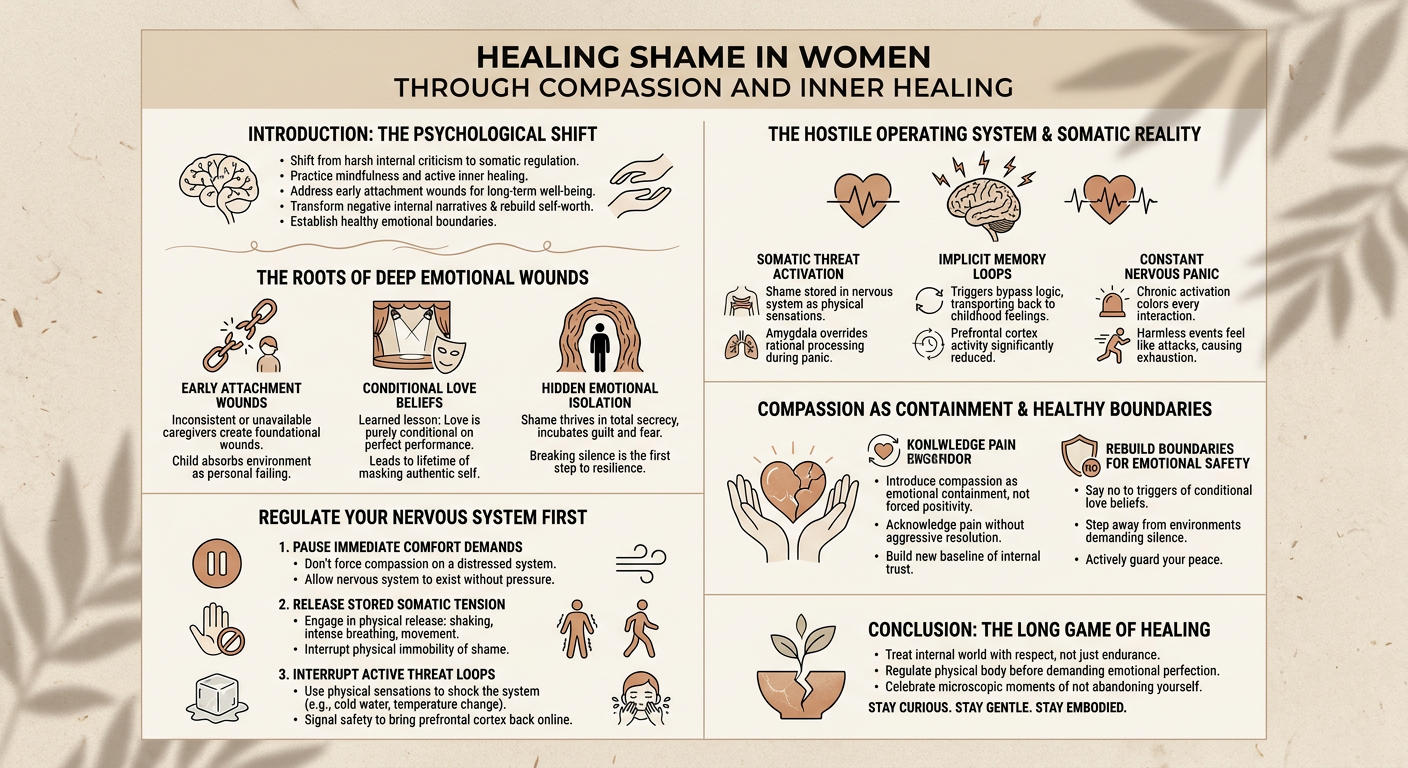
Healing shame in women requires a deliberate psychological shift from harsh internal criticism to somatic regulation, mindfulness, and active inner healing. By addressing early attachment wounds and practicing self-compassion, individuals can transform negative internal narratives, rebuild their inherent self-worth, and establish healthy emotional boundaries that protect long-term mental well-being.
That is the clinical, highly polished answer you will find in most textbooks.
But let us be completely honest for a second.
Many women sit in therapists’ offices or scroll through social media, in awe as they think, “Man, I wish I could just love myself like that!”
Why not take that fierce desire for peace and actually apply it to your physical body and internal landscape?
With enough focus and intense honesty, an individual can make their internal landscape a safe place to exist.
Deep, internalized shame represents the pinnacle of silent suffering. Millions of women around the world carry a heavy burden they cannot even articulate.
The sustained effort that go into just surviving a single day with a hyperactive inner critic is difficult for the average person to fully appreciate.
From obsessing over past mistakes for six hours a day to insane perfectionism that ruins any chance of joy, the intensity of those battling unprocessed shame is absolutely significant.
What does this have to do with healing?
More than you might think.
While comparing emotional recovery to an Olympic sport may seem odd, consider the struggles that women face when trying to unpack trauma:
- Some days it just feels like they are going nowhere, essentially expending significant energy without forward movement trying to support a mind that constantly attacks them.
- Reverting to previous patterns can be incredibly tempting when they are not seeing any emotional health improvements for their hard work.
- Overcoming that final mental hurdle into true healing can be like confronting what feels like an insurmountable challenge.
Likewise, individuals facing complex emotional wounds face massive physical and mental roadblocks.
But do they give up?
No.
And neither should anyone else walking this path.
It is time to begin approaching healing with the seriousness it deserves.
What Causes Deep Emotional Wounds?
Emotional wounds do not simply fall from the sky. They are created as a result of intense early life experiences and deeply ingrained beliefs about safety.
If your first attempt at therapy falls flat, does that mean you should give up altogether?
Of course not. Instead, you learn how those wounds were formed in the first place and understand what actually needs fixing.
Early attachment wounds
When people talk about emotional pain, they are usually talking about legacy emotions handed down from caregivers. A child relies entirely on the adults around them for survival. If those adults are inconsistent, critical, or emotionally unavailable, the child absorbs that environment as a personal failing.
They do not think their parent is flawed. They think they are flawed.
This creates a foundational wound.
Conditional love beliefs
When people say toxic shame, picture an old attachment wound that learned a very specific lesson. That lesson dictates that love is purely conditional. The individual learns they are fundamentally unsafe to be around unless they perform perfectly.
This underlying sense of wrongness leads to a lifetime of masking. The belief that one must earn basic respect drives a wedge between a person and their authentic selves.
Hidden emotional isolation
Experts note that shame thrives in total secrecy. The isolation acts as an incubator for guilt and fear. When women stay silent about their struggles, the mind builds a massive wall of perceived rejection.
According to foundational research detailing how women experience shame, breaking this silence is the first necessary step toward active resilience. A collective experience of sharing dissolves the illusion that a person is suffering alone.
The Hostile Operating System
Healing shame is rarely as simple as changing a few thoughts.
Honestly, the deep emotional weight people discuss in support groups is not something a person can just think their way out of.
Toxic shame functions more like a hostile operating system running silently in the background of the brain. Self-compassion can sometimes feel like pressure to override that program without actually changing the hardware underneath.
Somatic threat activation
Shame is held in the body. It is stored in the nervous system as physical sensations. Tight chest. Shallow breathing. A racing heart.
When a person tries to intellectually process their feelings while their body is reacting to an invisible threat, they are working against the body’s own responses. Medical studies tracking neurological threat responses show that the amygdala significantly overrides rational processing during these moments of panic.
Implicit memory loops
A trigger happens, and suddenly a woman is transported back to the exact physical feeling of childhood rejection. These implicit memory loops bypass logic entirely.
The prefrontal cortex activity is significantly reduced.
The body enters a state of fight or flight. Trying to have a quiet moment of reflection when the body is convinced it is in imminent danger is a massive mismatch of therapeutic tools.
Constant nervous panic
When the nervous system is sustained in a state of chronic activation, pervasive toxic shame colors every single interaction.
A harmless text message feels like an attack. A mild constructive correction at work feels like devastating abuse. The constant reactivity leaves women utterly exhausted.
Regulate Your Nervous System First
Olympic athletes do not try to fix their technique while actively training with the wrong method on the track.
You should treat your internal healing the exact same way.
If you demand compassion from yourself before your nervous system can even receive it, the effort will backfire.
Pause immediate comfort demands
For many, demanding self-kindness without physical regulation feels deeply performative. It feels exactly like trying to convince a nervous system in genuine distress to trust you by applying positive affirmations before the body feels safe enough to receive them.
You must pause the immediate demand to feel better.
Allow the nervous system to exist right where it is. Stop forcing the mind to generate compassion when it is physically incapable of doing so.
Release stored somatic tension
You must work with the body directly. This means engaging in practices that release stored activation. Shaking, intense breathing exercises, or even just walking vigorously can help Support the body in discharging stored activation.
Clinical research into the physical benefits of self-compassion highlights its role as a biological buffer against stress-related inflammation. Moving the body physically interrupts the physical immobility associated with shame.
Interrupt active threat loops
Before a person can heal, they must interrupt the threat loop.
Do something physical. Splash cold water on your face. Hold a piece of ice. Change the temperature of your environment. Once the body registers that there is no literal tiger in the room, the prefrontal cortex can come back online.
Multichannel Eye Movement Integration (MEMI) and Brain Switch 2.0 approaches are great to downregulate threat loops.
Only then can any therapeutic practice actually take root.
Apply Compassion As Emotional Containment
Once the physical panic subsides, compassion can be introduced. But it should be used as emotional containment rather than a prescriptive intervention.
A transformative self compassion program does not require a person to look in the mirror and declare they are completely flawless. Instead, it involves empathy for the situation.
“Oh, that old painful memory is here again, and it is genuinely painful in this moment.”
That simple acknowledgment contains the emotion. It holds the pain without trying to aggressively resolve it immediately. This approach mirrors the principles of Compassion-Focused Therapy, which actively soothes the brain’s threat centers by neutralizing feelings of inferiority.
By holding space for the parts of the self that carry pain, we build a new baseline of trust. Check out Therapy for Shame: How to Heal and Rebuild Self-Worth for more localized approaches to rebuilding this internal trust.
Rebuild Boundaries For Emotional Safety
You cannot always expect your new coping mechanisms to protect you flawlessly from the word go.
Remember that rebuilding emotional health represents a marathon, not a sprint.
Establishing healthy boundaries is how you protect your newly regulated nervous system. This means saying no to people who trigger your old conditional love beliefs. It means stepping away from environments that demand your silence.
If you hope to stay emotionally secure, you must actively guard your peace. You might need to Seek Trauma-Informed Professional Care to help identify where those boundaries need to be drawn. Mental health practitioners can provide the objective support required to maintain these new ways of living.
Why Do Standard Affirmations Fail?
Dozens of popular psychology blogs will tell you to simply journal your way out of a shame spiral.
In reality, standard advice often produce the opposite effect for women dealing with deep trauma.
| Conventional Advice | Somatic Reality |
|---|---|
| Write down your feelings immediately to gain perspective. | This often turns into endless rumination dressed up as true healing. The body needs physical regulation first. |
| Repeat positive affirmations daily to replace negative thoughts. | Forced positivity feels like a literal threat when the nervous system is panicked. It creates more internal conflict. |
| Analyze why you feel this way to achieve transformation. | Intellectualizing an emotional response keeps the trauma locked in the mind, ignoring the physical sensations completely. |
A common pattern observed in women processing shame involves journaling through a difficult interpersonal moment. The classic spiral of “what did I do wrong” takes over. They write for thirty minutes, feel significantly worse, and then tell themselves that their honesty is proof of growth.
This pattern more closely resembles rumination than genuine healing.
Awareness without equal amounts of gentleness can actually cause harm. A professional warning about the risk of building critical self-awareness shows how easily introspection turns into just further material for self-criticism.
You must act like a friend to your own mind. A true friend does not force you to recite happy quotes when you are still in acute distress”. A friend simply sits with you until the distress settles.
FAQ
What is the fastest way to stop an active shame spiral? You must change your physical state. Before you try to logically talk yourself down, interrupt the somatic threat activation. Change your environment, take a sharp breath, or use temperature shifts to shock the nervous system out of its implicit memory loop.
Can mindfulness actually change how the brain processes guilt? Yes. Consistent mindfulness practices physically alter the brain. By observing emotions without immediate judgment, you engage the prefrontal cortex, which dampens the amygdala’s panic response. It trains the brain to view an emotion as a passing event rather than a permanent identity.
Why does practicing self-compassion feel so incredibly uncomfortable at first? When you have spent a lifetime believing love is conditional, sudden unconditional kindness feels suspicious. The brain interprets the unfamiliar safety as a potential trap. This discomfort is a normal, temporary layer of the healing process.
Conclusion
Many women live by the mantra of pushing through the pain at all costs.
You should treat your internal world with far more respect than that.
If you are persistent in regulating your physical body before demanding emotional perfection, your healing journey has nowhere to go but up over time.
Yes, it can be deeply frustrating to see earlier patterns resurface.
Yes, it is genuinely difficult when immediate transformation does not follow we desperately want.
But that does not mean you should let your compassion program fail out of frustration. Do not expect your nervous system to fully rewire itself overnight. Realistic expectations will keep you grounded and focused on the long game.
Keep breathing. Keep unpacking the tension in your body. Keep replacing judgement with genuine curiosity.
If a specific coping mechanism is broken, figure out why and do what you can to change your approach. The success of your emotional recovery does not lie within one single perfect therapy session. It is the thousands of tiny, microscopic moments where you choose not to abandon yourself that determine your ultimate power.
Stay curious. Stay gentle. Stay embodied.
Your efforts will eventually pay off.