
Last updated on April 14, 2026
Key Takeaways
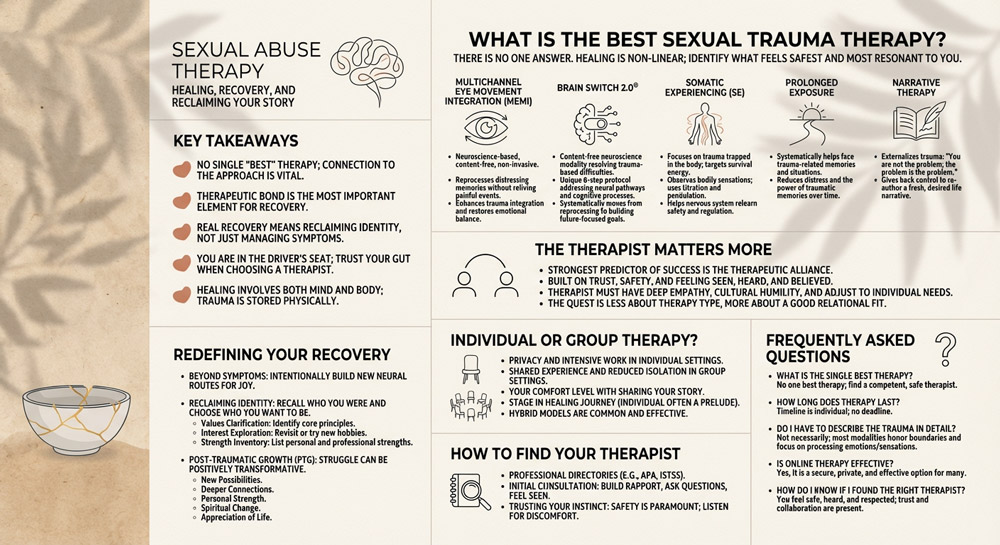
- There isn’t a “best” sexual trauma therapy, so check out trauma-focused modalities such as Multichannel Eye Movement Integration (MEMI), Brain Switch 2.0®, or somatic therapies such as Somatic Experiencing (SE). What is important is your own connection to the approach.
- The bond you form with your therapist is the most important element for your recovery. Seek out someone who makes you feel safe, understood, and respected.
- Real recovery is not just symptom management. It’s about reclaiming your identity and constructing a life of meaning and happiness. Healing is about having a chance to write your narrative and rewrite your narrative on your terms.
- Keep in mind that you’re the one in the driver’s seat of your recovery. Trust your gut when selecting a therapist and remember it is okay if you need to switch if someone is not the right fit.
- The healing is in both your mind and your body because trauma is stored physically as well. These body-focused therapies can assist you in releasing that pent-up tension and once again feel secure in your own skin.
- You’re not alone, and being with other survivors can be incredibly powerful. Group therapy provides a special environment for common empathy and developing a support network.
The quest to find the “best” sexual trauma therapy starts usually in the dark. Although approaches MEMI and Brain Switch 2.0 are among the most effective clinical options, the single most important thing is to find a route that you feel safe following.
It is not just about a diagnosis, but reclaiming your story. Here, we dig into how to make these decisions, respecting the human being at the core.
What is the best sexual trauma therapy?
As is the pursuit for the ‘best’ therapy. There is no one answer because healing is not a linear process with a universal solution. It’s about identifying what feels the safest and most resonant to you.
They’re not to forgive and forget, but to weave the experience into your life so it can no longer dominate your present. This is essential work because our humanity informs our professionalism.
1. Multichannel Eye Movement Integration (MEMI)
MEMI (Multichannel Eye Movement Integration) is an neuroscience-based, content-free and non-invasive method that helps your brain reprocess distressing or overwhelming memories so they lose their emotional charge.
In MEMI, structured, multi-directional eye movements are applied to stimulate different neural pathways, enhancing and accelerating trauma integration. It is designed to activate natural brain networks responsible for integrating experience, memory reconsolidation, calming the nervous system, and restoring emotional balance — without requiring you to relive painful events.
Unlike talk therapy or cognitive approaches, which may require storytelling or risk re-traumatising the client, MEMI is content-free. The client can keep details private throughout the protocol. Over time, distressing sensations, emotions, and body reactions soften — allowing space for calm, clarity, and self-regulation to return.
You learn to regulate distress, integrate trauma and is a proven model for reducing PTSD symptoms.
Sessions are highly effective and results can be seen in 1-2 sessions.
2. Brain Switch 2.0®
Brain-Switch 2.0® is another content-free, cutting-edge neuroscience-based modality designed to resolve trauma and emotion-based difficulties. The model integrates findings from large-scale brain network neuroscience, memory reconsolidation research, and qEEG-informed functional assessment to explain how trauma becomes encoded, maintained, and resolved.
The core of Brain-Switch 2.0® lies in its unique 6-step protocol that systematically addresses neural pathways and cognitive processes affected by traumatic experiences. It also utilises imagination, creativity through structured steps to reduce the emotional weight of distressing memories, or for generic issues or support with emotional regulation.
The method moves systematically from reprocessing and integration to building future-focused goals safety, assisting in a strong reduction of the trauma-related distress.
Sessions are highly effective and results can be seen in 1-2 sessions.
3. Somatic Experiencing
While not specifically designed as a sexual trauma therapy, somatic therapies works from the belief that trauma resides in the body. It targets this trapped survival energy that becomes locked in the nervous system during such an event.
Instead of emphasizing the story, SE gently directs you to observe bodily sensations. Using methods such as titration, which involves addressing small bits of trauma at a time, and pendulation, which means oscillating between states of distress and calm, it allows the body to fulfill its biological imperative defense responses.
This treatment helps the nervous system relearn a sense of safety and regulation, with research indicating it can reduce PTSD symptoms by 75 to 90 percent.
4. Narrative Therapy
This allows you to disassociate yourself from the trauma. The core principle is powerful: you are not the problem. The problem is the problem.
Narrative Therapy works by externalizing the trauma, treating it as something that has affected your life but not something that defines it. It gives you back the control to be the writer of your own plot, exploring the trauma’s impact and then consciously re-authoring a fresh, desired narrative.
It cultivates resilience and self-compassion, enabling you to ultimately reclaim your power and transcend the trauma.
The Therapist Matters More
We tend to get caught up in acronyms —searching for the “best” clinical modality. We’re asking the wrong question. Research has consistently demonstrated that the strongest predictor of a successful therapy outcome isn’t what kind of technique was used, but the rapport between therapist and client. The therapist matters more.
It’s the secure vessel in which recovery can occur. Without that bedrock of trust, even the most empirically supported method in existence will flounder. A strong therapeutic alliance is built on a simple yet profound premise: you feel safe. You are seen, heard, and believed without judgment.
It’s not about a therapist being ‘nice’. It’s about their ability to really be there to sit with you in your darkest moments, not turning away, not flinching, holding space for your pain, not rushing in to save or to fix. Their job is not just to hand out answers, but to hear deeply and together craft a way ahead.
Their manner of speaking, from the timbre of their voice to their body language, indicates that you are in a safe space and you can finally relax. When you’re seeking a therapist, you’re seeking a certain type of human. One who has not only expertise but deep empathy and cultural humility.
They must be nimble, adjusting their strategy to your individual needs, not cramming you into a strict regimen. This person has to be capable of bearing the burden of your narrative and assisting you in transporting it. You’re more likely to do the hard work of healing when you feel a real bond with the person leading you through it.
That’s why the quest is less about a type of therapy than it is about a good relational fit. This is the brave, human-first work that transforms lives. It’s not a deal; it’s a connection. The healing doesn’t happen because of a worksheet or a protocol.
It occurs because, for the first time, a survivor experiences basic safety in the presence of another human being. It’s an investment in a person, not a program, and that is where real, sustainable recovery starts for so many of us who have fought hidden wars.
Redefining Your Recovery
Recovery isn’t simply the absence of symptoms. That’s endurance. Real recovery is a redefinition of your life beyond the experience, an individualized path to self-actualization and overall health. It means looking beyond the hurt to fervently construct a world you want to occupy.
Beyond Symptoms
We tend to concentrate our treatment on the reverberations of trauma — the anxiety, the flashbacks. A life constructed merely for symptom management is still a life ruled by what has already happened.
As trauma expert Bessel van der Kolk writes, traumatic stress can rewire the brain’s pleasure and engagement circuits. The effort is to intentionally build these new routes by doing things that are actually fun and satisfying.
This isn’t about forced positivity. It’s about allowing your core strengths and values to lead you toward joy, which can robustly combat the ingrained impact of trauma.
Reclaiming Identity
Trauma can make it seem like it wipes away your identity, leaving just ‘survivor’. Redefining your recovery is about rewiring your recovery.
It is about recalling who you were and choosing who you want to be. This is a quiet, steady return to yourself.
-
Values Clarification: Identify your core principles (e.g., integrity, compassion). Does your daily behavior correspond?
-
Interest Exploration: Revisit old hobbies or try new ones without pressure. The objective is exploration, not domination.
-
Strength Inventory: List your personal and professional strengths. Trauma makes us forget our power.
Post-Traumatic Growth
We can redefine our recovery because from the deepest cracks, something new can grow. That’s the idea of post-traumatic growth (PTG) that a struggle can be transformative in a positive way.
It doesn’t erase the pain. It coexists with it.
|
Area of Growth |
Description |
|---|---|
|
New Possibilities |
Seeing new paths and opportunities in life. |
|
Relating to Others |
Experiencing deeper, more meaningful connections. |
|
Personal Strength |
A greater sense of one’s own resilience and power. |
|
Spiritual Change |
|
|
Appreciation of Life |
A renewed gratitude for life itself. |
This is your opportunity to come back not only whole, but better and more driven. You can develop this by actively noticing these growth zones in your own experience.
Individual or Group Therapy?
Feeling overwhelmed on whether to choose individual or group therapy, particularly when you’re already burdened with so much. You could be sitting there reading this in your office, a head of your field, but haunted by the unseen burden of trauma that renders the future lonelier. Individual therapy provides a contained space to start unpeeling this.
With a reliable clinician, you can probe the most intimate parts of your experience. Treatments such as psychodynamic psychotherapy or even MEMI are based on current evidence and are incredibly effective in treating sexual assault induced PTSD, providing tailored private processing.
Healing doesn’t often occur in a vacuum. I’ve experienced in my own life, for example, that connection is a strong antidote to shame. That’s the blessing of group therapy. There is nothing like walking into a room and hearing someone else recite a fear you assumed was yours alone to immediately disembowel years of solitude.
It’s a place that destigmatizes the strife and creates a deep sense of belonging. Research supports this, demonstrating that group settings, frequently employing CBT, work for survivors. It’s not as much a clinical intervention as it is a shared human experience of reassembling the fragments together.
Ultimately, the right path is personal. There’s no one answer, just what feels right to you at the time. As you consider your options, think about:
- Privacy and community and peer support.
- Or to work intensively on specific traumatic memories in an individual setting.
- Your comfort level with sharing your story with others.
- Where you are in your healing journey, for example, individual therapy is an important prelude to ever feeling ‘ready’ for a group.
More times than not, the best approach isn’t an “either/or” decision. Most full treatment plans intertwine both. You could use individual sessions to work through the raw, acute suffering of the trauma, while group therapy turns into a laboratory to exercise relating to others once again and to experience the power of common pain.
A therapist might even employ a hybrid model such as trauma-focused CBT, tailoring its concepts to both. Your healing is your own.
How to Find Your Therapist
Finding the right professional is a brave beginning. Your aim is finding the right therapist for you — one who specializes in sexual trauma, of course, but someone whose experience, training, and approach resonates with you and that you feel can make you safe to heal.
Professional Directories
Professional directories can be a useful place to begin. Trusted online resources such as the Singapore Association of Counselling (SAC), American Psychological Association (APA) or the International Society for Traumatic Stress Studies (ISTSS) provide searchable lists of vetted practitioners.
Read their profiles closely. Search for references to a trauma-informed care approach and verify their credentials and training. Trusted sources can provide guidance, like support groups, but always check that a prospective therapist is licensed.
Initial Consultation
That first appointment helps to build rapport. It’s your chance to evaluate whether this individual is the appropriate companion for your path. Come with questions! Be sure to inquire about their experience with sexual trauma survivors, what modalities they use, such as MEMI, Brain Switch 2.0 and Somatic Experiencing, and their healing philosophy.
This isn’t about testing them, but about feeling seen. Does their style speak to you? Do you feel listened to and validated, or hurried and criticized? This initial dialogue establishes the tone.
Don’t forget to address logistical things. Talk about their fees, if they take your insurance, and their cancellation policy. Having these clear saves future stress and makes the economics sustainable.
Trusting Your Instinct
Beyond credentials, your gut instinct is an important data point. The therapeutic alliance demands deep safety. You need to believe you can be vulnerable with this individual.
Listen for discomfort. If you feel judged, misunderstood, or that the therapist isn’t really there, these are big red flags. A good therapist will challenge you but will always honor you.
It’s totally fine to change therapists. Sometimes the first person you see is not the right fit. This is not defeat; it’s self-advocacy.
Take care of yourself. The journey is personal and you deserve to be selective.
What to Expect in Sessions
It takes a certain amount of courage to walk into a therapy room for the first time. It’s an act of self-advocacy at its most powerful. It’s not about deleting what occurred, but instead about learning to hold the narrative differently, in a way that it doesn’t control your now and what’s to come.
It’s a safe container where the silent can at last be heard. The path is different for every person, but the process of the work tends to follow a clinically verified, compassion-rooted arc. Therapy is an active, not passive, process. It’s about forming a relationship with an expert who serves as your mentor.
Every therapist’s method varies, and you can expect a structure that leaves you in control.
- Establishing a Safe Foundation: The initial sessions are about connection and goal-setting. This is where you and your therapist establish rapport. Be prepared to talk about your background, present difficulties, and your goals.
This preliminary evaluation describes a customized treatment strategy. The therapist’s main job at this point is providing a non-judgmental container where you feel seen and heard, setting the safety required for deeper work.
- Processing at Your Own Pace: When you feel ready, therapy moves into a phase of facing the trauma more directly. This doesn’t mean re-live it in a re-traumatizing way. Instead, a trained therapist guides you through memories and emotions in a safe, supportive context.
This latter portion of the work is all you. You are always in control of what you disclose and when.
- Developing New Skills: A significant portion of therapy is dedicated to building practical coping skills. That’s where treatments such as Cognitive-Based Interventions like Neuro-Linguistic Programming (NLP), Acceptance and Commitment Therapy (ACT) may come in.
You’ll learn how to manage triggers, regulate your nervous system, and reframe unhelpful thoughts. This hits trauma’s physical source, which is why it’s powerful for anxiety.
- A Realistic Timeline: Healing is non-linear. Therapy sessions, which can run 60 to 90 minutes, invite both short-term well-being boosts emerge within weeks, and enduring change.
Your Healing is Your Own — The Curious Bonsai
Once you’ve read about different therapies, you may feel more overwhelmed than when you began. It’s okay. The quest for the “best” can seem like yet another ambitious project to tackle, particularly when you’re drained.
What if healing isn’t a problem to solve, but a process to be held?
The best way forward is not a particular method you happen across in an article. It’s about finding a human being who encloses your narrative in a protective field. It’s about connection. Your healing is your own, and the bravest step is just to take that first step. Believe that still small voice within you — The Curious Bonsai is here to walk that path with you.
Reach out whenever you’re ready.
Frequently Asked Questions
What is the single best therapy for sexual trauma?
Not one “best” therapy. The key is finding a competent therapist with whom you feel comfortable. Your therapeutic fit and sense of safety are paramount.
How long does therapy for sexual trauma last?
The timeline is different for everyone. Some feel better in a few months. Others find long-term support helpful. Recovery is individual, and your therapist will collaborate with you at a speed that is comfortable for you.
Do I have to describe the traumatic event in detail?
Not really. Most trauma therapies guide you to process the feelings and sensations without demanding a step-by-step account. What you share is always up to you. A good therapist will honor your boundaries.
Is online therapy effective for trauma?
Yes, for most individuals, online therapy is equally as effective as face-to-face. It is a secure, easy-to-use, and private means of getting help from an environment you trust.
How do I know if I have found the right therapist?
You should feel safe, heard, and respected in your sessions. A good fit means you experience trust and collaboration. There is nothing wrong with trying a few different therapists until you find one that ‘clicks’.

Michelle Mah is a Singapore-based psychotherapist and executive coach specialising in burnout, perfectionism, and trauma recovery for high-functioning and high-achieving women. She is the founder of The Curious Bonsai Therapy & Coaching.
Michelle holds a Masters of Counselling (M.Couns) and is certified in a diverse range of modalities, including BodyTalk, the Gottman Couples Method, perinatal mental health, Trauma of Money, CliftonStrengths, and Neurolinguistic Programming (NLP).
Instagram: https://www.instagram.com/michellemah._/
LinkedIn: https://www.linkedin.com/in/themichellemah/
Facebook: https://www.facebook.com/themichellemah