
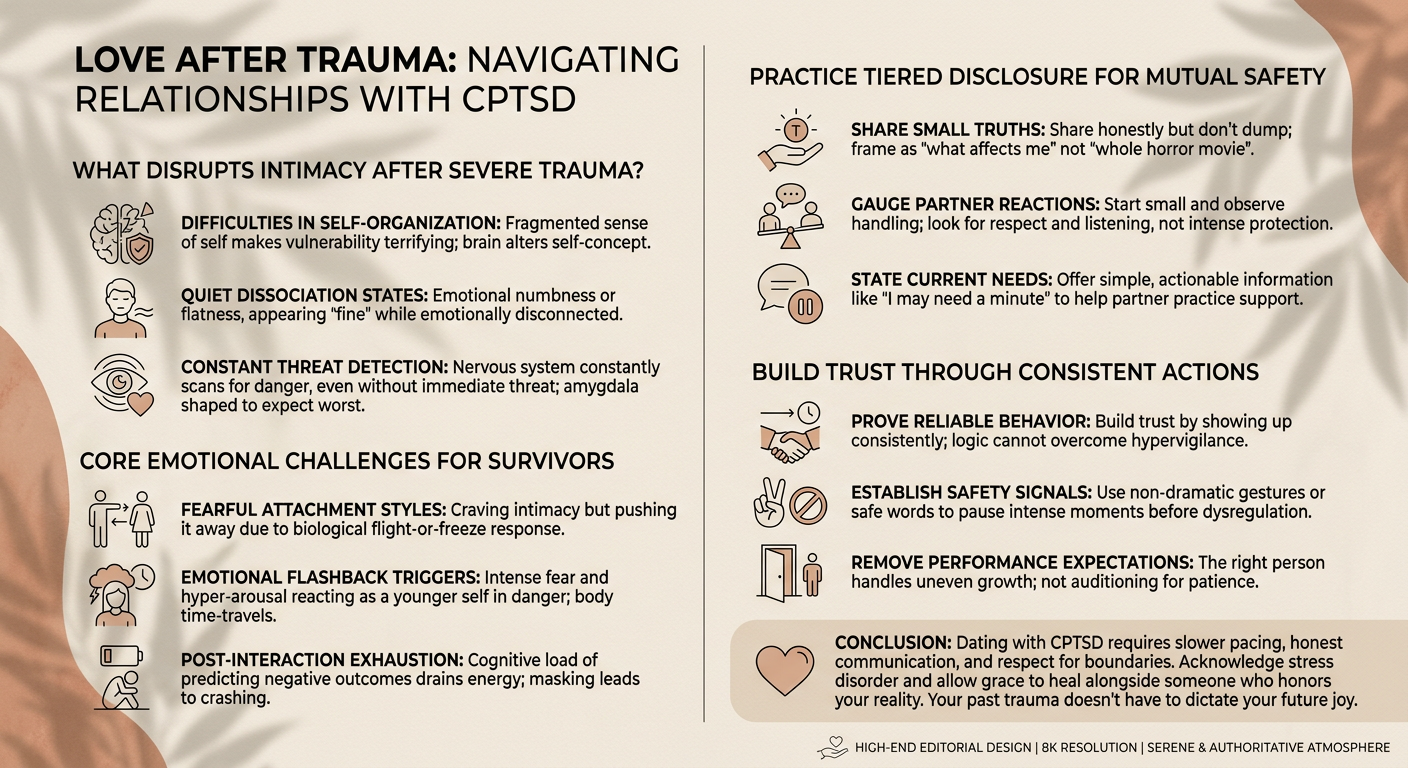
Complex post-traumatic stress disorder profoundly impacts emotional intimacy, trust, and communication within interpersonal relationships. Managing these dynamics requires a comprehensive clinical understanding of how persistent hypervigilance, emotional dysregulation, and dissociation fundamentally alter an individual’s capacity to establish and maintain healthy relational functioning.
When you are actually the one trying to build a life, dating with CPTSD can feel entirely different.
It isn’t about figuring out how to become “normal” enough for someone to love you.
It is about how you build safety with another human being without performing.
And yeah, it can feel weirdly lonely at first. But it’s also way more doable than most people admit.
Living with past trauma doesn’t mean your love life is doomed, but it does mean you are playing by a different set of rules. Your brain has been wired for survival.
So, what exactly happens when survival instincts collide with the desire for emotional relationships?
More than you might think.
What Disrupts Intimacy After Severe Trauma?
Trauma survivors aren’t just dealing with bad memories.
They are dealing with a nervous system that actively fights connection.
If you have survived prolonged trauma, your brain often perceives intimacy as a threat. Vulnerability requires letting your guard down, which is the exact opposite of what kept you alive in the past.
Difficulties in Self-Organization
This isn’t just a vague feeling of unease.
The medical community recognizes this as a core defining feature. In fact, the World Health Organization ICD-11 framework detailing Disturbances in Self-Organization across relational domains explicitly outlines how complex ptsd alters a person’s self-concept.
When your sense of self is fragmented, letting someone else into your world feels terrifying.
Quiet Dissociation States
Let me be blunt.
When I say I am “fine,” that fine may just be someone quietly dissociating.
Dissociation is a tricky beast. It doesn’t always look like checking out completely or staring blankly at a wall. Sometimes, it looks like emotional numbness where you are physically present but emotionally a thousand miles away.
Your partner might think everything is great.
Meanwhile, your affect is completely flat and you may be floating through the conversation to survive it.
Constant Threat Detection
CPTSD doesn’t feel like a standard mood disorder sometimes.
It can feel like a nervous system is running a background program that’s always scanning for danger, even when absolutely nothing is happening.
One can be having a perfectly normal day, and suddenly I’m bracing for impact.
This is a biological reality. It is backed by neuroimaging documentation of structural volume reductions in the amygdala during threat-processing in CPTSD patients. Your brain is literally shaped to expect the worst.
Core Emotional Challenges for Survivors
We all want to be loved.
But when you carry a traumatic stress injury, getting what you want can trigger massive emotional turbulence.
Fearful Attachment Styles
Mental health professionals often talk about attachment theory, and for those with relational trauma, fearful attachment is incredibly common.
It is a bizarre, painful oscillation.
You crave deep intimacy, but the second you get it, your biological flight-or-freeze response kicks in. This is why a recent meta-analysis of 92 studies mapping distinct profiles of social dysfunction and interpersonal impairments in CPTSD vs BPD reveals just how heavily trauma disrupts our ability to trust others.
We push people away precisely because we want them so much.
Emotional Flashback Triggers
Triggers aren’t just getting upset about a memory.
They are emotional flashbacks.
When a partner raises their voice, or when there is a hint of perceived abandonment, you aren’t reacting as a 30-year-old adult. You are reacting with the intense fear and hyper-arousal of a younger self in danger.
Your body time-travels.
Post-Interaction Exhaustion
Some people talk about CPTSD like it’s all vulnerability and healing journaling.
In real life, the stress responses look much messier:
- Going completely quiet because speaking simply costs too much energy.
- Being “high functioning” and heavily masked until you’re alone, and then crashing entirely.
- Feeling trapped because conflict is scary, even when you’re the one who needs something to change.
Why Does Anticipation Sabotage Safe Connections?
Anticipating.
Bracing.
Exhausting.
What’s truly messed up is that it often isn’t the actual trauma memories that hit the hardest.
It’s the anticipation.
The lead-up can be the absolute worst part. It’s that awful stomach tension, the panic that I’m going to be shamed, controlled, cornered, or expected to act okay.
Then, when one finally gets home or have to interact, they are basically already exhausted before anything even goes down. The cognitive load of predicting every possible negative outcome drains the joy out of the present moment.
Practice Tiered Disclosure for Mutual Safety
I used to think trauma disclosure was black and white.
You either spill everything on the first date, or you never talk about it until you have a ring on your finger.
Now? I’m way more team tiered disclosure.
Share Small Truths
One can choose to share honestly, but not dump.
One may not wish to overwhelm someone they barely trust, and they may not also wish for their healing to turn into a dramatic monologue that makes the other person responsible for my nervous system.
Frame it as “here’s what affects me” rather than “here’s the whole horror movie.”
Gauge Partner Reactions
Start small and gauge their response.
We could all benefit from consent in the room, not just goodwill. If someone drops a small truth about anxiety or past traumas, one may watch how they handle it.
Do they brush it off?
Do they get overly intensely protective?
Or do they just listen and respect it?
State Current Needs
If I’m on a second or third date and can feel oneself spiraling, it may not be a good time to share an whole history of childhood abuse or relational disconnectedness.
I’d offer something simple:
“I sometimes get overwhelmed by loud crowds or sudden emotional intensity, and I may need a minute. I’m not judging you; I’m just telling you what helps me stay regulated.”
That kind of info is highly useful. It lets the other person practice support without feeling like they’re holding a ticking bomb.
Build Trust Through Consistent Actions
The biggest shift for me was accepting that trust doesn’t arrive just because I deserve it.
It arrives because I’m consistent, and I let the pace be slow.
Prove Reliable Behavior
One cannot logic their way past hypervigilance.
And frankly, it should not be the case either. Start with low-stakes connection and steadily prove reliability. You build trust by showing up, doing what you said you would do, and not introducing unnecessary chaos.
Establish Safety Signals
Keep some sort of safety signal vibe.
Find a non-dramatic way to say “pause” when things get intense. Because once one is flooded with traumatic stress, explaining anything is impossible.
A simple hand gesture or a safe word can stop an emotional flashback in its tracks before the emotional dysregulation takes over.
Remove Performance Expectations
If someone acts like your pacing is an inconvenience, remember we’re not trying to win them over.
We’re not auditioning for patience from people who only like the clean, easy version of ourselves. The right person can handle a relationship that grows unevenly.
Provide Effective Support as a Partner
If you are loving someone with a mental health condition like this, you might feel confused or frustrated.
That is valid. Compassion fatigue is real.
But remember that your partner’s emotional withdrawal isn’t a reflection of their feelings for you. It is a reflection of their nervous system trying to protect them.
Don’t force them to talk when they are deep in avoidance. Don’t take their impulsive behavior or sudden emotional numbness personally. Instead, offer a steady, predictable presence.
The healing process requires a stable foundation, not a savior.
Can a Dysregulated Nervous System Truly Heal?
Yes.
But it requires work, and often, professional intervention.
While behavioral therapy and cognitive restructuring are helpful, complex trauma often requires specialized approaches. Understanding the deep roots of your triggers is essential, much like exploring therapy for shame: how to heal and rebuild self-worth: relational trauma origins.
Furthermore, a recent clinical trial showing how 6-week integrative multimodal psychodynamic therapy repairs ‘epistemic trust’ in severe CPTSD patients proves that our brains can relearn how to trust.
You aren’t broken beyond repair.
You just need the right tools, whether that is MEMI, Brain Switch 2.0, EMDR, TF-CBT, or targeted couples therapy.
FAQ
What is the difference between PTSD and complex PTSD in relationships?
Standard posttraumatic stress disorder usually stems from a single traumatic event, leading to avoidance and flashbacks. Complex PTSD (often called adult CPTSD) stems from chronic trauma, like domestic violence or childhood trauma. It includes PTSD symptoms plus severe emotional dysregulation, chronic feelings of guilt or shame, and profound difficulties in interpersonal relationships.
Why do I feel guilt when my relationship is actually going well?
Traumatized individuals often harbor deep, internalized shaming. When things go well, the contrast between the safe present and the dangerous past can trigger cognitive dissonance, making you feel unworthy of the peace you are experiencing.
Is CPTSD considered a personality disorder?
No. While it shares some overlapping symptoms with borderline personality disorder, such as emotional turbulence, CPTSD is fundamentally a stress response to prolonged trauma. The American Psychiatric Association currently groups similar profiles under dissociative PTSD in the DSM-5-TR, though the ICD-11 recognizes it as a distinct mental health diagnosis.
Conclusion
Dating with complex trauma can be messy and exhausting.
But having CPTSD does not make you unlovable. It simply means your relationships require a better fit, slower pacing, and fiercely honest communication.
Stop trying to force your connections to move at the speed of denial.
Acknowledge your stress disorder, respect your own boundaries, and allow yourself the grace to heal alongside someone who honors your reality.
Your past trauma shaped your survival, but it doesn’t have to dictate your future joy.
Keep going. Keep testing your boundaries safely.
And never apologize for needing to feel safe.