
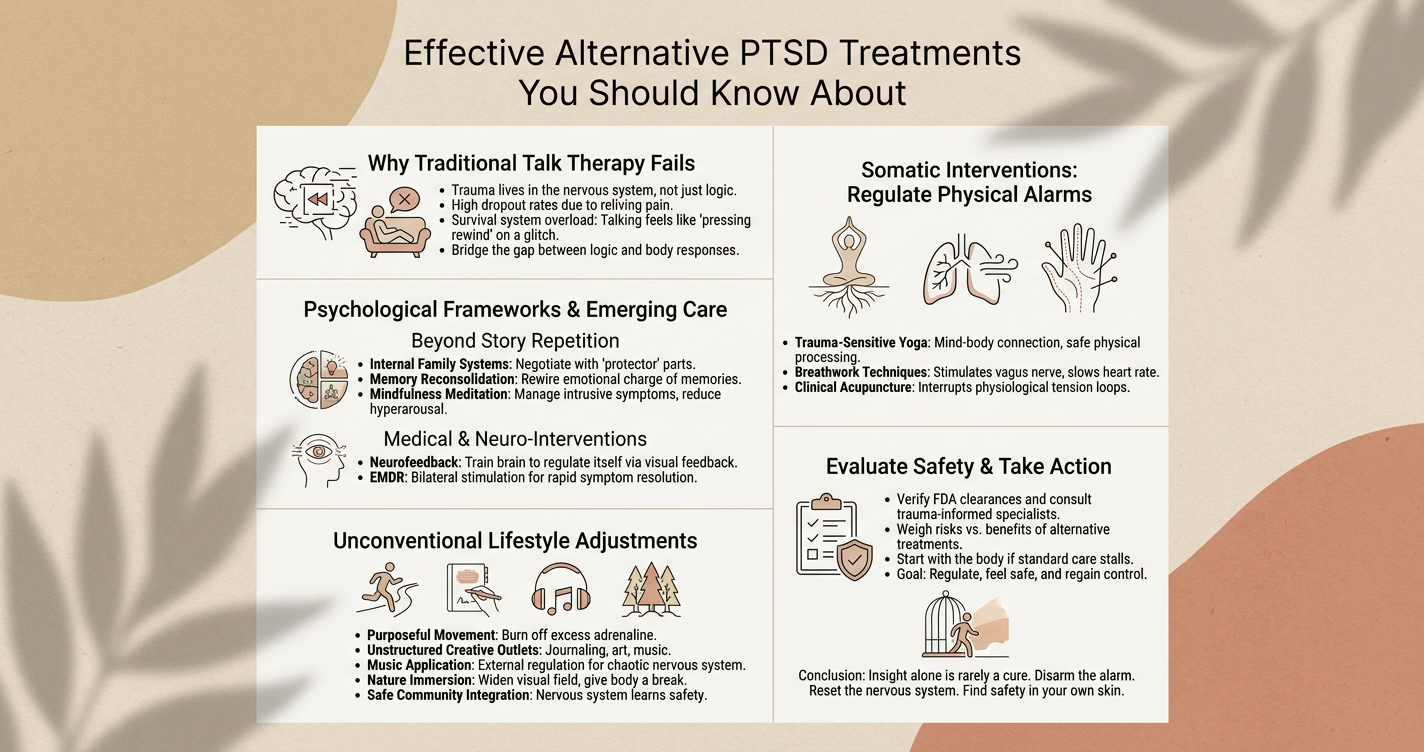
Effective Alternative PTSD Treatments You Should Know About
Most of us are handed a printed list of standard therapy options the second we get a PTSD diagnosis.
We are told to just talk it out.
To sit on a couch, dig up the worst day of our lives, and carefully analyze it with a mental health professional until it somehow stops hurting.
Talk therapy may not be effective as the default for trauma.
For many of us, trauma hasn’t lived in our logic brain. It lives in the body, hiding in the nervous system, triggering weird involuntary reactions that absolutely do not care how eloquent we can be about our childhoods.
It is time to look at interventions that change you holistically, not just your narrative.
Why Conventional Talk Therapy Fails Trauma Survivors
Conventional, evidence-based psychotherapies like cognitive behavioural therapy, cognitive processing therapy and prolonged exposure therapy are frequently heralded as the gold standards.
Yet, treating posttraumatic stress disorder isn’t a one-size-fits-all equation.
Sometimes talking just becomes a highly controlled way to revisit the pain without ever changing how your system actually responds to a traumatic event.
High Dropout Rates
People walk away from conventional treatments all the time.
It is a grueling process to repeatedly narrate a traumatic life event. In fact, high dropout rates have fueled interest in complementary and alternative strategies, which major health organizations recommend mainly as adjuncts to traditional talk therapy rather than as standalone cures.
If you are dreading your psychotherapy appointment to the point of physical illness, standard therapy is not working.
Frankly, talk therapy is still popular partly because it is easy to deliver, easy to bill, and feels socially clean to do. We expect mental health care to look like calm conversations.
Survival System Overload
Trauma recovery isn’t just a story problem. It is a survival system problem.
If your body is still stuck in threat mode, talking can become like repeatedly pressing rewind on a video that won’t stop glitching.
You are sitting in a chair trying to apply cognitive restructuring to a nervous system that genuinely believes a tiger is in the room. You can’t out-think a survival reflex.
Logic Versus Body Responses
When I see someone get stuck in endless tell-me-what-happened sessions, it feels like trying to fix a smoke alarm by writing a heartfelt essay about the fire.
Sure, you might feel understood. But it keeps you living in the exact same mental loop.
To actually resolve chronic PTSD, you have to bridge the massive gap between what your logical brain knows and what your physical body feels.
Somatic Interventions That Regulate Physical Alarm Responses
The approaches that resonate most with people match a very simple reality. Trauma shows up as a physical alarm.
You need body-based approaches to turn that alarm off.
Here are the signs that you might need somatic interventions rather than traditional psychotherapies:
- You experience intense fear or panic attacks without any clear, logical trigger.
- Your resting heart rate stays elevated, and you struggle with chronic muscle tension.
- You feel entirely disconnected or numb to your own physical sensations.
Trauma-Sensitive Yoga
This isn’t your neighborhood fitness class.
Trauma-sensitive yoga focuses heavily on the connection between mind and body, providing physical outlets to help individuals tolerate sensations associated with traumatic stress.
Systematic reviews published by the National Center for Biotechnology Information suggest that while the strength of evidence varies, yoga poses minimal health risks and can be incredibly valuable for somatic processing. It gives you permission to feel your physical space safely again.
Breathwork Techniques
I am talking about breathwork that is grounding, rather than performative.
Deep, rhythmic breathing stimulates the vagus nerve. This directly commands your heart rate to slow down. It forces the body out of the sympathetic stress response and into the parasympathetic rest state.
Clinical Acupuncture
Needles sound counterintuitive for anxiety disorders, I know.
But research indicates that acupuncture can significantly improve PTSD symptoms in civilian and military groups. The U.S. Department of Veterans Affairs finds it a promising complementary modality that is often integrated into holistic health plans. It interrupts the physiological loops keeping you tense.
Psychological Frameworks Beyond Story Repetition
I am skeptical of any approach that only targets the tell-the-story lane.
We need psychological treatments that do more than just record history. We need frameworks that help you stop treating every mood swing as a single, total truth.
Internal Family Systems
Internal Family Systems, or parts-based work, removes the shame from your reactions.
Instead of viewing yourself as broken, you view your mind as a collection of parts. The part of you that relies on avoidance or anger is just a protector part working overtime.
You don’t fight it. You negotiate with it.
Memory Reconsolidation
A lot of people describe these as memory processing methods in a different format.
For me, the win isn’t the traumatic memory being discussed. It is the emotional charge changing. You pull up the memory in a safe environment, introduce a contradictory experience of safety, and literally rewire how the brain stores that specific data point.
Mindfulness Meditation
Mindfulness-based stress reduction (MBSR) techniques have surprisingly low dropout rates.
They effectively manage intrusive symptoms, avoidance, and self-blame. The American Psychological Association recognizes mind-body practices as helpful grounding and coping mechanisms to reduce overall trauma-related hyperarousal.
You learn to sit with the present moment without scanning for danger.
Medical Procedures And Emerging Clinical Care
Sometimes the brain and body are too flooded for any behavioral therapy to stick.
This is where emerging clinical interventions step in to force a biological reset.
Transcranial Magnetic Stimulation (Neurofeedback)
Or more specifically, advanced neurofeedback and brainwave modulation.
Instead of just talking, you watch your brain activity on a screen and train it to regulate itself. A 2024 meta-analysis mapping the evolving efficacy of modern fMRI-guided and deeper brain derivative neurofeedback treatments on standardized CAPS-5 scales proves we can visually teach the brain to calm its own storms.
And we can’t ignore eye movement desensitization and reprocessing. We have U.S. Department of Veterans Affairs clinical data confirming EMDR efficacy and rapid symptom resolution timelines for complex military trauma programs.
The bilateral stimulation in EMDR keeps you anchored in the present while processing the past.
Unconventional Lifestyle Adjustments For Nervous System Reset
The stuff that helps most often interrupts the trauma cycle without requiring you to constantly narrate it.
Recent series highlighted by the National Center for Biotechnology Information suggest that the coping and emotion regulation skills cultivated through healthy lifestyle habits make it easier for patients to tolerate clinical treatments.
Purposeful Physical Movement
I noticed my symptoms dropped faster when I moved, not when I explained.
Lifting weights, running miles, or even cleaning the house like I am on a mission. Doing something physical on purpose burns off the excess adrenaline that PTSD leaves sitting in your veins.
Unstructured Creative Outlets
I don’t mean formal art therapy with a licensed person.
I mean drawing, recording music, or journaling in a completely messy way. Words can fail you when you are triggered, but colors and rhythm usually don’t.
Music Application
If you are flooded, blasting something that matches the feeling can bring you down way faster than trying to think your way out of it.
Music acts as external regulation. It forces a rhythm onto a chaotic nervous system.
Nature Immersion
Not in a cheesy, go-hug-a-tree way.
Being outside gives the body permission to stop scanning for social or urban dangers for a little while. The visual field widens. The brain gets a break from closed-in walls and screens.
Safe Community Integration
This sounds almost too simple.
But being around people who feel safe makes your nervous system learn that we are not in the danger zone anymore. Community outpaces solo emotional processing almost every time.
Evaluate Safety Guidelines Before Advanced Care Interventions
If you want tools that produce measurable relief, you also have to weigh the risks.
Not every alternative treatment is suitable for every person. You have to verify FDA clearances and consult a psychiatrist who actually understands trauma before letting anyone inject you or wire you up.
| Treatment Approach | Primary Mechanism | General Safety Profile & Considerations |
|---|---|---|
| Multichannel Eye Movement Integration (MEMI) | Eye Movements & Memory Reconsolidation | Non-invasive, content-free. High safety profile. Includes a somatic layer to the approach. Originated from neurolinguistic programming (NLP) approaches. |
| Brain Switch 2.0 | Memory Reconsolidation | Non-invasive, content-free. High safety profile. |
| Neurofeedback | EEG/fMRI guided brainwave training | Non-invasive. High safety profile. May cause temporary fatigue or mild headaches after intense sessions. |
| Trauma-Sensitive Yoga | Somatic movement and breathwork | Extremely low risk. Focuses on physical safety. Only contraindicated for severe physical mobility restrictions. |
Always check the clinical practice guidelines for your specific mental health disorder.
What Should Patients Do When Standard Care Fails?
When I went through a particularly bad wave of anxiety, I tried the classic route.
I tried to analyze it, talk it out, figure out what I was feeling.
It didn’t really help. I still felt like my body was in emergency mode.
Then I did something simple. I went outside, walked hard for two miles, put on consistent music, and focused purely on physical sensations like my feet hitting the pavement.
The anxiety didn’t vanish because I suddenly understood it. It shifted because my nervous system finally got a different input than panic.
If your current treatment goals are stalling, pivot. Look at interventions that target the body. Advocate for yourself.
FAQ
Why do I feel worse after traditional talk therapy? Talking about a traumatic event without proper grounding techniques can trigger severe emotional processing backlashes. You are reliving the event, which spikes your nervous system without actually resolving the physiological stress.
Are these alternative treatments covered by insurance? It depends entirely on your provider. Interventions like eye movements and certain neurofeedback protocols are frequently covered, while experimental therapies or holistic integrative health approaches often require out-of-pocket payments.
How do I know if somatic therapy is working? You will notice a change in your baseline physical tension. Your resting heart rate may drop, nightmares might decrease, and you will likely feel a stronger sense of physical presence rather than constant dissociation.
Conclusion
If someone’s trauma work isn’t also helping them regulate, feel safer in their body, and regain control of their physical reactions, then I am definitely side-eyeing it.
Insight alone is rarely a cure.
Standard therapy has its place, but it is not the only path forward for a PTSD diagnosis. Stop trying to reason with a smoke alarm.
Go disarm the thing making the noise. Put your boots on the ground, reset the nervous system, and find the treatment that actually makes you feel safe in your own skin again.