
Last updated on June 10, 2026
Most clinical literature defines Solution-Focused Brief Therapy as a pragmatic, goal-directed framework designed to treat psychological distress by focusing on a client’s present and future circumstances rather than their past.
It sounds highly professional and entirely logical.
Anxiety, however, rarely responds to logic alone.
When you are immersed in uncontrollable worry, your first instinct is usually to find out exactly why you are immersed in that space. You want to analyze the water. You want to understand the current. Solution-focused brief therapy does not care about the water. It asks you what a life raft looks like and demands you start building it immediately.
The primary answer to managing anxiety through this modality is surprisingly direct. Instead of dwelling on the root causes of worry, solution focused therapy helps clients identify existing coping mechanisms and build emotional balance by zeroing in on what is already working.
It is highly regarded by third-party mental health experts for this exact strengths-based approach.
But is it the perfect cure-all?
It is not a universal solution.
Sometimes it is the exact lifeline you need to break a cycle of fear. Other times, it feels like a shallow dismissal of very real pain. You have to understand how it operates in practice before you sit down in a practitioner’s chair.
What Is Solution Focused Brief Therapy?
Steve de Shazer and Insoo Kim Berg developed a completely different counseling model in the late 1970s. They believed that knowing the cause of a problem was not strictly necessary to solve it.
They realized that clients often possessed the emotional skills required to heal, even if those skills were buried under layers of stress.
Core Treatment Principles
This brief therapy approach operates on a few consistent core assumptions.
First, change is constant and inevitable. Second, clients are the ultimate experts on their own lives. A counselor is not there to diagnose deep-seated behavioral disorders or deliver directive expert guidance. They are a collaborator.
Many people get stuck spinning their wheels trying to support an underperforming mental state. They focus heavily on:
- Cataloging every single time they failed to manage a stressful event.
- Fixating on the origins of their intense feelings instead of the exit routes.
- Waiting for a magical “breakthrough” insight that will suddenly cure their panic.
SFBT therapists disrupt this pattern entirely.
Future Vision Focus
If you spend all your therapy sessions staring in the rearview mirror, you are probably going to crash.
This therapy forces you to look at the road ahead. The dialogue shifts aggressively toward how your life will look when the anxiety issues are manageable. You stop talking about the heavy weight on your chest. You start talking about what you will do on a Tuesday afternoon when that weight is gone.
Client Strength Utilization
You already have a toolkit.
Perhaps you managed a highly stressful academic presentation last month without entirely falling apart. To an SFBT practitioner, that is not a fluke. That is empirical data. It is proof of your underlying resilience. The focus is entirely on mining your past for successes rather than excavating it for failures.
How Does Brief Therapy Interrupt Anxiety Cycles?
Anxiety involves a learned pattern of threat response rooted in amygdala activation. It is a loop of anticipated catastrophe. Breaking that loop requires more than just hoping for the best.
Exception Moment Identification
Anxiety wants you to believe it is omnipresent. It wants you to think you are always terrified.
But that is rarely true. There are moments when the panic recedes. Maybe it is when you are gardening. Maybe it happens when you are distracted by a complex task at work. Therapists call these “exceptions.”
Instead of analyzing problem-saturated histories, the therapist directs your attention to these exact moments. Identifying exceptions proves that the anxiety is not bulletproof.
Internal Resource Activation
Once you find the exception, you replicate it.
If you notice that your daily stressors feel lighter after a morning walk, the intervention is simply to deliberately build upon that practice. You actively build upon internal resources. This is incredibly practical. It mirrors the straightforward tactics found in driving anxiety treatment therapy and self-help strategies, where the immediate goal is simply to get back behind the wheel safely.
Positive Perspective Shifts
You stop being a victim of your own mind.
When you start tracking your successes instead of your failures, your psychological well-being naturally stabilizes. The anxiety stops looking like a giant, impossible monster. It becomes a manageable quirk of your biology.
Compare Solution Focused Frameworks Against Traditional Psychotherapy
You cannot blindly choose a mental health service. You have to know the landscape.
When exploring what differentiates this methodology from traditional therapy, the contrast is usually stark.
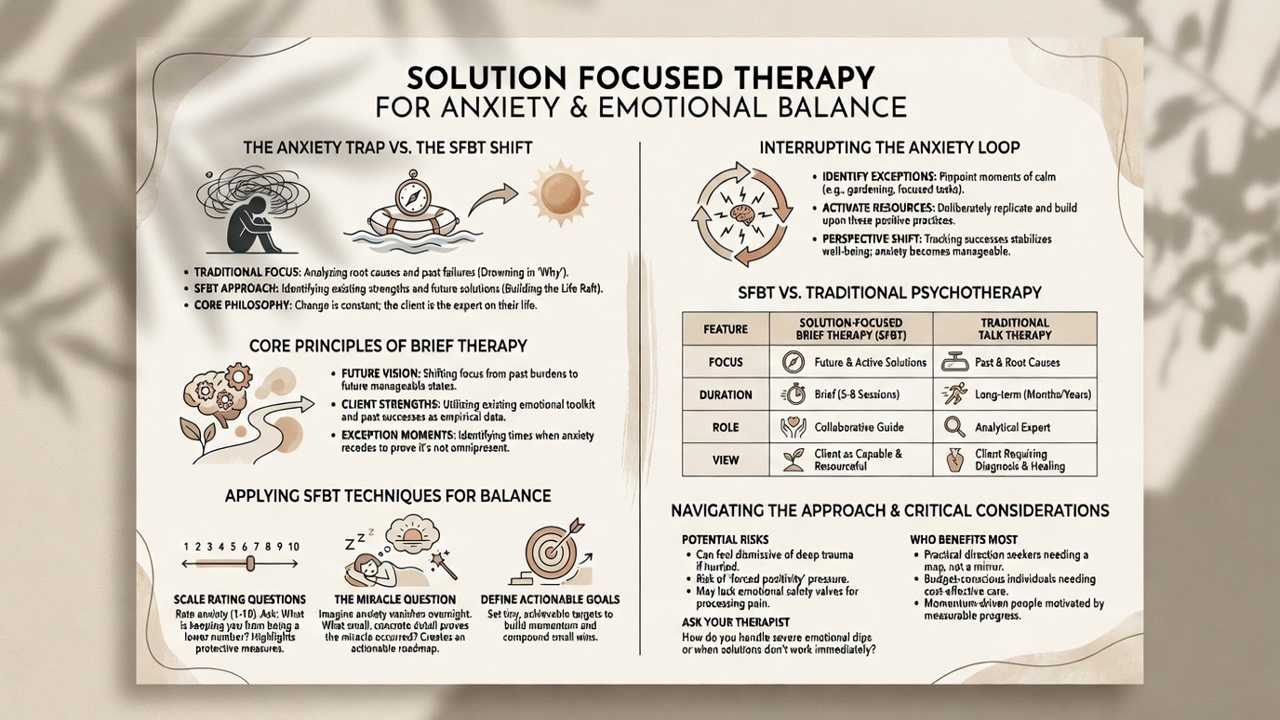
| Feature | Solution-Focused Brief Therapy | Traditional Talk Therapy |
|---|---|---|
| Primary Focus | The future and active solutions. | The past and root causes. |
| Duration | Typically 5 to 8 sessions. | Months to years of continuous work. |
| Therapist Role | Collaborative guide. | Analytical expert. |
| View of the Client | Inherently capable and resourceful. | Requiring diagnosis and deep healing. |
Session Duration Requirements
Brevity is the entire point.
Psychology professionals frequently utilize SFBT because it requires fewer sessions on average than alternative behavioral approaches. This makes it highly accessible for people who cannot afford long term psychotherapy. It is a sprint.
Root Cause Analysis
Traditional psychodynamic psychotherapy demands that you understand the “why.”
SFBT completely abandons the “why.” It only cares about the “how.” If your kitchen is flooding, an SFBT therapist helps you grab a bucket. A traditional therapist might ask who left the water running.
Symptom Reduction Efficacy
Comprehensive umbrella reviews and outcome studies suggest SFBT yields highly positive outcomes for affective disorders. In many controlled outcome studies, it improves emotional regulation at rates comparable to longer-term therapies.
Apply Therapy Techniques to Build Emotional Balance
You can actually try some of these strategies without setting foot in an outpatient program.
Deploy Scale Rating Questions
Therapists love scales.
They will ask you: “On a scale from 1 to 10, with 10 being the most anxious you have ever felt and 1 being complete peace, where are you today?”
If you say you are a 6, the next question is brilliant. They do not ask why you are a 6. They ask, “What is keeping you from being a 7?”
This forces your brain to acknowledge the protective measures you are already taking. It highlights your agency.
Ask Miracle Questions
This is the hallmark of the brief therapy evidence base.
Suppose you go to sleep tonight, and while you are sleeping, a miracle happens. Your anxiety vanishes. When you wake up tomorrow morning, what is the very first small detail that will tell you the miracle occurred?
Maybe you would make coffee without checking your phone. Maybe you would breathe deeply. By identifying these tiny, concrete actions, you create a roadmap for behavior change.
Define Actionable Goals
Motivation requires momentum.
You need tiny, achievable targets. This is quite similar to modern cognitive behavioral therapy for artist burnout, where the immediate focus is reclaiming small creative habits rather than overhauling an entire career. Small wins compound into massive psychological shifts.
Why Can Brief Therapy Feel Emotionally Dismissive?
Solution-focused therapy sounds incredible on paper. The orientation is toward building rather than dwelling.
But I suspect it can easily feel shallow to people who are actually drowning. Sometimes it feels like a slick way to dodge messy, painful realities.
Forced Positivity Pressures
If the sessions move too fast toward goals and miracle questions, it can accidentally pressure you to perform wellness.
When you are exhausted, traumatized, or grieving, “just focus on solutions” can feel like someone telling you to focus on solutions before the emotional reality has been acknowledged. You are forced to act upbeat just to satisfy the counseling model.
Emotional Bypass Risks
There are situations where you actually need to process historical pain.
Unlike deep therapy for shame how to heal and rebuild self-worth, which requires a certain level of emotional excavation, SFBT can sometimes leave genuine trauma insufficiently processed. The solutions are not wrong, but they are incomplete. Addressing surface behaviours without attending to underlying distress is incomplete treatment.
Absent Safety Valves
The approach is not inherently bad. Its biggest risk is that it can become a rigid script.
A good therapist must be able to slow down. They need to name what is happening emotionally and hold space for uncomfortable feelings without punishing you for not finding an immediate solution.
Who Benefits Most From Solution-Oriented Treatment?
Because the evidence base can be uneven depending on the severity of the mental illness, finding the right fit is crucial.
Practical Direction Seekers
Some people do not want to talk about their childhoods. They want traction.
They need a map, not a mirror. If you are overwhelmed by daily stressors and need actionable steps to keep from spiraling, this therapeutic approach can feel like an absolute lifesaver.
Budget Conscious Patients
Mental health treatment is expensive.
Because brief counseling is designed to wrap up in a handful of sessions, it is incredibly cost-effective. It is also highly adaptable, making it a staple in many modern online therapy for burnout and stress recovery support programs.
Momentum Driven Individuals
If you are naturally motivated by setting targets and seeing measurable progress, this framework speaks your language. It channels your natural drive into psychological resilience.
Ask Critical Questions Before Modality Selection
Clients should evaluate whether this approach suits their specific needs.
If you are considering this path, ask your therapist how they handle severe emotional dips. Ask them what happens if the “solutions” simply do not work one week.
We see similar questions pop up in specialized fields. For example, parents frequently ask if ABA therapy can be used for anxiety in neurodivergent children, carefully weighing the behavioral focus against emotional needs. You must weigh those exact needs for yourself.
FAQ
Does solution focused brief therapy work for severe panic attacks? It can be highly effective for managing the immediate behavioral response to panic, helping clients identify tools to ground themselves quickly. However, severe panic disorder may require a combination of therapies or medical intervention.
How is this different from cognitive behavioral therapy (CBT)? CBT actively challenges and restructures negative thought patterns. SFBT largely ignores the negative thoughts and instead focuses on building up the positive behaviors and exceptions that already exist in your life.
Can it be used for children and adolescents? Yes. School counselors frequently use this model because it is engaging, respects the child’s autonomy, and fits within the limited time constraints of academic settings.
Conclusion
Finding emotional balance is rarely a straight line.
Solution-focused brief therapy strips away the endless analysis and demands forward motion. It relies on a profound, slightly radical belief: you already possess the strength required to heal.
It is not a magic wand. It requires a willingness to look past the shadows and focus intensely on the light. If you are ready to stop analyzing the past and start building the future, it might be exactly what you need to experience meaningful relief.