
Last updated on June 20, 2026
Many professionals spend hours struggling to manage their own physiological stress responses, wondering why logical reasoning fails to interrupt an acute panic response. Brain therapy for anxiety utilizes neuroscience-informed techniques to calm the mind. Experts classify these into three main categories: mind-body practices like mindfulness and biofeedback, psychotherapies such as Multichannel Eye Movement Integration (MEMI), Brain Switch 2.0, Cognitive Behavioural Therapy (CBT), and neurostimulation. Third-party research indicates that these treatments effectively reduce fear reactivity and safely rewire neural pathways to improve emotional regulation.
The stuff that works for stress and anxiety is usually practical and physical.
You can try to rationalize your fears away all afternoon. But if your heart is pounding and your chest feels tight, your brain will absolutely ignore your logic.
How Does Neuroscience Explain Anxious Thought Patterns?
Your brain is constantly scanning your environment for danger. When it works perfectly, this mechanism keeps you alive. When it misfires, it produces significant interference with daily functioning.
How anxiety affects the brain is not a matter of weakness. It is a matter of biology.
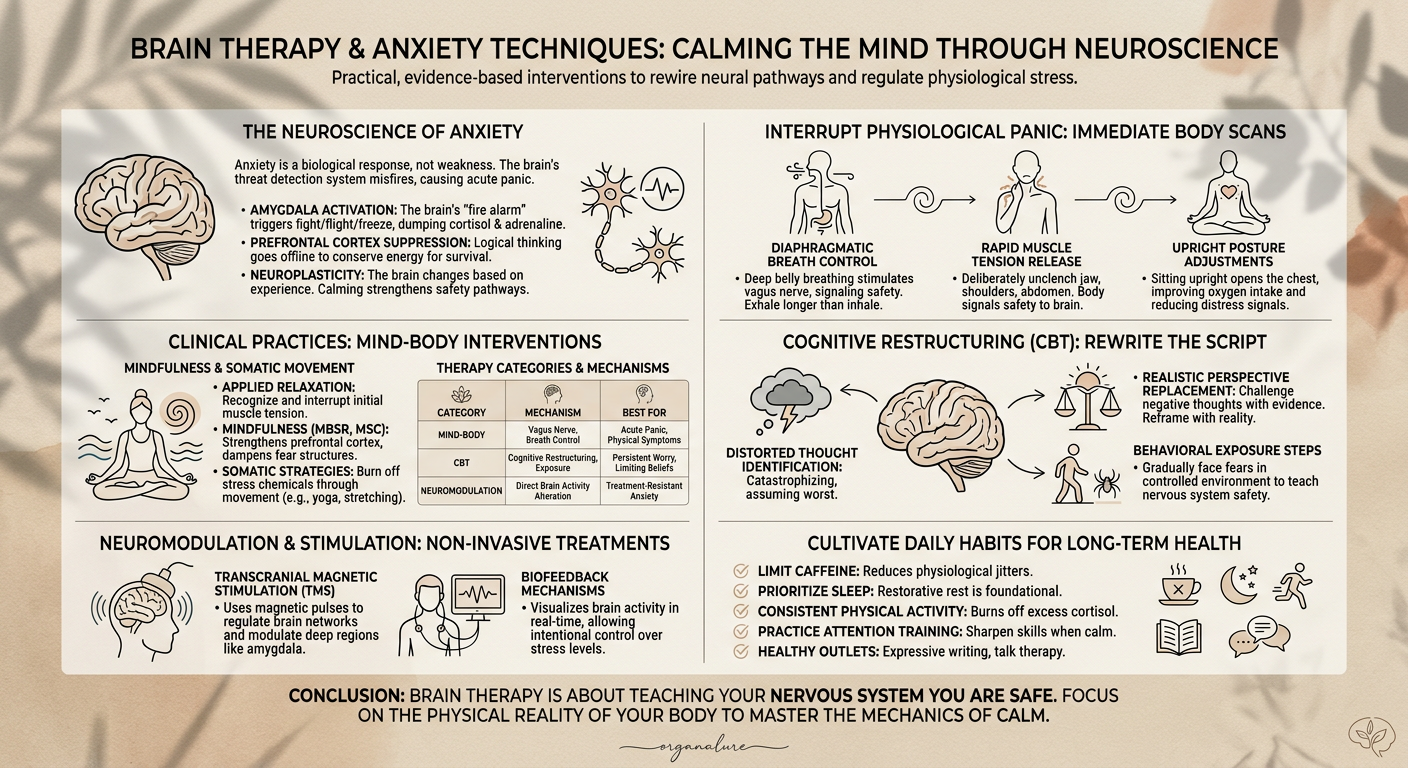
Amygdala Activation Cycle
Think of the amygdala as your brain’s fire alarm.
When it detects a threat, it does not stop to ask questions. It immediately triggers a fight, flight, or freeze response. It dumps stress chemicals, specifically cortisol and adrenaline, straight into your bloodstream. Your breathing gets shallow. Your muscles prepare for impact.
This cycle is incredibly fast. Before you even register what you are afraid of, your physical symptoms are already peaking.
Prefrontal Cortex Suppression
This is where the cycle becomes self-reinforcing. As the amygdala lights up, the prefrontal cortex activity is significantly reduced.
The prefrontal cortex is responsible for logical thinking, emotional regulation, and complex problem-solving. When you are in a state of sheer panic, your brain literally significantly reduces prefrontal cortex activity to conserve energy for physical survival.
This is why trying to talk yourself out of a panic attack rarely works. The equipment required to process that logic is temporarily offline. As trauma experts like psychologist dr therese rando have noted in related fields of grief and trauma, the nervous system simply overrides cognitive control when it feels threatened.
Neuroplasticity Principles
But you are not stuck with a a dysregulated threat-detection system.
The brain changes itself based on experiences. This is neuroplasticity. Every time you successfully calm down, you strengthen new neural pathways that signal safety. You are physically rewiring the anxious brain to stop overreacting to false alarms.
It takes work. But the brain learns.
Interrupt Physiological Panic With Immediate Body Scans
When the stress response is acute, slowing the breath and conducting a brief body scan gives the nervous system a concrete alternative focus.
It does not magically delete anxiety. But it moves the nervous system out of acute threat activation enough that I can function.
Diaphragmatic Breath Control
Diaphragmatic breath control is among the most well-supported immediate interventions for a few minutes. Belly breathing.
When you pull air deep into your abdomen instead of taking shallow breaths in your chest, you stimulate the vagus nerve. This nerve acts as a a direct regulatory pathway to the parasympathetic nervous system. It sends a massive safety signal directly to your brain.
Take slow breaths. Let the exhale last longer than the inhale. It forces your heart rate to drop. Medical professionals agree that correct breathing techniques are foundational to ending hyperventilation and restoring calm.
Rapid Muscle Tension Release
While you breathe, deliberately unclench the spots that always hold tension.
Common areas of held tension include the jaw, shoulders, and abdomen. Many relaxation techniques share the same underlying physiological mechanism for the exact same core mechanism. Your body cannot stay in a sustained state of physiological threat activation if you are consistently telling it “we are safe” with breath and muscle release.
Upright Posture Adjustments
It sounds trivial. But posture matters immensely.
Before a stressful call, I do two minutes of breathing. Then I sit completely upright. Slumping compresses your diaphragm and limits your oxygen intake, which subtly signals distress to your brain. Sitting up opens your chest. After that, my thoughts stop racing as hard and I can actually communicate more effectively under pressure.
Adopt Clinical Practices For Immediate Emotional Regulation
If you want tools backed by decades of clinical data, look at mind-body practices. These are designed to bridge the gap between physical sensation and mental panic.
Applied Relaxation Protocols
Applied relaxation teaches patients to recognize the very first signs of muscle tension and deliberately interrupt them.
Systematic reviews confirm it is a highly established psychological intervention for generalized anxiety disorder. Psychiatric organizations conclude that relaxation training is a well-supported strategy you can use on its own or alongside an appropriate treatment plan.
Mindfulness Interventions
Mindfulness is widely reviewed by psychological and psychiatric bodies.
The American Psychological Association highlights that mindfulness-based therapy such as Mindfulness Based Stress Reduction (MBSR) or Mindful Self compassion (MSC) reduces stress, anxiety, and depressive symptoms. Researchers note that these practices strengthen the prefrontal cortex while dampening the activity of fear-based structures.
Sometimes incorporating formal practices like integrating mindfulness meditation helps you sit with uncomfortable emotions without immediately reacting to them.
Somatic Movement Strategies
Anxiety shows up as tension in my body first.
Sitting perfectly still and trying to meditate when you are in a state of acute adrenal activation is agonizing. Somatic movement strategies like yoga or simple stretching allow you to burn off those stress chemicals physically. You train the body to calm threat responses by engaging the body to discharge stored physiological tension.
| Therapy Category | Primary Mechanism | Best Used For |
|---|---|---|
| Mind-Body Practices | Vagus nerve stimulation, breath control | Acute panic, physical symptoms |
| Cognitive Behavioural Therapy (CBT) | Cognitive restructuring, exposure | Persistent worry, stress, limiting beliefs, certain fears or phobias |
| Neuromodulation | Direct brain activity alteration | Treatment-resistant anxiety |
Cognitive Restructuring Frameworks From Professional Psychotherapy
Cognitive behavioral therapy is traditionally considered the gold standard for managing an anxiety disorder. It trains the brain to recognize fear-driven thinking patterns and replace them with reality.
Distorted Thought Identification
Anxiety-driven cognition consistently distorts perception of threat.
It catastrophizes. It assumes the absolute worst outcome is guaranteed. The first step in cognitive therapy is catching these negative thoughts in real time. You learn to assess the evidence for your negative thoughts rather than blindly accepting them as facts.
Realistic Perspective Replacement
Once you identify the distorted thought, you replace it.
Clinical neuroimaging studies show that CBT directly leads to functional improvements in brain activity by changing dysfunctional thoughts. You swap “I am going to fail and lose everything” with “This is difficult, but I have handled difficult situations before.”
This is also how you start silencing the inner critic during professional burnout. You actively rewrite the script.
Behavioral Exposure Steps
You cannot cure a fear of spiders by talking about spiders in a safe room. You eventually have to look at a spider.
Exposure therapy involves gradually facing your fears in a controlled environment. Whether it is social situations or treating specific fears like driving anxiety, exposure teaches your nervous system that the danger is not real. It is uncomfortable. But avoiding the fear only makes the fear grow larger.
What Are Noninvasive Neuromodulation And Stimulation Treatments?
For severe or treatment-resistant anxiety, medical and psychiatric researchers are exploring direct, non-invasive brain stimulation.
Transcranial Magnetic Stimulation
Noninvasive techniques such as Repetitive Transcranial Magnetic Stimulation use magnetic fields to directly alter the excitability of the cerebral cortex.
These magnetic pulses regulate interconnected brain networks. The Anxiety and Depression Association of America points out that focal brain stimulation provides a revolutionary paradigm to modulate deep brain regions, like the left amygdala, without the need for surgery or medications.
Biofeedback Mechanisms
Biofeedback and neurofeedback utilize technology like an EEG to show you your own brain activity in real time.
You watch your stress levels on a screen. Then you use relaxation techniques to intentionally lower those levels. It turns an invisible internal process into a visible game of control. Seeing the immediate physical results of your efforts provides a massive boost in resilience and confidence.
Cultivate Daily Habits To Maintain Long-Term Cognitive Health
A practical morning protocol for anxious individuals involves physical grounding before cognitive engagement.
I get out of bed. I drink water. I do a body scan and focus on my breathing. It is basically resetting the default setting.
Long-term recovery requires daily maintenance. You cannot wait until you are having a panic attack to start practicing your cbt skills.
Here are the non-negotiables for keeping your baseline anxiety low:
- Limit caffeine intake, especially if you are already prone to the jitters.
- Prioritize deep, restorative rest. Sleep deprivation mimics anxiety symptoms in the body.
- Engage in consistent physical activity to naturally burn off excess cortisol.
- Practice attention training when you feel calm, so the skill is sharp when you need it.
You also need to find healthy outlets for your emotions. For some, expressive writing about your worries provides incredible clarity. Others find comfort in talk therapy, especially when dealing with deep rooted shame and low self worth.
Why Do Universal Mental Health Strategies Often Fail?
As a mindfulness practitioner, I have tried the whole “just meditate” thing.
Mostly it works because we’re cultivating a richer landscape internally. However, sometimes my anxiety turns the meditation into a high-pressure homework assignment. The same goes for journaling. It is great when my mind is scattered. It is largely ineffective when I am already flooded with panic.
The best technique is the one that helps to positively shift your body’s pattern in the moment.
If a breathing technique or an exercise does not change how you feel physically within five to ten minutes even after months of practice, it may not be suitable for you as a tool. You may have to consider what isn’t working and pivot to something else.
If you want one technique that covers the widest range of bad days, pick something that changes your breathing and muscle tension quickly. It is the closest thing to a broadly effective intervention because it works directly with your biology, not against your racing thoughts. Discovering effective coping techniques for anxiety is a process of trial and error.
FAQ
Can therapy completely cure an anxiety disorder? Therapy provides you with the tools to manage and drastically reduce anxiety symptoms. While some people experience complete relief, the goal of behavioural therapy is usually to ensure that persistent worry no longer controls your daily life.
How do I know if I need an appointment with a counsellor or psychotherapist? If your fears are preventing you from doing normal activities, impacting your health, or causing frequent anger and depression, it is time to seek an appropriate treatment.
Does ABA therapy work for anxiety? Yes, applied behavior analysis is highly adaptable. Many professionals utilize how targeted behavioural interventions help reduce anxiety by breaking overwhelming situations down into manageable steps.
Is it normal to feel worse before feeling better in therapy? Sometimes. Discussing repressed emotions and actively confronting fears will temporarily spike your stress response. This is a normal part of the healing process.
Can I manage my overall stress levels without medication? Many patients successfully manage your overall stress levels utilizing a combination of cognitive restructuring, rigorous exercise, and consistent mind-body practices. Medication is advised by a psychiatrist if the need arises.
Conclusion
Brain therapy for anxiety is not about achieving endless zen.
It is about understanding your own nervous system well enough to understand and interrupt its patterns. Whether you are relying on advanced magnetic stimulation, intensive cognitive therapy, or simply remembering to exhale and drop your shoulders, the goal remains the same.
You are teaching your brain that you are safe.
Stop looking for a magic phrase that will make the fear vanish. Start focusing on the physical reality of your body. Master the mechanics of your breath. Overcoming negative self-talk becomes significantly easier when your heart isn’t beating out of your chest.