
Last updated on June 15, 2026
Many patients walk into a clinic with one desperate hope preoccupying them entirely. They just want the distressing symptoms to stop.
They view an effective anxiety treatment plan as a complete and immediate resolution.
If the racing heart and sweaty palms vanish, the therapy sessions worked.
Unfortunately, human neurology simply refuses to play by those rules.
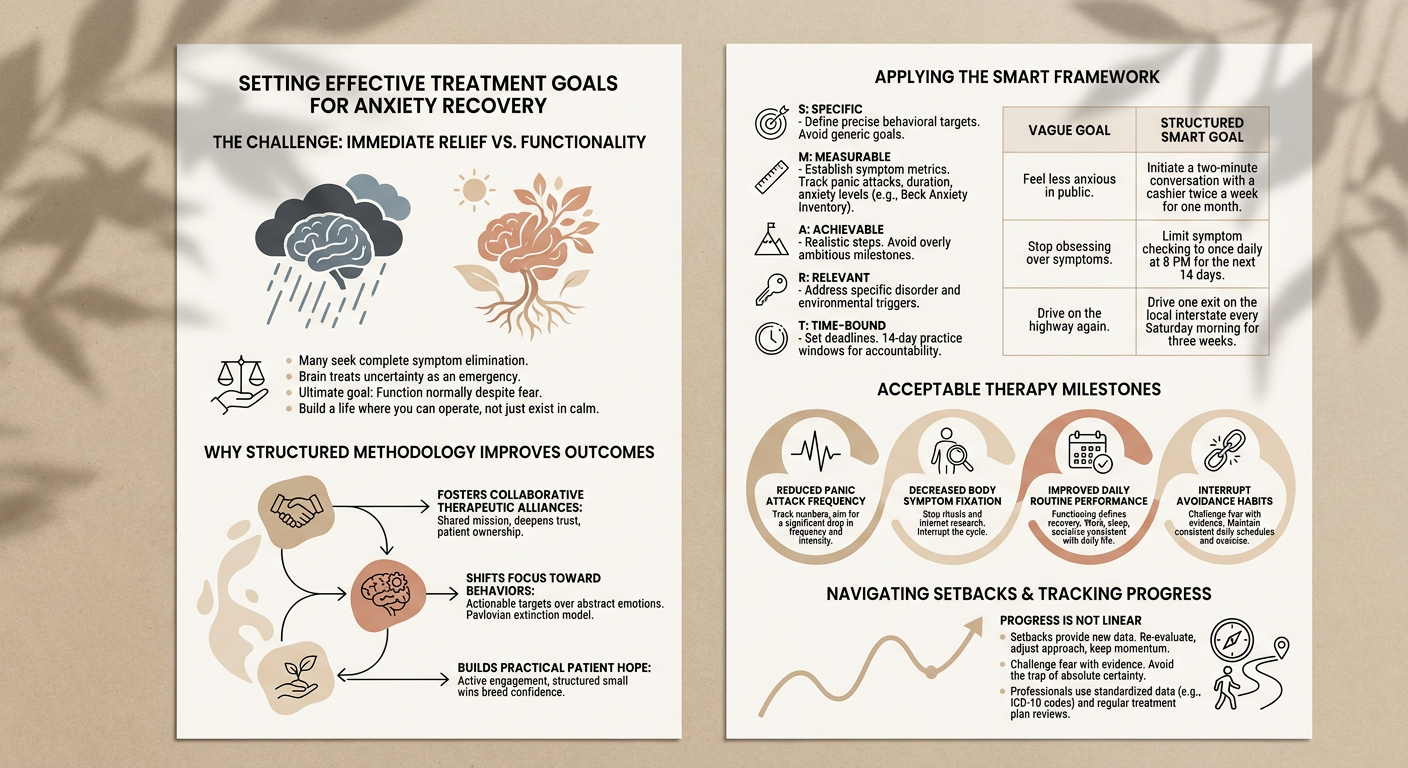
Health anxiety is one of those particularly challenging conditions where your brain treats uncertainty like an emergency. When you demand a life entirely free of anxious thoughts, you accidentally train your nervous system to stay on permanent high alert.
The ultimate objective isn’t finding a state of perpetual calm.
It’s building a life where you can function normally even while the fear exists.
Why does structured methodology improve clinical outcomes?
Aimless talking rarely treats clinical anxiety well.
Without a defined treatment goal, therapy easily devolves into a weekly venting session where patients leave feeling temporarily validated but fundamentally unchanged.
Fosters collaborative therapeutic alliances
The American Psychological Association consistently notes that successful recovery requires intense cooperation. A mental health professional cannot simply hand down directives from on high and expect miraculous compliance.
When therapists and patients align on a shared mission, the therapeutic alliance deepens.
The patient takes ownership. They help shape the agenda.
This mutual respect creates the foundation for every generalized anxiety disorder intervention that follows.
Shifts focus toward behaviors
Abstract emotional goals are notoriously slippery.
“Feeling happier” or “worrying less” gives a patient absolutely nothing to actually do on a Tuesday afternoon when panic strikes.
Instead, clinical researchers push for behavioral targets.
Successful goal setting shifts the spotlight away from the emotion. It demands action.
Exposure-based interventions follow a Pavlovian extinction model. You deliberately approach the scary thing, you sit comfortably with the intense physical discomfort, and you let the nervous system slowly recalibrate its baseline.
You change the response.
Builds practical patient hope
Hope plays a massive role in recovery.
We aren’t talking about blindly optimistic motivational posters or toxic positivity.
Practical hope means recognizing that change remains possible even if the process takes months. Evidence shows that active engagement in cognitive behavioral therapy significantly increases patient optimism compared to sitting on a waitlist.
Momentum matters. Small, structured wins breed confidence.
Apply the SMART framework to mental health objectives
Vague goals sabotage progress.
We have to steal a concept from the corporate world and adapt it for behavioral health compliance.
Define specific behavioral targets
You need precise targets.
If your current anxiety experience involves severe health concerns, a bad goal is “stop worrying about my heart.”
A brilliant goal looks entirely different.
Consider the common pitfalls that keep patients unable to make meaningful progress:
- Relying on generic milestones that fail to address the specific anxiety disorder diagnosis.
- Tracking feelings instead of tracking the coping skills used during an actual episode.
- Ignoring the environmental triggers that prompt the avoidance habits in the first place.
A strong objective targets the action. You agree to practice paced breathing for ten minutes daily.
Establish measurable symptom metrics
Progress requires data.
You need to know if the anxiety levels are actually shifting over time.
Using tools like the Beck Anxiety Inventory helps establish a baseline. From there, you track the daily anxiety ratings.
You count the panic attacks.
You measure the duration of an anxious moment.
Set time-bound practice windows
Deadlines create urgency.
Setting a 14-day window to practice a new mindfulness technique forces accountability.
You review the treatment plans at the end of the two weeks. If the intervention did not produce the intended result, you adjust.
| Vague Therapy Goal | Structured SMART Goal |
|---|---|
| I want to feel less anxious in public. | I will initiate a two-minute conversation with a cashier twice a week for one month. |
| I need to stop obsessing over symptoms. | I will limit symptom checking to once daily at 8 PM for the next 14 days. |
| I want to drive on the highway again. | I will drive one exit on the local interstate every Saturday morning for three weeks. |
Acceptable therapy milestones for health and panic disorders
People often assume they must eradicate the emotion entirely to declare victory.
That expectation is a massive trap.
Acceptable therapy goals revolve around behavior, functioning, and skill use.
Reduced panic attack frequency
Aiming for fewer panic attacks provides a highly tangible milestone.
You track the numbers. A drop from four attacks a week to one attack a month represents a massive clinical victory.
The intensity often drops alongside the frequency.
Decreased body symptom fixation
Untreated anxiety essentially forces your brain to treat every minor ache as a catastrophic event.
A symptom appears. You invent a worst-case scenario. You frantically consult Google. You feel brief relief. The cycle repeats.
Recovery means stopping the rituals that feed the cycle.
When you stop treating a random muscle twitch as an instruction manual for an internet deep dive, the illness anxiety disorder loses power.
Improved daily routine performance
Functioning defines recovery.
Can you go to work? Can you sleep? Can you socialize?
You build a life where you can operate normally even while the fear exists in the background.
For example, a child navigating specific developmental hurdles might require strict milestones targeting [ABA Therapy for Autism and Anxiety: Goal Attainment] to improve daily academic and social functioning.
Likewise, professionals trying to reclaim their career momentum often find that exploring [Therapy for Artist Burnout: Reclaim Your Creative Fire: Therapeutic Pathways to Recovery] heavily emphasizes returning to a consistent, productive daily routine rather than waiting for inspiration to strike.
Interrupt avoidance habits and reassurance loops
Excessive anxiety feeds on avoidance.
Every time you run away from a trigger, you tell your brain that the threat was real.
Limit online medical research or AI research
Information spirals are unhelpful for mental health care.
Many patients tell themselves they are just looking for a little clarity. They want one quick answer to settle their nerves {hello dopamine hits!}
Reassurance buys a temporary peace of mind but the bill comes due with interest.
Checking a medical website or engaging in a conversation with AI once inevitably turns into an hour-long scrolling session. Shift the behavior completely.
Maintain consistent daily schedules
An empty day gives an anxious mind far too much room to operate.
When a day lacks shape, the brain happily invents diseases or catastrophes to fill the void.
Staying active redirects attention away from ruminative thought.
Exercise forces the body to do normal physical things, which pulls attention away from irrational fears. Routine creates an anchor.
Challenge fear with evidence
Challenging cognitive distortions requires careful clinical framing.
Forced positivity is clinically counterproductive.
You have to ask yourself a very clinical question. Are you making decisions based on actual evidence or are you just listening to fear?
You can be worried and still refuse to act like you are in grave physical danger. Acting like danger is imminent guarantees the fear stays alive.
The trap of absolute certainty and control in mental healthcare
A need for absolute certainty and control contributes to almost every specific anxiety disorder.
Patients may demand a guarantee that they will never get sick, never embarrass themselves, or never face a sudden panic attack.
The world simply refuses to offer those guarantees.
Aiming for a life where you always feel perfectly safe keeps you stuck in a relentless loop. The brain will endlessly demand new proof of safety.
Recovery requires accepting a degree of uncertainty.
You aim to respond differently to the world around you, even if the fear occasionally flares up.
How do professionals track progress beyond emotional relief?
Mental health professionals rely on structured data to justify ongoing care.
They use standardized diagnostic frameworks to organize anxiety treatment plans. When a provider logs an appropriate anxiety icd 10 code, they establish a permanent clinical record.
Different presentations require specific tracking.
A patient struggling with constant, generalized worry might be tracked under a gad icd 10 f 411 designation. Someone consumed by physical symptoms might have their progress monitored using a health anxiety icd 10 code f 4521 framework.
These aren’t just administrative hoops to jump through.
Proper icd 10 codes map directly to individualized treatment plans. It ensures that every therapy session directly addresses the precise mental health conditions at hand.
Regular treatment plan reviews keep the therapy focused. If the daily anxiety metrics stall, the therapist updates the approach.
What happens when patients face severe panic setbacks?
Progress is never a straight line.
A patient might string together three fantastic weeks and then suddenly suffer a massive panic attack in the grocery store.
This is completely normal.
A setback does not mean the behavioral therapy failed.
It simply provides new data.
Maybe an old trigger slipped through the cracks. Maybe the patient stopped utilizing their coping skills because they felt “cured.”
The key is momentum.
You examine the breakdown. You figure out why the defense failed. You tweak the treatment approach and you keep moving forward.
For individuals struggling with the intense fear of getting behind the wheel, identifying the root cause of a sudden setback is a critical step in mastering [Driving Anxiety Treatment: Therapy and Self-Help Strategies].
FAQ
How often should a treatment plan be updated?
Therapists generally review and adjust goals every few months, or sooner if a patient experiences a major life shift or a severe plateau in symptom reduction.
Can medication replace goal-setting in therapy?
Pills can lower the volume of the anxiety experience, but they cannot teach you new coping skills. Medication and structured therapy work best when paired together.
What if I cannot meet my therapy goals?
Missing a milestone just means the target was too ambitious for the current moment. You simply break the goal down into smaller, more manageable pieces and try again.
Conclusion
Beating back severe panic requires grit, patience, and a willingness to do exactly what your brain desperately wants to avoid.
You have to step out of the moving beyond unstructured emotional processingg.
Unspecified emotional goals do not produce measurable clinical change of a social anxiety disorder or panic condition.
You need targets you can see, measure, and aggressively pursue.
Stop waiting for the fear to completely evaporate before you start living your life. The fear fades only after you prove to your nervous system that you can function despite it.