
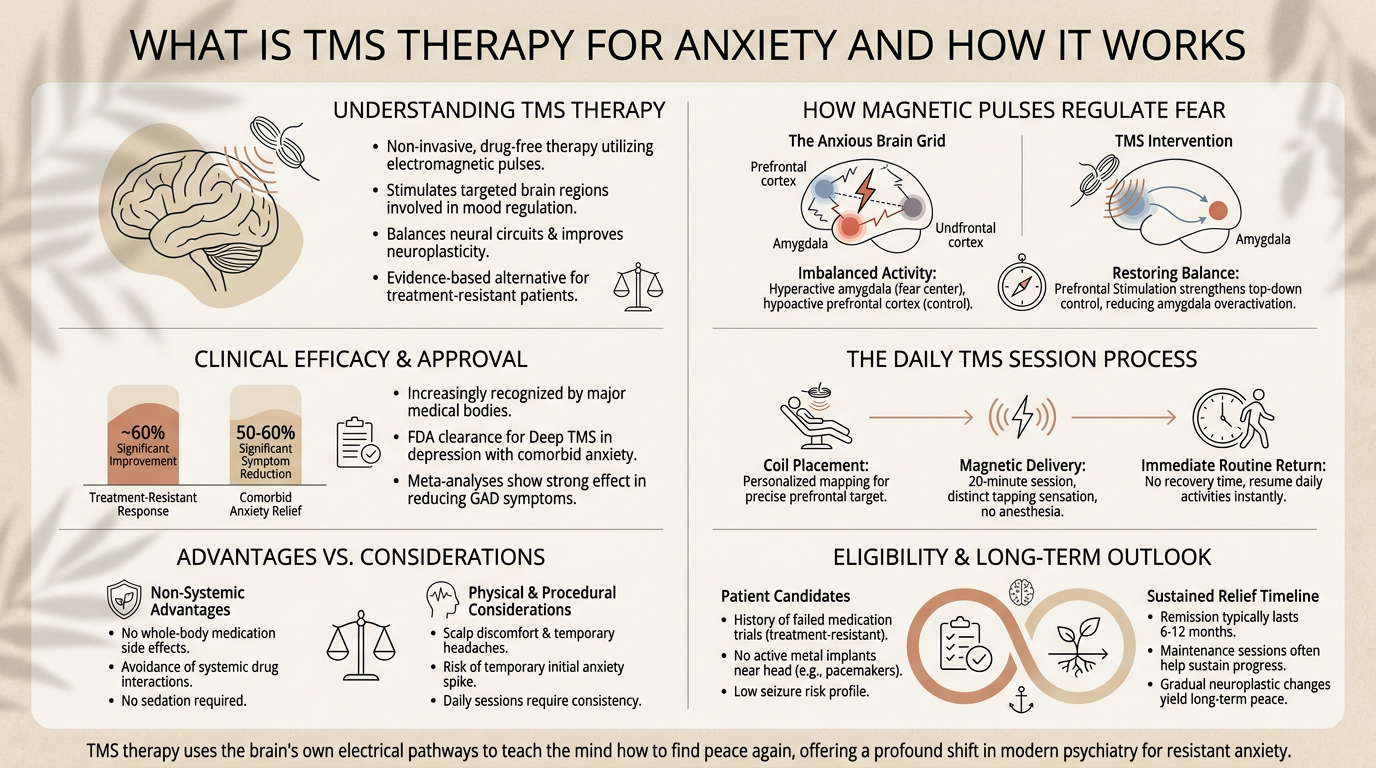
Transcranial magnetic stimulation is a non-invasive, drug-free therapy that uses electromagnetic pulses to stimulate targeted areas of the brain involved in mood regulation and fear response. It works by using neuromodulation to balance brain circuits and improve neuroplasticity. Third-party medical institutions note it is an effective, evidence-based alternative for treatment-resistant patients.
Many of us hit a massive wall when trying to manage persistent anxiety.
You try the standard antidepressant medication. It fails. You try cognitive behavioral therapy. You end up talking in circles. Some days it just feels like we are spinning our wheels trying to support an underperforming nervous system.
Throwing in the towel can be incredibly tempting when you are not seeing any real symptom relief for your hard work.
Enter TMS therapy.
While comparing a magnetic brain device to a miracle cure is an exaggeration, the actual science behind this noninvasive treatment is fascinating.
Okay, so what exactly does magnetic stimulation have to do with reducing persistent anxious thought patterns?
More than you might think.
How do magnetic pulses regulate fear circuits?
Think of your brain as a highly complex electrical grid.
When you have generalized anxiety disorder, certain parts of that grid are essentially drawing too much power. They exhibit overactivation. Other parts are significantly underactive.
TMS uses localized electromagnetic induction to restore functional balance to disrupted circuits.
Prefrontal cortex targets
The treatment starts by focusing on the control center of your brain.
An electromagnetic coil sits comfortably on your scalp. It generates magnetic fields that pass unimpeded right through your skull.
When these fields reach the left dorsolateral prefrontal cortex, they convert into tiny electrical currents. This forces dormant nerve cells to fire.
Amygdala activity reduction
Why does firing up the prefrontal cortex matter for a panic disorder?
Because your prefrontal cortex is the regulatory structure that governs amygdala activity.
The amygdala is the brain’s internal alarm system. It is your fear center. By stimulating the prefrontal cortex, TMS therapy strengthens this region’s ability to exert top-down control over a hyperactive amygdala. Calming this circuit decreases muscle tension, persistent worry, and irrational fear.
Neural plasticity changes
Over time, this is not just a temporary band-aid.
Neuromodulation actively helps regulate neurotransmitters like serotonin. It improves neural plasticity. The brain literally learns how to balance its own circuits again.
Review clinical efficacy and regulatory approval status
It sounds like science fiction.
But independent medical organizations and clinical studies heavily back this up.
If you hope to understand your anxiety treatment options, you cannot afford to ignore the clinical data.
Psychiatric association consensus
Major medical bodies recognize this as a highly successful pathway.
The American Psychological Association notice on FDA approvals highlights how the technology has evolved from a niche idea into a mainstream psychiatric tool. It is increasingly recognized for treatment-resistant depression and obsessive compulsive disorder.
Clearance landscape
Is it officially cleared as an intervention tool for anxiety?
Yes and no. It depends on the specific diagnosis.
While primarily known for treating major depressive disorder, recent advancements changed the game. The FDA in America have approved of Deep TMS to treat depression with comorbid anxiety, proving that these magnetic systems effectively tackle overlapping symptoms.
Patient remission rates
The numbers are actually staggering for people who have tried everything else.
A 2026 meta-analysis showing rTMS produced a strong effect in reducing symptoms of GAD revealed that a full course of treatment significantly drops anxiety scores.
Many patients achieve partial or full remission.
| Clinical Metric | Average Reported Outcome |
|---|---|
| Treatment-Resistant Response Rate | Approx. 60% of patients |
| Comorbid Anxiety Improvement | 50% to 60% significant reduction |
| Remission Maintenance | Typically lasts for several months |
What happens during a standard daily session?
This goes beyond a single-session resolution.
Earning that mental clarity requires patience. Earning long term relief requires repetition.
Coil placement procedures
You walk into the clinic. You sit in a reclining chair.
The TMS provider maps your head to find the exact anatomical target. They place a padded helmet or a heavy wand against your head, usually near the front left side.
Magnetic pulse delivery
Then the machine turns on.
You hear a loud clicking sound. You feel a distinct tapping sensation on your head.
It feels bizarre at first. Like a woodpecker lightly tapping on your skull. But there is no anesthesia. There is no sedation.
Immediate symptom checks
A mental health professional stays nearby.
They monitor you closely during the 20-minute session. They watch for physical reactions. They ask about your comfort level.
Evaluate non-systemic advantages against physical drawbacks
There are no shortcuts in mental health.
Every anxiety treatment has trade-offs. The pros of advanced TMS therapy are frequently emphasised, but we need a realistic look at the cons as well.
Avoidance of systemic drugs
Here is the biggest advantage I actually believe in.
It is completely non-systemic.
Unlike SSRIs or benzodiazepines, you do not get whole-body side effects.
Immediate return to routines
You can drive yourself home immediately.
People describe being able to keep their day-to-day life moving because they do not need recovery time. You leave the clinic and go straight back to work.
Scalp discomfort risk profiles
The experience involves physical discomfort for many patients.
Headaches are common. Scalp discomfort happens. Your jaw might clench during the magnetic pulses.
Why do some individuals experience heightened panic?
When I see people online saying that a TMS session gave them debilitating panic attacks, my first thought is: yeah, that is not surprising as it isn’t entirely risk-free.
Brains do not always take orders politely, as we know!
Brain circuit over-activation
You are blasting a highly sensitive organ with patterned magnetic energy.
Even if the intent of the therapy is to calm a specific circuit, you can accidentally activate it. I have known people who start a new treatment and feel weirdly activated for a stretch before anything improves.
If someone is already anxious to begin with, that activation snowballs fast.
Rapid stimulation parameter risks
Different TMS devices and different protocols yield vastly different results.
Fast, high-frequency stimulation over certain prefrontal targets has been linked to increased panic in some small reports. Sometimes the parameters need to be adjusted to a low-frequency, slower pulse to actually soothe an anxious mind.
Initial emotional turbulence phase
The “worse before it gets better” phase is real.
Anxiety can worsen for some people early on. Mood swings happen. Emotional volatility happens. Even if severe negative outcomes are statistically rare, the experience of a difficult initial phase is genuinely distressing because you are doing daily sessions.
Rarity does not matter to the person currently living through a panic attack.
Assess your eligibility for neuromodulation interventions
Are you a candidate?
You cannot just demand a TMS system because you feel stressed out at work.
Clinical use is strictly gated behind specific medical criteria.
Medication trial failure history
Insurance companies and clinics require proof that you are treatment-resistant.
Typically, this means you have tried and failed at least two to four different antidepressant medications. Your depressive symptoms or generalized anxiety must be stubbornly resistant to standard care.
Active metal implant constraints
TMS involves powerful electromagnetic fields.
- You absolutely cannot have a pacemaker.
- You cannot have aneurysm clips or coils in your brain.
- Bullet fragments or shrapnel near your head will disqualify you.
Any magnetic metal within 12 inches of the treatment coil is a massive safety hazard.
General health prerequisites
If you have a history of seizures, this might not be for you.
The rapid magnetic pulses carry a very small, but real, risk of inducing a seizure. Your doctor will heavily screen your neurological conditions before clearing you.
How long does symptom relief typically last?
You cannot expect your treatments to nail it from the word “go.”
For the roughly 60% of patients who respond well, the relief is substantial. The overwhelming sense of dread fades. Social anxiety becomes manageable. The fear center stops sounding the alarm every five minutes.
Most patients maintain their remission for six months to a year.
Some people require occasional maintenance sessions. A maintenance session to keep the brain circuits properly balanced.
For those looking beyond just standard anxiety protocols, checking out Effective Alternative PTSD Treatments You Should Know About: Transcranial Magnetic Stimulation (Neurofeedback) provides a deeper look into how versatile this technology has become for complex trauma.
Formulate an action plan for escalated symptoms
Here is my personal bottom line:
If one were deciding to do repetitive TMS and has a history of severe anxiety spikes, I would treat the risk of feeling worse as a potential possibility.
I would request for a clear plan from my provider.
What happens if my anxiety escalates on day four? Do we adjust the parameters? Do we switch from the left side of the brain to the right side? Do we pause treatment entirely?
“Push through the pain” is the wrong advice if panic is suddenly taking over your life.
You need a clinic that listens to you.
Conclusion
Finding the right anxiety treatment is exhausting.
There is no single key to success. Your emotional regulation depends on a combination of biology, environment, and finding the right clinical tools.
Transcranial magnetic stimulation is not a universal or immediate solution.
But for people trapped in the relentless cycle of resistant anxiety and medication side effects, it represents a profound shift in modern psychiatry. It uses the very electricity of your brain to teach your mind how to find peace again.