
Last updated on June 18, 2026
Maximizing academic outcomes requires implementing comprehensive stress management interventions to mitigate psychological stress and ensure long-term student success.
Students are experiencing significant and well-documented levels of distress
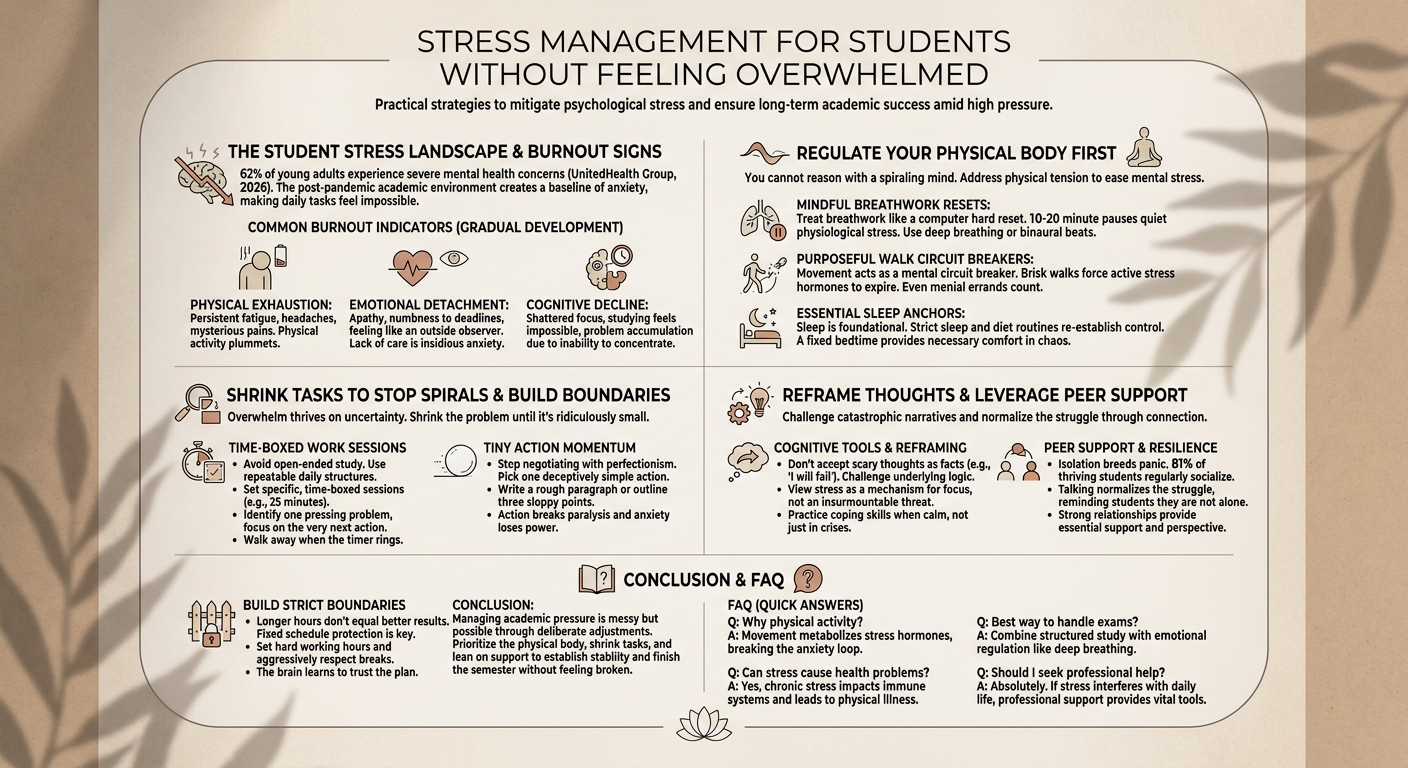
A 2026 report from UnitedHealth Group presents concerning findings, noting that a massive 62% of young adults experience severe mental health concerns.
That is not just a mild case of mild pre-examination anxiety.
The shadow of the covid 19 pandemic still lingers over modern education, leaving many with an underlying baseline of anxiety that makes everyday schoolwork feel impossible.
How do students survive the modern academic pressures without significant psychological cost?
They need actual, practical coping tools that fit into a chaotic day.
What Are Common Burnout Signs?
It rarely happens all at once.
Burnout develops gradually and often without immediate recognition.
Before a student realizes they are in trouble, chronic stress has already rewired their daily habits and physical responses.
Physical Exhaustion Indicators
The body can keep score.
When stress levels spike, students might initially brush off a persistent headache or mysterious stomach pain.
But physical activity plummets.
Their physical fatigue becomes pronounced.
These physical symptoms are glaring warning signs that the stress continuum has shifted from a healthy tension into dangerous territory.
The physiological toll of severe stress is well-documented in extreme medical cases, heavily researched among cancer patients navigating severe illness, but the basic biological stress response applies directly to students facing severe burnout.
Emotional Detachment Signals
Then comes the apathy.
The emotional response flatlines.
A student who once cared deeply about their goals suddenly feels totally numb to deadlines.
They experience feelings of detachment, almost as if they are watching their own life happen from the outside.
This lack of care is an insidious form of anxiety.
Cognitive Focus Decline
Finally, the mind simply refuses to cooperate.
Studying for ten minutes feels like running a marathon.
Problem after problem piles up because basic cognitive focus is completely shattered.
Regulate Your Physical Body First
Here the truth about managing intense anxieties.
You cannot simply think your way out of a panic spiral.
When the brain is screaming, trying to reason with it is a lost cause.
Students must regulate the physical body first to effectively ease the tension.
Mindful Breathwork Resets
Forget the idea that meditation is some mystical personality trait.
Treat breathwork exactly like a hard reset button for a frozen computer.
Taking a short mindful breathing pause for 10 to 20 minutes can completely quiet the physiological stress response.
The American Psychological Association routinely points to grounding techniques like deep breath exercises to immediately recalibrate a spiraling mind.
It stops the doom-scrolling before it devours hours of the day.
Even listening to low-frequency binaural beats while practicing breathing techniques can help regulate a elevated heart rate.
Purposeful Walk Circuit Breakers
Sitting still is sometimes the worst possible option.
Walking acts as a literal mental circuit breaker.
When psychological stress hits an extreme level, taking a brisk walk forces the body to move and allows the active stress hormone loop to finally expire.
Even running menial errands counts as physical activity.
The brain simply becomes less “sticky” after the body gets moving in a healthy way.
Essential Sleep Anchors
Sleep is not a luxury.
It is the foundational anchor of any reliable stress management kit.
According to the Mental Health Foundation, maintaining a strict routine for sleep and diet re-establishes a healthy sense of control when an academic workload feels entirely unmanageable.
When the environment is chaotic, a fixed bedtime provides necessary comfort.
Shrink Tasks to Stop Spirals
PhD-level overwhelm is a unique beast.
It thrives on uncertainty and constant, looming evaluation.
When the workload looks like a mountain, the only logical step is to shrink the problem until it becomes almost ridiculously small.
Time-Boxed Work Sessions
Open-ended study sessions are a trap.
Working “until it is done” is a surefire recipe for burnout.
Instead, students need a repeatable daily structure to keep the pressure manageable.
By setting specific, time-boxed work sessions, they reduce the crushing uncertainty of their schedule.
Let’s look at how tasks should be broken down to avoid paralysis:
- Identify the single most pressing problem in your schoolwork.
- Ignore the final goal and focus solely on the very next action.
- Set a timer for 25 minutes and refuse to look at anything else in your space.
- Walk away the exact second that timer rings.
Tiny Action Momentum
Task paralysis happens because the brain demands a flawless plan before taking step one.
Stop negotiating with perfectionism.
Pick one next action that feels deceptively simple.
Open the document and write a rough initial paragraph.
Outline three sloppy bullet points.
Once the momentum starts, the anxiety instantly loses its power over the situation.
Build Strict Boundaries Around Work
There is a toxic culture in academia that glorifies endless work.
Longer hours do not equal better results.
Sometimes, they just train the brain to expect exhaustion and invite severe health problems.
Fixed Schedule Protection
Students need to build boundaries around their work, not vibes around their productivity.
Working too long “because it has to get done” creates a lingering sense of being trapped.
Setting hard working hours and aggressively respecting breaks makes a person significantly less anxious in the long term.
The brain learns to trust the plan.
Routines for Bad Days
Bad days are part of the deal.
A solid stress management protocol survives those bad days without completely collapsing.
If a student is operating in “can’t cope” mode, they need a fallback routine.
| Routine State | Action Required | Goal |
|---|---|---|
| High Energy | Deep focus blocks | Advance major academic goals |
| Moderate Stress | Standard study hours | Maintain baseline tasks |
| Severe Overwhelm | The “Bare Minimum” checklist | Survive the day without spiraling |
That bare minimum checklist might just be attending class, drinking water, and reading a single page.
That is a highly effective, healthy tension management strategy.
Reframe Thoughts With Cognitive Tools
CBT-style reframing is a practical tool, not a therapy aesthetic.
Students constantly accept scary thoughts as undisputed facts.
“I am going to fail this class” becomes a concrete reality in their minds, triggering an intense emotional response.
A missed assignment feels like a matter of life and death, even though the objective consequences of a poor grade are significantly less severe than the catastrophic narrative suggests.
Instead of accepting that catastrophic narrative, they must challenge the underlying logic.
Teaching students to view stress as a mechanism for increased focus actually improves academic outcomes, rather than treating it like an insurmountable threat.
It takes more than a forced gratitude journal to calm the mind.
It is about actively using coping skills even when things feel relatively calm.
Using healthy techniques only during a crisis means they will likely feel useless when the pressure peaks.
How Do Peers Improve Resilience?
Isolation breeds panic.
When students lock themselves away to study, their anxieties echo off the walls.
A recent American Campus Index survey revealed that 81% of thriving students regularly socialize.
Social support acts as a buffer against psychological stress.
Talking to peers normalizes the struggle.
It reminds students that they are not the only ones feeling crushed by the weight of their goals.
Strong relationships provide essential support and perspective, replacing a feeling of doom with a healthy sense of solidarity.
Why Do Academic Spirals Happen?
The root of the issue is rarely just the schoolwork itself.
Spirals happen because of the terrifying combination of ambiguity and high stakes.
Students fear the unknown.
They worry about the effects of a single bad grade on their entire future.
Some students describe their academic environments as a metaphorical war zone, dealing with anxieties that border on actual ptsd symptoms after a severe academic failure.
When interventions are delayed, that fear morphs into chronic stress.
That is why early intervention is critical.
Taking advantage of university resources—whether that means finding a mentor, utilizing mental health apps, or engaging with campus wellness centers like the Cornell Health programs—can intercept a downward spiral before it hits rock bottom.
A recent meta analysis on student mental health confirmed that structural support systems dramatically improve a student’s ability to cope with academic pressures.
FAQ
Why is physical activity so important for stress relief?
Movement forces the body to metabolize stress hormones, actively breaking the physical loop of anxiety.
Can severe stress cause actual health problems?
Yes. Chronic stress heavily impacts the immune system and can lead to genuine physical illness over time.
What is the best healthy way to handle an upcoming exam?
Combine action-based problem solving, like structured study times, with emotional regulation techniques, like deep breathing.
Should students seek professional help?
Absolutely. If stress is heavily interfering with daily life, securing outside help or exploring formal stress management interventions is a smart, efficient move. While you might not need clinical hypnosis, professional therapy provides vital tools for long-term resilience.
Conclusion
Managing academic pressures is a messy, imprecise science.
There are no magic tricks.
Just practical, deliberate, practical adjustments.
By prioritizing the physical body, shrinking impossible tasks, and leaning on social support, students can navigate the chaos of school.
They can establish stability.
And they can actually finish the semester without feeling completely broken.