
Last updated on June 17, 2026
Many of us feel that familiar, dreadful tightening in the chest during a stressful day, wishing we had a simple off switch for our racing minds.
Why not leverage the actual mechanics of human biology to help support us instead?
With a little practice, conscious airflow can become a highly effective regulating mechanism for the nervous system.
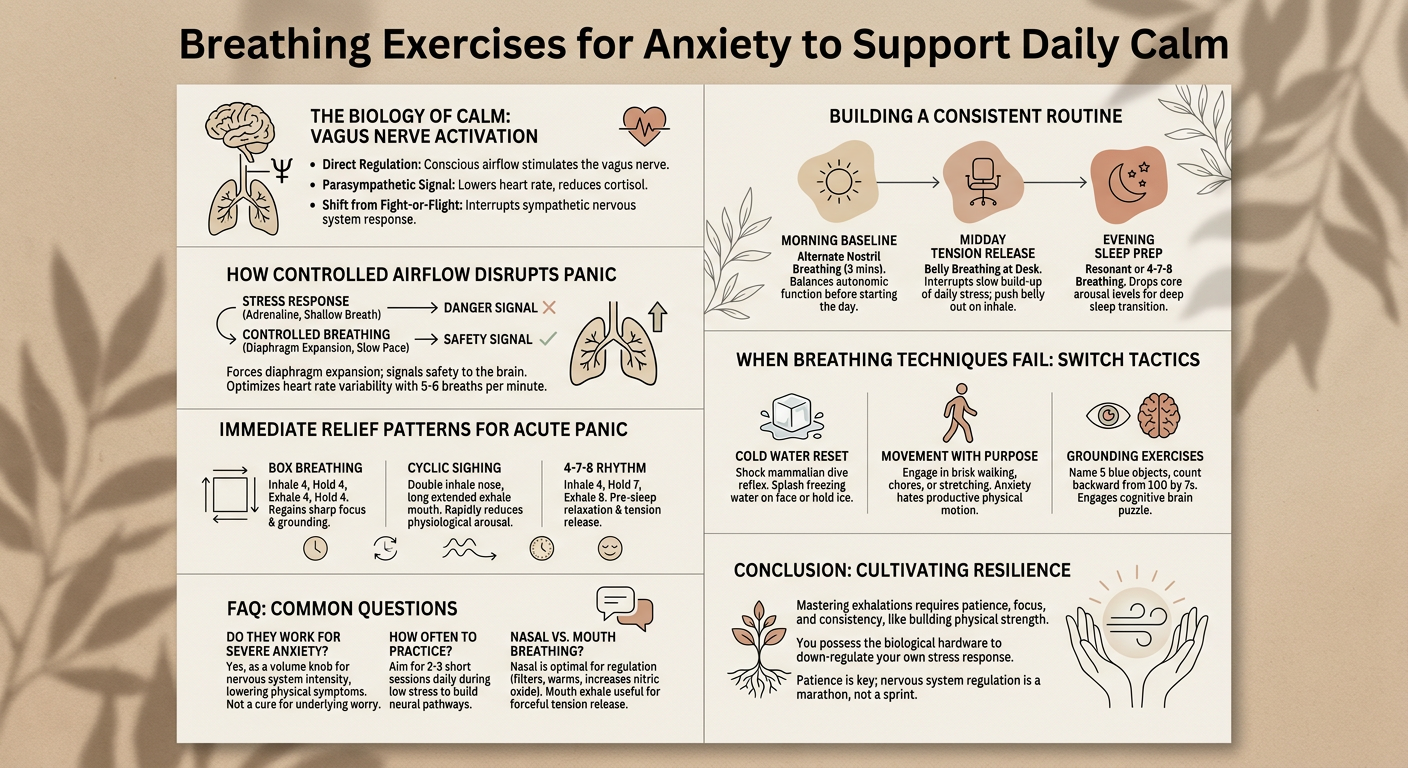
Breathing exercises for anxiety support daily calm by directly stimulating the vagus nerve, which signals the parasympathetic nervous system to lower your heart rate and reduce cortisol production.
The sheer physical exhaustion that comes from living in a constant state of physiological arousal is difficult for the average person to wrap their head around.
From enduring hours of a racing heart while sitting perfectly still at a desk to stomach-churning nervous energy that ruins our sleep, the intensity of an anxious brain constantly looking for danger is absolutely staggering.
Does a breathing practice have to do with fixing this?
More than you might think.
While comparing a simple deep breath to clinical therapy or medication may seem ridiculous, consider the physical struggles that anxious people face:
- Some days it just feels like your chest is in a vice, essentially xpending significant effort simply to breathe comfortably.
- Allowing the panic episode to progress without intervention can be incredibly tempting when you feel lightheaded and disconnected from reality.
- Overcoming that sudden spike of state anxiety before a big meeting can feel like staring up at a giant.
Anxiety forces your body into survival mode to prepare for a threat that often does not actually exist.
But do you have to stay stuck in that loop?
No.
And neither should you.
It is time to take your stress management out of autopilot.
How?
How Does Controlled Airflow Disrupt The Fight-Or-Flight Response
Anxious responses are not simply conscious choices: they are triggered as a result of millions of years of evolutionary survival mechanisms.
Likewise, effective stress management strategies do not fall from the sky: they are created as a result of understanding your own biology.
When a stressor hits, your sympathetic nervous system pumps out adrenaline. Your breathing rate increases, becoming shallow and trapped in the upper chest.
This rapid breathing signals your brain that you are in immediate danger.
If your anxiety is screaming that you are under attack, does that mean you have to believe it?
Of course not. Instead, you can learn to manually interrupt the threat response.
Specific breathing techniques force the diaphragm to expand fully, sending a mechanical signal up the vagus nerve to the brain. This tells your nervous system that the environment is safe.
According to a recent comprehensive review showing how paced slow breathing directly reduces anxiety in daily life, shifting your respiratory rate to about five or six breaths per minute significantly optimizes heart rate variability.
Think of fine-tuning your exhalations as simply part of the process, much like athletes have to train for hours on end to recreate their best performances.
The more time you spend practicing a calming breathing technique when you are relatively relaxed, the more opportunities you have to grow your resilience when panic actually strikes.
Execute Immediate Relief Patterns For Acute Panic
Dozens of different breathing exercises exist in the wellness space.
In fact, it seems like new mindful breathing variations are constantly being promoted year after year.
Why?
Human physiology adapts. As researchers uncover new data on autonomic stress sleep cycles and heart rate variability, behavioral health experts adapt accordingly.
If you hope for your coping skills to stay effective, you need a few distinct patterns in your within a broader stress management repertoire.
| Technique | Breathing Pattern | Best Used For |
|---|---|---|
| Box Breathing | Inhale 4, Hold 4, Exhale 4, Hold 4 | Regaining sharp focus and grounding |
| Cyclic Sighing | Double inhale, long extended exhale | Rapidly reducing physiological arousal |
| 4-7-8 Rhythm | Inhale 4, Hold 7, Exhale 8 | Pre-sleep relaxation and tension release |
The Box Breath Pattern
Many tactical professionals rely on this highly structured method to stay grounded under immense pressure.
You inhale deeply for a count of four, hold the air in your lungs for four, exhale smoothly for four, and hold empty for four.
This controlled breathing exercise forces your mind to count, giving your cognitive brain a concrete task that distracts from anxiety thinking.
The Cyclic Sigh Method
There are physiological reasons why humans naturally let out deep sighs when relieved.
Two quick inhalations through the nose followed by a prolonged, audible exhalation out the mouth helps offload excess carbon dioxide.
Scientific data regarding how cyclic sighing and nervous system balance are connected indicates that prioritizing the exhale is the fastest way to manually trigger a calming effect.
The 4-7-8 Rhythm
Some people need to force their bodies into rest mode.
By holding the breath for seven seconds and exhaling for eight, you create a mild, safe change in oxygen and carbon dioxide ratios. This slows down the heart rate noticeably.
It acts like a natural tranquilizer.
Build A Consistent Nervous System Regulation Routine
It can take years of unlearning bad habits before your baseline anxiety permanently lowers: building a resilient nervous system requires extreme patience.
You cannot always expect your deep breathing exercises to interrupt the panic response from the word “go.”
Remember: nervous system regulation represents a marathon and not a sprint.
Think about how long-distance runners kick it into high gear at the end of the race: the fact that they were ever struggling early on becomes irrelevant.
For example, it is completely fine to feel awkward or distracted during your first few sessions of mindfulness meditation.
Many people get laser-focused on finding the perfect breathing style that they ignore essential elements of daily consistency.
In reality, ensuring that you build a base habit of checking in with your breath represents the difference between a panicked reaction and a measured response.
Morning Baseline Setup
Start your day on a yoga mat or sitting upright on the edge of your bed.
Cortisol naturally spikes in the morning to wake you up, but for anxious individuals, this feels like instant dread.
Spend three minutes practicing alternate nostril breathing. Closing off one nostril while inhaling and switching for the exhale balances autonomic function before you even look at your phone.
Midday Tension Release
Your posture at your desk directly impacts your lung capacity. Slumping compresses the diaphragm, leading to shallow breathing.
Take a midday break. Sit back in your chair, place your palms on your stomach, and push your belly out on the inhale.
This simple calming technique interrupts the slow build-up of daily stress.
Evening Sleep Preparation
When it is time for bed, respiratory control is vital for transitioning into deep sleep.
Resonant breathing or the 4-7-8 method drops your core arousal levels, signaling to your brain that the daily activities are officially over.
Why Do Specific Respiratory Rhythms Trigger More Stress
Building.
Monitoring.
Testing.
Breathwork represents a lot of mental effort initially.
There are plenty of people who do not benefit from traditional deep breath instructions.
Sometimes, focusing intently on your breathing rate backfires completely. You might find yourself locked in a spiral of performance pressure, thinking, “Am I breathing right? Why do I not feel calm instantly?”
That kind of hyper-vigilance adds stress instead of reducing it.
If you are already prone to panic or tend to interpret body sensations as immediate danger, drawing intense focus to your chest can make you feel lightheaded. Taking too many rapid deep breaths pushes you into hyperventilation territory.
My honest perspective on this is very straightforward.
If breathing exercises make you more self-conscious or more panicky, that is not a failure on your part. It is simply your nervous system saying, “not this tool right now.”
There is no need to force a treatment plan that makes you feel worse.
The energy spent digging for a sense of calm through a frustrated breathing habit could be spent utilizing a completely different intervention.
Knowing the limits of your own body can take you much further than blindly following generic advice.
Switch Tactics When Breathing Techniques or Airflow Management Fails
Many wellness advocates live by the mantra of “just take a deep breath.”
You should treat your anxiety with a bit more nuance than that.
If you are spiraling, sometimes you need a hard sensory switch rather than a gentle mindfulness activity.
Perhaps the biggest mistake you could make is sitting quietly in a chair, continuing to panic while trying to force a deep sigh.
Yes, it can be frustrating to realize a breath focus technique is not working.
But that does not mean you should let the panic escalate without intervention.
Use a cold water temperature reset. Splash freezing water on your face or hold an ice cube in your palms. This shocks the mammalian dive reflex and effectively interrupts the physiological arousal.
Engage in movement with a purpose. Take a brisk walk, do household chores, or stretch aggressively. Anxiety hates being ignored, but it also hates being paired with productive physical motion.
Try grounding exercises that involve your eyes and brain rather than your lungs. Naming five blue objects in the room or counting backward from one hundred by sevens gives your cognitive brain a very specific puzzle to solve.
For those looking at a broader spectrum of care, exploring effective alternative PTSD treatments you should know about, including breathwork techniques, often reveals that combining cognitive unloading with physical grounding provides the best outcome.
Keep going and keep experimenting. If a specific meditation is broken for you, figure out why and swap it for something concrete.
What Is The Expected Timeline For Symptom Relief
From baseline health to underlying health condition variables, there are many pieces to successful stress management.
For starters, let us think about:
- The frequency of your practice during non-anxious times.
- The severity of your baseline anxiety and negative affect schedule.
- The presence of any heart problem or respiratory limitation that changes how you experience an inhale.
- The environment you practice in, whether a quiet room or a crowded train.
Here is a somewhat unpopular reality.
The success of your anxiety management does not lie within one single session.
It is the elements combined over weeks and months that determine your overall positive affect.
Unfortunately, chronic stress requires sustained intervention over time.
Similarly, many people practice for a few days, experience a minor panic attack anyway, and assume the techniques are completely useless.
Fortunately, you always have the opportunity to recalibrate.
You might notice the physical symptoms dulling slightly after just ten minutes of equal breathing. You might notice a drop in your resting heart rate after two weeks of daily practice.
Stay organized with your routine. Stay diligent in your check-ins.
Your efforts will compound.
FAQ
Do breathing exercises actually work for severe anxiety? Yes, they do work by acting as a volume knob for the nervous system. They lower the physical intensity of symptoms like a racing heart, which often gives your brain enough space to stop the panic loop, even if they do not magically cure the underlying worry. However, if it persists, this warrants an assessment by a qualified mental health counsellor or psychotherapist.
How many times a day should I practice a breathing technique? Aim for two to three short sessions daily during moments of low stress. Practicing a five minute breathwork exercise when you are already calm builds the neurological pathways needed to deploy the skill effectively during an anxious situation.
Is nasal breathing better than breathing through the mouth for anxiety? Inhaling through the nose filters and warms the air while also increasing nitric oxide production, which helps dilate blood vessels and improve oxygen absorption. Exhaling through the mouth is often utilized to forcefully expel tension, but nasal breathing is generally optimal for steady regulation.
Conclusion
While fighting off daily panic is not exactly an Olympic sport, there are serious parallels between physical endurance and the mental challenges faced by chronically stressed individuals.
The modern world moves incredibly fast and is difficult to maneuver in the wake of constant digital noise and professional demands.
Much like building physical strength, learning to master your exhalations requires patience, focus, and consistency as key virtues to help ensure your success.
You have the biological hardware required to down-regulate your own stress response.