
Last updated on April 14, 2026
Key Takeaways
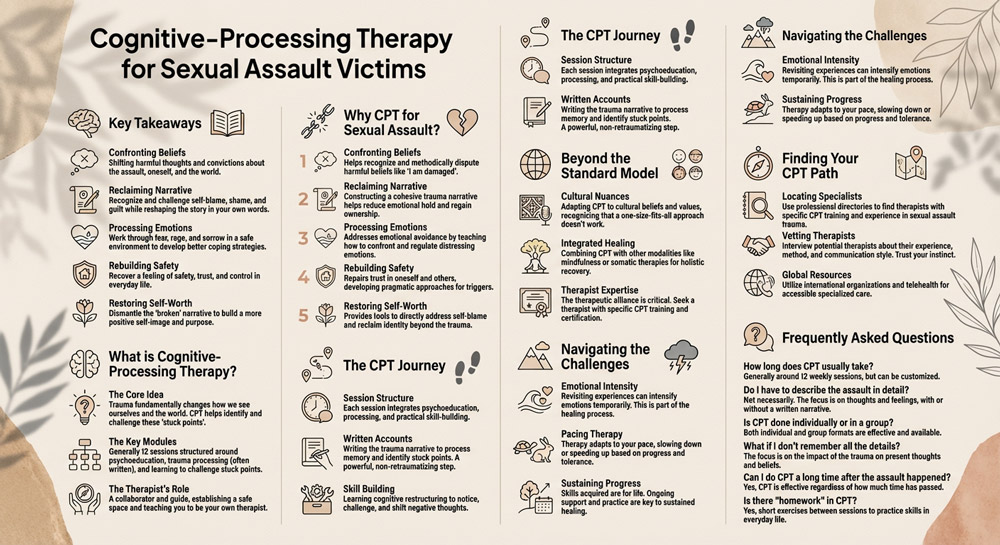
- Cognitive-Processing Therapy, or CPT, is a potent instrument to assist you in confronting the harrowing cognition and convictions that trauma instigates. It helps you shift your thinking about the assault, yourself, and the world.
- A key component of this therapy is to retake your story and to retake your power from the trauma. You’ll learn to recognize and challenge self-blame, shame, and guilt while reshaping the story in your own words.
- You can’t really heal by avoiding. CPT creates a secure and organized environment to work through emotions such as fear, rage, and sorrow, assisting you in developing better coping strategies.
- This isn’t just TALK — it’s real, practical skills for life-long cognitive management. You’ll discover how to recover a feeling of safety, trust, and control in your everyday life.
- Finding a therapist who’s trained in CPT and with whom you connect is crucial to your healing process. This is a collaborative journey, and you deserve a guide who holds a safe container for you to undertake this brave work.
- Navigating CPT can be difficult. It’s a tried and true approach to alleviating trauma symptoms and taking back your life. Recall that healing is non-linear and each step forward is a triumph.
Cognitive-Processing Therapy (CPT) is a standardized psychotherapy for people after trauma. For female survivors of sexual assault, it takes aim at the agonizing, repetitive thoughts—what therapists term “stuck points”—that can keep us caught spinning long after the incident.
It’s a way to begin facing down the invisible voice that keeps telling us it was our fault. In this post, we’ll break down how this framework assists survivors in deconstructing those beliefs and reclaiming their narrative, one brave conversation at a time.
What is Cognitive-Processing Therapy?
Cognitive-Processing Therapy, or CPT, is a specific and highly structured form of trauma-focused therapy. It was originally developed to treat the symptoms of posttraumatic stress disorder (PTSD) in rape victims. The entire approach is built to help survivors address the powerful, often negative, thoughts and beliefs that take root after a traumatic event.
It is an evidence-based treatment that provides a clear path toward reducing psychological distress and rebuilding coping skills, moving from just surviving to actively healing.
The Core Idea
CPT operates on a simple and profound premise: a traumatic event can fundamentally change how we see ourselves, other people, and the world. It can shatter our fundamental beliefs about security and faith.
It’s about recognizing these maladaptive posttraumatic thoughts, or as they’re referred to, ‘stuck points,’ and actively challenging them. These are the rumination that holds us stuck in the trauma, such as ‘I am to blame’ or ‘The world is entirely unsafe.’
CPT offers a space for survivors to work through the trauma and, more significantly, the sense they’ve made of it. It’s not about deleting the memory but about transforming its hold on you. By changing these unhelpful beliefs, the therapy seeks to promote a healthier and more robust recovery.
The Key Modules
The therapy is generally provided across 12 weekly sessions and is structured around a number of core components that are meant to be synergistic. It starts with psychoeducation, teaching you about PTSD, Complex PTSD (CPTSD) and how CPT operates, a key initial step in de-mystifying your own responses.
A key component, for example, is trauma processing — often by writing full trauma narratives — so that you can face the memory in a controlled, therapeutic environment. You write an impact statement to examine how the trauma has impacted your beliefs.
From there, the real work begins: learning to identify and challenge your stuck points across critical life themes. This is where we have brave discussions about safety, trust, control, power, esteem and intimacy, methodically breaking down the distorted beliefs the trauma imbued.
The Therapist’s Role
In CPT, your therapist is your guide and collaborator, not a couch. Their job is to establish and maintain a safe, supportive therapeutic space where this very hard work can occur. They’re in the trenches with you, but they have the map.
Your therapist actively teaches you to be your own therapist. They assist you in identifying the exact thoughts that are hurting you and then provide you with the cognitive tools to challenge and reframe them.
They supply the psychoeducation, lead you through the exercises, and bring the experience to bear in handling the nuances of your recovery process.
Why CPT for Sexual Assault?
CPT is a potent, regimented treatment for the particular aftermath of sexual assault. The trauma of such an event isn’t merely a memory; it’s a fissure in one’s being and worldview. It frequently results in the pervasive residue of shame, guilt, and self-blame.
CPT directly confronts these toxic narratives, helping survivors regain a sense of control and empowerment. Statistically significant reductions in PTSD and depression symptoms in female survivors, for example, are confirmed by research that affirms its effectiveness.
1. Confronting Beliefs
Following a trauma, our brain invents narratives to help us comprehend the turmoil. For many survivors, these stories curdle into negative beliefs: “I am damaged,” “I can’t trust anyone,” or “It was my fault”.
These thoughts, or stuck points, are not character defects. They are the mind’s effort to manage an unmanageable incident.
CPT offers a structure to recognize and methodically dispute these beliefs. It is a process of testing these thoughts for and against, helping to build a more balanced and realistic view of the trauma and its consequences.
2. Reclaiming Narrative
One of the key elements of CPT is constructing a cohesive trauma narrative, usually in the form of written trauma accounts. This isn’t about re-traumatization. It’s about reclaiming power.
When trauma occurs, the memory can seem fragmented and invasive, commandeering the here and now. Writing it down, giving it a beginning, a middle, and an end helps you process those memories and diminishes their emotional hold.
By situating the trauma within a broader narrative, a survivor ceases to be about it. They regain ownership of their life.
3. Processing Emotions
Trauma instinctively induces emotional avoidance or numbing. It can seem easier to numb than to confront the wrenching depths of sorrow, rage, or terror.
CPT directly addresses these “coping deficits” and trains survivors how to confront, recognize, and regulate distressing emotions without becoming overtaken.
It helps distinguish between appropriate emotions, such as anger at an offender, and inappropriate ones, such as guilt or shame. This work develops healthier coping strategies, making space for emotion instead of stifling it, which is necessary for sustained recovery.
4. Rebuilding Safety
Sexual assault destroys our basic sense of safety. The world can all of a sudden seem like a threatening environment.
CPT addresses these fears and anxieties head-on. It assists survivors in creating pragmatic approaches for handling triggers and encountering threatening feeling situations.
In doing so, CPT repairs trust—initially in yourself and in your judgment and ultimately in others.
5. Restoring Self-Worth
One of the most damaging impact from sexual assault is the erosion of self-worth.
CPT gives you tools to directly address self-blame and rebuild a sense of worth. It helps survivors identify their own power and the deep courage they have shown.
By dismantling the ‘broken’ narrative, CPT helps victims build a more positive self-image, reclaiming their identity and purpose beyond the trauma.
The CPT Journey
Well, CPT is a gold-standard treatment for PTSD. It’s not a quick fix, but a journey that is structured and collaborative. Usually spanning 12 weekly sessions, it’s a collaboration between you and your therapist. This is work you must do, work you must roll up your sleeves and execute to take back your story. The therapist is a Sherpa, and you’re the one doing the climbing.
Session Structure
Each session is a healing work space — integrating psychoeducation, processing, and practical skill-building. We begin with the ‘why’—how trauma affects our mind and heart, leading to those unseen wars we wage. This isn’t just talk therapy, it’s an active process.
We debrief assignments from the prior week, troubleshoot challenges, and introduce new skills. My objective is to create a toolbox you can deploy beyond the therapy room, translating insights into practical resilience. It’s a structured conversation with a clear purpose: to help you move forward.
Written Accounts
As a component of this, you write the trauma narrative. You could be reading this and saying wow that sounds really hard. It is. It’s the most potent segment of the therapy.
It’s not to re-traumatize, it’s to let your brain process the memory, both the facts and the feelings that became lodged. By articulating the experience, you start to view it externally.
You map out the stuck points, the bad posttraumatic thoughts that keep you pounding to the hurt. This narrative becomes a record we co-create, a blueprint of where the repair must take place.
Skill Building
CPT is ultimately a skills-building approach for tackling the warped beliefs trauma scribbles in its wake. We learn cognitive restructuring, a systematic approach to noticing, challenging, and shifting negative thoughts about the trauma, yourself, and the world.
For example, we take apart self-blame, shame and confront unhelpful safety beliefs. These skills specifically target the negative cognitions that commonly fuel both PTSD severity and issues such as sexual distress.
It’s important to know that these are skills you practice. It’s the daily work that reorients your brain, helping you curb symptoms and develop a strong sense of self-efficacy.
As studies indicate, CPT diminishes PTSD and depression symptoms with impacts enduring well beyond the conclusion of therapy. It can potentially rewire the pathways underpinning other types of suffering. You are not merely coping; you are rewiring your response to the past.
Beyond the Standard Model
Cognitive Processing Therapy (CPT) is an evidence-based, time-limited therapy, usually conducted over a dozen or so sessions. We’ve seen it work, taking the PTSD out of traumas that happened as little as 3 months ago or as far back as 65 years ago. Humans are not standard models. Flexibility is necessary in the road to recovery.
The vanilla framework for CPT can and must be modified for clients with complex trauma histories or comorbidities. We recognize that support can appear differently for each individual, which is why CPT is offered in groups and via telehealth, making it accessible. It’s not in isolation; it can be combined with other therapies to heal the entire individual.
Cultural Nuances
Trauma is personal, yet our processing of it is cultured. We cannot kid ourselves that a one-size-fits-all approach is going to work for everyone. Cultural beliefs about gender roles, family honor or shame can deeply affect a survivor’s “stuck points,” the very cognitions CPT seeks to modify.
For others, the thought of vocalizing sexual assault is a cultural taboo that further complicates recovery. This is a heavy burden for the therapist. They can’t be just clinically trained. They have to be culturally competent and sensitive, ready to learn and adapt their approach.
After all, adapting CPT to a survivor’s culture isn’t just polite. It is a clinical imperative to deliver the therapy and to deliver it well.
Integrated Healing
Healing is not merely a cognitive event; our bodies keep the score. CPT is robust in assisting us to reframe the story in our head. Combining it with other modalities provides a more well-rounded way forward.
Imagine integrating CPT’s formatted processing with the grounding presence of mindfulness, the somatic release of yoga, or the non-verbal expression of art therapy. It’s not about tacking on wellness fads; it’s about accepting that an individual’s physical and emotional wellness are linked.
Other studies indicate CPT may enhance sexual functioning, and the integrated perspective that reunifies a survivor with her body can only amplify that healing. It assists you in transitioning from surviving the memory of the trauma to once again feeling whole.
Therapist Expertise
When seeking assistance, we have to go beyond a laundry list of offerings. It is important to locate a therapist who has specific training and certification in CPT. I want to be very clear: credentials are not enough.
The one thing above all else in effective therapy is the relationship. How safe does the survivor feel? Are they seen? Got it? The goal of a therapist is to provide a loving, supportive, and judgment-free environment for that hard work to occur.
If you’re a leader vetting mental health partners for your folks, inquire about their therapists’ experience, and ask how they foster a powerful, human connection. A robust therapeutic alliance isn’t a perk. It’s critical.
Navigating the Challenges
Cognitive Processing Therapy (CPT) is a courageous act. Let’s be clear: this path is demanding. Working through trauma memories can cause symptoms to temporarily intensify. That’s not a failure; it’s an indicator that you’re peeling back some deep-seated pain.
With determination, strong self-care, and the proper support, this difficult period yields powerful, permanent progress. It’s about getting through the tempest to discover the tranquility.
Emotional Intensity
CPT requires you to revisit experiences you have every reason to avoid, which can create a flood of intense emotions. This is the heart of the “invisible battle.” A skilled therapist’s role is to create a safe container for these feelings, ensuring you are not alone.
They guide you in using coping skills to regulate these powerful emotions, both during sessions and in the quiet moments after. CPT has been successfully adapted for deeply sensitive populations, including female rape victims and Bosnian refugees, proving that even profound pain can be managed within a structured, empathetic framework.
This emotional intensity is not a sign something is wrong; it is a sign the work is happening. It is a normal part of reclaiming your story.
Pacing Therapy
Your heal-up isn’t on some corporate schedule. Human-first means therapy adapts to you, not vice versa. Depending on your advancement and tolerance, a therapist will slow down or speed up treatment, knowing CPT’s structure is intentionally flexible.
It can be delivered in small groups or individually and in different durations, which is why it works whether the trauma was three months or sixty-five years ago. This flexibility has been key for clients with a range of needs from those with cognitive challenges to those seeking therapy in Spanish or Chinese.
The objective is to coax stuck points into non-stuck positions without re-traumatizing. It’s a caring method necessary to treat.
Sustaining Progress
CPT’s work reaches well beyond the therapist’s office. The skills you acquire become part of your intellectual arsenal for life.
To stay on track means to keep catching old thought patterns when they rise and actively practice cognitive restructuring and new coping strategies. For some, those booster sessions or support groups are an essential touchstone.
This ongoing support can be just as powerful by videoconference as in person. Sustained healing is a challenge that demands an ongoing commitment to healing and self-care.
Finding Your CPT Path
Seeking a therapist is a brave dialogue with yourself. It’s a recognition that you’re worthy of assistance. Your way out is to find your CPT guide, someone to help craft a safe container as you navigate the twists and turns of trauma. Your recuperation is important, and the appropriate therapeutic partnership is the basis for that effort.
Locating Specialists
Discovering a CPT-trained therapist is an essential initial step. Begin with the online directories of professional bodies, like the American Psychological Association or local psychological societies in your country. These databases let you filter by specialty, so you can identify practitioners with specific experience in trauma and CPT.
When you shop, seek past a generic “trauma-informed” branding. You want someone certified in CPT. This matters because CPT was initially created for treating PTSD in sexual assault victims, and its rigid 12-session format necessitates specific expertise to be successful.
Never discount a referral. Your PCP or trusted healthcare provider can often refer you to vetted mental health professionals in their network. This introduces an element of faith into your quest from the get-go.
Vetting Therapists
Finding the right person is more than credentials; it’s about finding a human connection. You can interview potential therapists. Bring questions to an initial consultation, even if it’s a short call or an initial session.
Inquire point blank about their experience utilizing CPT with sexual assault survivors. Request that they outline their method and what you should anticipate. You might read this and say that sounds confrontational, but it’s your right. It’s about your safety and your recovery.
It’s worth talking about their communication style, availability, and fees to make sure the practicalities fit you. If the connection doesn’t feel right, no problem, say thanks and keep on looking. Believe that instinct.
Global Resources
Assistance is not limited by distance. Most international organizations have resources and hotlines for survivors of sexual assault, offering urgent, confidential assistance wherever you are. These can be a lifeline as you look for long-term care.
Telehealth’s growth has brought specialized therapies like CPT more within reach than ever. Several reputable therapists provide online CPT courses and virtual sessions, eliminating location as a barrier to treatment.
CPT research has been underway since the early 1990s, and with that, delivery methods have adapted, including longer 26-session hybrids of group and individual work. These materials make certain that no one has to make this path alone.
The First Step in Reclaiming Your Story — The Curious Bonsai
The journey through trauma isn’t about burying the past. It’s about finally knowing how to hold the story in a different way, so it no longer controls your destiny. You might be reading this and feeling the burden. That’s all right. No magic bullet. CPT is a brave dialogue with yourself, facilitated by a process that allows you to take control of your own story.
One life altered sends out ripples. Each of us who somehow manages to get well nurtures an environment of increased psycho-social resistance. Making that first move is a powerful step of courage. It is a calm, ferocious statement that your health counts and your life remains yours to craft — and The Curious Bonsai’s licensed therapists are here to help you make it.
You don’t have to do this alone.
Frequently Asked Questions
How long does CPT usually take?
CPT is a manualized therapy that generally spans around 12 weekly sessions. The sessions can be customized to your individual healing process and pace.
Do I have to describe the assault in detail?
Not at all. The emphasis is instead on the thoughts and feelings that followed. You and your therapist determine the right approach for you, with or without a written narrative.
Is CPT done individually or in a group?
CPT works just as well one-on-one as in groups. It’s up to your comfort and availability. Your therapist can assist you in determining what is appropriate for you.
What if I don’t remember all the details?
CPT instead centers on the impact the trauma has on your thoughts and beliefs in the present. The therapy deals with what you do remember and how you feel now.
Can I do CPT a long time after the assault happened?
Yes, by all means. CPT works for trauma, sexual or otherwise, that took place months ago, years ago, or decades ago. It’s never too late to begin to heal.
Is there “homework” in CPT?
Yes, CPT involves short exercises between sessions. These drills assist you in taking the tools you gain in therapy to your everyday existence, which is crucial for progress.

Michelle Mah is a Singapore-based psychotherapist and executive coach specialising in burnout, perfectionism, and trauma recovery for high-functioning and high-achieving women. She is the founder of The Curious Bonsai Therapy & Coaching.
Michelle holds a Masters of Counselling (M.Couns) and is certified in a diverse range of modalities, including BodyTalk, the Gottman Couples Method, perinatal mental health, Trauma of Money, CliftonStrengths, and Neurolinguistic Programming (NLP).
Instagram: https://www.instagram.com/michellemah._/
LinkedIn: https://www.linkedin.com/in/themichellemah/
Facebook: https://www.facebook.com/themichellemah