
This is a common scene in many households. One person may start spiraling into a panic, and suddenly, the entire living room feels like it is vibrating with tension.
Family therapy for anxiety goes beyond individual symptom reduction. It actively strengthens family bonds by correcting problematic interactional patterns, reducing the “emotional contagion” of distress, and teaching households how to approach rather than avoid challenges together.
Treating a mental health condition in isolation often feels like trying to put out a fire while someone else unknowingly pours gasoline on it.
With enough focus and structural change, a family unit can transform from a source of stress into a powerful engine for healing.
The emotional health of a household dictates the emotional health of the individuals within it.
What exactly does it take to stop the cycle of panic?
More than just deep breathing exercises.
While teaching an anxious teenager to meditate is helpful, consider the very real struggles that families face daily:
- Parents instinctively stepping in to remove any obstacle, unknowingly reinforcing a child’s belief that the world is too dangerous to handle.
- Siblings modifying their entire routines to keep the peace, leading to deep seated resentment and familial fractures.
- Couples spinning their wheels, entirely exhausted from managing the daily fallout of untreated panic without seeing any real return on their emotional investment.
These are not individual failures. They are systemic patterns that sustain distress.
It is time to take household dynamics out of autopilot.
How?
How Do Household Dynamics Drive Distress?
Anxiety does not exist in a vacuum.
It moves through shared environments, shaping the responses of everyone within them.
If a single family member is constantly on edge, the family system adapts to that tension. Unfortunately, those adaptations usually make the problem worse.
Identify Rigid Interaction Styles
When a family system operates on incredibly strict, unbreakable rules, there is no room to breathe.
Rigid interaction styles demand perfection. They leave zero margin for error.
If a child knows that a single mistake will result in a harsh lecture or emotional withdrawal from a parent, their baseline stress levels will remain dangerously high.
Spot Enmeshed Relationship Habits
On the opposite end of the spectrum, some families have absolutely no boundaries.
Enmeshment happens when emotional connections are so blurred that nobody knows where one person’s feelings end and another’s begin.
If a mother becomes physically ill with worry because her son is nervous about a math test, that is enmeshment.
When one person panics, the entire household responds with heightened anxiety.
Recognize Emotional Contagion Effects
Stress is highly infectious.
When parents exhibit high levels of fear, children absorb that energy like sponges. They learn to view the world through a lens of impending doom.
Addressing this requires counselors to help families intentionally lower the temperature in the room.
Avoid Fear Accommodation
Accommodation happens when families twist themselves into knots to prevent a loved one from feeling anxious.
Maybe parents stop inviting guests over because it triggers their child’s social anxiety. Or perhaps a spouse handles all the highway driving because their partner refuses to seek driving anxiety treatment.
While it feels supportive in the moment, accommodation actually starves the anxious person of the opportunity to build resilience.
A National Institute of Mental Health study highlights that focusing on these dynamics can even be preventative. Changing how family members interact limits a child’s susceptibility to anxiety disorders down the line.
Therapeutic Frameworks That Rebuild Connection
Historically, some clinical models isolated children for treatment.
They sent the kid into a room with a therapist for an hour and expected a miraculous cure.
However, experts reviewing randomized clinical trials for the American Psychological Association concluded that including parents and families in treatment is an essential, highly effective approach for managing child and adolescent anxiety disorders.
You cannot fix a plant by ignoring the soil it grows in.
Leverage Attachment-Based Interventions
Third party research emphasizes that addressing the parent child attachment bond can drastically improve outcomes.
Studies highlight that enhancing positive parenting behaviors, such as validating distress and promoting autonomy, repairs attachment. This increased security directly increases the family’s overall willingness to engage in difficult behavioral tasks.
Implement Cognitive Behavioral Tools
Mental health professionals frequently rely on cognitive behavioral therapy to restructure distorted thinking.
When applied to a family dynamic, it involves three critical phases:
- Psychoeducation: Teaching the entire household how the brain processes fear and why avoidance makes it worse.
- Cognitive Restructuring: Challenging the catastrophic “what if” scenarios that parents and children feed each other.
- Exposure Planning: Creating a unified household strategy to gently face fears together, rather than running away.
This shared vocabulary ensures everyone is operating from a shared understanding.
Navigate Internal Family Systems
Internal Family Systems therapy has become incredibly popular recently.
IFS provides a highly relatable language for the chaos people already feel. The concept that a person has different “parts”, a terrified part, a protective angry part, resonates with individuals who have engaged with multiple therapeutic approaches and finally want something that does not reduce them to a clinical label.
It replaces profound shame with a workable framework.
Instead of asking “why are you like this?” the approach asks “what is this part trying to protect you from?” That shift alone can stop a self hate spiral dead in its tracks.
Mitigate Hypervigilance Risks
But there is a catch.
If a mental health professional pushes a framework like IFS as the one true answer, it can easily go sideways.
The approach can become too good at explaining things, risking turning every natural instinct into a “part” that requires endless analyzing. For individuals who already struggle to trust their own minds, this backfires hard.
The therapy can accidentally act like a flashlight that never turns off, constantly shining back at the person until they lose the thread of who they actually are. A competent family therapist knows when to analyze and when to simply let a person exist.
Establish A Supportive Home Environment
Building a supportive family and home environment requires dedication.
They are created as a result of intense effort and a foolproof strategy.
If your current household environment is a high-stress environment, does that mean you should give up?
Of course not.
Validate Distress Without Judgment
Telling an anxious person “you have nothing to worry about” is one of the least validating responses available.
Validation is not agreeing with the fear. Validation is acknowledging that the fear is real to the person experiencing it.
Promote Individual Autonomy
Allowing individuals to work through difficulty independently is clinically important.
If a teenager is stressed about a school project, parents need to resist the urge to do the project for them. True emotional support means standing by their side while they do the hard thing, not doing the hard thing for them.
Shift Toward Approach Behaviors
Anxiety demands avoidance. Resilience demands approach.
Understanding the family’s role in ABA therapy for anxiety, for instance, reveals that encouraging a child to take small, manageable steps toward their fears is non negotiable for long term success.
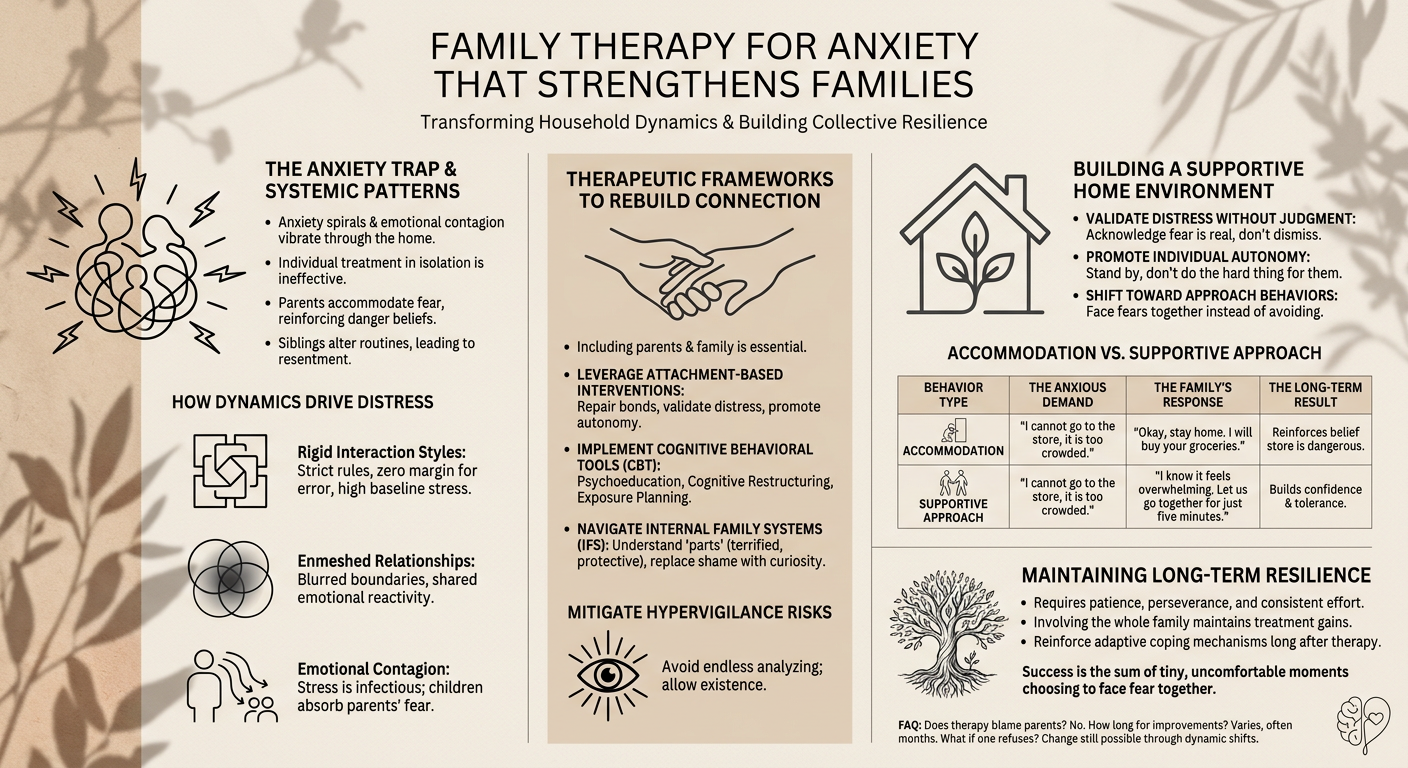
Below is a clear breakdown of how a family can pivot from hindering progress to genuinely helping.
| Behavior Type | The Anxious Demand | The Family’s Response | The Long Term Result |
|---|---|---|---|
| Accommodation | “I cannot go to the store, it is too crowded.” | “Okay, stay home. I will buy your groceries.” | Reinforces the belief that the store is dangerous. |
| Supportive Approach | “I cannot go to the store, it is too crowded.” | “I know it feels overwhelming. Let us go together for just five minutes.” | Builds confidence and tolerance for discomfort. |
Model Accountability And Repair
Adults must own their own anxiety.
Addressing the root causes of parental distress often involves therapy for shame, helping individuals heal and rebuild self worth so they no longer project their own insecurities onto their children.
When parents lose their temper because they are stressed, they need to apologize. Modeling repair after a conflict teaches children that relationships can withstand friction.
Enforce Boundaries With Extended Relatives
Consider the endless internet forum debates where a spouse demands their partner finally confront their overbearing parents.
These situations ignite fierce arguments because they are never just about what a mother in law said at dinner. They are about boundaries, loyalty, and control.
If a partner refuses to communicate basic boundaries with extended family, that choice is not neutral.
It is a choice to prioritize comfort with outside relatives over protecting the relationship built with the person sitting right beside them. When one person is stuck holding all the stress because their partner refuses to have an uncomfortable conversation, that dynamic absolutely morphs into emotional neglect.
Much like how financial therapy for couples improves communication and trust by tackling hidden resentments, treating interfamilial anxiety requires pulling the curtain back on shared avoidances.
You cannot let family connections steal the oxygen from your immediate household.
Why Do Parenting Comparisons Fail?
“Feeling like an outlier, are we failing our baby?”
This specific brand of panic pops up constantly among young parents.
But that feeling is usually just a potent mix of grief and pressure. It is rarely actual evidence that a parent is doing anything wrong.
When a family’s trajectory does not look perfectly normal, it is dangerously easy to start believing every unmet benchmark means total failure. But that is a productivity mindset applied to a parenting context.
The people bragging about their parenting successes online are usually just bragging about favorable logistics.
The actual work, building emotional safety, maintaining consistency, modeling accountability, is entirely invisible and infinitely harder.
How Can Households Maintain Resilience?
It can take athletes years of rigorous training before they ever see a medal. Earning emotional stability requires extreme patience and perseverance.
You cannot expect a few sessions of talk therapy to cure decades of generational trauma.
Experts suggest that involving the whole family enables the maintenance of treatment gains over time. Because the process equips the entire household with conflict resolution tools, they are better prepared to reinforce adaptive coping mechanisms long after formal treatment ends.
Whether working with a clinical psychologist in Raleigh or consulting counselors online, the goal remains the same.
Keep testing boundaries. Keep pushing for open communication.
FAQ
Does family therapy blame the parents for a child’s anxiety? Absolutely not. A competent clinician views the family system as a team. The goal is never to assign blame, but to identify patterns that accidentally keep the anxiety alive so the family can dismantle them together.
How long does it usually take to see improvements? Therapy length varies wildly depending on the severity of the mental health challenges. However, families often notice a reduction in daily household tension within the first few months of consistently applying approach behaviors instead of accommodation.
What if one family member refuses to participate? Change can still happen. Even if a highly anxious parent or a resistant teenager refuses to join a family therapy session, the rest of the family unit can learn how to stop accommodating the fear, which naturally forces the dynamic to shift.
Conclusion
There is no single key to success when it comes to untangling complex family relationships.
The success of your household does not lie within one magical therapy approach or one perfectly executed conversation.
It is the sum of all the tiny, uncomfortable moments where a family chooses to face a fear together instead of running from it.