
Introduction
Most professional engagements begin with a strategic objective. You define the problem, allocate resources, and measure output. Couples walking into a clinic rarely have this clarity. They arrive with a singular, exhausted goal. They want the pain and conflict to ease.
In a high-pressure society, relationship therapy Singapore searches spike when relationship challenges gradually develop into emotional disconnection. You do not wake up one day and decide to pay a clinical psychotherapist or psychologist hundreds of dollars out of sheer curiosity. You book a session because the same argument has looped endlessly for five years.
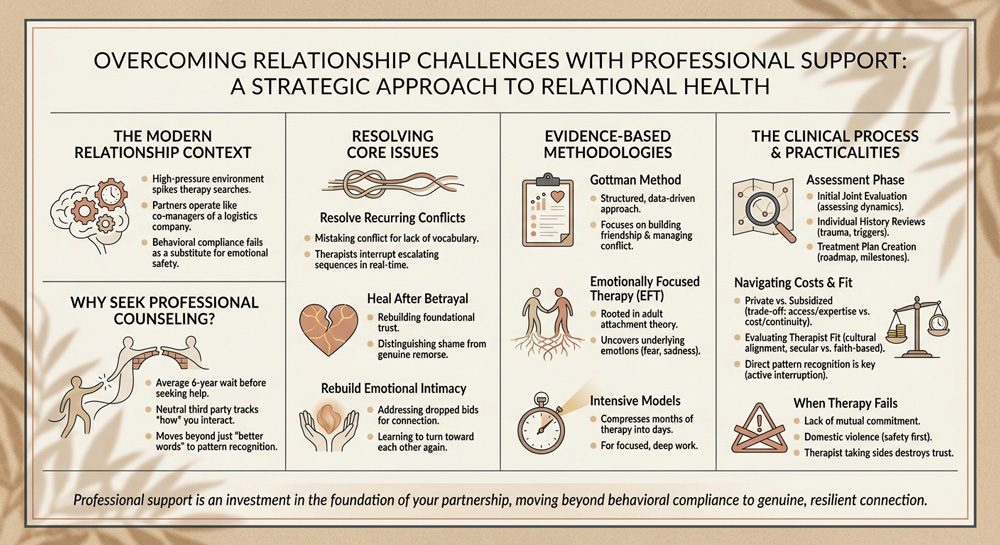
The modern relationship often carries the heavy expectations of dual careers, property upgrades, and intergenerational family experiences. Partners operate like co-managers of a logistics company. When intimacy drops, they try to out-manage the problem. The demand for structural therapeutic support has grown because behavioral compliance is a poor substitute for genuine character development and emotional safety.
Why Seek Professional Couples Counseling?
People wait an average of six years before seeking professional marriage counselling for marital difficulties. Years of unresolved concerns can build over time. A clinical setting forces a pause. It introduces a neutral third party trained to track how you interact, rather than just what you argue about.
Resolve Recurring Conflicts
Couples often mistake recurring conflicts for a lack of vocabulary. They assume they just need better words. I once watched a couple in my circle practice active listening for months. Tons of talking. Very little movement. Generic worksheets. The turning point occurred only when they found a professional who named their recurring emotional pattern and disrupted it immediately.
If your conflicts are stuck on repeat, you do not need more communication strategies from a workbook. You need direct pattern recognition. A competent therapist maps out the escalating sequence and physically interrupts you in the room when the cycle starts.
Heal After Betrayal
Infidelity destroys the foundational trust of a couple relationship. Healing after betrayal requires intense relational repair and rehab. It demands a distinction between shame, which makes the offending partner hide, and genuine remorse, which promotes active repair. Rebuilding is not guaranteed.
Rebuild Emotional Intimacy
Disconnection happens quietly. One partner stops sharing small details. The other stops asking. Over time, you live separate lives under the same roof. A professional intervention focuses on the small, missed bids for connection. The goal of any effective couple counselling singapore session is mapping how those bids are dropped and teaching both partners to turn toward each other again.
Explore Common Evidence-Based Methodologies
Not all therapy is equal. If you are entrusting your marriage to someone, their approach must be grounded in actual clinical data.
-
The Gottman Method Marriage researcher John M Gottman and Julie Gottman spent decades observing couples in a laboratory setting. He built an entire framework around divorce prediction by measuring physiological responses like heart rate during conflicts. His approach is highly structured and focuses on building friendship while managing conflict. Clinical practitioners rely heavily on this method, often outlining the Sound Relationship House theory applied by clinical practitioners to guide the treatment plan.
-
Emotionally Focused Approach Emotionally focused couples therapy looks under the hood of your arguments. It is deeply rooted in adult attachment theory. When a partner yells, they are usually protesting a loss of connection. The clinical goal involves focusing on attachment theory and de-escalation of distress cycles to help partners express softer, underlying emotions like fear or sadness.
-
Intensive Intervention Models Weekly hour-long sessions frustrate some couples. They spend forty minutes catching the therapist up on the week’s fights, leaving twenty minutes for actual work. Intensive models compress months of therapy into two or three consecutive days.
What to Expect During Clinical Assessments?
Therapists do not just jump into fixing your problems on day one. A proper assessment phase is non-negotiable.
Initial Joint Evaluation
The first session assesses the dynamic. How do you sit? Who interrupts? The therapist identifies areas where communication has become difficult. Many practitioners use formal questionnaires. You might go through the structural components and multi-step assessment phase utilized in the Gottman Relationship Checkup protocol to generate a baseline profile of your relationship health.
Individual History Reviews
Your past walks into the room with you. Therapists usually schedule one individual session with each partner. They need to understand your family of origin, any intergenerational trauma, and personal triggers. If you grew up in a household where anger was violent, a raised voice from your spouse will trigger a different nervous system response than someone who grew up in a loud, expressive family. To seek professional therapeutic support to heal past trauma individually often accelerates the joint work.
Treatment Plan Creation
Following the assessment, the therapist presents a roadmap. This outlines the specific therapeutic approach, the frequency of sessions, and the expected milestones. You should know exactly what you are working toward.
Navigate Treatment Costs Across Singapore
Therapy requires a financial commitment. Money carries heavy emotional weight in this country, and deciding to spend it on your marriage forces a conversation about priorities.
|
Therapy Setting |
Estimated Cost Per Session |
Typical Wait Time Estimates |
|---|---|---|
|
Private Clinic (Senior Therapist) |
$250 to $500 |
1 to 2 Weeks |
|
Private Clinic (Associate Therapist) |
$200-250 |
1 to 2 Weeks |
|
Family Service Centres (Subsidized) |
Nominal or Free |
4 to 12 Weeks |
Private Clinic Rates
Private sessions range broadly depending on the provider’s seniority and specialized training. You are paying for immediate access and specialized expertise.
Subsidized Community Options
Community options offer heavily subsidized rates. The government is actively expanding Strengthening Families Programme capacity targets to 12,000 cases by 2030 to meet growing needs. This is vital for accessibility.
Continuity of Care
There is a hidden cost to free or extremely cheap therapy. Lower cost often means lower continuity. You might see a different counsellor every few months due to high turnover rates in community settings. You may waste time re-explaining your history. If both partners are motivated, the consensus among many who have navigated this system is that a focused financial investment yields clearer results. For couples struggling heavily with money psychology itself, financial therapy for couples can bridge the gap between financial stress and relational health.
Evaluate Therapist Fit and Cultural Alignment
Credentials are only the baseline. The real variable in success is the fit. You need a therapist who grasps the local relationship vibe rather than offering generic advice.
Secular Practice Preferences
I heavily prioritize secular clinics unless someone specifically requests faith-based counseling. You do not want uninvited religious ideology creeping into your sessions. The Other Clinic frequently earns praise precisely for this reason. They operate with internationally trained therapists who are highly familiar with the local culture but maintain strict neutrality regarding personal beliefs.
Local Context Familiarity
Money, housing, and status are not just background noise here. They are the actual terrain of a marriage. A therapist must understand the significant pressures of securing a property or navigating the primary school registration system. Practitioners like The Curious Bonsai stand out because they handle the complex realities of these pressures without judgment. When former clients recommend someone after burning through multiple other therapists, pay attention. That signals an earned authority.
Direct Pattern Recognition
A less effective approach is when a therapist sit passively. If your counselor allows you to fight for fifty minutes straight and then asks how that made you feel, consider finding another therapist. You need someone who is comfortable interrupting you.
When Does Marriage Counseling Fail?
Sometimes therapy does not work. Singapore statistics show annual indicators showing over 7,000 marriages ending in divorce or annulment. Not every couple survives the assessment phase.
Therapy is less likely to be effective if one partner is entirely uncommunicative or physically forced to attend. It requires mutual commitment. The process is also completely inappropriate for domestic violence situations. Couples therapy assumes a baseline of safety. If abuse is present, an unequipped counselor treating the violence as a simple communication issue will actively endanger the victim.
Professional ethics dictate that in couples therapy, the relationship is the client. The therapist must never take sides. If a practitioner aligns with one partner to appear to side with one partner, the therapeutic container shatters.
Should Partners Attend Sessions Individually?
Couples therapy sessions focus on the dynamic between two people. While therapists conduct initial individual interviews, ongoing secret-keeping destroys trust. A competent therapist will establish clear rules about secrets. If you tell your therapist privately that you are having an active affair, they will likely require you to disclose it to your spouse or terminate the couples work. Privacy is respected. Secrecy is not.
FAQ
How long does couples therapy typically take? Most couples see initial shifts within 8 to 12 sessions. Deeply entrenched betrayal or trauma takes much longer, often spanning a year or more of consistent work.
Can we do this ourselves at home? You can improve daily habits. Certain DIY couples therapy exercises help maintain connection. But you cannot self-diagnose a blind spot. A professional provides the necessary friction and perspective you lack.
What if my partner refuses to go? You cannot force someone to participate in therapy or change. If they refuse, seek individual support for yourself. Clarify your own boundaries and figure out what you are willing to tolerate.
Conclusion
We treat our relationships as something that should naturally sustain itself without maintenance. That defies the laws of physics. Seeking support is an acknowledgment that your current relationship strategies are no longer working well. Finding a therapist who understands the intense cultural pressures of this city, respects the messiness of human connection, and refuses to offer overly simplistic advice is the first actual step toward relational repair. Do the work. Demand a space that feels safe enough to be open and honest.