
Last updated on August 20, 2026
Introduction
Couple therapy is a structured clinical intervention designed to diagnose relational dysfunction, mitigate escalating conflict, and systematically restore baseline communication between partners. That is the textbook definition. The reality looks entirely different. Nobody books an appointment with a couples therapist to optimize their relational synergy. They show up because they are utterly exhausted. They sit on opposite ends of a sofa in a clinic, silently tallying who works harder, who sacrifices more, and whose identity took the heaviest hit over the years.
In a culture obsessed with output, we are conditioned to believe that every problem has a fast, scalable solution. We expect intimate relationships to function like well-oiled corporate machines. But human connection defies efficiency. Therapy is the deliberate process of putting down the scoreboard. It is not about forcing agreement. It is about creating a space where two people can finally hear each other without the noise of their own defensiveness drowning out the conversation.
What defines modern couple therapy?
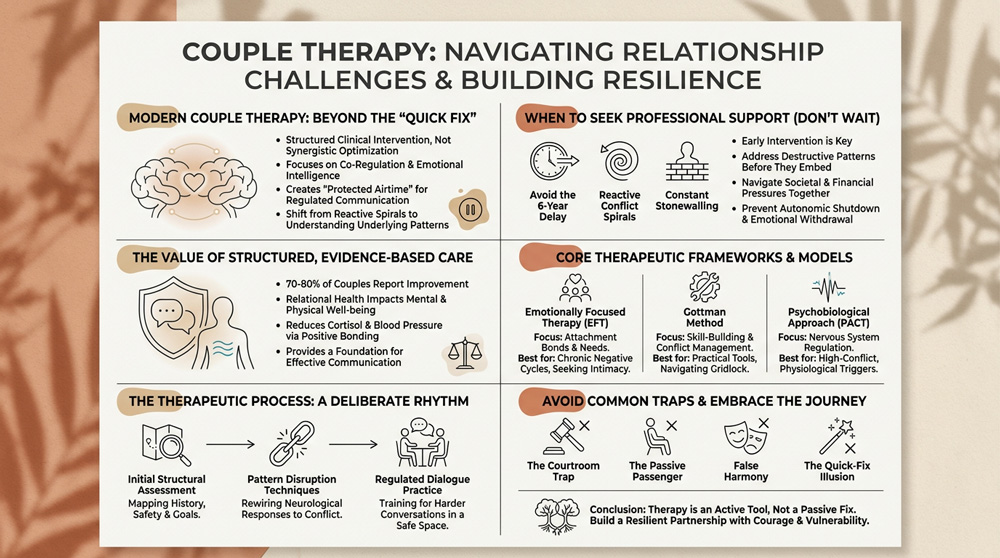
People often walk into the therapy room hoping for a quick fix. They want the one hour that fixes everything. My opinion is that psychotherapy only really works when both people show up ready to be uncomfortable in a highly structured way. Modern practice abandons the outdated notion of the therapist as an impartial referee handing out penalties. Instead, it focuses on co-regulation, emotional intelligence, and trauma-informed care.
Purpose of protected airtime
In real life, most couples do not lack love. They lack regulated communication under stress. When a persistent disagreement flares up in the kitchen after a ten-hour workday, the environment is ripe for a reactive spiral. Therapy forces the discussion to happen without the normal interruptions and scorekeeping. It provides protected airtime. If you get even a little bit of that uninterrupted space, you start noticing the deep underlying patterns instead of just blindly re-enacting them week after week.
Role of regulated communication
That uninterrupted hour matters more than it sounds. I have seen this shift happen countless times. One person stops going nuclear because they finally feel like they are being taken seriously. The other person stops stonewalling because the clinician keeps drawing the dialogue back to the actual issue instead of letting it devolve into “you always” and “you never.” That realization of actually talking, rather than just waiting for a turn to speak, is incredibly powerful. It builds a foundation for effective communication even if the complex problems do not vanish immediately.
Evidence and clinical scope
This is not just anecdotal optimism. Comprehensive reviews consistently demonstrate that 70% to 80% of individuals receiving couple therapy are better off than those who receive no treatment. The clinical scope extends far beyond simple date night planning. Relational distress actively maintains mood disorders. When the dynamics at home involve intense conflicts or emotional abandonment, individual therapy alone often stalls. Treating the partnership directly is sometimes the most evidence-based path to individual mental health.
When should partners seek professional help?
I am firmly in the camp that seeking support does not have to be a last-ditch effort to prevent a breakup. The most helpful version of intervention happens early, while the dynamics are still somewhat flexible. Unfortunately, couples wait an average of six years after severe relationship distress sets in before looking for professional assistance. If you wait until everything is already glued to the wall, treatment turns into an exhausting effort to uninstall habits that have had years to embed themselves.
Reactive conflict spirals
Predicting a peaceful dissolution versus long-term satisfaction is not guesswork. Researchers can predict divorce with over 90% accuracy simply by coding specific interaction behaviors during a brief debate. Destructive communication patterns like criticism and contempt directly increase the likelihood of breakups. When a couple is caught in a reactive loop, the actual topic of the fight stops mattering. The fight becomes about the feeling of being attacked.
Constant stonewall behaviors
Silence is rarely empty. When one partner withdraws completely, it often registers to the other partner’s nervous system as a profound threat. Stonewalling is an autonomic shutdown. It happens when the physiological stress is too high to process language. A couples therapist intervenes by slowing the pacing down, helping the withdrawing partner regulate their nervous system while helping the pursuing partner feel secure enough to pause.
High baseline resentment
Money is never just money. In places with immense societal pressure, money carries intergenerational emotional weight. It carries the script of constantly upgrading lifestyles, securing better schools, and proving your worth through tangible assets. The pursuit of MORE often breeds high baseline resentment. When the partnership becomes a logistical arrangement to manage a household, intimacy dies of neglect. Navigating this pressure cooker requires more than casual advice, making structured Couple Counselling Singapore a necessity rather than a luxury for local partners trying to find each other again.
Process of standard clinical sessions
Couples psychotherapy follows a deliberate rhythm. It does not look like the dramatic screaming matches portrayed on television. It requires consistency, empathetic understanding, and a willingness to examine your own blind spots.
Initial structural assessment
The first appointment is about mapping the terrain. Counselors need to understand the history of the bond, the nature of the current struggles, and the goals each person brings to the table. We evaluate for safety, screen for abuse, and look at how external stressors like career burnout or family dynamics are leaking into the intimate relationship.
Pattern disruption techniques
You cannot think your way out of a physiological trigger. You have to experience a different outcome. Clinicians use specific interventions to stop couples from falling into their usual traps. This might involve pausing a heated exchange mid-sentence or requiring partners to practice 15 Couples Therapy Exercises for Communication right there in the room. The goal is to rewire the neurological response to conflict.
Regulated dialogue practice
I view this phase as practical training. You show up, you practice the harder conversations, and you let the professional steer you away from the cliff. When you start before resentment hardens, you can make the whole “we feel safe enough to talk” vibe much easier to maintain. You learn the difference between expressing a need and launching an indictment.
Common therapeutic models for relationships
Therapists employ various approaches depending on the specific issues presented. There is no universal template.
|
Therapy Model |
Primary Focus |
Best Suited For |
|---|---|---|
|
Emotionally Focused Therapy (EFT) |
Attachment bonds and underlying emotional needs. |
Couples stuck in chronic negative interaction cycles seeking deeper intimacy. |
|
Gottman Method |
Skill-building, managing conflict, and enhancing friendship. |
Partners needing practical tools to navigate gridlock and rebuild trust. |
|
Psychobiological Approach (PACT) |
Nervous system regulation and secure functioning. |
High-conflict couples who trigger each other’s physiological threat responses. |
Attachment framework
Understanding how we learned to love as children profoundly influences how we love as adults. An attachment framework explores these early blueprints. It helps explain why a perceived slight makes one person anxious and makes another person completely detach. For neurodivergent individuals, the approach must be highly nuanced. Exploring How is this different from regular couples therapy? reveals that standard advice often fails neurodivergent couples, requiring a strictly trauma-informed lens to build a secure relationship.
Emotionally focused methods
EFT is incredibly robust. Clinical trials clearly demonstrate that Emotionally Focused Therapy significantly improves relationship satisfaction and reduces depressive symptoms for partners. It shifts the focus from arguing about the logistics of the grocery list to uncovering the hidden fears of rejection or inadequacy driving the argument.
Psychoeducation integration
Sometimes people just do not know how relationships are supposed to work. Psychoeducation involves teaching partners about the biology of stress, the mechanics of a proper apology, and the psychological impact of transition periods like becoming new parents. It demystifies the chaotic feelings and replaces shame with clarity.
How do interventions affect long-term outcomes?
The human nervous system is inherently relational. We are wired for connection. When that connection is fractured, we suffer physically and mentally. The inverse is also true. Scientific reviews indicate that close family relationships and positive social bonding reduce cortisol levels and blood pressure via oxytocin mechanisms.
A loving attachment literally heals the body. When relationship counseling succeeds, it does not just prevent a divorce. It alters the daily lived experience of two human beings. They sleep better. They parent with more patience. They navigate corporate burnout with a secure base to return to at the end of the day.
Prevent common traps during your sessions
Therapy is entirely useless if you use it as a weapon. I see intelligent, high-performing corporate professionals fail at marriage counseling because they treat the session like a quarterly performance review.
-
The Courtroom Trap: Treating the clinician like a judge. You are not there to present evidence proving your partner is the problem. If either partner is treating it like a stand-up routine to prove they are right, it is going to feel pointless very fast.
-
The Passive Passenger Trap: Expecting the counselor to do the heavy lifting. Insight without applied behavior change is just expensive trivia.
-
The False Harmony Trap: Nodding along during the session and then fighting about the exact same issue in the car ride home. You have to risk being honest in the room.
-
The Quick-Fix Trap: Believing that three sessions will undo a decade of neglect. Healing requires time, consistency, and a tolerance for awkwardness.
FAQ
What is the difference between various types of relationship support? Many wonder about Couples Therapy vs Marriage Counseling. Historically, marriage counseling focused on immediate problem-solving and behavioral contracts, often guided by religious or community leaders. Modern couples psychotherapy is a licensed clinical practice dealing with deep psychological patterns, trauma, and mental health conditions affecting the life partnership. These terms can be used interchangeably.
Can therapy help with infidelity? Yes, though the road is brutal. Rebuilding trust after a betrayal requires immense vulnerability. It is not about simply forgiving and forgetting. It involves a forensic examination of the relationship’s vulnerabilities and a rigorous commitment to transparency.
Is couples therapy appropriate if there is domestic violence? This is a critical distinction. Traditional couples counseling is generally contraindicated in situations involving coercive control or severe physical abuse, as it can dangerously escalate the risk for the victim. Safety must be the absolute priority. Individual therapy and contacting local support organizations or the national domestic violence hotline is the necessary first step. Specialized interventions only apply to highly specific, stress-related situational violence under strict clinical parameters.
Do we need a specific type of therapist for LGBTQ couples? Yes. Finding clinicians who are not just friendly, but actively trained in the unique minority stress and systemic challenges faced by the community is vital for psychological safety. At The Curious Bonsai, we are queer-affirmative.
Conclusion
We spend decades optimizing our careers, our investment portfolios, and our physical health, yet we expect our most intimate relationships to thrive on leftover energy. It does not work that way. Compliance is not character, and avoiding a fight is not the same thing as building a connection.
While I am pro-couples therapy, but I am not pro-couples therapy as a passive fix. It is a tool. It works best when both people are willing to use it like training. Show up. Lean into the discomfort. Let the professional steer you away from your ego. The goal is not a perfect relationship devoid of conflict. The goal is a resilient partnership where two people have the courage to be deeply, messily human together.