
We are told that long-term relationships require work. We are rarely told that sometimes, the work feels like one of the most emotionally difficult experiences a person can face. The discovery of an affair does not feel like a communication glitch. It can feel deeply distressing. You are suddenly feeling as though you no longer recognize your partner.
Infidelity counselling in Singapore is often tossed into the broader bucket of general marriage therapy. This should not be the case and treated in a category of its own. Treating betrayal like a standard disagreement over finances or scheduling is the fastest way to compound the damage. When the bounds of fidelity are broken, the foundation of your reality fractures. You need a trauma-informed protocol to stabilize a nervous system in collapse.
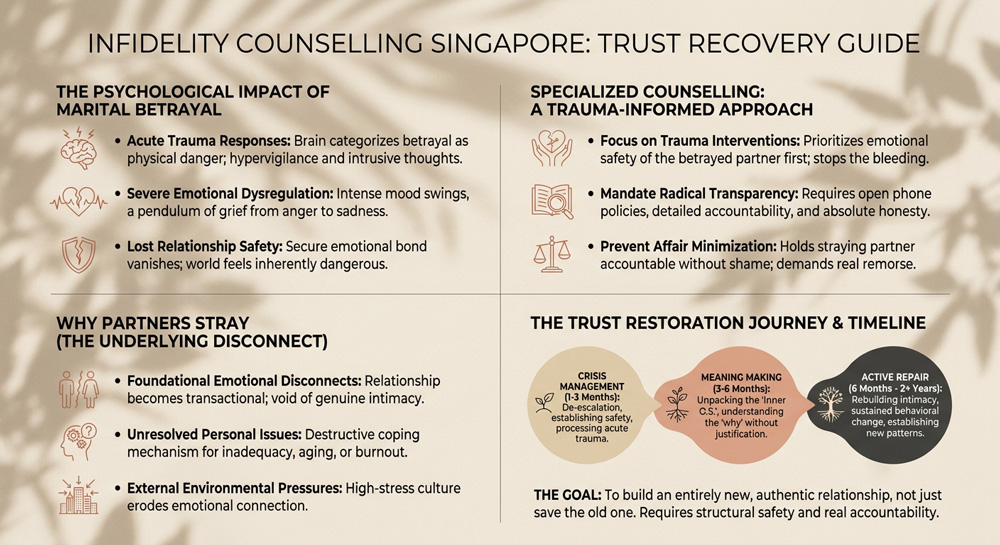
What Is the Psychological Impact of Marital Betrayal?
A betrayed partner is not just sad or angry. They are fundamentally disoriented. The psychological fallout mirrors profound psychological injury.
Acute Trauma Responses
The brain categorizes sudden relationship betrayal alongside physical danger. You might experience intrusive thoughts while trying to draft an email at work. Hypervigilance becomes your new baseline. You check phones, scrutinize receipts, and analyze micro-expressions. Clinical experts frequently observe the secondary somatic and psychological side effects of betrayal trauma such as severe insomnia, chronic anxiety, and inexplicable physical pain. Your ongoing stress can affect both the mind and body, remaining in a heightened state of alertness.
Severe Emotional Dysregulation
Healing from this is unpredictable. One minute, you are consumed by a intense anger you want to leave the relationship immediately. Ten minutes later, you are feeling overwhelmed with sadness, desperately clinging to the very person who caused the pain. This is the challenging reality of processing emotions under extreme stress. It is a pendulum of grief. You are mourning the loss of the relationship you thought you had, while simultaneously trying to figure out if a new one can be rebuilt over time.
Lost Relationship Safety
The person who was supposed to be your safe harbor just became the storm. Attachment science tells us that human beings require a secure emotional bond to thrive. When fidelity is compromised, that safety vanishes. The world suddenly feels inherently dangerous. Rebuilding trust isn’t a matter of listening to apologies. It requires the straying partner to actively, consistently prove they are no longer a threat.
Why Do Partners Stray in Committed Relationships?
People want a simple villain. We want to believe that cheating happens purely out of malice or moral failure. The truth is far more uncomfortable. Affairs are rarely about sex. They are almost always about a profound emotional distance and an inability to navigate the internal self.
Foundational Emotional Disconnects
Couples drift. You stop asking questions out of curiosity and start issuing logistical commands. Who is picking up the kids? Did you pay the conservancy charges? The relationship becomes transactional. In this void of genuine intimacy, people become susceptible to outside attention. It does not excuse the behavior, but it explains the vulnerability.
Unresolved Personal Issues
Often, the affair is a misguided attempt to solve a glitch in someone’s “Inner O.S.” (operating system). A partner might use an emotional affair or physical infidelity to self-medicate feelings of inadequacy, aging, or profound burnout. Similar to how some use money and status to close a wound that money did not cause, an affair is frequently a destructive coping mechanism for unresolved personal issues. It is a desperate bid for validation.
External Environmental Pressures
We live in a culture obsessed with upgrading. HDB to condo. Manager to Director. We optimize for output and quietly erode the conditions that make people feel seen. Singapore’s high-stress, high-performance environment creates immense relational fatigue. When couples do not actively nurture their emotional connection and resilience, the relentless ongoing pressures of daily life can fracture the strongest of bonds.
How Does Specialized Therapy Outperform General Counseling?
I’m gonna be real. Reading local forums makes me feel like therapy is less about finding some magical specialist and more about avoiding the wrong fit. You have to stick it out long enough for the process to actually work. But if you walk into a generic couples counselling session to address an affair, you are likely wasting your time.
For cheating-related damage, professional counselling only starts to feel worth it when the therapist is explicitly comfortable with infidelity.
Focus on Trauma Interventions
General marriage counselling assumes both partners are on equal footing. Infidelity trauma shatters that footing. You need practitioners who understand clear distinctions between general and crisis-focused work. A qualified infidelity therapist will prioritize the emotional safety of the betrayed partner first. They stop the bleeding before they try to teach you how to communicate better.
Mandate Radical Transparency
Trust is not rebuilt in the dark. Specialized infidelity counselling sessions require the unfaithful partner to surrender their right to secrecy. This means open phone policies, detailed accountability of whereabouts, and absolute honesty. A good therapist will enforce this structure, knowing that the betrayed partner needs this data to regulate their anxiety.
Prevent Affair Minimization
It can be especially difficult when a therapist who subtly pressures a betrayed partner to “move on” for the sake of harmony. If a counselor lets the cheating partner minimize the impact of their actions, resentment will quickly disguise itself as a “healthy discussion.” The right therapist will hold the straying partner accountable without shaming them, demanding real remorse rather than just behavioral compliance.
Establish Structural Rules for Emotional Safety and Accountability
Relational repair requires structure. You cannot just wing it and hope the pain fades. You need a heavily defined framework.
If you are searching for local help to navigate this, I personally prioritize three specific things when evaluating a mental health provider:
-
They clearly demonstrate deep, evidence-based experience with infidelity and betrayal trauma.
-
They possess the clinical strength to handle both the emotional chaos and the practical fallout (transparency rules, boundary setting).
-
You feel fundamentally respected and believed, rather than “managed” to keep the peace.
Define Disclosure Frameworks
How much detail is too much? A careless confession may cause as much PTSD-like trauma as the discovery itself. Professional guidance is vital here. Using structured dialogue models assist partners in processing acute betrayal trauma safely. You learn what gets disclosed, what triggers a relapse into old arguments, and how to repair without pretending the affair never happened.
Track Behavioral Changes
A partner who stops cheating just because they were caught has not learned fidelity. They have learned crisis management. Compliance is not character. Real recovery demands watching their actions over months. Are they defensive when asked a question? Or do they meet your anxiety with compassion and reassurance? Behavioral therapy within this context tracks these micro-interactions.
Rebuild Broken Trust
Trust is a series of small, consistent actions over time. It is earned. The straying partner must understand the difference between enforced power and earned authority. They have to willingly carry the heavy lifting of the healing process.
How Should Couples Evaluate Their Relationship Future?
Not every relationship survives infidelity. And frankly, not every relationship should. Discernment counselling is a specific type of therapy designed for couples on the brink. It is not about saving the marriage; it is about finding clarity.
You sit down and evaluate the collateral damage. You look at the emotional patterns that led to the crisis. You assess whether both people possess the resilience and willingness to endure a grueling therapeutic journey. Sometimes, the most holistic, compassionate outcome is a carefully mediated separation that preserves the dignity of both individuals, especially if children are involved.
Singapore Legal Context and Societal Isolation Dynamics
Navigating an affair in Singapore carries unique, heavy baggage. Adultery remains a legally recognized fact for divorce under the Women’s Charter. This adds an immediate layer of legal and financial terror to the emotional devastation. Suddenly, you are not just crying over a broken heart; you are panicking about HDB rules, matrimonial assets, and child custody.
If the marriage completely breaks down, you will likely encounter the official legal pathway and mandatory attendance requirements set by the family justice system.
Beyond the legalities, there is a suffocating social isolation. We live in a society that highly values face and status. The shame attached to a marital affair keeps people silent. You can easily read the sentiments and peer experiences regarding the emotional realities of dealing with infidelity in Singapore on community platforms, and the underlying theme is always loneliness. People suffer in private because they fear judgment from their families and peers. Finding a confidential, supportive environment through professional therapists is often the only safe outlet available.
How Long Does the Trust Restoration Process Take?
If you are looking for instant results, you are in the wrong place. Infidelity recovery is not a six-week boot camp. It is a profound rewiring of two human beings.
|
Therapy Phase |
Primary Focus |
Typical Timeline |
|---|---|---|
|
Crisis Management |
De-escalation, establishing safety, radical transparency, processing acute trauma. |
1 to 3 Months |
|
Meaning Making |
Unpacking the “Inner O.S.”, understanding the ‘why’ without justifying the ‘what’. |
3 to 6 Months |
|
Active Repair |
Rebuilding intimacy, establishing new emotional patterns, sustained behavioral change. |
6 Months to 2+ Years |
The timeline is dictated by the straying partner’s willingness to be accountable and the betrayed partner’s capacity to process grief. Pushing for a quick resolution only guarantees a relapse. You must embrace an unhurried pacing through panic, grief, and navigating the remorse experienced by both individuals.
FAQ
Can a relationship ever be the same after an affair? Perhaps, although that takes time. The goal of affair recovery therapy is to build an entirely new, more authentic relationship from the ashes of the old one.
Is individual therapy necessary during infidelity counselling? Highly recommended. Individual counselling provides a private space for the betrayed partner to process trauma and for the unfaithful partner to dissect their destructive emotional patterns without causing further harm in joint sessions.
How do we know if we have the right counsellor? You will know when you feel structurally safe. The right counsellor will take charge of the room, refuse to let the cheating partner minimize the betrayal, and provide concrete frameworks rather than just letting you vent for an hour.
Conclusion
Betrayal forces a terrifying mirror in front of our lives. It strips away the polite fictions we tell ourselves about who we are and what our relationships actually look like. Infidelity counselling is not about punishing the guilty or forcing the wounded to forgive. It is a brutally honest excavation of the truth.
If you are standing in the wreckage right now, understand that the pain you feel is valid. It is proportional to the loss. Do not let anyone rush your healing. Seek out the precise, trauma-informed support you need. Demand the truth, demand real accountability, and give yourself the grace to figure out your next steps slowly, one agonizing, courageous day at a time.