
Last updated on August 20, 2026
Introduction
Corporate organisations optimize for output. Risk management protocols, quarterly performance reviews, strategic alignment meetings. Marriage counseling often begins under the same clinical perspective. Partners sit on a clinical couch seeking a performance review for their relationship, armed with mental spreadsheets of grievances. They expect an authority figure to assess their communication difficulties and dispense actionable deliverables.
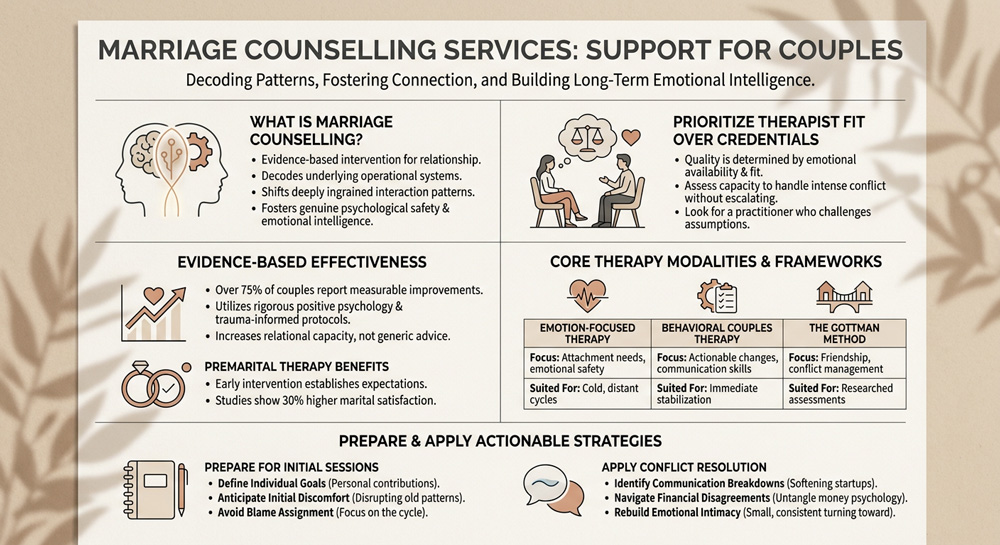
Therapy rarely works that way. Marriage counseling is an evidence-based intervention designed to decode the underlying operational system of a partnership, shift deeply ingrained interaction patterns, and foster long-term emotional intelligence. It requires treating the relationship itself as the primary client. The process strips away the behavioral compliance many adults learn in high-pressure environments, replacing it with genuine psychological safety.
What Is Marriage Counselling?
Couples often spend years managing the logistics of their lives together while quietly starving for connection. They manage households, navigate career promotions, and accumulate assets. Money and status carry emotional weight, subtly dictating who partners are allowed to be. Counseling forces a pause in this constant upgrading. It provides a structured environment where two individuals can explore the emotional realities they have been avoiding.
Evidence-Based Effectiveness
Clinical data suggests that structured therapy yields tangible mental health outcomes. Surveys tracking therapeutic efficacy indicate that over 75% of couples undergoing systemic therapy report measurable relationship improvements, according to AAMFT Mental Health Efficacy Metrics. The process works not by offering generic advice, but by utilizing rigorous positive psychology tools and trauma-informed methodologies to rebuild safety. This is a deliberate practice of increasing relational capacity.
Interaction Pattern Shifts
The goal is entirely missing the mark if partners attend sessions solely to figure out who is right. Therapy focuses on modifying the dance between two people. Research into marital stability points out that specific systemic variables accurately predict whether couples stay bonded. Analysis from a Gottman Institute Oral History Study demonstrates that a shared narrative of “we-ness” versus separateness is a primary indicator of long-term relationship functioning. The therapist acts as a human-first facilitator, mapping out these patterns and guiding couples toward a shared narrative rather than separate defensive corners.
Premarital Therapy Benefits
Waiting for a crisis to seek help is a common misstep. Establishing clarity before legally binding a partnership offers a significant protective buffer against future marital discord. Studies highlighted by the APA 30% satisfaction increase finding show that couples who complete structured programs experience a massive jump in overall marital satisfaction. Exploring the reasons Why Every Couple Needs Pre Marriage Counselling Singapore reveals that secular early intervention helps establish expectations around finances, intimacy, and conflict resolution before resentment takes root.
Prioritize Therapist Fit Over Credentials
Online recommendation threads are flooded with couples asking for the best local professional. Relying on polished credential lists or institutional prestige is a trap. In the real world, a quality counselor is determined by fit, emotional availability, and their capacity to maintain control when sessions get inevitably messy.
Assess Conflict Management
A competent professional does not allow sessions to devolve into a therapy-flavored debate club. If a counselor merely nods, reframes statements, and offers vague platitudes, couples are essentially paying a premium to be talked at. True therapeutic work requires a practitioner who can handle intense conflict without escalating blame. They must challenge assumptions and hold space for radical vulnerability.
Match Therapy Styles
Couples rarely realize how much clinical style matters until they get burned by a bad match.
-
Some practitioners lean heavily into measurable frameworks, assigning homework and tracking data points weekly.
-
Others favor open-ended dialogue, prioritizing historical context and family-of-origin exploration.
-
A few blend these approaches, oscillating between somatic experiencing and cognitive restructuring.
If partners crave momentum and direction, a completely unstructured, slow-paced approach will feel like making limited progress.
Ensure Equal Engagement
Imagine one spouse arrives eager to acquire practical positive relationships exercises, treating therapy like a project. The other spouse arrives exhausted, feeling heavily scrutinized and defensive. A practitioner who leans too far into either extreme will alienate one half of the room. The alliance between the couple and the therapist is paramount. Resentment builds quickly if one person feels they are being diagnosed rather than understood.
Demand Session Traction
Progress should not remain a mystery for months on end. While deep relational repair takes time, couples should leave early sessions feeling a distinct shift in their perspective. Industry baselines detailed in AAMFT Clinical Practice Duration Data note that couples therapy averages 11.5 sessions. You need someone who facilitates tangible change and actual traction, not just endless conversation.
Core Therapy Modalities And Frameworks
Different forms of psychological distress require different therapeutic blueprints.
|
Modality |
Primary Focus |
Best Suited For |
|---|---|---|
|
Emotion-Focused Therapy |
Attachment needs, emotional safety |
Couples stuck in cold, distant, or highly reactive cycles. |
|
Behavioral Couples Therapy |
Actionable changes, communication skills |
Partners needing immediate stabilization and conflict rules. |
|
The Gottman Method |
Friendship, conflict management, shared meaning |
Couples seeking highly researched, structured assessments. |
Emotion-Focused Therapy
This approach dives underneath the surface arguments about chores or finances to address primal fears of abandonment and rejection. Emotion-focused work is compassionate and intentionally paced. It uncovers the raw, unprotected feelings driving the anger, allowing partners to experience each other with genuine curiosity rather than defensiveness.
Behavioral Couples Therapy
For those drowning in daily friction, behavioral couples therapy offers a scaffold. This framework emphasizes immediate behavioral modifications. It helps spouses increase positive exchanges and decrease unhelpful interaction patterns. The focus remains heavily on the present, relying on evidence-based strategies to rebuild baseline goodwill.
Structured Action Plans
Growth requires deliberate practice. Structured frameworks operate on the premise that you cannot just meaningful change requires both communication and behavioural changes. These modalities utilize Couple Therapy Singapore for Better Communication to introduce specific rules of engagement, timeout protocols, and weekly connection rituals.
Deep Emotional Exploration
Sometimes, the current conflict is merely an echo of much older stories. Deep exploration involves untangling intergenerational scripts, childhood conditioning, and individual trauma. Spaciousness in these sessions allows for a deepening of who each person is, removing the pressure of rushing toward an artificial resolution.
Prepare For Your Initial Sessions
Showing up is only the first requirement. The actual work happens in how you orient yourself to the process.
Define Individual Goals
Therapy is not a space to drop off a partner for repairs. Each individual must clarify what they are willing to change about themselves. A request for the other person to change is a complaint, not a goal. Identifying personal contributions to the marital discord creates a foundation for empowerment and mutual accountability.
Anticipate Initial Discomfort
Investigating the inner operating system is disruptive. Therapy often causes a temporary spike in anxiety because it requires dismantling the coping mechanisms that previously kept the peace. Nurture an expectation that things may feel worse before they feel better. Relational rehab is demanding work.
Avoid Blame Assignment
A child who stops a behavior simply out of fear has not developed character. Similarly, an adult who only changes a behavior because they were cornered in therapy has not developed emotional intelligence. The focus must remain on the cycle, not the person. If both people commit to attacking the dynamic rather than each other, resilience naturally follows.
Apply Actionable Conflict Resolution Strategies
Therapy sessions provide the blueprint, but daily life is the construction site. Practicing these strategies in the wild determines whether the marriage health actually improves or simply stagnates.
Identify Communication Breakdowns
The beginning of an argument dictates its end. Data from Gottman Institute Divorce Prediction Research reveals that 96 percent of the outcome of a harsh conflict conversation can be predicted by the first three minutes. Softening the startup of a disagreement is critical. Partners must learn to state their needs without lacing the request with contempt or criticism.
Navigate Financial Disagreements
Money psychology is rarely just about math. It carries the weight of personal identity, childhood scarcity, and societal pressure to constantly upgrade. When financial stress impacts affection and trust, engaging in specialized Financial Therapy for Couples: Improve Communication & Trust helps untangle these loaded narratives. Non-attachment to money allows it to function as a tool rather than a weapon.
Rebuild Emotional Intimacy
Intimacy is not purely physical. It is the steady accumulation of small, seemingly insignificant moments of turning toward one another. Sharing a mundane story, acknowledging a bid for attention, or simply sitting in silence together without the interference of screens.
When Do Couples Need Intervention?
Certain physiological markers indicate that a relationship has crossed from normal friction into destructive territory. When arguments trigger intense biological responses, cognitive processing shuts down completely. Tracking experiments in the Gottman Institute Couples Research Lab show that heightened cardiovascular arousal during conflicts strongly correlates with long-term happiness deterioration. If your heart rate spikes above 100 beats per minute during a disagreement, you are physically incapable of empathy or creative problem-solving. This level of flooding requires professional mediation to establish a safe container for dialogue.
Why Do Some Therapy Attempts Fail?
Couples often conclude that their marriage is unsalvageable after a failed stint in counseling. Frankly, many therapeutic attempts fail because the practitioner lacked the authority to disrupt the room. If a counselor relies entirely on passive listening, couples will simply repeat their toxic arguments in a more expensive zip code.
Furthermore, exploring The Gottman Method: Principles, Benefits, and Resources highlights that therapy fails when one partner views the process as a checklist for the other to complete. Without holistic participation, the environment remains unsafe.
FAQ
How long does marriage counseling usually take? Most focused interventions run between 10 to 20 sessions, though complex historical issues may require extended support.
Can counseling work if only one partner wants to go? Individual therapy can significantly shift relationship dynamics, but treating the specific entity of the marriage requires both people in the room.
Is it normal to feel worse after a session? Absolutely. Unpacking ignored resentments temporarily increases emotional turbulence before true clarity emerges.
Conclusion
Compliance is a terrible substitute for connection. High-performing adults are exceptionally good at modifying their outward behavior to meet systemic expectations, but mimicking a happy marriage is not the same as actually inhabiting one. Unquestioned scaling of life logistics without anchoring it in human connection erodes the foundation of a partnership. Navigating this terrain requires stepping out of the transactional mindset and engaging in the messy, vital work of holding space for another human being.