
Last updated on July 8, 2026
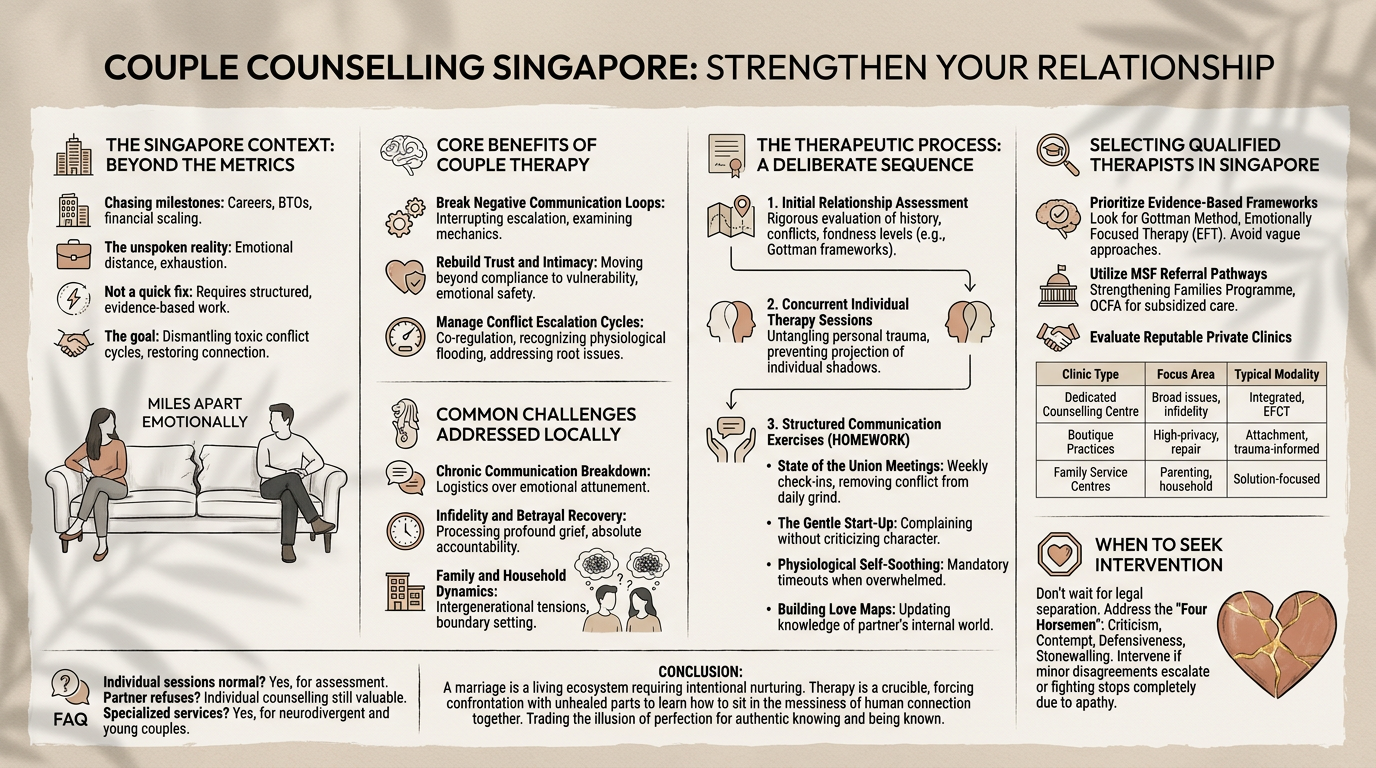
Some modern professionals in Singapore treat their marriages like a Q4 earnings report. Metrics are tracked. Milestones are checked off. The BTO flat is secured, the keys are collected, the renovation is completed, and the careers are scaling upward. Yet, couples often find themselves sitting on a pristine velvet sofa in a quiet clinic, miles apart emotionally, wondering why the math of their life is not adding up to happiness. They arrive exhausted. The primary answer to their unspoken question is not a quick fix or a communication hack. Couple counselling in Singapore offers a structured, objective space to dismantle toxic conflict cycles, but it demands mutual commitment and the rigorous application of evidence-based frameworks to actually restore connection. It is the deliberate, often painful process of unlearning.
We live in a culture obsessed with upgrading. But unquestioned scaling at all costs leaves people hollow. The power of authentic, messy, unpolished connection is the very thing partners are starving for.
What Are the Core Benefits of Couple Therapy?
Therapy is not a courtroom where a professional judge decides who is wrong. The actual utility of sitting in a room with a stranger is to map the invisible architecture of a relationship.
Break Negative Communication Loops
Most arguments are never about the actual subject being argued. They are well-worn grooves in a record. One partner escalates a concern into a demand. The other registers this as an attack and withdraws. This triggers deeper panic in the first partner, leading to louder demands. A qualified relationship therapist interrupts this loop. They force both individuals to pause and examine the mechanics of their interactions. Breaking these loops requires mapping out how fear masquerades as anger, and how overwhelm masquerades as apathy.
Rebuild Trust and Intimacy
Trust is incredibly fragile in high-stress environments. It erodes quietly. Financial therapy for couples is sometimes required just to address the hidden resentment tied to money psychology, where income disparity becomes a proxy for self-worth. Rebuilding intimacy requires emotional safety. A partner who stops yelling just because they are afraid of the consequences has not learned that hurting their spouse is wrong. They have only learned compliance. Genuine repair demands vulnerability, moving beyond superficial behavioral changes to foster deep, structural resilience.
Manage Conflict Escalation Cycles
When the brain senses a threat, the amygdala takes over. Higher-order thinking vanishes. Couples therapy provides an environment where co-regulation can occur. The presence of a regulated third party helps the nervous systems of both partners settle. They learn to recognize the physiological signs of flooding. Once the physical panic subsides, the actual work of addressing the underlying relationship issues can begin.
Identify Common Relationship Challenges Addressed Locally
Singapore carries its own unique emotional weight. The environment is highly engineered, and the pressure to conform to a specific script of success breeds distinct forms of relational friction.
Chronic Communication Breakdown
The relentless pace of the city leaves little room for spaciousness. Couples communicate purely in logistics. Who is picking up the kids. Who is paying the maintenance fee. Over time, the emotional language atrophies. When couples finally try to talk about their internal worlds, they lack the vocabulary. A structured intervention provides the translation required to move from logistical management to emotional attunement. This is often where foundational couples therapy 101 communication strategies become vital to establishing a new baseline of understanding.
Infidelity and Betrayal Recovery
Betrayal shatters the foundational reality of a partnership. The trauma of infidelity counseling is not about deciding whether to stay or leave immediately. It is about processing profound grief. The affair itself is often an acute symptom of a long-decaying structure. Repairing this requires intense, focused couples therapy where accountability is absolute, and the injured party is given the space to process betrayal trauma without being rushed toward premature forgiveness.
Family and Household Dynamics
Intergenerational tensions are rampant. Couples frequently find themselves wedged between the demands of their aging parents and the needs of their own nuclear family. Boundaries are culturally complicated. Navigating in-law interference or differing views on parenting challenges requires a united front. Without it, the marriage becomes a collateral casualty of extended family obligations.
How Does the Therapeutic Process Work?
Therapy is not just talking. If it is just talking, you are wasting your time. Effective clinical work follows a deliberate sequence designed to diagnose, stabilize, and rebuild.
Initial Relationship Assessment
The first step is a rigorous evaluation. Practitioners utilizing frameworks developed by marriage researchers Dr John and Julie Gottman from The Gottman Institute typically start with a comprehensive relationship assessment. This involves understanding the history of the couple, identifying gridlocked conflicts, and assessing the current level of fondness and admiration. The therapist needs a clear map of the territory before attempting any intervention.
Concurrent Individual Therapy Sessions
Reddit forums and local community discussions frequently converge on a vital truth. You cannot fix a dynamic if one individual is drowning in unresolved personal trauma. Often, concurrent individual counselling sessions are recommended. Engaging in online couples therapy and relationship help alongside individual work allows a person to untangle their own coping mechanisms, preventing them from projecting their individual shadows onto their partner.
Structured Communication Exercises
Vague advice yields vague results. Homework is essential. Between sessions, couples must practice new ways of engaging.
-
State of the Union Meetings: A dedicated weekly hour to discuss what went well and what needs adjustment, removing conflict from the daily grind.
-
The Gentle Start-Up: Practicing how to complain without criticizing the character of the partner.
-
Physiological Self-Soothing: Recognizing when the heart rate exceeds 100 beats per minute and calling a mandatory timeout.
-
Building Love Maps: Actively updating your knowledge of your partner’s internal world, fears, and hopes.
Couples who engage in self-directed couples therapy exercises at home between clinical visits tend to see faster, more sustainable shifts in their dynamic.
Select Qualified Relationship Therapists in Singapore
Finding the right fit is critical. A mismatched therapist is not just unhelpful; it can actively accelerate the demise of a partnership.
Prioritize Evidence-Based Frameworks
Couples must insist on proven methodologies. Look for practitioners who explicitly state their training in the Gottman Method or Emotionally Focused Therapy. These frameworks rely on attachment science and measurable progress. You want a structured method because couples can spiral rapidly when the guidance is ambiguous. If a clinic’s approach sounds like empty corporate jargon or marriage counselling filler text monday morning motivation, look elsewhere.
Utilize MSF Referral Pathways
For those overwhelmed by private options, the government provides established avenues. The MSF Strengthening Families Programme offers a network of agencies designed to support families. Through the OCFA platform, couples can find access to subsidized care. These MSF referral pathways connect citizens to organizations like the Singapore Association for Counselling, ensuring a baseline of ethical and professional standards.
Evaluate Reputable Private Clinics
There are numerous private options with solid clinical reputations.
|
Clinic Type |
Focus Area |
Typical Modality |
|---|---|---|
|
Dedicated Counselling Centre |
Broad spectrum marital issues, infidelity |
Integrated approach, EFCT |
|
Boutique Practices |
High-privacy, intensive relationship repair |
Attachment science, trauma-informed |
|
Family Service Centres |
Parenting, co-parenting, household conflict |
Solution-focused, behavioural therapy |
Centers like the singapore counselling centre or niche boutique outfits such as just 2 hearts counselling often cater to different demographics. Evaluate them based on their transparency regarding their therapeutic models.
Avoid Unstructured or Vague Treatment Approaches
There is a growing trend of unstructured, non-clinical support. This is dangerous. If you sit in a room and the professional simply nods while you and your partner re-litigate the same exhausting fights for an hour, you are paying for supervised arguing.
Vague therapy lacks a specific mechanism for change. It feels supportive in the moment but leaves the underlying structure compromised. Couples need a therapist who will interrupt them. Someone who will challenge their narratives and enforce boundaries within the room. If the professional support feels too passive, or if you find yourself wondering what the actual treatment plan is after three sessions, it is time to find a new provider.
When Should Partners Seek Professional Intervention?
Do not wait until the divorce petition is drafted. Legal practitioners and lawyers will tell you that by the time couples seek legal counsel for a divorce, the emotional death of the marriage occurred years prior.
Intervention is required when you notice the four horsemen of the apocalypse taking up permanent residence in your home. Criticism, contempt, defensiveness, and stonewalling. Contempt is particularly lethal. Eye-rolling, mocking, and hostile humor destroy the psychological safety required for a marriage to survive. If a couple finds that minor disagreements consistently escalate into character assassinations, or if they have stopped fighting entirely because they no longer care enough to try, professional help is urgently needed.
FAQ
Is it normal for a therapist to see us individually as well as together? Yes. Many structured frameworks require the therapist to conduct at least one individual session with each partner early in the process. This allows the couples therapist to assess for issues like ongoing marital affairs or domestic violence, which fundamentally alter the trajectory of the treatment.
What happens if my partner refuses to attend? You cannot force someone into reconciliation. However, attending individual counselling to navigate your own boundaries and reactions to the relationship challenges can still radically shift the dynamic. Change in one part of a system invariably forces a reaction in the rest of the system.
Are there specialized services for young couples or neurodivergent partners? Absolutely. Many modern practices offer trauma-informed couples therapy specifically tailored for neurodivergent couples, addressing unique sensory and communication processing needs. Similarly, exploring whether young couples therapy is worth it can help newly married partners establish healthy conflict resolution skills before bad habits calcify.
Conclusion
A marriage is not a machine you can simply optimize for better output. It is a living, breathing ecosystem that requires intentional nurturing and a profound tolerance for discomfort. We optimize our careers, our portfolios, and our schedules, but quietly erode the conditions that make us feel seen by the person sleeping next to us.
Couple counselling in Singapore is not a magic eraser for past grievances. It is a crucible. It forces individuals to confront the challenging, unhealed parts of themselves they have been projecting onto their partners. When couples commit to evidence-based therapy, they stop trying to “fix” each other and start learning how to sit in the messiness of human connection together. They trade the illusion of a perfect, frictionless life for the gritty, authentic reality of knowing and being known.