
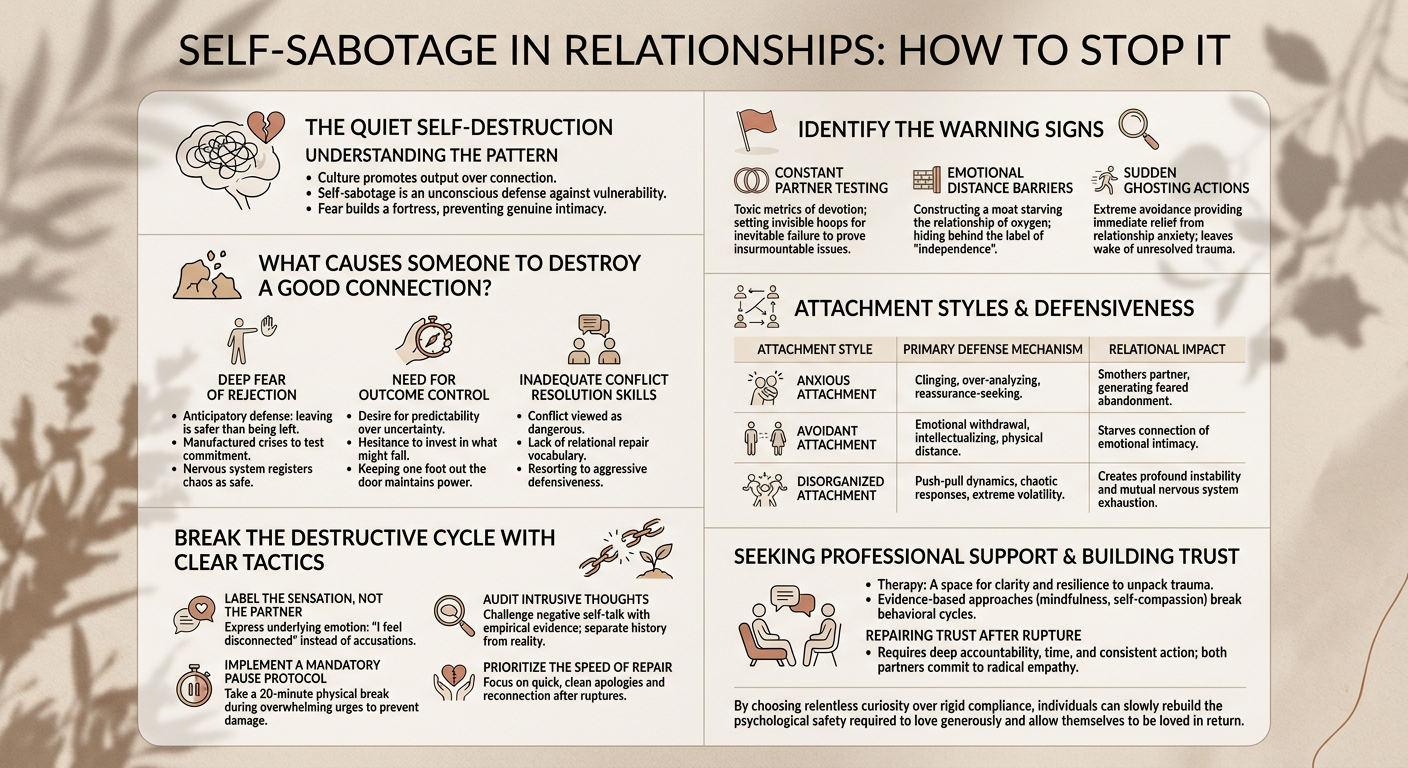
Modern culture operates under a quiet, devastating assumption. People are taught to optimize their lives for output, manage emotional risks, and secure a high return on investment with absolute certainty. Self-sabotage in relationships is an unconscious, self-defeating attitude that prevents individuals from initiating or maintaining fulfilling intimate partnerships. When people apply corporate risk management logic to human connection, they systematically dismantle the exact intimacy they crave. Researchers and psychologists typically view this destructive behavior not as a structural flaw in character, but as a misguided, desperate attempt at self-protection.
A recent clinical analysis defining relationship sabotage as a repeated, maladaptive pattern of behaviors rather than a single interaction confirms what many trauma-informed therapists already suspect. Sabotage is deeply methodical. The human mind builds a fortress out of fear, ensuring no one can get close enough to inflict real damage. People measure every interaction by the inch, tracking slights and perceived rejections like metrics on a spreadsheet, quietly eroding the conditions that make their partner feel seen.
What causes someone to destroy a good connection?
Efficiency demands predictability. Intimacy, however, is inherently unpredictable and messy. When an individual feels the emotional ground shifting beneath their feet, their internal operating system often triggers defensive protocols to regain balance.
Deep fear of rejection
Rejection trauma creates a anticipatory defense mechanism. A person carrying unhealed childhood wounds often decides that leaving is infinitely safer than being left. They manufacture crises out of thin air. They pick fights over minor misunderstandings or purposefully agitate a romantic partner just to see if that person will fight to stay. This is the subconscious self trying to preemptively end the connection. It guarantees a painful outcome, but it provides an outcome the individual controlled. The nervous system registers this artificial chaos as safer than the terrifying vulnerability of trusting another human being.
Need for outcome control
Human beings despise uncertainty. The relentless desire to meticulously control how a relationship unfolds often masquerades as having “high standards.” Sociological data indicates a lack of commitment is cited by 73% of individuals as a primary cause for romantic dissolution. That hesitance rarely stems from genuine apathy. It stems from a profound terror of investing time and energy into something that might fail. By keeping one foot perpetually out the door, people maintain the illusion of power. They trade the possibility of profound joy for the guarantee of never looking foolish.
Inadequate conflict resolution skills
Compliance is frequently mistaken for character. Children who grow up in households where anger was met with punitive discipline or icy silence learn very early that conflict is dangerous. They never acquire the vocabulary for relational repair. When inevitable disagreements arise in adulthood, they lack the tools to navigate the friction. They resort to aggressive defensiveness. Cultivating proper communication strategies requires replacing the urge to win the argument with a sincere curiosity about the partner’s internal world.
Identify the warning signs of self-destructive romantic behavior
People rarely announce they are about to ruin a good thing. The warning signs are subtle, woven quietly into everyday routines and passing comments.
Constant partner testing
Testing is a toxic metric of devotion. It involves setting up invisible hoops and waiting silently to see if a spouse or partner jumps through them. The partner inevitably fails because the rules of the game were never communicated. The person self-sabotaging then uses this failure as hard evidence that the relationship issues are insurmountable. This dynamic fundamentally damages trust, mirroring a transactional culture where love must be constantly earned and proven rather than freely given.
Emotional distance barriers
Creating necessary psychological space allows partners to breathe. Constructing an impenetrable moat simply starves the relationship of oxygen. Emotional withdrawal often hides behind the convenient label of independence. A person might refuse to share their difficult feelings, claiming they do not want to be a burden. In reality, establishing rigid, unrealistic rules damage close relationships because they deny the partner any opportunity to offer meaningful support.
Sudden ghosting actions
Disappearing entirely is the extreme measure of avoidance goals. Modern dating culture has normalized this abrupt vanishing, but the underlying metrics betray a quiet terror. Industry reports suggest only 33% of young adults date regularly, largely due to the overwhelming frequency of sudden emotional abandonment. Ghosting provides immediate relief from relationship anxiety. The individual escapes the uncomfortable conversation. Yet, this superficial exit leaves a wake of unresolved trauma and compounding insecurity for both parties.
How do attachment styles dictate your romantic defensiveness?
Early experiences write the base code for how people receive and process love. Clinical evaluations of human behavior consistently show that insecure attachment predicts weaker goals to approach closeness. The attachment system acts as a thermostat, constantly adjusting to maintain a perceived level of emotional safety.
|
Attachment Style |
Primary Defense Mechanism |
Relational Impact |
|---|---|---|
|
Anxious Attachment |
Clinging, over-analyzing text messages, reassurance-seeking. |
Smothers the partner, generating the exact abandonment feared. |
|
Avoidant Attachment |
Emotional withdrawal, intellectualizing feelings, physical distance. |
Starves the connection of necessary emotional intimacy. |
|
Disorganized Attachment |
Push-pull dynamics, chaotic responses, extreme volatility. |
Creates profound instability and mutual nervous system exhaustion. |
Anxious attachment triggers
Individuals with an anxious attachment style operate with a hyperactive threat detection system. A delayed response is immediately interpreted as a precursor to a breakup. They seek constant validation, which eventually exhausts the partner. Engaging in effective relationship anxiety therapy often involves learning to self-soothe. The individual must learn to tolerate their own distress rather than outsourcing their emotional regulation entirely to someone else.
Avoidant withdrawal tactics
High attachment avoidance looks like exceptional, almost admirable self-sufficiency. When a romantic relationship reaches significant milestones like moving in together, the avoidant partner suddenly feels trapped. They might begin working late, pick apart their partner’s minor flaws, or prioritize casual acquaintances over their spouse. They dismantle closeness inch by inch, convinced they are just being rational.
Disorganized emotional responses
This attachment style is typically deeply rooted in of severe childhood trauma. The early caregiver was simultaneously the source of comfort and the source of terror. Adults with disorganized attachment deeply crave love but remain absolutely terrified of it. They frequently spot enmeshed relationship habits in themselves, oscillating wildly between desperately clinging to a partner and aggressively pushing them away. The internal experience is profound emotional turbulence.
Break the destructive cycle with clear communication tactics
Rewriting deeply ingrained destructive habits demands intentional, uncomfortable effort. It requires moving away from the desire for an instant quick-fix and embracing the slow, unglamorous work of personal development.
-
Label the internal sensation, not the partner: Accusations trigger defensiveness. Express the underlying emotion instead. Saying “I am feeling incredibly disconnected right now” opens a dialogue. Saying “You never pay attention to me” escalates the conflict.
-
Implement a mandatory pause protocol: When the overwhelming urge to destruct or flee arises, enforce a twenty-minute physical break. This gives the nervous system time to exit fight-or-flight mode before permanent verbal damage occurs.
-
Audit intrusive thoughts: Challenge negative self-talk aggressively. When the brain insists a partner is losing interest, demand empirical evidence. Separate historical triggers from current reality.
-
Prioritize the speed of repair: Accept that ruptures will happen. Shift the focus from preventing all conflict to improving how quickly and cleanly both partners can apologize, forgive, and reconnect.
Perfectionism in romance is simply avoidance dressed in a tailored suit. Unchecked, this mindset inevitably leads to damaged relationships, driven by the false expectation that real love should never require hard work.
Seek professional therapeutic support to heal past trauma
Therapy is a dedicated space for cultivating clarity and resilience. People carrying the heavy luggage of traumatic experiences often need a trained third party to help unpack it. An evidence-based, holistic approach allows individuals to examine their subconscious self without drowning in shame. Healing requires a human-first approach, recognizing that behavior is a symptom, not the core identity.
Working with a clinical professional helps bridge the massive gap between knowing a behavior is harmful and actually possessing the emotional capacity to stop it. Interventions focused on mindfulness and self-compassion prove remarkably effective. Guided counseling provides the necessary framework for breaking behavioral cycles. A trauma-informed therapist helps clients build psychological safety, proving through co-regulation that vulnerability does not inevitably lead to disaster.
How can partners repair trust after a serious rupture?
Trust is a muscle that grows denser and stronger through the agonizing process of tearing and healing. Repairing a connection after significant emotional withdrawal, betrayal, or long-term sabotage requires moving far beyond superficial apologies. It requires deep, sustained accountability.
The offending partner must earn back authority through time and consistent action. The injured partner must practice the difficult art of allowing the repair to happen, actively resisting the urge to perpetually punish the transgressor. When deep-seated fears or financial secrets cause the rupture, improving communication and trust necessitates complete, uncomfortable transparency. Both parties must commit to nurturing the environment. Trauma’s echo in relationships often demands that couples navigate the aftermath of their absolute worst moments with radical empathy.
FAQ
What is the psychological root cause of relationship sabotage? The core driver is a profound fear of vulnerability, often stemming from early childhood trauma, rejection, or insecure attachment styles. The brain perceives emotional intimacy as a literal threat to survival and triggers defensive behaviors to regain a sense of safety and control.
Can a highly self-sabotaging relationship actually be saved? Yes, but it requires radical honesty and a high tolerance for discomfort. Both partners must commit to understanding the underlying psychological triggers rather than endlessly fighting about surface-level drama. Professional counseling is frequently necessary to facilitate this deeply vulnerable work safely.
How do I stop pushing my partner away when I feel overwhelmed? You must learn to recognize the physiological signs of your nervous system flooding. Before you resort to ghosting or starting an unnecessary argument, explicitly tell your partner you need a temporary timeout to regulate your difficult feelings. Taking ownership of your anxiety prevents it from being used destructively against the person you love.
Are certain people just incapable of a healthy romantic relationship? No human being is inherently incapable of connection. However, individuals with untreated trauma, severe trust difficulty, or high attachment avoidance may currently lack the emotional regulation skills required to sustain a healthy connection. With consistent effort, mindfulness, and proper support, anyone can develop secure, empowering relationship skills.
Conclusion
Society mistakenly treats vulnerability as an operational inefficiency. People are instructed to manage risks, secure firm guarantees, and cut losses the moment the relationship metrics look unfavorable. The human heart operates on entirely different principles. Self-sabotage in relationships is the tragic, inevitable result of applying corporate self-protection strategies to the most intimate spaces of life.
Breaking these deeply ingrained patterns is not about finding a magical cure or permanently fixing something broken. It is about gifting yourself the spaciousness to be deeply, messily human. It requires trading the hollow, isolated comfort of control for the terrifying reality of being truly seen. True personal development happens in the quiet, uncomfortable moments after the urge to run has finally passed. By choosing relentless curiosity over rigid compliance, individuals can slowly rebuild the psychological safety required to love generously and allow themselves to be loved in return.