
Last updated on September 4, 2026
The moment the promotion lands, the anxiety sets in. A quiet, persistent suspicion takes over, whispering that a clerical error was made and exposure is imminent.
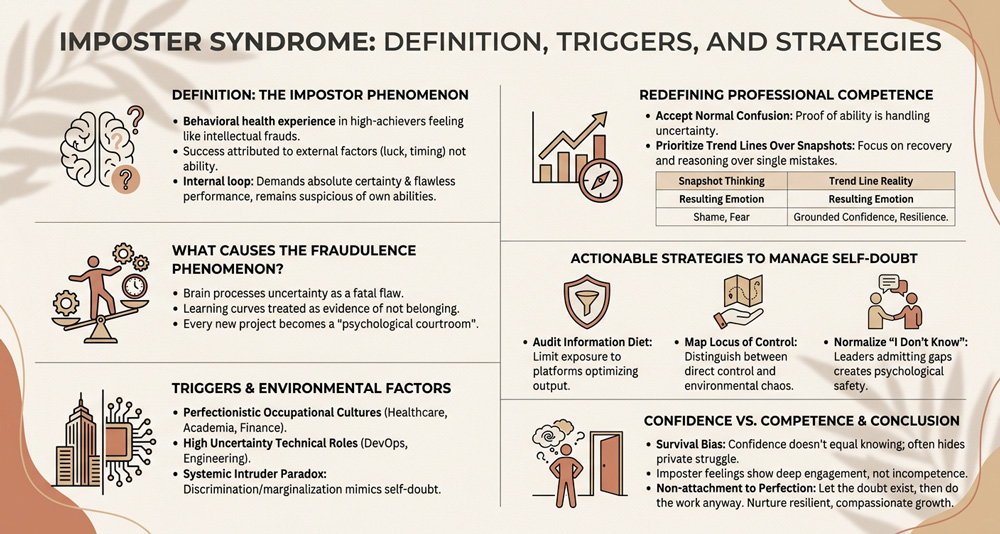
Imposter syndrome—formally recognized in psychological literature as the impostor phenomenon—is a behavioral health experience where high-achieving individuals feel like intellectual frauds. They attribute their success to external factors like luck or timing rather than genuine ability. It is not a charming quirk of the humble. It operates as a punishing internal loop where a person demands absolute certainty and flawless performance, only to remain deeply suspicious of their own abilities even after delivering undeniably excellent results.
The frustrating reality is that this internal experience does not care about outcomes. It only cares whether an individual feels fully prepared in the moment.
What Causes the Fraudulence Phenomenon?
To understand this intellectual phoniness, one must look at how the human brain processes uncertainty. Often, the mind treats the natural learning curve like a fatal flaw. If a person is not instantly adept at a new task, their internal narrative decides they simply do not belong. Every new project becomes a psychological courtroom. The professional acts as both the defendant and the prosecutor, constantly searching for evidence of their own inadequacy.
Clinical Comorbidity Factors
Psychiatrists and clinical psychologists emphasize that this experience is not a distinct mental illness. It lacks a formal medical classification in the DSM or ICD frameworks. Yet, independent evaluations reveal it rarely travels alone.
Clinicians note that intense impostor feelings are highly comorbid with severe anxiety and social isolation. Major depression and low self-esteem frequently accompany this state. It is a complex emotional ecosystem. When a healthy self-perception deteriorates, the resulting distress often bleeds into broader mental health issues, turning a temporary crisis of confidence into a chronic baseline of fear.
Psychological Behavioral Loops
Experts observe a recurring behavioral pattern known as the imposter syndrome cycle. The fear of falling short triggers one of two extreme responses: severe overpreparation or chronic procrastination.
A professional might spend seventy hours preparing for a routine presentation, terrified of being exposed. When the presentation succeeds, they attribute the success entirely to the grueling overpreparation, reinforcing the belief that their natural talent is insufficient. Alternatively, they procrastinate until the final hour, attribute the eventual success to pure luck, and the cycle of self-doubt restarts. This feedback loop of emotional distress quietly drains a person’s resilience.
Perceived Knowledge Gaps
Professionals suffering from impostorism often harbor a distorted perception of intelligence. They assume everyone else in the room possesses complete clarity. This creates an impossible standard. When they inevitably encounter a gap in their own knowledge, they interpret this normal confusion as definitive proof of their incompetence.
Behavioral Archetypes and Common Environmental Triggers
Environments shape behavior. A culture obsessed with unchecked scaling and flawless output provides the perfect ideal environment for workplace impostor thoughts to thrive.
Perfectionistic Occupational Cultures
Certain fields demand an aggressive standard of excellence. Healthcare, academia, and high finance cultivate rigid, perfectionistic cultures. A sweeping systematic review highlights how high-pressure environments foster these feelings, leading to emotional exhaustion.
Organizational data connects these intense imposter traits directly to severe burnout. When the institutional script dictates constant “upgrading” and flawless job performance, individuals naturally suppress their vulnerability. They score high on the Clance impostor phenomenon scale not because they lack skills, but because the environment lacks psychological safety.
High Uncertainty Technical Roles
Technical disciplines like DevOps and software engineering carry uncertainty baked into their daily operations. Stacks move constantly. Incidents happen. Weird edge cases break systems at three in the morning.
In these roles, professionals are constantly required to QA someone else’s code or untangle undocumented logic. There is always a broken process one can point to and say, “See? I am not legit.” Because the work itself involves constant trial and error, the individual misinterprets systemic ambiguity as personal fraudulence.
Systemic Intruder Paradox
Contemporary sociological research delivers a heavy critique of the traditional, individualized framework. Labeling this self-doubt strictly as a personal “syndrome” shifts the focus away from systemic inequities.
Scholars point to the intruder paradox. Systemic discrimination or gaslighting within institutions forces marginalized individuals to feel out of place. When ethnic minorities, women, or LGBTQ+ professionals experience higher rates of the phenomenon, it is often because they navigate environments rife with stereotypes and subtle microaggressions. In these cases, feeling like an impostor is a completely normal response to an exclusionary environment. It is not an internal deficiency. It is workplace discrimination.
Redefine the Concept of Professional Competence
One does not overcome this phenomenon by thinking positive thoughts harder. Superficial affirmations do little to quiet a deeply entrenched belief system. The solution requires changing what constitutes “proof” of competence.
Accept Normal Confusion
Competence does not mean existing in a state of perpetual certainty. Proof of ability is actually the evidence that one can handle uncertainty.
When taking on larger responsibilities, professionals must stop waiting until they feel entirely confident. Instead, they can build a debug routine. Write down what is known, what is unknown, what is suspected, and what must be tested next. This shifts the internal experience from a feeling of exposure into actionable work mode. The emotion might not disappear instantly, but it stops dictating the situation.
Prioritize Trend Lines
The anxious brain loves single snapshots. One awkward meeting. One botched exam. One public mistake. But true career accomplishment is a trend line, not a photograph.
|
Cognitive Approach |
Focus Area |
Resulting Emotion |
|---|---|---|
|
Snapshot Thinking |
A single mistake or isolated moment of confusion. |
Shame, fear of exposure, intellectual phoniness. |
|
Trend Line Reality |
The ability to unblock oneself and recover over time. |
Grounded confidence, sustainable resilience. |
Tracking tiny wins that do not even feel like successes in the moment builds undeniable evidence. How quickly did they recover after a misstep? How many times did they reason through a problem instead of freezing? Over time, these receipts make the “I am an imposter” narrative mathematically difficult to support.
Ask Specific Questions
Reassurance-seeking is a trap. Asking a colleague, “Am I doing okay?” invites vague emotional comfort that evaporates within hours.
Instead, professionals must lean into specific external reality checks. Asking, “Does this plan make sense, or am I missing something obvious?” generates concrete feedback on the approach. It grounds the individual in evidence-based reality. Once they practice this consistently, they often realize their peers are not judging them nearly as harshly as their own inner critic.
Execute Actionable Tactics to Manage Self-Doubt
Changing the internal operating system requires deliberate, physical practice. Holistic growth demands moving beyond awareness into tangible behavioral shifts.
-
Audit the information diet: Limit exposure to platforms that optimize for output and artificial perfection. Social media often exacerbates the feeling of falling behind.
-
Map the locus of control: Physically write down which aspects of a project are within direct control and which belong to environmental chaos. Stop taking responsibility for systemic bottlenecks.
-
Normalize the “I don’t know” in leadership: Leaders who admit their own knowledge gaps create psychological safety for early stage professionals and doctoral students, disrupting the generational transmission of impostorism.
Does Confidence Correlate With True Competence?
A pervasive myth suggests that those who look confident always know exactly what they are doing. This is survival bias. The observer only sees the moments of clear explanation, completely missing the hours of private Googling, guessing, and frantic iteration.
Imposter feelings usually show up in people who actually care deeply about their work. If an individual did not care about the consequences of their actions, they would not spiral. They would simply coast. Therefore, this anxiety is rarely proof of incompetence. It is usually proof of deep engagement. The trap closes when a person confuses “I care and I am anxious” with “I am a total fraud.” True talent involves asking the right questions and narrowing uncertainty quickly, not walking into every room with unshakeable bravado.
When Does Systemic Bias Mimic Self-Doubt?
It is crucial to differentiate between an internal crisis of confidence and the external reality of societal pressure. Research explicitly details how individuals from marginalized backgrounds experience higher rates of these feelings due to toxic workplace dynamics.
When an organization lacks diversity, the friction of simply existing in that space takes a toll. Racism, sexism, and exclusionary policies create an environment where a person is constantly asked to prove their worth. Blaming the individual for exhibiting moderate impostor phenomenon characteristics under these conditions is a profound failure of leadership. Relational repair requires addressing the institutional structures that make people feel unseen in the first place.
FAQ
Is imposter syndrome considered a mental illness? No. It is not recognized in the DSM-5 as a medical condition. However, it is a significant behavioral health experience that often correlates with clinical anxiety and depression.
Can someone ever get rid of these feelings entirely? Eradication is rarely the goal. For many, the feeling never fully vanishes, but it transitions from a debilitating fear into manageable background noise. The objective is to stop worshipping the feeling and continue taking action alongside it.
Does watching resources like a 10 minute ted impostor syndrome video actually help? Brief educational content builds initial awareness and provides a vocabulary for the experience. However, translating that awareness into systemic change requires deeper structural work, boundary setting, and consistent behavioral practice.
Conclusion
The obsession with flawless scaling—whether in business or personal development—strips away the messy, vital components of human connection. The drive to eradicate every trace of self-doubt often just creates more pressure.
Non-attachment to the concept of perfection allows a professional to let the impostor feeling pass through them without it taking their sense of self with it. Growth and curiosity require spaciousness. They require the grace to be uncertain. The goal is not to build an armor of absolute confidence, but to nurture a resilient, compassionate relationship with one’s own evolving abilities. Let the doubt exist. Then do the work anyway.