
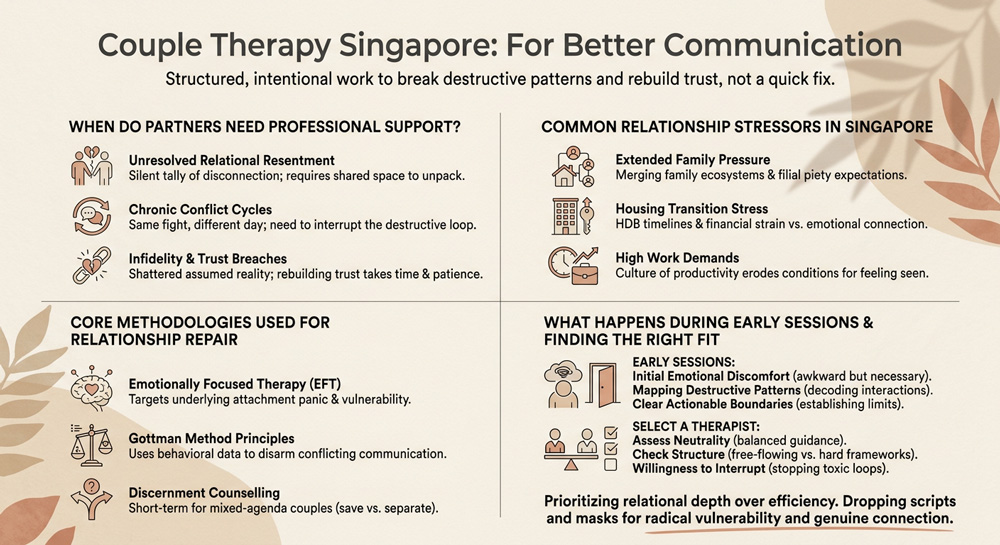
Couple therapy Singapore is a professional counseling service led by clinical psychologists or experienced therapists designed to help couples break destructive communication cycles, resolve chronic conflicts, and rebuild trust amidst high-pressure environments. Most working professionals approach marriage counseling like a quarterly performance review. You identify the metrics, highlight operational bottlenecks, and may have uneven expectations for a clinical psychotherapist or psychologist to deploy a framework that optimizes domestic output. That is not how it works. In reality, engaging in couple therapy in Singapore means you are essentially paying a trained professional to help you stop doing the same destructive patterns on repeat. It is not about finding a magical fixer who will hand you a checklist for marital bliss. It is intentional, structured work. We live in a city obsessed with key performance indicators, yet we severely underestimate the emotional toll required to maintain a functioning partnership under immense systemic pressure.
When you finally decide to strengthen your relationship through couple counselling in Singapore, the first hurdle is abandoning the idea that your partner is a problem to be solved. They are a person to first be understood.
When Do Partners Actually Need Professional Support?
Most people wait until the house is actively burning before they call the fire department. You do not need to wait for a major difficulties. Seeking counseling early is an act of resilience.
Unresolved Relational Resentment
Resentment is quiet. It does not scream across the living room. It looks like polite indifference during dinner. It is the silent tally of unwashed dishes, forgotten anniversaries, and dismissed opinions. Over time, this emotional disconnection becomes more deeply rooted. You stop giving your partner the benefit of the doubt. Individual sessions might help you process your own frustration, but unpacking mutual resentment requires a shared space.
Chronic Conflict Cycles
Some couples have the exact same fight for ten years. The subject changes from money to parenting styles, but the choreography remains identical. One partner becomes more critical, the other withdraws. Or both escalate until someone walks out. This is a destructive relationship pattern. You need an experienced couples therapist to interrupt the cycle in real time. They force you to look at the machinery of your argument rather than the content of it.
Infidelity And Trust Breaches
Betrayal shatters the assumed reality of a relationship. It is not just about the physical or emotional affair. It is about the sudden, painful realization that the person sleeping next to you is a stranger. Rebuilding trust after a breach often takes time and patience. It requires the hurt partner to voice their pain without cruelty, and the offending partner to hold space for that pain without defensiveness.
Common Relationship Stressors For Spouses In Singapore
We cannot talk about mental health and relationships here without acknowledging the environment. Our geography dictates our psychology.
Extended Family Pressure
Marriage in this part of the world is rarely just between two people. You are merging two entire family ecosystems. The expectations around filial piety, weekend visits, and grandparent involvement can easily suffocate a young marriage. This dynamic is deeply rooted, as recent clinical research on cultural values explicitly shows how Asian nuances shape systemic relationship distress. If you do not draw a boundary around your marriage, your extended family will gladly draw one through it.
Housing Transition Stress
The timeline of romance here is often dictated by the Housing Development Board. Couples apply for a flat, wait five years, and can feel as though they are being locked into a life path before they have learned how to resolve a basic argument. The financial strain of upgrading from an HDB to a condo introduces massive friction. When money becomes the proxy for love and security, unspoken assumptions require financial therapy for couples to unearth the real pain hiding behind budget spreadsheets.
High Work Demands
We optimize for output. We scale our careers. We answer emails at midnight. And in doing so, we quietly erode the conditions that make people feel seen.
|
Stressor |
The Surface Argument |
The Underlying Emotional Root |
|---|---|---|
|
Work Hours |
“You are never home for dinner.” |
“I feel abandoned and unimportant to you.” |
|
Finances |
“You spend too much on trivial things.” |
“I am terrified we will not be secure.” |
|
In-Laws |
“Your mother is overbearing.” |
“I need you to protect our partnership first.” |
This intense culture of productivity leaves very little room for emotional safety. Recognizing this, official government programs designed to strengthen transnational and young marriages have been established to help couples navigate these very modern, very exhausting pressures. However, they are at this moment to little success.
What Happens During Early Counseling Sessions?
People overestimate how quickly counseling will change things. The posts you read online from couples at an all-time low usually attract people who are entirely burned out. When you are burned out, you want fast relief. Therapy does not offer that.
Initial Emotional Discomfort
Early therapy sessions can feel awkward. Sometimes you walk out feeling worse than when you walked in. This is normal. You are finally saying the things you have spent years carefully dodging. A good marriage counsellor will not let you hide behind polite banter. They will ask the questions that make your stomach drop. That discomfort is the feeling of beginning the process of emotional openness.
Destructive Relationship Patterns
You will spend time mapping out your patterns and cycles. Often, couples therapists use established methods to decode these interactions. The Emotionally Focused Couple Therapy framework and Gottman Couples Institute framework is widely used here because it explicitly explains how negative interaction cycles are resolved through attachment science. You learn that your partner’s anger is actually panic, and their withdrawal is actually self-preservation.
Clear Actionable Boundaries
Therapy is not a place to endlessly vent. It is a place to establish what is acceptable and what is not. You will learn to articulate your limits without issuing threats. This requires both partners to take responsibility for their own emotional regulation. You cannot demand your partner soothe a wound they did not create.
Select A Therapist Who Fits Your Conflict Style
You do not just need a professional. You need the right fit when it comes to therapy.
-
Assess their neutrality: Look for a therapist who provides balanced guidance. If a therapist validates the other partner and asks “how does that make you feel” while your partner verbally bulldozes you, it is a red flag.
-
Check their structure: Some couples need free-flowing emotional exploration. Others need hard frameworks and behavioral therapy principles. Know what you respond to.
-
Evaluate their willingness to interrupt: A highly experienced counsellor will stop you mid-sentence if you are repeating a toxic loop.
Communication Directness Level
If you read community threads on marital help, the subtext is always “please tell me what actually worked.” What works is a practitioner who is direct but respectful. I have been in situations where a neutral approach felt entirely useless. A more assertive relationship therapist can suddenly make it feel like you are actually naming the problem instead of just circling it.
Treatment Framework Style
Some couples want vibes. Some want blueprints. If you are highly analytical, an unstructured approach will may not be the right fit. You might prefer a professional who uses concrete pattern mapping and clear action steps. It is perfectly fine to ask a psychotherapist about their specific modalities during the first session.
Mutual Partner Buy-In
Here is the important reality about joint sessions. Couples therapy is only worth it when both people show up with at least partial buy-in. If one partner is just going along to keep the peace, the room turns into a slow-motion debate club where nothing lands. A therapy room is not a courtroom. You are not there to present evidence to a judge to prove your partner is defective. If you lack mutual buy-in, you might still get some benefit, but it will feel like dragging a suitcase up stairs you did not choose to build.
Why Do Generic Communication Tips Often Fail?
A friend of mine did a few sessions with someone who focused heavily on communication tips. It felt like being handed a script while the real issue was deep relational hurt. They did not just need better phrasing. Handing out 15 couples therapy exercises for communication without context is like putting a band-aid on a much deeper issue.
If there is no underlying emotional connection, using “I feel” statements sounds incredibly patronizing. We need help addressing the actual pain. Relying strictly on basic communication therapy for couples often falls flat because it treats the symptom rather than the disease. You have to rebuild the foundation before you worry about the paint color.
How Long Does Relationship Restoration Actually Take?
It takes as long as it takes for both of you to drop your emotional armor. For some, a brief therapy block of eight to twelve weeks provides enough clarity to change the trajectory. For couples unwinding decades of betrayal trauma, infidelity or complex extended family enmeshment, it can take much longer.
The data is highly encouraging for those who stick with it. A meta-analysis on treatment outcomes shows that the average person completing this work is significantly better off than the vast majority of those who try to fix it entirely alone. Locally, this is supported by preliminary findings on state-backed family counseling which clearly show improved mental well-being and marital adjustment for those who participate in structured interventions.
You are investing in the psychological safety of your home. That is not a quick process.
FAQ
Can counseling help if we have already decided to separate? Yes. Sometimes the goal shifts from saving the marriage to navigating an amicable separation, especially when parenting is involved. In fact, the judicial framework for mandatory mediation in Singapore strictly requires attendance for couples with young children going through divorce to ensure the transition does not destroy the child’s well-being.
Is online couples therapy effective? Virtual counseling help can be highly effective provided both partners are in a private, distraction-free environment. If you are dialing in from a busy cafe or while feeding a toddler, the therapeutic process will suffer. You need a dedicated container for the work.
What if my partner refuses to go? You cannot force someone to grow. If they refuse to attend marriage counselling sessions, you can still pursue individual counselling. Changing your half of the dynamic often forces the overall relationship pattern to shift, even if they never step foot in a clinic.
Conclusion
We spend exorbitant amounts of money upgrading our physical spaces while allowing our emotional spaces to decline. A beautiful condo means very little if you cannot stand the person sitting next to you on the imported sofa. Prioritizing relational depth is counter-cultural in a society that worships efficiency.
Couples counseling is not a sign that your relationship cannot improve. It is a signal that you are finally taking the relationship seriously enough to do the difficult, unglamorous work of genuine human connection. You drop the scripts and masks. You face the resentment and difficult conversations. You learn to nurture the important bond that exists between the two of you. That requires radical vulnerability and a willingness to be wrong. It is messy, it is frustrating, and it is absolutely the most vital work you will ever do.