
Last updated on August 11, 2026
Marriage counselling in Singapore operates as a structured, evidence-based clinical intervention meant to overhaul a relationship’s emotional operating system. The primary purpose is not to mediate minor domestic squabbles or decide which partner is legally right. Instead, it treats the relationship system itself. Professional intervention provides a neutral, highly regulated environment where couples can dismantle their entrenched defensive behaviors, rebuild psychological safety, and foster genuine curiosity about each other’s inner worlds. A clinical psychologist or registered counsellor steps in to map out the dysfunctional cycles that two capable adults cannot see because they are entirely caught inside them.
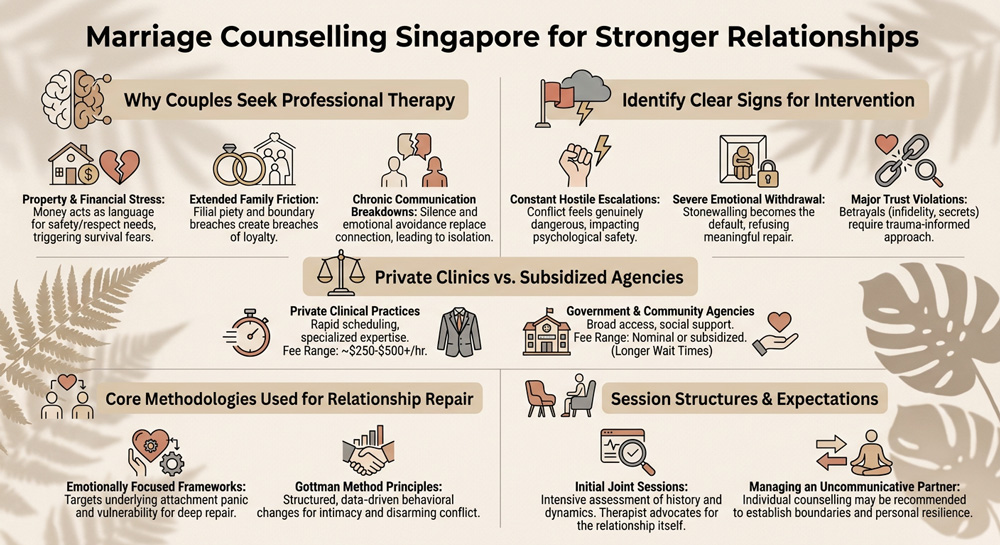
Why Do Couples Seek Professional Therapy Locally?
Singapore demands relentless progression. The culture dictates a very specific script of upgrading, securing the right properties, and maintaining outward stability. Couples therapists routinely see the heavy toll this environment takes on the human nervous system. When two people are continuously optimizing for economic output and societal compliance, they quietly erode the conditions required to nurture authentic emotional connection.
Property and Financial Stress
Money carries deep intergenerational weight. Conversations about balancing a renovation budget or navigating the leap from an HDB flat to a private condominium rarely stay focused on mathematics. Financial stress triggers deeply rooted survival fears. Couples often sit in a counselling centre arguing over perceived irresponsibility, missing the underlying terror of not feeling secure. Exploring Financial Therapy for Couples: Improve Communication & Trust often reveals that money simply acts as the language partners use to express unmet needs for safety and respect.
Extended Family Cultural Friction
Filial piety is frequently can sometimes become a source of tension in local domestic disputes. The expectations of extended families, ranging from weekend visitation schedules to uninvited parenting critiques, create massive friction. A partner might feel deeply unsupported if their spouse repeatedly sides with a parent to maintain familial peace. This dynamic creates a fundamental breach of loyalty. The marital unit must establish firm boundaries to survive, which requires significant clarity and compassionate negotiation that many couples simply never learned growing up.
Chronic Communication Breakdowns
Arguments eventually stop. That is rarely a positive sign. When constant bickering morphs into a quiet, efficient coexistence where partners operate like indifferent roommates, the relationship may begin to feel emotionally disconnected. Chronic communication breakdowns usually manifest as profound emotional avoidance. One partner pursues connection through criticism. The other withdraws into work or digital distractions. They lose the ability to co-regulate each other through daily stressors, leaving both individuals isolated within the very space they should feel most seen.
Identify Clear Signs for Professional Relationship Intervention
Recognizing when to move beyond self-help books and seek an actual couples therapist requires brutal honesty. The threshold for professional intervention is crossed when the relationship becomes a source of chronic distress rather than a reliable base of support.
Constant Hostile Escalations
Conflict is inevitable in any long-term partnership. Escalations that feel genuinely dangerous to a person’s psychological safety are not. When minor disagreements consistently explode into personal attacks, the nervous system begins to perceive the partner as a source of emotional distress. This biological response severely limits higher-order thinking. Without a professional counsellor to impose structure and slow down the reactivity, the couple will simply continue to reinforce emotional hurt.
Severe Emotional Withdrawal
Silence destroys marriages faster than shouting. Severe emotional withdrawal happens when a partner entirely shuts down and refuses to engage in any meaningful repair attempts. The silent treatment is a highly effective way to exert control while claiming innocence. When this stonewalling becomes the default mechanism for handling discomfort, the relationship requires an external facilitator to break the gridlock and re-establish a baseline of functional communication.
Major Trust Violations
Infidelity counselling is one of the most common reasons partners cross the threshold of a clinical practice. Trust violations extend beyond physical affairs. They include hidden debts, secret emotional relationships, and sustained deception. Repairing this level of rupture demands a trauma-informed approach. For couples navigating these complex betrayals, understanding Trauma-Informed Couples Therapy | For Neurodivergent Couples offers insight into how deeply trust deficits impact the body and mind, requiring far more than a simple apology to resolve.
Private Clinics Versus Subsidized Family Service Centres
Public sentiment often highlights the massive disparities in how marital support is accessed locally. The landscape is generally split between government-backed community services and private clinical practices. Navigating this requires understanding exactly what each sector provides.
-
Private Clinical Practices: These centers typically offer immediate access to highly specialized practitioners. They allow clients to select therapists based on specific therapeutic modalities and specific demographic experiences.
-
Government and Community Agencies: These centers prioritize accessibility and holistic social support for families facing multi-faceted crises, including financial hardship or domestic instability.
-
Online Therapy Platforms: Digital access points have grown significantly, allowing couples to engage in therapy from their own homes, which removes logistical barriers for high-stress corporate professionals.
Session Fee Structures
Cost remains a major deciding factor for many seeking help. The financial commitment varies drastically depending on the chosen route.
|
Service Environment |
Estimated Fee Range |
Primary Accessibility Focus |
|---|---|---|
|
Private Therapy Clinics |
$250 to $500+ per hour |
Rapid scheduling and specific clinical matching |
|
MSF-Supported Agencies |
Nominal fees or fully subsidized |
Broad community access and essential social support |
Wait Time Differences
Time is a critical variable when a marriage is actively falling apart. Private clinics generally offer appointments within days or a week. Conversely, community agencies face overwhelming demand. Subsidized care through avenues like the MSF Family Assist Face-to-Face Counselling Portal provides crucial support but often comes with a waitlist stretching several weeks or months. For couples in acute distress, that delay can allow resentments to harden permanently.
Niche Expertise Availability
Different conflicts require different clinical tools. Government programs often excel at providing foundational stabilization for families. For instance, the MSF Strengthening Families Programme (FAM) Overview details specialized structures for minor or transnational couples facing unique legal and social hurdles. Private practices, however, are more likely to house specialists certified in advanced relational therapies or specific psychosexual interventions.
Match Therapist Styles to Your Specific Conflict Dynamic
Treating the search for a marriage counsellor as a hunt for the objectively “best” provider is a mistake. It is entirely a fit problem. If the professional does not match the couple’s specific conflict dynamic, the process will stall.
Evaluate Structural Approach
Therapy must involve an actual framework. If the first few sessions feel like polite communication practice where the therapist merely nods and validates, but nobody fundamentally changes how they fight at home, the intervention is failing. A competent couples therapist takes control of the room. They map out the recurring cycles of who pursues and who withdraws. They do not settle for superficial promises to “talk more.”
Observe Communication Guardrails
Partners who engage in blunt, highly escalated arguments require a therapist who can rapidly enforce communication guardrails. The therapist must possess the authority to interrupt destructive loops in real-time. Conversely, if a couple is cold and avoidant, the practitioner needs a style that draws out hidden resentments without turning the session into an interrogation. Professional bodies maintain strict standards for these clinical competencies, which can be verified through the Singapore Association for Counselling Registered Counsellors List.
Recognize Incompatible Styles
Clients should bail out of incompatible therapeutic relationships much faster than they typically do. If partners consistently leave sessions feeling more defensive, confused, or attacked, the chosen modality is likely the wrong mechanism for their dynamic. Wasting months in ineffective therapy only deepens the marital resentment.
Core Methodologies Used for Relationship Repair
Effective relationship counselling is not just advice-giving. It relies on rigorously tested clinical methodologies designed to rewire how partners interact.
Emotionally Focused Frameworks
Emotion-Focused Therapy targets the underlying attachment panic that drives marital conflict. Rather than teaching couples how to negotiate chores, it addresses the fundamental fear of abandonment or rejection. Practitioners utilizing a Talk Your Heart Out Emotion Focused Therapy Resource guide partners to express their softer, more vulnerable emotions rather than leading with anger. This promotes genuine empowerment and deep relational repair.
Gottman Method Principles
The Gottman Method is highly structured and heavily reliant on behavioral data. It focuses on disarming conflicting verbal communication, increasing intimacy, and removing barriers that create a feeling of stagnancy. Many couples wonder if they need a crisis to benefit from this approach, but exploring Gottman Method Premarital Counseling shows that building resilience early often prevents crises entirely.
Discernment Intervention Tactics
Sometimes, one partner wants to save the marriage while the other is leaning heavily toward divorce. Traditional couples therapy often fails here because the goals do not align. Discernment counselling is a short-term intervention designed specifically for mixed-agenda couples. Programs similar to those outlined in the Methodist Welfare Services Marriage and Divorce Support framework help partners achieve clarity on whether to pursue full marital therapy or move toward an amicable separation.
What Happens During Initial Joint Sessions?
The initial stages of therapy serve as an intensive assessment period. The therapist evaluates the relationship’s history, the nature of the current distress, and the individual psychological backgrounds of both partners. Crucially, ethical practitioners operate under strict guidelines, such as those mandated by the Singapore Association for Counselling Code of Ethics, which dictate that the therapist must never take sides. The relationship itself is the client. The therapist’s job is to advocate for the health of the partnership, pointing out where both individuals contribute to the dysfunction.
How Do You Manage an Uncommunicative Partner?
A frequent failure point in marital therapy occurs when one person is forced into the room against their will. Therapy requires mutual consent and active participation. If one partner remains entirely uncommunicative, rigid, or hostile to the process, traditional joint sessions will likely exacerbate the tension. In these scenarios, the willing partner is often advised to seek individual counselling first. Deciding between Couples Therapy vs. Marriage Counseling options can help an individual clarify their own boundaries and develop emotional resilience, which sometimes inadvertently shifts the dynamic of the marriage enough to invite the resistant partner to the table later.
FAQ
Does marriage counselling actually prevent divorce in Singapore? Success depends heavily on when the couple seeks help. Therapy is highly effective for couples who intervene before contempt becomes permanently entrenched. It cannot salvage a relationship where one partner has already finalized their emotional exit.
Can we use Medisave to pay for couples therapy? Generally, Medisave cannot be used for standard marriage counselling or couples therapy in private practices unless the treatment is part of an ongoing psychiatric intervention for a diagnosed mental health condition at an approved medical institution.
What if my partner refuses to go? You cannot force therapeutic engagement. Attending individual therapy to manage your own stress, set clear boundaries, and understand your role in the relationship dynamic is the most productive path forward when a partner refuses joint intervention.
Conclusion
The pursuit of a healthy marriage in a high-pressure environment requires intentional effort and a willingness to confront uncomfortable realities. Relational repair demands far more than superficial behavior modifications. It requires unearthing the fears, pressures, and historical wounds that dictate how two people treat each other under stress. Engaging with professional marriage counselling in Singapore offers a structured pathway out of destructive cycles. It is a rigorous process of unlearning defensive habits and choosing to build a partnership grounded in genuine respect, rather than mere compliance.