
Last updated on July 1, 2026
You grow up believing your household is perfectly normal. Maybe it was a little loud. Maybe the air got terribly thick when someone dropped a glass or brought home a B on a report card. Children learn quickly to read the room. You figure out which moods are safe, which questions are forbidden, and how to shrink yourself when the adults are tired. That hypervigilance feels like a personality trait until you sit in a clinician’s office decades later and realize you inherited a survival strategy.
Intergenerational trauma operates in the shadows of family culture. It is the transmission of traumatic effects from one generation to the next. The original wound might have occurred decades before you were born. A war. A forced migration. Deep poverty. Yet the psychological distress and physiological bracing against the world are handed down to you like an antique piece of furniture nobody knows what to do with. You did not personally live the original events. Your body learned the threat patterns anyway.
What Defines Inherited Emotional Wounds?
We tend to think of trauma as a terrible event that happens to an individual. But transgenerational trauma is much more insidious. It does not just carry feelings from the past. It carries rules.
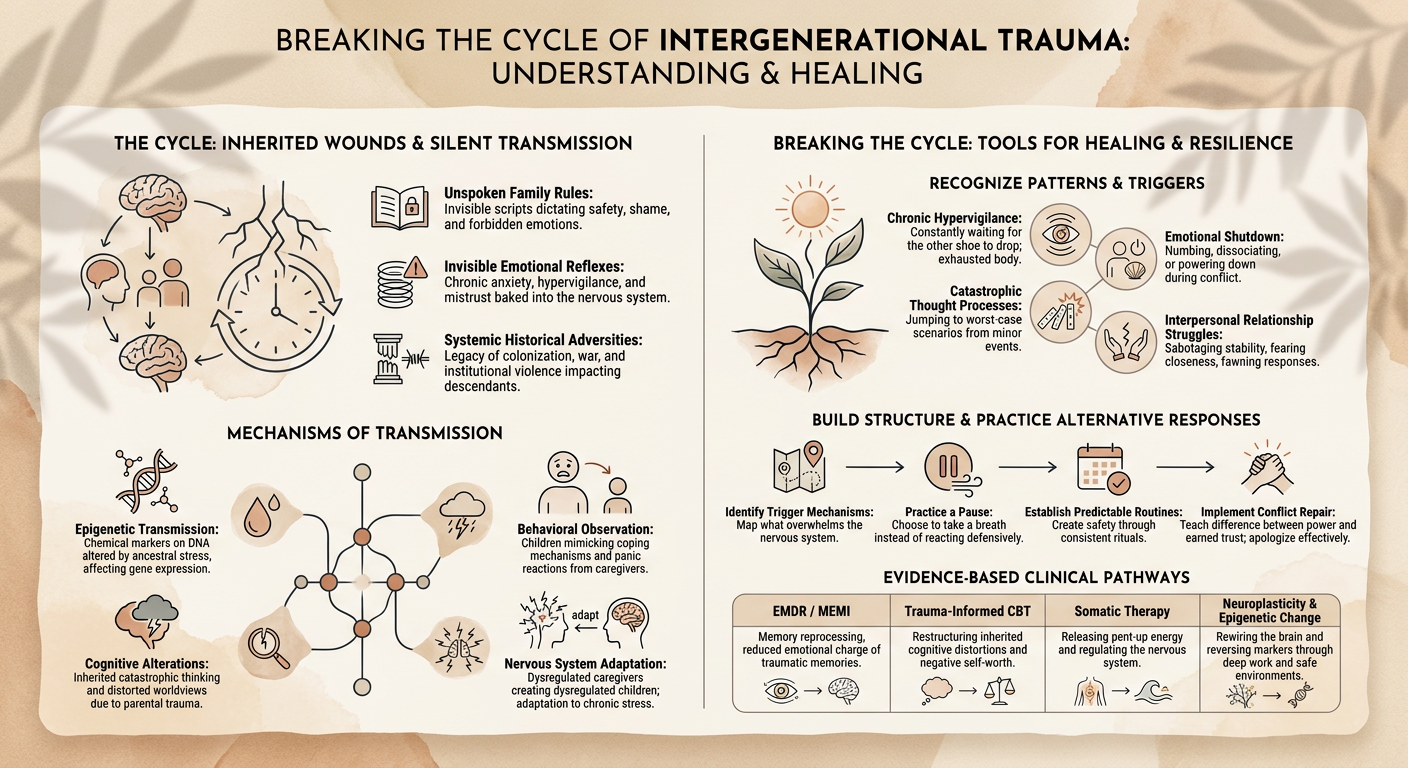
Unspoken Family Rules
Every family operates on an invisible script. These unspoken laws dictate what is safe, what is shameful, what you are allowed to want, and who gets believed in a conflict. Over time, those rules become rigid habits. Habits morph into an identity. The next generation grows up thinking this is just how people are, completely unaware they are running on a behavioral program designed to survive a threat that ended forty years ago. It becomes exceptionally difficult to begin breaking the generational shame spiral tied to bank accounts or relationships when silence is the required currency.
Invisible Emotional Reflexes
The biggest tell of inherited pain is not a family that openly talks about their hardships. The true indicator lies in the emotional reflexes. Shame. Chronic anxiety. Feeling constantly on edge. Trouble trusting affection. People can look entirely fine on the outside, securing promotions and buying homes, while their nervous system is locked in a defensive posture. The American Psychological Association explains how maternal stress alters biological pathways, meaning these reflexes are often baked in before we even have the language to describe them.
Systemic Historical Adversities
Broad scientific consensus acknowledges the systemic impact of large-scale historical adversities on marginalized communities. The trauma of colonization, systemic racism, and war fundamentally alters the trajectory of descendants. Research from Georgetown University regarding the health consequences of boarding schools demonstrates exactly how institutional violence strips away psychological safety across multiple generations. Similarly, evaluations of Jewish Holocaust survivors and their children confirm that severe trauma deeply influences the psychiatric vulnerabilities of offspring.
How Do Survival Behaviors Pass Down?
The mechanisms of transmission are layered. They weave through our biology, our living rooms, and our minds.
Epigenetic Transmission
Our genes do not change, but how they are expressed certainly does. Extreme stress alters the chemical markers attached to our DNA. A foundational study analyzing how fear conditioning affects offspring behavior in mice revealed that trauma changes biology. When an ancestor experiences profound fear, the biological mechanisms of trauma transmission ensure that descendants are born with a heightened sensitivity to specific stressors. It is essentially a biological warning system.
Behavioral Observation
Children are brilliant observers and terrible interpreters. When a child watches a parent react to a minor financial setback with sheer panic, they absorb the panic. Exploring the roots of generational financial trauma shows us how a parent’s constant anxiety over resources teaches the child that the world is scarce and dangerous. The child mimics the coping mechanism without ever knowing the original source of the poverty.
Cognitive Alterations
Parental trauma changes the way a family processes information. A parent who survived intense interpersonal betrayal might view the world with deep suspicion. They model catastrophic thinking. Their children learn to translate silence into a threat and interpret constructive criticism as a total rejection of their worth.
Nervous System Adaptation
When caregivers are trapped in their own unresolved trauma, they struggle to co-regulate with their children. A dysregulated parent creates a dysregulated child. The child’s nervous system adapts to chronic stress by either staying hyper-aroused or shutting down completely. This is not weakness. It is a highly efficient adaptation to an unstable environment.
Recognize Patterns of Inherited Behaviors
Awareness is the absolute prerequisite for change. You cannot dismantle a cycle you refuse to acknowledge. Let us look at how this actually shows up on a random Tuesday.
- Financial Hoarding or Recklessness: Treating money as a shield against unpredictable disaster rather than a tool for living.
- Perfectionism as Armor: Believing that flawless performance is the only way to secure love or prevent abandonment.
- Intimacy Avoidance: Pushing partners away when things get too quiet or stable because peace feels profoundly suspicious.
- Fawning: Immediately abandoning your own boundaries to keep the peace and placate a perceived authority figure.
Chronic Hypervigilance
You are constantly waiting for the other shoe to drop. Even in moments of joy or deep rest, a background alarm hums in your mind. This hypervigilance exhausts the body, often leading to physical ailments and unpacking trauma in high-stress corporate environments where employees burn out rapidly because they perceive routine communications as severe threats.
Emotional Shutdown
When conflict arises, some people fight. Others simply power down. Emotional shutdown is a protective mechanism learned in environments where fighting back was dangerous. The mind dissociates. The body goes numb.
Catastrophic Thought Processes
A minor inconvenience is never just an inconvenience. A missed deadline means you will be fired. Being fired means you will lose your home. The brain skips the middle steps and jumps straight to the worst-case scenario.
Interpersonal Relationship Struggles
We often see the undeniable impact of past trauma on adult relationships. If you grew up in a house where conflict meant physical or emotional danger, you might believe that closeness always costs something. You learn to anticipate mood shifts and walk on eggshells, sabotaging healthy connections because the stability feels entirely foreign.
Build Structure to Break the Cycle
I am not convinced that simply talking about the past is enough. Insight is wonderful, but insight without action is just a different flavor of rumination. People need structure. We have to break the emotional autopilot with targeted repetition because trauma patterns do not dissolve from awareness alone.
Identify Trigger Mechanisms
You need to know exactly what overwhelms the nervous system. Is it the sound of heavy footsteps? Is it a specific tone of voice? Is it receiving a bank statement? Mapping these triggers is the first step in recognizing that your intense reaction belongs to the past, not the present moment.
Practice Alternative Responses
If your default response to criticism is defensive rage, the work involves practicing a pause. It is choosing to take a breath and ask a clarifying question instead of immediately counter-attacking. These small changes, repeated relentlessly, begin to rewire the brain.
Establish Predictable Routines
Trauma thrives in chaos. Healing requires predictability. Building stable routines tells your body that it is safe to lower its guard. This is particularly crucial for families. Creating predictable rituals around meals, bedtimes, and weekends provides an anchor of safety for children.
Implement Conflict Repair
Relational repair requires teaching a child the difference between power enforced by fear and authority earned through trust. Shame makes people hide. Real remorse promotes repair. If we want to heal relational trauma origins, we must learn how to apologize effectively and reconnect after a rupture.
Evidence-Based Clinical Treatment Methods
Healing transgenerational trauma often requires professional scaffolding. Conventional talk therapy can sometimes fall short because it keeps the client in the cognitive brain while the trauma lives in the body.
We look toward evidence-based approaches like EMDR or MEMI that move beyond traditional talk therapy. Eye Movement Desensitization and Reprocessing (EMDR) and Multichannel Eye Movement Integration (MEMI) can help the brain reprocess traumatic memories so they are no longer emotionally charged. Similarly, taking a trauma-informed approach to cognitive behavioral therapy allows individuals to challenge the catastrophic distortions they inherited. Somatic experiencing focuses directly on releasing the pent-up fight-or-flight energy trapped inside the physical body.
| Treatment Approach | Primary Focus | Best Used For |
|---|---|---|
| EMDR | Memory reprocessing via bilateral stimulation. | Deeply entrenched traumatic memories and physical triggers. |
| MEMI | Memory reconsolidation and reprocessing. Largely content-free. | Deeply entrenched traumatic memories, physical triggers. |
| Trauma-Informed CBT | Restructuring inherited cognitive distortions. | Catastrophizing, negative self-worth, and rigid family rules. |
| Somatic Therapy | Nervous system regulation and bodily awareness. | Chronic tension, dissociation, and emotional shutdown. |
Can Biological Epigenetic Changes Be Reversed?
The science of epigenetics sounds terrifying at first glance. The idea that your ancestors’ grief is written into your chemical makeup is heavy. But epigenetics is fundamentally a story of adaptation. And adaptation works in both directions.
Neuroplasticity proves that the brain can rewire itself. When we engage in deep therapeutic work, establish physical safety, and practice emotional regulation, we can actually reverse some of these epigenetic markers. The SAMHSA guidelines for trauma-informed care emphasize that resilience is just as transmissible as pain. Safe, nurturing environments alter our biology for the better. We can pass down a regulated nervous system just as easily as a dysregulated one.
Why Do Good Intentions Perpetuate Family Distress?
Here is a frustrating reality. A massive amount of intergenerational trauma is passed down by parents who are genuinely trying their best. They do not call it trauma. They call it discipline. They call it preparing their kids for the real world.
Imagine a parent who grew up poor in Singapore, terrified of falling behind. They subject their child to immense academic pressure, screaming over minor mistakes. They believe they are protecting the child from the humiliation of poverty. But the child does not learn resilience. The child learns that their worth is entirely conditional on their output.
Compliance is not character. A child who stops a behavior because they are terrified of corporal punishment has not developed moral reasoning. Research shows physical punishment affects neural circuits in the brain underlying emotional regulation. We keep mistaking behavioral compliance for genuine growth. The cycle hides behind good intentions, but the impact remains incredibly heavy.
FAQ
What is the difference between personal trauma and intergenerational trauma? Personal trauma stems from events you experienced directly in your lifetime. Intergenerational trauma involves the psychological and physiological stress responses inherited from your parents or ancestors’ experiences.
Can you have inherited trauma without knowing what happened to your ancestors? Absolutely. You inherit the adaptation, not the memory. You might carry intense anxiety around authority figures without ever knowing your grandparents lived under a suppressive political regime.
Is it possible to completely heal from transgenerational trauma? Healing is not about erasing the past. It is about changing your relationship to it. You can reach a point where the inherited fears no longer dictate your daily choices, relationships, or sense of self-worth.
Conclusion
We live in a society that loves a quick fix. We want a quick solution to optimize our mindset and scale our lives. But unwinding the deeply rooted patterns of intergenerational trauma requires patience, immense self-compassion, and the willingness to look at the messy reality of our family histories.
It is profoundly unfair that you have to heal from wounds you did not cause. But taking on that work is the ultimate act of collective resilience. By regulating your own nervous system, challenging the unspoken rules, and choosing curiosity over judgment, you stop the transmission. The cycle ends here. You get to decide what the next generation inherits.