
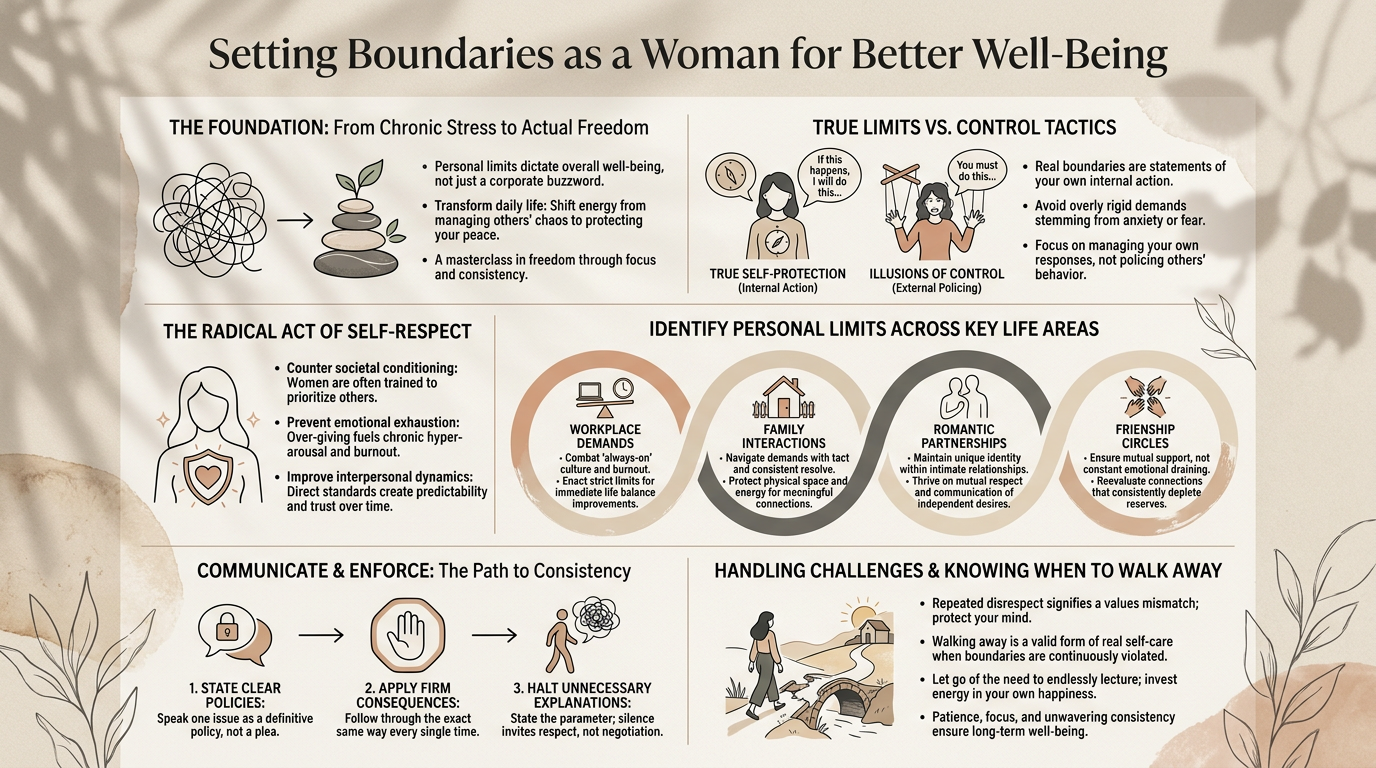
Corporate wellness initiatives and mental health experts agree that personal limits dictate overall well-being, yet most working professionals fail to implement them. The role of personal boundaries in improving mental health goes far beyond a trendy corporate talking point. Defining what you will and will not accept establishes the absolute foundation of a functioning life.
Many of us crowd our schedules with obligations, constantly accommodating everyone else’s needs while thinking, “I just need to push through this week.”
Why not take the energy spent managing other people’s chaos and apply it to protecting your own peace?
With enough focus and consistency, you can transform your daily life from a state of chronic stress into a masterclass in actual freedom.
Setting boundaries as a woman for better well-being is heavily scrutinized in our culture. The sustained effort that go into maintaining a perfect facade for neighbors, colleagues, and family members is difficult to untangle from genuine self care. You give, you bend, and you stretch your comfort level until your own desires vanish completely.
What does this have to do with true well-being?
More than you might realize.
While comparing your emotional health to a well-defined personal boundary may seem extreme, consider the daily struggles that most women face:
- Some days it just feels like you are expending significant energy trying to support a relationship that drains your empathy.
- Abandoning one’s own needs becomes incredibly tempting when you aren’t seeing any reciprocal compassion for your hard work.
- Overcoming that final psychological hurdle to prioritize your own physical space feels like facing what feels like an insurmountable shift.
Likewise, individuals navigating severe mental health issues face similar challenges in the midst of physical and mental roadblocks as they spend years trying to rebuild a sense of self.
But do they give up?
No.
And neither should you.
It’s time to begin taking mental health seriously and establish firm, unshakeable limits.
How?
The Radical Act of Self-Respect
Women aren’t simply born accommodating: they are heavily conditioned as a result of years of fierce social training to prioritize others.
Societal expectations
A foundational study preserved on the NCBI Bookshelf Gendered Labor Framework demonstrates that work-life boundaries are naturally more permeable for women, who face intense societal pressure to interrupt their own tasks for family demands. The world expects a seamless flow of endless giving. Establishing limits disrupts that flow. Setting boundaries is viewed by experts as a radical act of self-respect. It demands that your time, energy, and mental health matter just as much as the people you serve.
Emotional exhaustion
The psychological toll of overextending yourself leads directly to deep emotional exhaustion. Specialized occupational metrics curated by WifiTalents Boundaries Statistics indicate that formal boundary-setting training can decrease career burnout by up to 35%. Without limits, your body remains trapped in a state of hyper-arousal. Clinical analysis from the Aviva Romm Medical Boundary Guide explores how over-giving sustains chronically elevated adrenaline levels and cortisol. This relentless cycle damages your immune system, triggering physical symptoms from indigestion to severe thyroid disruption.
Interpersonal dynamics
Quiet resentment destroys fulfilling relationships faster than any vocalized conflict. When established with clarity and consistency, direct standards actually improve interpersonal dynamics over time. People crave predictability. They prefer to know exactly where the edge of your comfort lies rather than guessing in the dark.
What Separates True Limits From Control Tactics?
There are dozens of misconceptions about what boundary setting actually means. In fact, it seems like definitions are constantly being twisted by pop psychology, year after year.
True self protection
People often treat boundaries like strict rules until they realize they are actually just your personal thresholds. Real psychological boundaries are statements of internal action. To Build Agency Through Strong Relational Boundaries, you must focus on what you will do if a standard isn’t met. “This is what I will do if my needs aren’t respected.” That is the essence of true self protection.
Illusions of control
Using the word “boundary” as a loosely defined justification to manage other adults functions as a trap. If a stated limit only exists to police someone’s behavior, it quickly morphs into an attempt to punish them for being human. The emotional intelligence piece requires understanding that you are protecting your own peace, not negotiating their personal freedom.
Anxiety in disguise
If a limit requires constant surveillance to stay secure, it is simply anxiety presenting itself as self-protection. Overly rigid demands that force loved ones into tight behavioral boxes often stem from deep-seated fear rather than a genuine desire for harmony. True freedom comes from releasing the need to control others and solely managing your own responses.
Identify Personal Limits Across Key Life Areas
It can take individuals years of rigorous counseling or therapy before they successfully map out their internal boundaries. You can’t always expect your newfound limits to feel perfectly natural right from the beginning.
Remember: building appropriate boundaries represents a marathon, not a sprint.
Workplace demands
The corporate world routinely demands more than you can sustainably give. The LeanIn.org Women in the Workplace Report reveals that nearly 60 percent of professional women experience burnout as a primary performance barrier due to an “always-on” culture. Setting professional boundaries is a critical survival tool. Data from a workplace survey states that 57% of workers who enacted strict professional limits noted immediate improvements in life balance.
Family interactions
Navigating family members requires immense tact and an consistent resolve. Relatives often assume they possess unrestricted access to your time and physical space. Protecting availability preserves your energy for the interactions that actually matter.
Romantic partnerships
Intimate relationships blur the line between two distinct individuals. You must protect relationship health with clear external boundaries to maintain your unique identity. Romantic relationships thrive on mutual respect, which is only possible when both partners communicate their independent desires.
Friendship circles
Social distancing during the pandemic taught us the literal value of space, but emotional boundaries within friendships require just as much awareness. Friendships should offer mutual support. If a dynamic consistently drains your emotional reserves, the connection requires immediate reevaluation.
Communicate and Enforce Consequences With Consistency
Communicating.
Enforcing.
Evaluating.
Good boundaries represent a lot of hard work, and there are no shortcuts.
Similarly, psychologists train for years to understand human behavior; however, such clinical guidance can easily be rendered useless if a patient refuses to act on it. On a similar note, individuals attempting to rely on hints or passive aggressive sighs can lose their relationships at little more than a moment’s notice.
State clear policies
Boundaries are taught through repetition and consistency. Pick one issue that actually matters. Speak it once clearly, like a definitive policy rather than a desperate plea.
Apply firm consequences
Follow through the exact same way every single time. People will inevitably test you the first few times. That is simply a predictable relational response to newly established limits about your new standards.
Halt unnecessary explanations
Over-explaining your rationale invites negotiation. You do not need to present a peer-reviewed paper from Psychology Today just to justify needing an evening alone. State the parameter and allow the silence to hang in the air.
Why Do Unrealistic Rules Damage Close Relationships?
Treating normal interpersonal behaviors like a betrayal forces partners to lie. Unrealistic limits turn a warm connection into an environment of strict surveillance and paranoia. Secrecy breeds resentment. When boundaries act as absolute barriers against normal human interaction, they destroy the foundation of trust. Poor boundaries isolate you, whereas effective boundaries build a safe zone where honesty can flourish.
How Do You Handle Repeated Disrespect?
Failing to establish clear limits leads to severe self-doubt, causing individuals to question whether their basic needs are even justified. If someone repeatedly crosses your line and then acts deeply offended that you have one, that behavior signifies a massive values mismatch. Clinical findings highlighted by the Mental Health Center Boundaries Analysis confirm that individuals who struggle with saying no are significantly more vulnerable to clinical anxiety and depression. Protect your mind. Step away from the conflict when your stated consequences are continuously ignored.
When Should You Stop Teaching Grown Adults?
You can teach a person how to treat you exactly once.
After that, you are either compatible or you are not.
Perhaps the biggest mistake a compassionate woman could make is treating another adult like a toddler who needs constant supervision and behavioral correction. If a person continuously violates your physical boundaries or disrespects your time boundaries, walking away is a perfectly valid form of real self care. Let the goodbyes happen. The energy spent endlessly lecturing someone could be spent optimizing your own happiness.
FAQ
Do psychological boundaries ruin natural empathy? Actually, limits preserve your capacity for empathy. Without them, you become resentful and completely numb to the struggles of others due to chronic stress.
How can boundary setting be distinguished from a trauma response? A clinical perspective details how a woman’s adult boundary system is fundamentally compromised if her personal limits were chronically violated during childhood. Consulting a professional through a trusted counseling directory or engaging in specific psychotherapy can help distinguish between healthy self-protection and rigid, trauma-induced walls.
Can boundary building exercises feel physically uncomfortable? Yes. Neurobiological evidence have discussed how people-pleasing and suppressing personal needs triggers the amygdala. Breaking that cycle feels terrifying at first because your nervous system associates compliance with basic survival.
Conclusion
The modern world moves incredibly fast and is difficult to maneuver in the wake of endless societal demands, complex social contexts, and the constant pressure to simply be “nice.”
Much like elite athletes training for a highly competitive event, women should consider patience, firm focus, and unwavering consistency as key virtues to help ensure their long-term well-being. Without clear limits, others will consistently exceed what is appropriate.
You always have the opportunity to bounce back from unhealthy dynamics. Stay organized in your thinking. Stay diligent in your enforcement. Remain consistent in your self-respect.
Your efforts will absolutely pay off.