
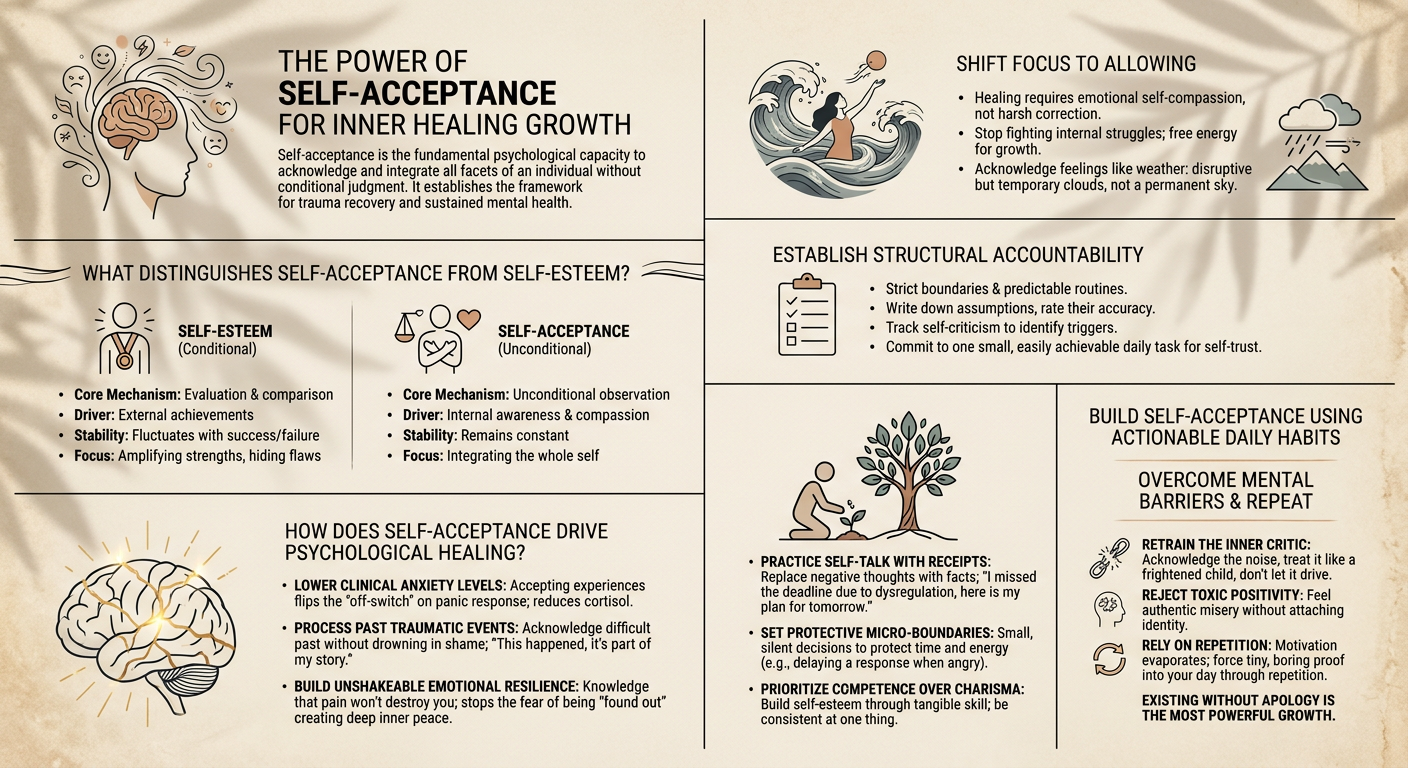
Self-acceptance represents the fundamental psychological capacity to acknowledge and integrate all facets of an individual’s character, behaviors, and emotions without applying conditional judgment or punitive evaluation. This baseline cognitive function allows individuals to process psychological distress by neutralizing internal resistance, ultimately establishing the necessary framework for clinical trauma recovery and sustained mental health stabilization.
Many people spend their waking hours mentally pacing a tiny cell of their own design, convinced they are uniquely broken.
They stare in the mirror and meticulously catalog their faults, hoping that enough brutal self-criticism will eventually forge a better version of themselves.
That strategy usually fails spectacularly.
It fails because attempting to hate oneself into health is like trying to put out a house fire with gasoline. The psychological foundation for inner healing actually requires shifting the focus away from “fixing” perceived flaws. Instead, individuals must embrace their authentic self, recognizing that rejecting their own pain only amplifies the suffering.
What does this actually look like in practice?
It requires a radical pivot.
What Distinguishes Self-Acceptance From Self-Esteem?
People constantly confuse these two concepts.
They assume that if they just achieve enough, earn enough, or look good enough, their low self-esteem will vanish. But self-esteem is highly conditional. It relies on evaluation. It demands that a person constantly measure their strengths against their weaknesses to prove they hold value.
Self-acceptance operates entirely differently. It does not require a person to feel extraordinary or successful. It simply asks them to stop arguing with reality.
| Psychological Metric | Self-Esteem | Self-Acceptance |
|---|---|---|
| Core Mechanism | Evaluation and comparison | Unconditional observation |
| Driver | External achievements and validation | Internal awareness and compassion |
| Stability | Fluctuates based on success or failure | Remains constant despite outcomes |
| Focus | Amplifying strengths, hiding flaws | Integrating the whole self |
When the pursuit of high self-esteem collapses under the weight of an inevitable failure, self-acceptance acts as the safety net.
Shift Focus To Allowing
Healing requires emotional self-compassion rather than harsh correction.
Most people treat their internal struggles like a math problem to solve or a disease to eradicate. By stopping the active rejection of their own mental experiences, they free up vital energy. That energy can then be directed toward authentic personal growth.
Clinical psychologists assert that this approach is never about settling or complacency. It simply provides a safe, non-judgmental foundation.
Treat Emotions Like Weather
For someone attempting to rebuild their self-worth after enduring a dysfunctional environment, the biggest hurdle is usually internal interpretation.
They must learn that their feelings are not proof of their inherent worthlessness.
If someone feels small, awkward, or behind in life, they often treat that emotion as a concrete verdict on their identity. They need to start treating those feelings like weather. A thunderstorm is loud, disruptive, and very real, but it is not a permanent prophecy. The sky remains unchanged behind the clouds.
Establish Structural Accountability
You cannot force self-worth into existence through sheer willpower or aesthetic morning routines.
When an individual grows up around chaos, their sense of value gets tied to the volatile moods and approvals of others. The solution requires strict boundaries, predictable routines, and heavy accountability.
Consider these practical methods to enforce structural accountability daily:
- Write down the specific assumptions made before entering a stressful social situation, then rate their factual accuracy afterward.
- Track instances of self-criticism in a physical notebook to identify behavioral triggers rather than emotional ones.
- Commit to one mundane, easily achievable task every morning to generate undeniable proof of self-trust.
This trains the brain to stop automatically believing the worst-case scenario.
How Does Self-Acceptance Drive Psychological Healing?
Taking the time to untangle deep-seated beliefs is exhausting work.
It can feel like stagnating while attempting to support a mind that constantly expects disaster. But giving up is not an option when Therapy for Shame: How to Heal and Rebuild Self-Worth offers a clear map out of the dark.
By actively engaging with these hidden fears, people naturally reduce their psychological distress.
Lower Clinical Anxiety Levels
Anxiety thrives on resistance.
When a person desperately tries to push away an intrusive thought or a nervous physical sensation, the brain registers that resistance as a threat. The nervous system then pumps out more cortisol to fight the perceived danger.
Accepting mental experiences without judgment essentially flips the off-switch on this panic response. In fact, individuals exploring how nurturing self-compassion physically changes neural pathways often find their resting heart rate and baseline stress levels drop significantly over time.
Process Past Traumatic Events
Trauma therapy relies heavily on an individual’s willingness to look at past experiences without drowning in shame.
If someone cannot accept that they were victimized or that they reacted in a messy, human way to survive, they remain stuck. Healing demands that they look at the difficult past experiences and say, “This happened, and it was terrible, but it is part of my story.”
Build Unshakeable Emotional Resilience
Resilience is not the absence of pain.
It is the knowledge that pain will not destroy you. When someone fully accepts their true nature, they stop living in fear of being “found out”. They no longer waste time hiding their perceived weaknesses from the world.
That kind of authenticity creates a very quiet, very powerful inner peace.
Build Self-Acceptance Using Actionable Daily Habits
A lot of self-love advice available online is too vague to help someone raised in chaos.
Telling a traumatized person to “just love yourself” is like telling a drowning person to simply swim faster. Actionable change requires boring, repeatable habits.
Practice Self-Talk With Receipts
Stop pretending everything is perfect.
If someone fails at a task, toxic positivity demands they smile and call it a blessing. Brutal self-criticism demands they call themselves a failure. Acceptance simply states the facts.
Replacing “I am terrible at my job” with “I missed that deadline because I was dysregulated, and here is the exact step I will take tomorrow” forces the brain to deal with reality. It demands self-talk backed by actual receipts.
Set Protective Micro-Boundaries
Setting boundaries does not always require a huge dramatic exit or a confrontation.
It looks like small, silent decisions. It looks like deciding not to respond to a provocative text message while angry. It looks like refusing to explain personal choices to strangers for free.
Every single time a person protects their time and energy, their brain learns that they are safe and capable of self-care.
Prioritize Competence Over Charisma
Building self-esteem through tangible skill beats relying on external validation every single time.
Nobody needs to become an Olympic athlete or a tech genius. They just need to pick one lane and get boringly consistent at it. It might be attending a weekly fitness class, learning a new software tool, or mastering one complex meal.
Confidence follows proof. Action always precedes belief.
Overcome Deep Mental Barriers To Unconditional Acceptance
The road to true self-discovery is littered with obstacles installed decades ago by other people.
Many women, for instance, carry immense pressure to be perfect caretakers, sacrificing their mental well being to keep the peace. Understanding the dynamics of Healing Shame in Women Through Compassion and Inner Healing involves directly confronting these societal and familial expectations.
It requires tearing out the old wiring to make room for something stable.
Retrain The Inner Critic
The voice in a person’s head yelling at them to do better rarely belongs to them.
Usually, it is an echo of a highly critical parent, a demanding teacher, or an unforgiving culture. Overcoming this barrier requires an individual to stop treating that internal critic like a biological parent who demands absolute obedience.
Instead, they must treat it like a frightened child experiencing distress. Acknowledge the noise, but refuse to let it drive the car.
Reject Toxic Positivity
Forcing a smile while bleeding internally helps absolutely no one.
Attempting to cover up legitimate pain with inspirational quotes or shallow gratitude lists actually damages self-trust. If a person feels devastated, telling themselves they are “fine” is a form of gaslighting.
Authentic healing demands the space to feel miserable without attaching permanent identity to the misery.
Overwrite Dysfunctional Childhood Programming
Children raised in volatile homes learn to read the room before they learn to read a book.
Their entire survival depends on predicting the moods of unstable adults. Consequently, their inherent worthiness becomes deeply entangled with their ability to manage other people’s discomfort.
The fix involves surrounding oneself with a supportive community. Self-esteem grows significantly faster when an individual spends time with people who do not constantly confuse love with control.
Why Rely On Repetition Instead Of Fleeting Inspiration?
Motivation is incredibly cheap.
Anyone can feel fired up after watching a two-minute video about personal development or reading a profound quote. But inspiration evaporates the moment real friction appears.
Rebuilding a fractured identity requires forcing tiny, boring proof into the day through repetition. When a person does one minor thing they promised themselves they would do, they must let that win register as concrete data. Over time, a mountain of undeniable data eventually overrides the old narrative of failure.
It is a slow, unglamorous grind.
But it works.
Can Authentic Acceptance Coexist With Personal Improvement Goals?
Yes.
There is a massive difference between attempting to improve oneself out of self-hatred and attempting to improve out of self-respect.
When a person despises their current state, any progress they make feels frantic and desperate. They operate under the delusion that reaching a certain weight, a certain income bracket, or a certain relationship status will finally make them acceptable.
Conversely, operating from a place of deepest acceptance means realizing that inherent worth is already secured. Any goals pursued from that point forward are simply expansions of a life already deemed valuable.
This subtle shift in perspective often makes the journey toward Women Rebuilding Self-Worth and Finding Confidence infinitely more sustainable. They no longer punish themselves for stumbling, because stumbling is just a natural part of the learning curve, not a moral failing.
FAQ
What is the fastest way to start practicing self-acceptance? Stop fighting the current reality. Acknowledge the exact physical and emotional state you are in right now without trying to change it immediately. Name the emotion out loud to remove its hidden power.
Does accepting my flaws mean I am giving up on getting better? Absolutely not. Acknowledging a leaky pipe does not mean you refuse to fix it. It simply means you stop pretending the floor is dry. You can only change what you are first willing to see clearly.
Why does self-compassion feel so uncomfortable at first? If you have spent decades running on the fuel of self-criticism, your brain perceives kindness as a threat to your productivity. It feels unnatural because it is unfamiliar. With consistent repetition, that discomfort fades into relief.
Can therapy accelerate this process? Yes. Professional therapists provide a structured environment to untangle deeply rooted beliefs that you might not be able to see clearly on your own. They offer the objective mirror needed to reflect your true self back to you.
Conclusion
The pursuit of inner healing does not end with a magical realization where you suddenly adore every single thing about yourself.
That expectation is a trap.
The real victory is measured in the quiet moments. It is the ability to spiral into doubt, recognize the old programming taking over, and actively choose to step back into reality. It is the refusal to lie about your struggles and the equal refusal to let those struggles dictate your value.
When you strip away the desperate need for external validation and stop treating your own mind like a battlefield, you finally create the space required to simply exist.
And existing without apology is the most powerful growth of all.