
Introduction
Corporate wellness initiatives frequently present stress management as a performance metric. Organizations schedule brief webinars on resilience, expecting professionals to optimize their output, manage their mental health challenges, and return to their desks perfectly refreshed. Expecting a few deep breaths to cure exhaustion treats the human body like a malfunctioning machine. When an individual carries unresolved trauma, these superficial tools feel entirely inadequate. People talk about traumatic events as if they are simply unpleasant memories waiting to fade away. The reality is far more physiological. The body acts as a living ledger. It records every overwhelming experience, embedding that history directly into the biological architecture.
A person navigating the daily commute or sitting in a boardroom might look perfectly fine on the outside. Inside, their internal stress response may remain highly active. We live in a society that rewards endless output and constant upgrading. This cultural pressure forces individuals to ignore their physical ailments and push through the pain. People learn to disconnect from their bodies to survive the demands of their environments. Recognizing how the body stores these experiences is the first step toward genuine, evidence-based healing. True recovery requires curiosity about our own biology rather than shame about our perceived shortcomings.
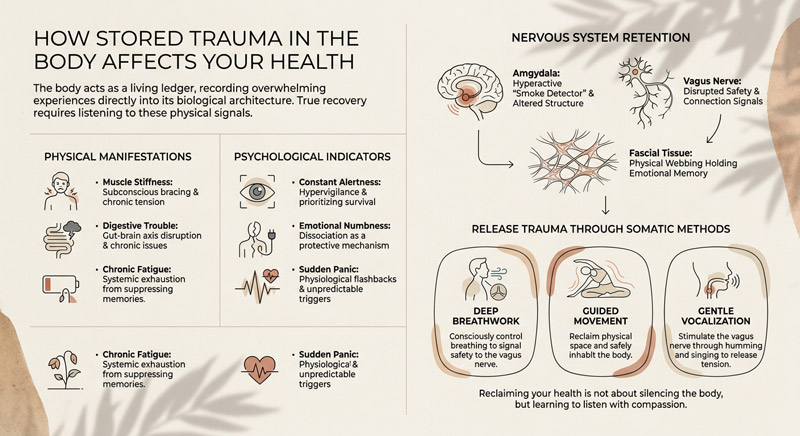
How does the nervous system retain trauma?
The human nervous system operates as a relentless surveillance mechanism. Its primary objective is to keep the organism alive at all costs. When a person faces a deeply stressful situation, the system bypasses logical thought and initiates a cascade of survival responses. Under normal conditions, a threat appears, the body reacts, the threat passes, and the physiology returns to a calm baseline. Unresolved trauma disrupts this natural arc. The threat disappears from the physical environment, but the internal stress response never receives the signal to stand down.
Brain Structure
The amygdala functions as the brain’s smoke detector. During a traumatic experience, this tiny almond-shaped structure becomes hyperactive. It floods the system with stress hormones like cortisol and adrenaline. Simultaneously, the prefrontal cortex goes offline. This is the part of the brain responsible for higher-order thinking, logic, and emotional regulation. Over time, chronic trauma alters these structures permanently. The brain becomes becomes more sensitive to perceived threats. A slammed door or a sharp tone of voice can trigger a massive physiological response because the amygdala cannot distinguish between a past experience and a present inconvenience.
Vagus Nerve
Trauma deeply affects the vagus nerve. This sprawling neural network connects the brain to the heart, lungs, and digestive tract. It dictates our ability to feel safe and connect with others. Researchers studying vagus nerve stimulation breakthroughs in PTSD confirm that targeted therapy can fundamentally change fear networks and enhance synaptic plasticity in trauma survivors. When the vagus nerve is functioning well, it acts as a brake on the heart rate and promotes a state of social engagement. Following severe relational trauma, this nerve can lose its flexibility. The body gets stuck in a state of high alert or collapses into complete shutdown.
Fascial Tissue
The physical webbing of the body also remembers. Fascia is a continuous layer of connective tissue surrounding every muscle, bone, and organ. Emotional memory physically lodges in these tissues. When an individual braces for an impact or instinctively curls inward to protect themselves, the fascia tightens. If the survival response remains incomplete, that tension never resolves. Recent academic literature, including a mixed methods study on trauma and embodiment, found that patients frequently report their trauma is quite literally located within their physical tissues, leading to chronic discomfort that talk therapy alone cannot reach.
Physical Manifestations
People often expect mental health struggles to remain entirely mental. The division between the mind and the body is a complete illusion. Psychological trauma symptom improvement requires addressing the physical fallout. The body carries the burden when the mind refuses to process the pain.
To understand this somatic dysregulation, we can look at the primary ways the body signals distress:
-
Musculoskeletal bracing that refuses to release even during sleep.
-
Gastrointestinal distress linked to a compromised gut-brain axis.
-
Unexplained chronic pain that migrates across different body parts.
-
Autoimmune flare-ups triggered by prolonged cortisol exposure.
Muscle Stiffness
Chronic muscle tension is the body’s way of creating an armor against a hostile world. Individuals who have experienced ongoing trauma often walk around with their shoulders raised up to their ears. Their jaws are permanently clenched. This is not simply bad posture. It is a subconscious bracing for an attack. The muscles remain locked in a defensive holding pattern, draining immense amounts of physical energy and leading to severe headaches and back pain.
Digestive Trouble
The gut and the brain communicate constantly. When the nervous system is locked in a state of traumatic stress, blood flow is diverted away from the digestive organs and sent to the limbs for fighting or fleeing. Digestion is deemed non-essential for immediate survival. Over time, this leads to chronic digestive issues. Nausea, bloating, and irritable bowel syndrome are frequent companions for trauma survivors.
Chronic Fatigue
Running a high-performance engine constantly at the redline eventually burns it out. Carrying unresolved emotional wounds requires a massive amount of metabolic energy. The sheer effort of suppressing traumatic memories and maintaining a functional exterior exhausts the system. People dealing with complex trauma often wake up feeling as though they have run a marathon in their sleep. This profound exhaustion is a direct result of the nervous system working overtime to manage perceived threats.
Psychological Indicators
The physical holding patterns inevitably bleed into psychological states. A body that feels unsafe will generate a mind that feels chaotic.
Constant Alertness
Hypervigilance is an exhausting way to exist. A person dealing with posttraumatic stress disorder might constantly scan a room for exits. They might startle easily at sudden noises. This constant alertness is the nervous system prioritizing survival over comfort. The individual is not being paranoid. Their biological smoke detector is simply calibrated to be highly sensitive.
Emotional Numbness
Sometimes the pain is too immense to process, so the system simply unplugs. Dissociation is a protective mechanism. It allows a person to survive unbearable situations by mentally leaving their body. While this numbness serves a critical purpose during an acute crisis, it becomes highly problematic when trying to live a fulfilling life. Understanding trauma’s echo in relationships often involves recognizing how this numbness prevents authentic connection between partners.
Sudden Panic
Triggers are unpredictable. A specific smell, a tone of voice, or a certain phrase can instantly transport a person back to the site of their original wounding. These sudden waves of panic are physiological flashbacks. The logical brain knows the traumatic event happened years ago, but the body reacts as if the threat is happening right now in the present moment.
Release Trauma Through Somatic Methods
Cognitive behavioral therapy and traditional talk therapy have their place, but they often fail to address the somatic reality of trauma. You cannot simply think your way out of a nervous system response. The healing process must involve the physical form. Somatic therapy focuses on the body experience to safely discharge trapped energy.
Deep Breathwork
Breathing is the only autonomic nervous system function that we can also consciously control. It serves as a direct bridge to the vagus nerve. By extending the exhalation, individuals can manually signal to their nervous system that they are safe. This is not about forcing relaxation. It is about gently nudging the biology toward a calmer state. Proper breathing techniques help lower stress hormones and bring the prefrontal cortex back online.
Guided Movement
When the body freezes during a trauma response, movement becomes the medicine. Trauma-informed yoga and gentle movement practices allow individuals to reclaim ownership of their physical space. As Dr. Karestan Koenen highlights in a recent Harvard study on body-based therapies, intentional movement helps survivors safely inhabit their bodies again. Practitioners tracking physical sensations learn to tolerate discomfort without becoming overwhelmed. Exploring somatic therapy for professional burnout often starts with these subtle, guided exercises to re-establish a sense of safety.
Gentle Vocalization
The vocal cords are deeply intertwined with the vagus nerve. Activities like humming, singing, or gentle vocalization directly stimulate this nerve. This sends calming signals down the spine and into the major organs. It sounds remarkably simple, but using the voice can be a profound way to release chronic tension and signal to the nervous system that the environment is no longer hostile.
Where do emotional memories reside physically?
Emotions are physical events. Every feeling corresponds to a specific physiological signature. Fear often resides in the chest and the gut. Grief can literally make the throat ache and weigh down the limbs. Emotional memories do not sit in the brain like books on a shelf. They map themselves onto our posture, our breathing patterns, and our muscular holding habits.
When someone finally begins processing past traumatic events, they often experience spontaneous physical releases. Their body might shake, they might suddenly cry, or they might feel a sudden rush of heat. This is the physical architecture literally letting go of the emotional weight it has been carrying for years. Healing happens in the tissues, not just in the mind.
What role does chronic stress play?
Chronic stress acts as an amplifier for stored trauma. When a person is already carrying the invisible weight of past trauma, their biological baseline is elevated. Adding the daily pressures of modern corporate life, financial anxiety, and societal expectations creates an unsustainable allostatic load. The system never gets a chance to recover.
Stressful situations at work might cause an oversized emotional release because the boss’s criticism feels exactly like a childhood reprimand. The body cannot tell the difference between the two. The ongoing stress prevents the nervous system from doing its necessary repair work. To genuinely heal, one must create environments that offer psychological safety and relational depth, allowing the nervous system to finally rest.
FAQ
-
Can trauma be released without talking about it? Yes. Many trauma survivors find that extensively rehashing the details of an event only re-traumatizes them. Exploring why conventional talk therapy fails trauma survivors reveals that bottom-up approaches, focusing first on bodily sensations, are often far more effective for deep nervous system regulation.
-
How long does it take to release stored trauma? There is no definitive timeline. Healing is not a linear project with a clear end date. It is a practice of ongoing neuroception and body awareness. Some individuals notice significant shifts in their chronic muscle tension within a few months of starting somatic practices, while profound nervous system rewiring can be a lifelong journey of gentle maintenance.
-
Is somatic experiencing safe to do alone? While gentle yoga and deep breathwork are generally safe, actively unpacking severe relational trauma or posttraumatic stress disorder should initially be guided by a certified somatic therapist. A trained professional provides a safe container to prevent flooding the nervous system.
Conclusion
We spend an inordinate amount of time trying to optimize our lives, fix our perceived flaws, and force ourselves into compliance with a culture obsessed with speed. None of this touches the deeper truth of how our biology remembers our lived experiences. Stored trauma in the body dictates how we breathe, how we connect, and how we survive. Choosing to turn toward these physical sensations with compassion rather than judgment requires immense courage. Reclaiming your health is not about finding another quick fix to silence the body. It is about finally learning how to listen to it.