
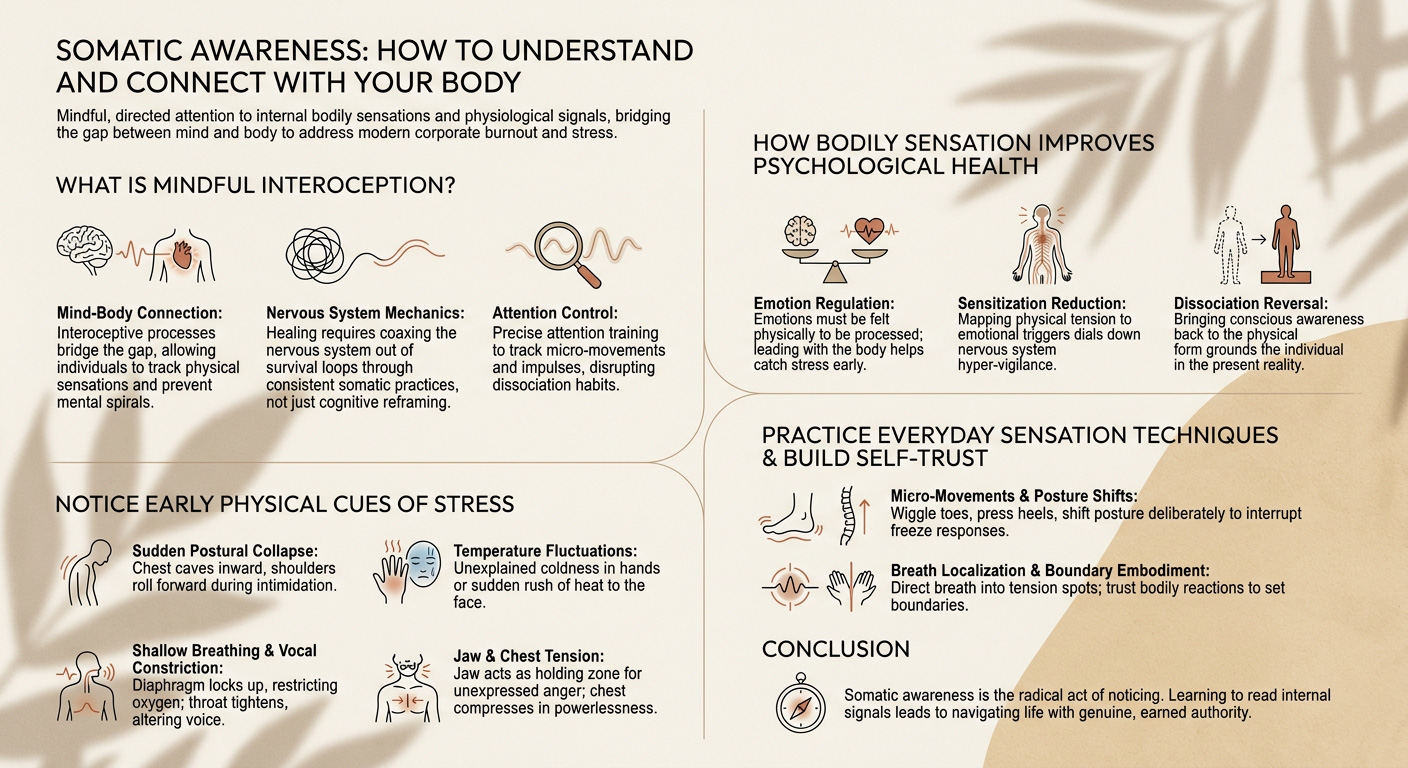
People are tired. They log off from grueling corporate jobs, return to their heavily mortgaged homes, and wonder why the tension in their shoulders remains entirely untouched by their supposedly impressive salaries. We live in a culture obsessed with upgrading everything from our job titles to our real estate, yet our well-being is often neglected. Somatic awareness addresses this exact deficit. It is the mindful, directed attention to internal bodily sensations and physiological signals.
For the average professional dealing with high-stress environments, the default mode is often completely numb. Existing purely from the neck up. People sit down to process complex emotions and end up thinking in circles, entirely disconnected from the physical vessel carrying those very thoughts.
What Is Mindful Interoception?
Intellectualizing a problem rarely resolves the physiological weight it carries. Mindful interoception shifts the focus away from the relentless chatter of the mind and directs it toward the raw data of the body.
Mind-Body Connection
The human body reacts long before the brain formulates a coherent thought. Interoceptive processes bridge this gap. When someone attempts to intellectualize their way out of a stressful event, they often miss the physiological cues signaling that their nervous system is already preparing for a threat. Somatic awareness interrupts this avoidance. By tracking physical sensations, individuals catch the exact moment their physical form tightens right before hitting the difficult part of a memory or a conversation. This connection prevents the mind from spiraling into a void.
Nervous System Mechanics
Trauma therapy frequently explores the reality of autonomic survival loops. When faced with overwhelming stress, the limbic system can affect the brain’s ability to think clearly, throwing the individual into a primitive freeze response. Understanding nervous system mechanics is critical because behavioral compliance is a poor substitute for genuine physiological safety. When the body perceives danger, it bypasses logical reasoning. Healing requires coaxing the nervous system out of these loops through consistent, gentle somatic practices rather than forced cognitive reframing.
Attention Control
A common misconception is that somatic therapy involves magical words or mystical energy healing. It is fundamentally attention training. In standard 50 minute sessions of traditional talk therapy, patients often narrate their experiences without ever feeling them. If a somatic therapist effectively helps a client track micro-movements and impulses, it severely disrupts the habit of dissociation. However, if the practitioner merely sits and “feels” the space vaguely, the practice becomes incredibly useless. The goal is precise attention control.
How Bodily Sensation Improves Psychological Health
Chasing intellectual certainty in therapy often leads to frustration. Psychological health improves dramatically when individuals become willing to sit with the discomfort of physical sensations without immediately needing to categorize them.
Emotion Regulation
A major goal for many seeking mental health support is to experience fewer moments of feeling emotionally disconnected. Somatic work operates on the premise that emotions must be felt physically to be processed. Research indicates that low interoceptive sensibility actively impairs the capacity to process and regulate daily emotional impacts. By letting the physical body lead rather than forcing an emotion cognitively, an individual can catch stress hiding in the gut before it escalates into an intense anxiety.
Sensitization Reduction
Chronic pain and functional neurological disorders often stem from a highly sensitized nervous system. Mapping physical tension to emotional triggers serves as a functional heuristic for symptom reduction. Clinical evidence shows that a high somatic symptom burden correlates heavily with emotional awareness deficits. When patients learn to distinguish between a dangerous biological threat and a harmless physical sensation, the central nervous system begins to dial down its hyper-vigilance.
Dissociation Reversal
Dissociation is a brilliant survival mechanism that becomes a terrible long-term strategy. Bringing conscious awareness back to the physical form reverses this shutdown. A guided body scan or scan meditation forces the brain to acknowledge the limbs, the breath, and the weight of the entire body against a chair. This simple act of noticing grounds the individual in the present reality, pulling them out of the traumatic stress echoes of the past.
Notice Early Physical Cues Of Stress
Catching stress early prevents it from dictating behavior. The body always keeps a record, and it signals distress through very specific channels long before the mind registers panic.
-
Sudden postural collapse: The chest caves inward and the shoulders roll forward during intimidating conversations.
-
Temperature fluctuations: Unexplained coldness in the hands or a sudden rush of heat to the face when boundaries are tested.
-
Shallow breathing: The diaphragm locks up, restricting oxygen flow and signaling to the brain that danger is imminent.
-
Vocal constriction: The throat tightens, altering the pitch and resonance of the voice.
Jaw Tension
The jaw often acts as the primary holding zone for unexpressed anger and boundary violations. A tight jaw is the physical preparation for a fight that the conscious mind is trying to hold back. Recognizing this tension allows a person to consciously relax the muscles, which in turn sends a signal of safety back to the brain.
Chest Compression
In moments that trigger a sense of powerlessness, the chest physically compresses. Shoulders creep toward the ears. This postural shift limits lung capacity and reinforces a psychological state of submission. Reversing this requires noticing the compression and actively choosing to expand the chest cavity.
Gut Distress
The digestive system is intricately linked to emotional experiences. Gut distress is rarely just about food. It is the visceral manifestation of changes in the body’s stress response. Recognizing this early cue helps individuals step away from activating sessions or environments before they reach a breaking point.
Practice Everyday Sensation Techniques
You do not need a specialized clinical psychologist or expensive physical therapies to start practicing embodiment. Small, intentional practices woven into daily life yield significant cumulative results.
Micro-Movements
When conversations cause the mind to go blank, doing something tiny can interrupt the pattern. Micro-movements like wiggling the toes, pressing the heels into the floor, or slowly turning the neck can disrupt a freeze response. These movement practices require no special equipment and can be done entirely unnoticed in a corporate boardroom.
Posture Shifts
Posture dictates state. A slumped spine reinforces feelings of defeat. Shifting posture deliberately alters the biofeedback loop. This is not about rigid, aggressive body language. It is about finding a grounded, steady physical stance that allows for psychological safety and clear thinking.
Breath Localization
Generic breathing exercises often fail because they are disconnected from the actual site of tension. Breath localization involves directing conscious perception and breath into the exact spot where the body holds stress. If the chest is tight, the focus goes there. If the gut is twisted, the breath aims low. Clinical trials show that focused mindful attention reduces physiological reactivity by targeting these specific neural activations.
Build Self-Trust Without Trauma Focus
A massive amount of somatic content is currently wrapped in heavy trauma language. This creates a barrier for people who simply want to improve their well-being without treating their daily lives like a trauma case file.
|
Approach |
Primary Focus |
Typical Application |
|---|---|---|
|
Trauma-Oriented Somatics |
Processing past traumatic experiences, resolving freeze responses. |
Sensorimotor psychotherapy, clinical settings. |
|
Everyday State Regulation |
Managing daily stress, improving posture, regulating mood. |
Workplace stress management, conscious awareness. |
State Regulation
You can absolutely build somatic awareness for better posture, clearer boundaries, and nervous-system regulation without digging into the past. Everyday state regulation focuses on the present moment. It is about understanding what the body needs right now to feel calm and centered, whether that is a walk, a glass of water, or simply five minutes of silence away from a screen.
Boundary Embodiment
Boundaries are physical before they are verbal. Trusting the body means honoring the instinct that says a situation feels wrong. A profound indicator of depression severity is the absolute loss of trust in these internal bodily signals. When a client crosses a line, the body reacts immediately. Embodiment is the practice of listening to that reaction and acting on it, rather than prioritizing social politeness over personal safety.
Separate Legitimate Care From Wellness Myths
The internet is currently flooded with unregulated wellness spaces misusing somatic terminology. Digital platforms oversimplify interpersonal neurobiology, frequently misapplying concepts like “cortisol belly” to market quick-fix weight loss programs. This commercial exploitation undermines the profound benefits of genuine somatic therapies.
While modalities like Somatic Experiencing may lack the massive empirical backing of traditional cognitive behavioral therapy, rigorous scoping reviews confirm their actual modulation of interoceptive and proprioceptive sensations. Legitimate somatic practice requires nuance. It is not an instant cure for all physical ailments, nor is it an excuse to replace appropriate medical care. It is a slow, often messy process of rebuilding a relationship with one’s own physical form.
Why Do Cross-Cultural Body Vocabularies Differ?
Anthropological studies reveal a fascinating paradox regarding how different cultures view the body. Non-Western cultures consistently demonstrate a much higher emphasis on spontaneous somatic focus. Their daily language is rich with bodily metaphors for emotional states. Yet, when subjected to objective interoceptive accuracy tests, these populations frequently score lower than Western cohorts.
This discrepancy suggests that talking about the body culturally does not automatically equate to precise, conscious awareness of internal physiological metrics. A tool like the Multidimensional Assessment of Interoceptive Awareness, useful for measuring body-listening and self-regulation, highlights that actual interoceptive accuracy requires deliberate, practiced attention regardless of cultural background.
FAQ
What is the difference between somatic therapy and regular talk therapy? Traditional therapy typically operates top-down, using logic and language to change feelings. Somatic therapy operates bottom-up, using physical sensations and movement studies to process emotions and regulate the nervous system directly.
Can somatic exercises cure chronic pain? They are not a magic cure. They serve as a tool to help down-regulate the nervous system, which can significantly reduce the severity of pain by changing how the brain interprets somatic sensation.
Do I need a trauma history to benefit from somatic practices? Absolutely not. Anyone experiencing daily stress, burnout, or a desire for better physical health and emotional regulation can benefit from learning to track their internal focus.
Is yoga considered a somatic practice? Mindful yoga and gentle movement series can function as somatic practices if the practitioner maintains a focus on internal bodily experience rather than merely achieving a specific physical pose.
Conclusion
We spend decades optimizing our careers, our networks, and our financial portfolios while quietly eroding the conditions that make us feel human. Somatic awareness is not another task to add to an endless checklist of self-improvement. It is the radical act of noticing what is happening inside your own skin. It requires patience, a willingness to sit with discomfort, and a healthy skepticism of anyone promising instant results. When you finally learn to read the signals, you stop being more able to respond to random emotional weather and start navigating life with genuine, earned authority.