
Last updated on September 4, 2026
We demand endless productivity from the human physical form. When the body eventually becomes overwhelmed under the weight of accumulated stress, people usually attempt to negotiate with it. They use cognitive processes to talk themselves out of exhaustion. They try to out-think a the body’s stress response. It rarely works because the intellect cannot reason with an autonomic nervous system that fundamentally believes it is under threat.
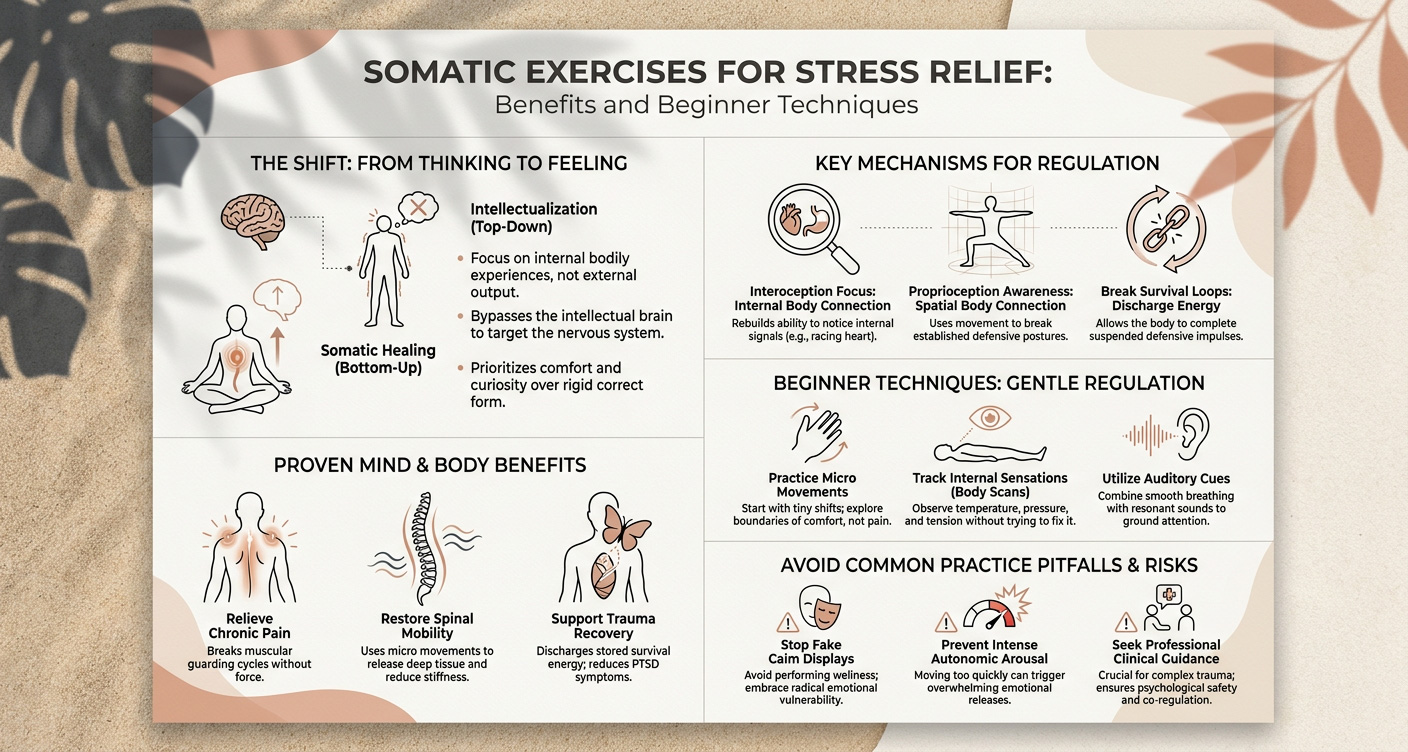
Somatic exercises bypass this intellectualization entirely. They are an evidence-based therapeutic approach focused entirely on internal bodily experiences rather than external output or aesthetic performance. A traditional fitness routine optimizes for speed or strength. A somatic practice centers on interoception, which is the internal perception of physical sensations. It is the practice of letting the body complete defensive impulses it started but never got the chance to finish.
What Exactly Is This Movement Practice?
We live in a culture obsessed with compliance and measurable results. When corporate professionals experience severe burnout or couples face entrenched relational conflict, they often seek solutions that require more effort. They try harder. They adopt rigid wellness routines that just add another layer of pressure. Somatic methods flip this dynamic. The act of engaging in somatic work requires a profound shift away from achieving a specific posture and toward developing genuine curiosity about how a movement feels.
A foundational somatic workout generally incorporates a few distinct elements:
-
Tracking internal physical responses without attempting to instantly alter them.
-
Utilizing mindful movement to map exactly where chronic tension resides in the tissue.
-
Engaging in daily body scans to bridge the gap between mental awareness and bodily sensations.
-
Embracing childlike movement that prioritizes comfort over correct form.
The Bottom Up Mechanism
Most traditional mind therapies operate on a top-down model. You identify a cognitive distortion, challenge the thought, and hope the physical tension subsides. Somatic healing therapies operate bottom-up. They target the nervous system directly by utilizing physical sensation as the primary entry point for emotional regulation. This approach is highly useful for individuals facing pre-verbal trauma or those who find that talking about their distress feels entirely overwhelming. Clinical data points to the fact that these interventions effectively target neuroplasticity and the autonomic nervous system via bottom-up processing to facilitate deep healing.
Internal Interoception Focus
Interoception is the internal body connection. It is the capacity to notice a racing heart, a tightened jaw, or a sudden drop in the stomach. High-pressure environments routinely condition individuals to sever this connection. When success demands sitting at a desk for fourteen hours a day, tuning out internal sensations becomes a survival skill. Somatic healing exercises rebuild this lost communication network. By practicing body awareness exercises, individuals slowly regain the capacity to interpret their internal landscape with clarity and compassion.
Spatial Proprioception Awareness
Proprioception is the awareness of where the physical body exists in space. When people carry immense emotional weight, they often unconsciously alter their physical posture to protect themselves. Shoulders roll forward. The spine curves. Breathing becomes shallow. Somatic exercises deliberately play with proprioception to break these established holding patterns. The simple act of noticing how a foot meets the floor or how the pelvis rests on a chair can provide the nervous system with vital cues of safety.
How Does It Regulate The Nervous System?
Regulation is not the absence of stress. It is the capacity to experience stress and return to a baseline of calm without getting stuck.
Break Survival Loops
A traumatized nervous system is essentially stuck in a recurring stress pattern. The threat has passed, but the body continues to stay prepared for something stressful. This is why individuals with severe anxiety often feel exhausted despite getting adequate sleep. Their muscles are continuously working to defend against an invisible danger. Somatic practices provide an off-ramp from this cycle. By deliberately engaging in gentle movements, practitioners send new, non-threatening data to the brain.
Discharge Pending Energy
Consider a person having a terrible day. They start spiraling mentally, trying to fix their emotional distress with relentless overthinking. Then they do something body-first like taking a slow walk while listening to a playlist that matches their emotional temperature. Suddenly, their physical response shifts. They are getting out of the mental loop enough for real regulation to actually happen. They are not magically cured. They are simply allowing the body to process pending survival energy through motion and sound rather than suppressing it.
Shift Baseline States
Effective somatic work is not about feeling better for ten minutes. It is about fundamentally lowering the resting heart rate and decreasing the baseline level of autonomic arousal. When an individual engages in somatic experiencing over time, they often notice that their recovery period following a stressful event becomes significantly shorter. This shift represents genuine empowerment. The nervous system stops living in a state of high alert.
Proven Mind And Body Benefits
The physical and psychological systems are completely entangled. You cannot affect one without altering the other.
Relieve Chronic Pain
Physical therapy frequently integrates somatic education to help patients overcome persistent discomfort. Chronic pain often creates a cycle of muscular guarding. The brain anticipates pain, so it restricts blood flow and tightens the surrounding tissue, which ironically generates more pain. Mindful movements allow patients to safely break the guarding cycles associated with chronic pain by retraining the brain’s control over the musculature. This is achieved without forcefully overloading the joints.
Restore Spinal Mobility
Years of sitting, stressing, and bracing take a massive toll on the spine and hip flexors. A somatic healing exercise often involves tiny, almost imperceptible motions designed to release deep connective tissue. Instead of a deep full body stretch that might trigger a defensive contraction, practitioners use micro movements to gently encourage the muscles to relax. This gentle movement effectively reduces hip stiffness and restores natural spinal mobility.
Support Trauma Recovery
Trauma resides in the physiology. For individuals navigating complex trauma or PTSD, standard cognitive interventions sometimes fall short because the rational brain goes offline during a trigger. Research indicates that somatic processing significantly reduces post-traumatic stress and anxiety symptoms by discharging stored survival energy. The focus remains entirely on establishing safety in the present moment.
Start Gentle Daily Regulation Routines
You do not need an elaborate setup or complicated equipment to begin a somatic practice. The most effective routines are often the simplest.
Practice Micro Movements
Begin with tiny shifts. Try a gentle arms swing or slowly tilt the pelvis while sitting. Notice how the muscles respond. The goal is never to push past a barrier but to explore the boundary of comfort. A somatic technique works best when it feels easy. Force creates resistance, but slow, deliberate physical activity nurtures resilience.
Track Internal Sensations
Body scanning is a highly accessible entry point. A practical guide to daily body scans involves simply lying down and directing attention to different body parts without trying to relax them. Notice the temperature. Notice the pressure. The act of observation alone often facilitates a spontaneous release of muscle tension.
Utilize Auditory Cues
Sound deeply influences our bodily sensations. Combining smooth breathing with a resonant frequency or specific music can dramatically alter your physical state. Steady breathing paired with auditory tracking redirects attention, gently pulling the mind away from intrusive thoughts and grounding it entirely in the immediate physical environment.
Avoid Common Practice Pitfalls And Risks
While somatic workouts are generally safe, they require a nuanced approach to avoid unintended consequences.
Stop Fake Calm Displays
There is a profound difference between actual regulation and performing calm. Sometimes people use meditation, breathwork, or yoga to suppress their authentic emotional state. They force a deep breath to mask their anxiety. True somatic movement requires radical vulnerability. If the body wants to shake, you let it shake. You do not force relaxation onto a system that needs to mobilize.
Prevent Intense Autonomic Arousal
Because these exercises specifically target deeply held physical tension, they can occasionally trigger a sudden release of buried emotions. Unregulated practice outside a clinical setting carries a potential risk of increased emotional distress if implemented without strict professional supervision. The body remembers what the mind has chosen to forget. Moving too quickly into intense bodily experiences can overwhelm the system.
Seek Professional Clinical Guidance
For individuals with severe histories of trauma, navigating the internal landscape alone is risky. A qualified somatic therapist or psychologist provides necessary co-regulation. They help pace the work, ensuring the individual remains anchored in the present while processing difficult sensations.
Clinical Evidence And Institutional Therapy Comparisons
The medical and psychological communities maintain a cautious optimism regarding somatic therapies and interventions. Clinicians view them as highly promising tools for nervous system regulation. However, institutional critique remains valid. The current body of research consists heavily of small-scale pilot studies and mixed-quality literature reviews, which prevents these modalities from entirely replacing first-line treatments.
|
Feature Category |
Professional Consensus Strengths |
Main Institutional Criticisms |
|---|---|---|
|
Primary Mechanism |
Effectively targets neuroplasticity via bottom-up processing. |
Relies on frameworks that currently lack definitive neurobiological proof. |
|
Physical Benefits |
Proven to break chronic pain guarding patterns safely. |
Results occasionally replicate standard relaxation or stretching protocols. |
|
Trauma Utility |
Highly useful for complex trauma where talking feels overwhelming. |
Potential risk of distress if implemented without professional clinical supervision. |
|
Research Quality |
Supported by growing, highly promising localized pilot data. |
Mixed overall study quality with limited large-scale unbiased replication. |
Why Do Physical Sensations Trigger Emotional Releases?
The physical body is essentially a living archive of every experience, joy, and threat you have ever encountered. When an animal survives a frightening experience, it physically shakes to discharge the massive influx of adrenaline. Humans, particularly those in civilized, high-pressure societies, suppress this urge. We sit in meetings after a devastating phone call and pretend everything is fine. The pending energy does not simply vanish. It becomes trapped in the fascia, the muscles, and the nervous system.
When you engage in somatic therapies or practice a somatic healing exercise, you are finally giving the body permission to complete that suspended action. A simple stretch or a moment of progressive muscle relaxation might unlock decades of suppressed physical tension. People often find themselves crying during a hip opening motion or shivering during a basic body scan. The physical sensations trigger emotional releases because the tissue itself is finally letting go of the burden it was never meant to carry long-term.
FAQ
Are somatic exercises just typical cardio or weight training? No. Typical cardio focuses on external output, increasing heart rate, and burning calories. A somatic workout focuses on the internal experience of the movement, prioritizing slow, conscious physical responses over mechanical repetition.
Do I need a somatic therapist to start a routine? If you are looking for personal stress relief or basic mobility, simple gentle movements and body scan tips can be practiced alone. If you are addressing complex trauma or PTSD, working with a qualified somatic therapist is highly recommended to ensure psychological safety.
Can somatic exercises replace cognitive therapies? They are generally viewed as complementary. While they excel at shifting autonomic states and resolving physical tension, cognitive processes are still valuable for integrating those changes into conscious awareness.
Conclusion
We spend so much of our lives operating as human doings rather than human beings. We drag our bodies through endless tasks, ignoring their signals until they completely shut down. The cultural script tells us that more effort is the answer to our exhaustion. Somatic work challenges this fundamentally flawed narrative. It offers a gentle, radical invitation to stop optimizing the physical form and start listening to it instead. Spaciousness allows a deepening of who you actually are. By learning to track our physical sensations and honor our internal cues, we foster a sustainable, human-first resilience that no quick-fix life hack could ever replicate.