
Last updated on September 4, 2026
People routinely sit in perfectly safe rooms, surrounded by soft lighting and stable circumstances, while their internal physiology experiences ongoing stress. Cognitive awareness rarely touches this depth. A person can logically understand their safety while their heart rate responds automatically entirely, accelerating as if escaping a physical threat. The modern corporate environment exacerbates this beautifully. The relentless push for productivity, the subtle status games, the quiet desperation of burnout—these stressors bypass rational thought and settle directly into the tissue.
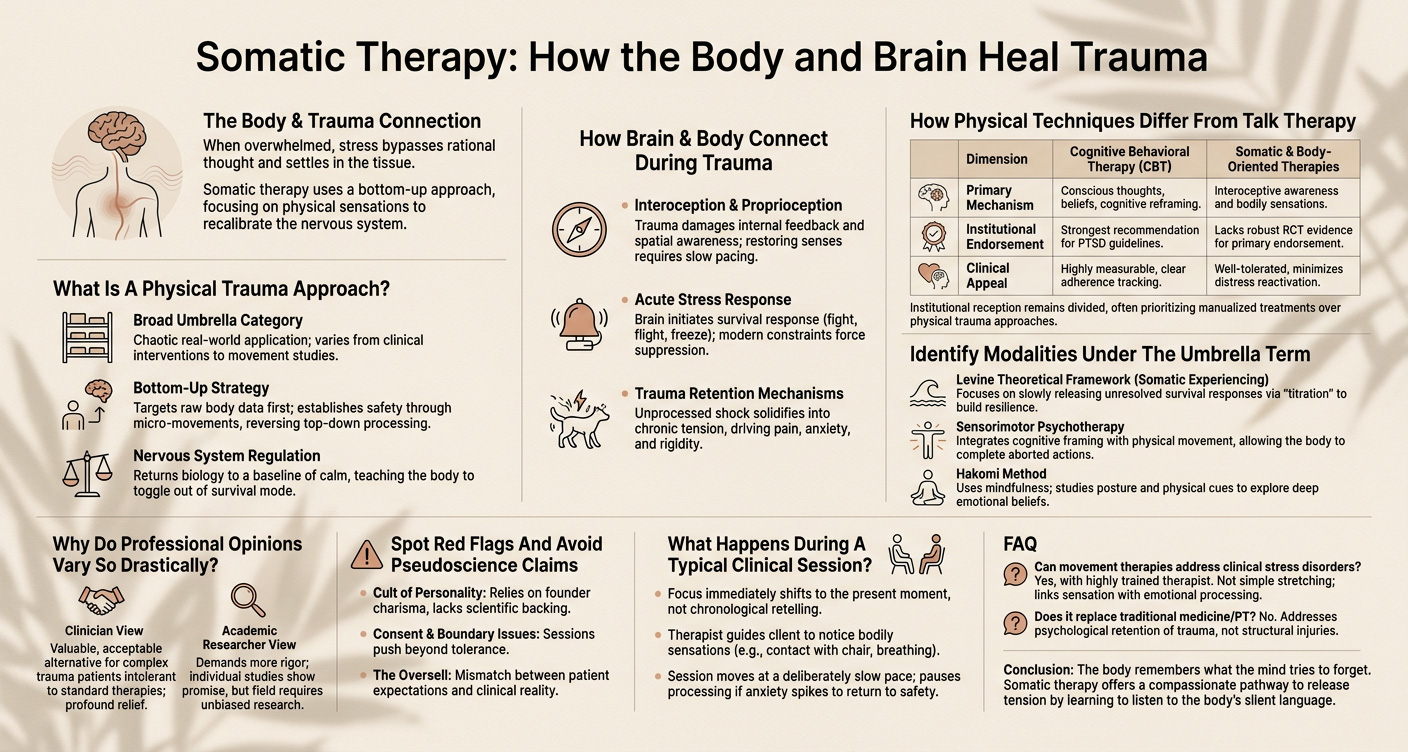
Somatic therapy bypasses the narratives humans construct to survive their lives. It focuses directly on the physiological retention of stress, utilizing a bottom-up processing framework. Instead of starting with thoughts to change feelings, it starts with physical sensations to recalibrate the nervous system. The body becomes the primary gateway to healing.
What Is A Physical Trauma Approach?
Broad Umbrella Category
The term somatic therapy sounds highly clinical, yet the real-world application remains undeniably chaotic. It functions less as a specific tool and more as a messy shelf label. Underneath this broad classification sits everything from heavily manualized trauma interventions grounded in interpersonal neurobiology to vague movement studies that lack clinical rigor.
Patients seeking a somatic therapist often encounter a confusing landscape. One clinic might offer structured exercises tracking autonomic arousal, while another might incorporate elements derived from indigenous healing practices or abstract dance. This massive variance in methodology means consumers must meticulously evaluate the exact therapeutic model being offered.
Bottom-Up Strategy
Mainstream psychology traditionally relies on top-down processing. Talk therapy starts in the prefrontal cortex, operating under the assumption that analyzing thoughts will eventually soothe the underlying biology. Somatic therapies reverse this map entirely.
They target the raw data of the body first. A practitioner asks a client to notice the tightening of the jaw, the shallowness of the breath, or the sudden urge to fidget. By establishing a sense of safety within these micro-movements, the brain receives biological evidence that the environment is secure.
Nervous System Regulation
Dysregulation strips a person of their autonomy. A nervous system locked in chronic freeze or fight responses loses the capacity for curiosity and connection. Nurture cannot occur in a state of terror. The objective of bodywork in a psychotherapeutic context is returning the biology to a baseline of calm. It teaches the physical form how to toggle out of survival mode and back into a state of ease, allowing for genuine social engagement rather than forced behavioral compliance.
How Do Brain And Body Connect During Trauma?
Interoception And Proprioception
Humans navigate the physical world through proprioception, the awareness of where the body exists in space. Interoception governs the internal focus—the ability to feel a racing heartbeat or a knot in the stomach. Traumatic stress frequently damages these internal feedback loops. People may dissociate, severing their body connection to survive an unbearable reality. Restoring these senses requires meticulous, slow pacing.
Acute Stress Response
When an acute threat appears, the brain initiates a survival response. Cortisol floods the system. The muscles tense for flight. If the threat is inescapable, the biology shifts into a shutdown state. This evolutionary mechanism preserves life, but it carries a massive cost. The physiology prepares to process the shock, but modern societal constraints often force individuals to swallow the reaction and return to work.
Trauma Retention Mechanisms
Animals in the wild physically discharge survival energy. They shake, tremble, and release the chemical buildup after escaping a danger. Humans rarely permit themselves this biological luxury. We sit in traffic. We attend meetings. The unprocessed shock solidifies into chronic tension. The trauma response becomes a permanent fixture of the posture, driving mysterious physical pain, chronic anxiety, and behavioral rigidity.
How Do Physical Techniques Differ From Talk Therapy?
Conscious Cognitive Pathways
Mainstream cognitive therapies rely heavily on logic. They demand that patients articulate their trauma, analyze the cognitive distortions, and actively challenge their own beliefs. This works remarkably well for certain mental health challenges. Yet, for individuals carrying profound developmental trauma, asking the mind to rationalize the body out of terror is akin to calming an alarmed nervous system. The alarm does not care about logic. It only registers smoke.
Physical Sensation Pathways
Body-oriented therapies prioritize the sensation over the story. During 50 minute sessions, a client might spend the majority of the time simply noticing the temperature of their hands or practicing a gentle movement series. There is no pressure to talk through the traumatic experience. This minimizes the risk of emotional overwhelm, offering a highly compassionate alternative for those who find traditional exposure techniques deeply destabilizing.
Professional Guideline Status
The institutional reception of these methods remains fiercely divided. Major governing bodies prioritize highly manualized treatments.
|
Dimension |
Cognitive Behavioral Therapy (CBT) |
Somatic & Body-Oriented Therapies |
|---|---|---|
|
Primary Mechanism |
Conscious thoughts, beliefs, and cognitive reframing. |
Interoceptive awareness and bodily sensations. |
|
Institutional Endorsement |
Strongest recommendation for PTSD treatment guidelines. |
Lacks sufficient robust RCT evidence for primary endorsement. |
|
Clinical Appeal |
Highly measurable, clear behavioral adherence tracking. |
Well-tolerated; minimizes the risk of reactivating distress. |
Independent healthcare institutions frequently relegate physical trauma approaches, arguing the field lacks the research base of CBT. In formal clinical practice guidelines, governing bodies often omit these modalities from first-line status, prioritizing exposure therapies based on rigid empirical requirements.
Identify Modalities Under The Umbrella Term
Levine Theoretical Framework
Dr Peter A Levine, PhD, fundamentally shifted the trauma landscape by observing how wild animals recover from life-threatening encounters. His somatic experiencing therapy focuses on slowly releasing the unresolved survival response trapped within the nervous system. The process involves “titration”—exposing the client to tiny, manageable amounts of distress while anchoring them in safety, building profound resilience over time.
Sensorimotor Psychotherapy
Developed by Pat Ogden, sensorimotor psychotherapy integrates cognitive framing with physical movement. It recognizes that unresolved trauma often manifests as incomplete physical actions—the hands that wanted to protect themselves, the legs that needed to run. By allowing the body to complete these aborted movements in a safe environment, the client regains a sense of empowerment.
Hakomi Method
This approach heavily relies on mindfulness meditation. It operates on the premise that the body serves as a perfect map of the unconscious mind. A Hakomi therapist studies a client’s posture, gestures, and facial expressions, using these physical cues as direct entry points to explore deeply held emotional beliefs with radical curiosity.
Why Do Professional Opinions Vary So Drastically?
The scientific evaluation of somatics heavily depends on who is holding the magnifying glass. Independent frontline medical staff working in complex public health settings frequently champion these methods. Clinicians view body-based approaches as an invaluable, highly acceptable alternative for complex trauma patients who cannot tolerate standard exposure-based therapies. The qualitative feedback from marginalized populations often highlights a profound sense of relief.
Academic researchers offer a much colder assessment. While individual randomized controlled trials—including studies conducted by researchers like Porat and colleagues—show substantial decreases in PTSD symptoms, the broader scientific literature demands more rigor. Scoping reviews acknowledge the potential but conclude the field requires more support from unbiased research before it can rival traditional cognitive behavioral therapy.
Spot Red Flags And Avoid Pseudoscience Claims
The moment a practitioner implies their specific physical method is uniquely capable of curing complex psychiatric disorders, skepticism must arise. The industry suffers from vague branding.
-
The Cult of Personality: Some modalities rely heavily on the charisma of their founders rather than peer-reviewed biology. Critics rightfully argue that certain underlying neurological frameworks lack scientific backing in modern neuroscience, leaning uncomfortably into non-evidence-based ideas.
-
Consent and Boundary Issues: A client might walk into a session expecting gentle grounding exercises and instead face intense, activating sessions that push their nervous system beyond its window of tolerance.
-
The Oversell: When analyzing patterns evident in community discussions on mental health treatments, a glaring mismatch emerges between patient expectations and clinical reality.
Treating somatic therapy as a magical, one-size-fits-all cure creates massive backlash. This dynamic mirrors the outrage often seen when tracking consumer mismatch in wellness marketing. True evidence-based practice requires clarity, specific modality identification, and informed consent regarding what the physical interventions will actually entail.
What Happens During A Typical Clinical Session?
A patient entering a room expecting traditional group psychotherapy or standard talk therapy might find the somatic environment disorienting. The therapist rarely asks for a chronological retelling of the traumatic event. Instead, the focus immediately shifts to the present moment.
The practitioner might ask the client to notice where their body makes contact with the chair. They might engage in tracking exercises, watching how a specific emotion shifts the breathing pattern. Practitioners utilizing the PhD trauma resiliency model often incorporate simple tools—sometimes called somatic shorts—to help clients rapidly ground themselves during moments of high stress. The session moves at a deliberately slow pace. If the client experiences an overwhelming spike in anxiety, the therapist pauses the processing and focuses entirely on returning the biology to a baseline of safety.
FAQ
Can movement therapies actually address clinical stress disorders? Yes, but they require a highly trained somatic therapist. Simple stretching or intuitive dance is not psychotherapy. Clinical effectiveness relies on the intentional linking of bodily sensations with emotional processing, closely monitoring the nervous system to prevent overwhelm.
Does this approach replace traditional medicine or physical therapy? No. It exists strictly within the realm of mental health and psychology. While clients often report a reduction in physical tension and chronic pain, somatic therapies are designed to address the psychological retention of traumatic stress, not to treat structural physical injuries.
Conclusion
The body remembers everything the mind attempts to forget. The daily commute, the suppressed anger in a corporate meeting, the lasting effects of childhood struggle—these experiences weave themselves into our biology. Somatic therapy offers a compassionate, holistic pathway to gently release that tension. It requires discarding the illusion of absolute cognitive control and learning to listen, with immense curiosity, to the silent language of our own bodies.