
Last updated on September 16, 2026
Introduction
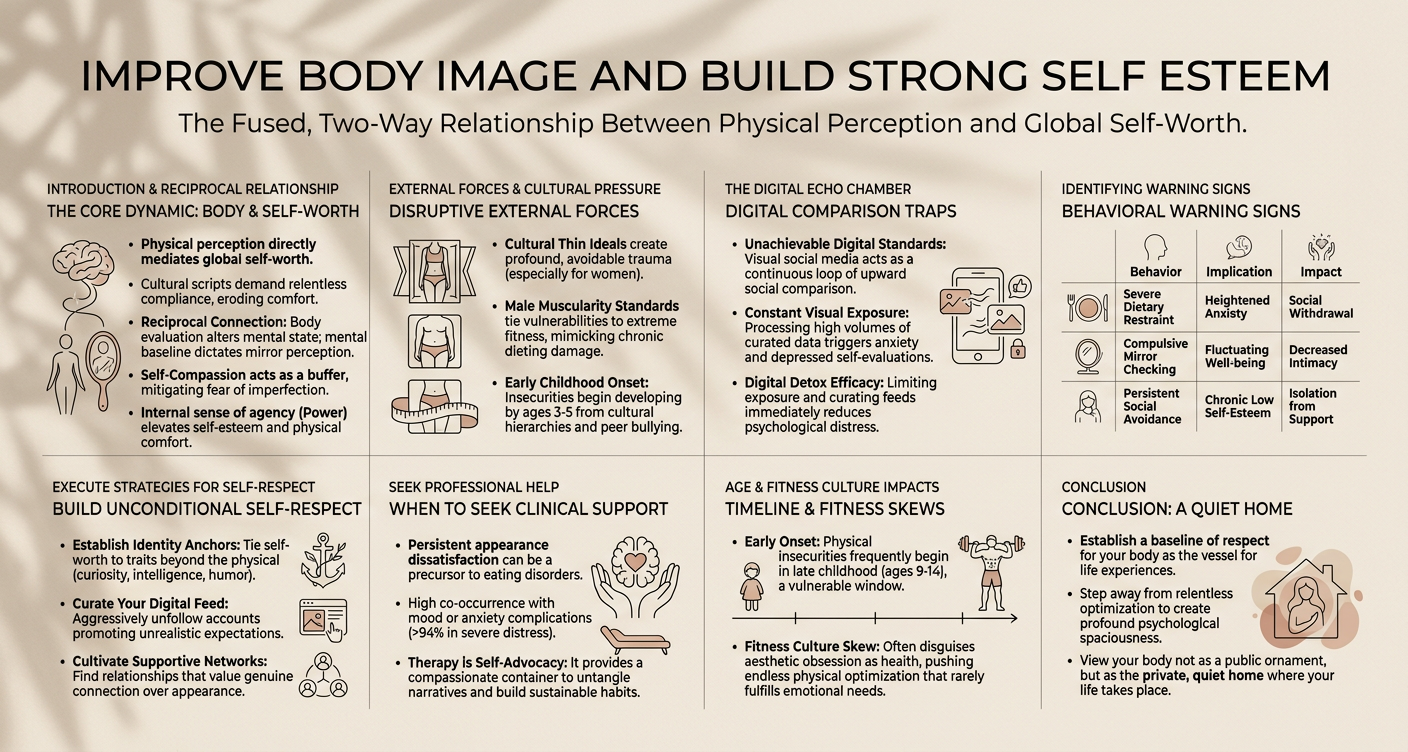
Body image and self-esteem operate in a tightly fused, two-way relationship. The research shows establishes that how individuals perceive their physical shape directly mediates their global self-worth. If someone perceives their physical self as inadequate, their underlying self-respect reliably crumbles. This dynamic goes far beyond a mere aesthetic concern. It represents a fundamental metric of psychological safety.
People frequently treat their bodies like something to manage. Always evaluating. Always upgrading. Always assessing the market value. This cultural script demands relentless compliance, quietly eroding the very conditions that make a person feel genuinely comfortable in their own skin. The mind simply cannot compartmentalize physical feelings from overarching emotional reality. When an individual internalizes a negative view of their appearance, that distress inevitably leaks into their broader personal identity and daily life experiences.
How Do Physical Perceptions Influence Global Self-Worth?
The Reciprocal Relationship
The connection works in both directions. An individual’s evaluation of their physical body significantly alters their mental state, while their mental baseline dictates what they see in the mirror. People who harbor a high self-esteem possess a natural psychological buffer. They securely anchor their identity to traits beyond physical appearance, allowing them to navigate the natural changes of age and lifestyle without spiraling into body obsession.
When self-worth is inherently low, the mirror becomes an enemy. This deficit cascades into how people handle intimate relationships and navigate simple day-to-day interactions. You cannot hate your physical form and expect your relationship satisfaction to thrive. Finding paths to rebuilding self-worth and finding confidence requires acknowledging that absolute physical measurements bear little relation to actual psychological peace.
Self-Compassion as Mediator
Self-compassion acts as the necessary buffer. The relationship between physical perception and self-esteem is rarely a straight line. It is heavily mediated by how much grace a person extends to themselves during moments of doubt. Individuals who practice intentional self-compassion naturally mitigate the fear of physical imperfection.
They do not demand relentless optimization. Instead, they nurture their baseline wellbeing. Learning to build self-acceptance using actionable daily habits allows a person to detach their core value from their temporary physical presentation. It fosters the resilience needed to let unrealistic expectations pass through the mind without leaving permanent emotional damage.
The Role of Power
Power deeply alters physical perception. Clinically defined, this involves a person’s perceived capacity to influence their environment and exert authority over their own choices. People who feel authoritative and secure in their lives routinely report higher body appreciation. The psychological consensus demonstrates that an internal sense of agency elevates self-esteem, which then radiates outward into profound physical comfort. When someone feels they have a voice, they worry significantly less about how much space their body occupies.
What External Forces Disrupt Healthy Appearance Evaluations?
Cultural Thin Ideals
Societal narratives aggressively demand behavioral compliance. The cultural obsession with maintaining an airbrushed aesthetic creates profound and entirely avoidable trauma. Women consistently report higher baselines of appearance dissatisfaction across all stages of life, frequently tying their worth to social acceptance and the internalization of unyielding thin ideals.
This pressure exacts a massive, tangible toll. A collaborative health-economic study estimates that systemic body dissatisfaction imposes an economic and psychological burden costing the U.S. economy roughly $300 billion annually. These impossible metrics artificially uncouple human physical autonomy from natural biological reality. It hurts. Profoundly.
Male Muscularity Standards
Men face parallel, albeit distinctly flavored, pressures. Male vulnerabilities are increasingly tied to extreme fitness and muscularity standards rather than just thinness. Underweight men frequently report significantly lower self-esteem and higher distress than their peers. The modern standard hinges on unyielding physical performance, forcing many into a cycle of over-training that mimics the same psychological damage seen in chronic dieting.
Early Childhood Onset
Physical insecurities do not magically appear during adolescence. They begin to develop much earlier. By ages three to five, toddlers already absorb cultural hierarchies regarding size and shape. Peer bullying regarding weight frequently begins before elementary school, laying the groundwork for a lifetime of esteem problems. A child’s earliest experiences with their body heavily dictate their future capacity for love and self-trust.
The Digital Echo Chamber and Upward Social Comparison
Unachievable Digital Standards
Visual social media platforms function as continuous feedback loops of upward social comparison. Users constantly weigh their organic, unfiltered reality against heavily curated highlight reels. This persistent disparity directly degrades adolescent confidence metrics, operating as a primary comparison trap for developing minds. The screen becomes a metric of self-worth.
Constant Visual Exposure
The sheer volume of visual data humans process today is unprecedented. An exhaustive academic review of interactive applications indicates that selective digital self-presentation directly triggers chronic humiliation, elevated anxiety scores, and clinically depressed self-evaluations. When an individual spends hours viewing enhanced realities, their own completely normal physical shell begins to feel inherently flawed.
Digital Detox Efficacy
Interventions work, provided they are practiced with clarity and consistency.
-
Limiting exposure immediately reduces the psychological distress. Survey data highlights that 45% of teenagers explicitly recognize they spend excessive time online, linking this habit directly to their own diminished mental health.
-
Curating algorithms limits upward social comparison by replacing curated bodies with broader, more holistic interests.
-
Intentional disconnection creates the spaciousness required for authentic, in-person emotional bonds.
Identify Warning Signs of Appearance Dissatisfaction
Understanding when normal physical awareness crosses into harmful body obsession requires observing specific behavioral shifts. Aggregated mental health screening data highlights that poor self-image is the leading specific concern cited by over 50% of respondents seeking psychological check-ins.
|
Behavioral Pattern |
Psychological Implication |
Interpersonal Impact |
|---|---|---|
|
Severe dietary restraint |
Heightened daily anxiety |
Withdrawal from shared meals and family events |
|
Compulsive mirror checking |
Fluctuating personal well-being |
Decreased intimacy and relationship satisfaction |
|
Persistent social avoidance |
Chronic low self-esteem |
Isolation from close friends and emotional support |
These warning signs rarely exist in isolation. A loved one might begin skipping events in January, escalating to severe dieting by March, and completely withdrawing by May. Tracking these behaviors provides a map of their internal distress.
Execute Strategies to Build Unconditional Self-Respect
Identity Anchors
Tying self-worth exclusively to a changing physical self is a highly precarious way to live. The body changes. It ages, it heals, it scars, and it softens. Building self-worth requires establishing identity anchors that have absolutely nothing to do with gravity or measurements. Cultivating curiosity, intelligence, humor, and empathy provides a much safer psychological foundation.
Digital Feed Curation
Your digital environment directly alters your neural pathways. If every time you open an app you feel a sharp pang of inadequacy, the tool is harming you. Aggressively curate your feeds. Unfollow accounts that promote unrealistic expectations or use fitness as a moral imperative. Protect your attention with the same ferocity you would use to protect your physical home.
Supportive Personal Networks
Healing happens in safe relationships. Finding individuals who value genuine connection over superficial appearances is vital. Cultivating these secure attachments helps to naturally build self-trust without trauma focus. When you are surrounded by people who hold space for your whole, messy humanity, the desperate need to perform a perfectly curated physical existence quietly fades.
Seek Professional Help for Severe Psychological Deficits
Some wounds require a structured, evidence-based approach. Persistent appearance dissatisfaction frequently serves as an emotional precursor for deeply entrenched eating disorders. Clinical parameters demonstrate how these specific struggles become functional vulnerability factors that demand clinical intervention.
Nationally representative findings indicate that upwards of 94% of individuals experiencing severe body-related distress also battle concurrent lifetime mood or anxiety complications. Seeking guidance from a licensed therapist is not a sign of defeat. It is an act of profound self-advocacy. Individual therapy provides a private, compassionate container to untangle early childhood narratives, address specific esteem issues, and develop sustainable healthy habits.
At What Age Do Physical Insecurities Typically Begin?
The timeline for these insecurities points to an alarmingly early onset. Developmental data reveals that baseline self-esteem in young girls frequently peaks around age nine before dropping noticeably as complex social expectations accelerate. Studies published in reputable journals like the J Clin Child Adolesc Psychol consistently document that even pre-teens harbor intense desires to alter their body shape.
The transition from late childhood into early adolescence—spanning roughly from ages ten through fourteen—represents a highly vulnerable window. During this time, the sexual self begins to form alongside an intense fear of peer rejection. Without proactive parental support and intentional conversations about physical autonomy, children easily become influenced by the dominant cultural narrative that they must continually alter themselves to earn respect.
How Does Fitness Culture Skew Male Appearance Standards?
Fitness culture frequently disguises aesthetic obsession as health. For men, the relentless pursuit of muscularity often masks deep-seated emotional avoidance. The modern gym environment can easily morph from a space of empowerment into a breeding ground for punishment. Men are praised for grueling workouts and rigid diets that, in any other context, would immediately trigger clinical concern.
This environment skews normal appearance standards, convincing young men that a very specific, highly dehydrated, heavily muscled physique is the only acceptable baseline. The resulting lifestyle leaves little room for actual peace, pushing them into an endless cycle of physical optimization that rarely fulfills the underlying desire for authentic connection.
Conclusion
We cannot expect to thrive holistically if we continually wage war against our own physical forms. A healthy body image is not about demanding that you view yourself as flawless every single day. That is merely another unrealistic expectation disguised as wellness. It is simply about establishing a baseline of respect for the vessel that carries you through your life experiences.
When you step away from the relentless drive to optimize and upgrade your appearance, you create profound spaciousness. You reclaim the time, energy, and emotional bandwidth required to actually live. Whether you begin this shift in February, hit a stumbling block in April, and find your footing by September, the overarching trajectory remains the same. True resilience requires viewing your body not as an ornament meant for public consumption, but as the private, quiet home where your actual life takes place.