
Last updated on July 29, 2026
Introduction
Corporate financial strategies typically emphasize optimal asset allocation, quantitative risk assessment, and algorithmic compounding to maximize net worth over sustained economic cycles. Analysts build immaculate spreadsheets to project investment returns and mitigate loss. I just finished reading Morgan Housel’s recent work, and it confirmed what I see in my therapy practice every single day. Money is a behavior puzzle more than a math problem. When a client sits on my couch sweating over their portfolio, we are rarely discussing actual numbers. We are discussing their father’s bankruptcy in 1998. The core of personal financial success relies less on raw intelligence and far more on your behavioral skills.
People assume that doing well with finances requires sophisticated financial education. I suspect the opposite is closer to the truth. Good investing requires an acute awareness of your own internal operating system. If you cannot manage your anxiety, no amount of market data will consistently prevent emotionally driven decisions from making terrible choices.
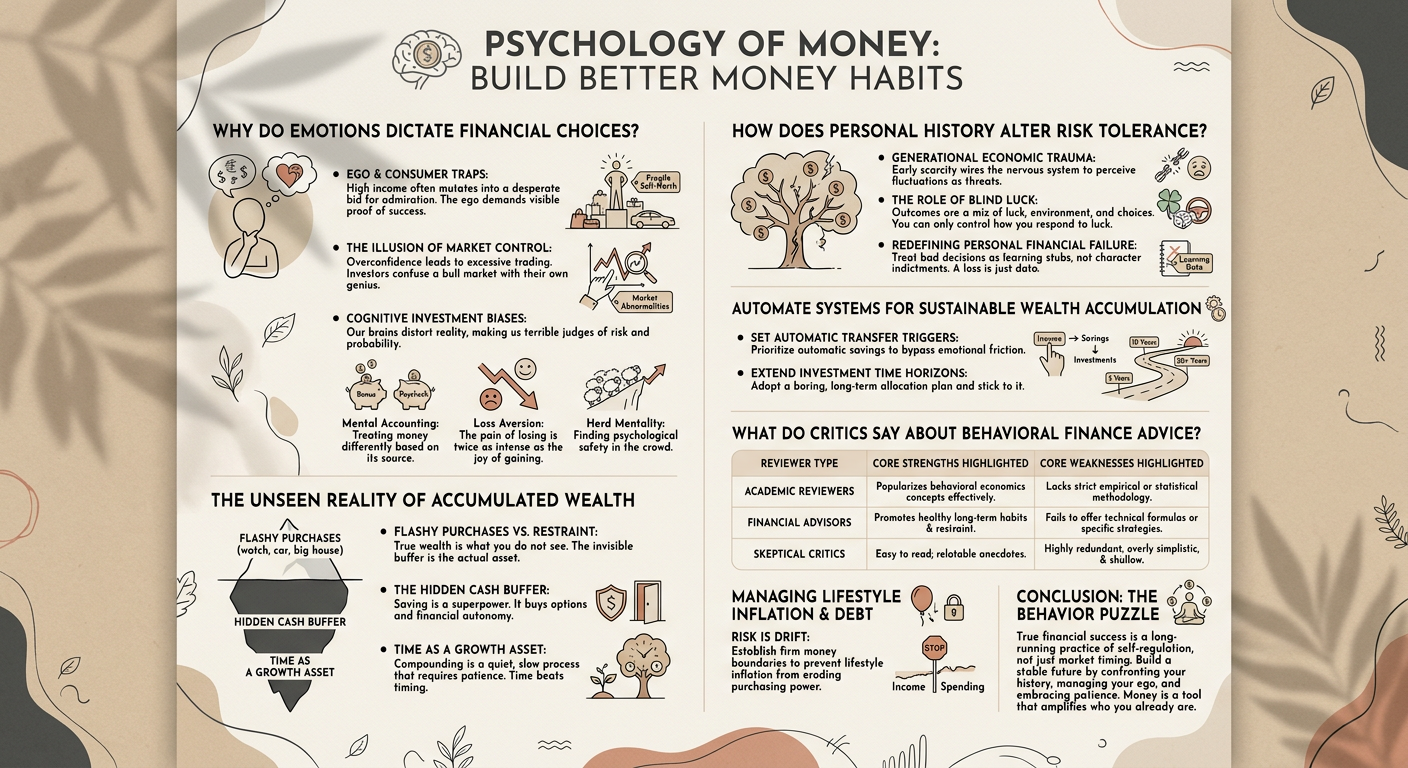
Why do emotions dictate our financial choices?
A staggering amount of financial planning ignores the human nervous system entirely. We make decisions based on how we feel in a given moment, and then we reverse-engineer a logical justification for that choice afterward. Emotions are the invisible architects of our economies.
Brad Klontz’ research on money psychology posits that we have four core types of money scripts: money status, money worship, money vigilance and money avoidance.
Ego and consumer traps
In my mid-20s, I bought several luxury bags the moment my own salary started landing in my bank account. I grew up in a struggling household where you quickly learned to read the room and simply not ask for things. The bags appeared as a way of using money to close a wound money did not inherently cause. High income often mutates into a desperate bid for admiration. The ego demands visible proof of success, leading people to buy expensive cars and a bigger house to impress acquaintances they do not even respect. We confuse ambition with the accumulation of heavy, expensive objects.
The illusion of market control
People desperately crave control over their lives. When the world feels chaotic, we try to impose order on the global economy. This overconfidence leads directly to excessive trading. A recent academic journal study on how emotional biases directly affect investor returns shows that the illusion of control creates market abnormalities and massive personal wealth destruction. Investors convince themselves they have a special skill or unique knowledge. They do not. They are simply confusing a bull market with their own genius.
Cognitive investment biases
Our brains can lead us toward cognitive biases our efforts at building wealth. Cognitive biases distort reality, making us terrible judges of risk and probability.
-
Mental Accounting: We treat money differently depending on its source. A work bonus is spent frivolously while a standard paycheck is hoarded. Richard Thaler’s concept of mental accounting explains why we make irrational choices with unexpected windfalls.
-
Loss Aversion: The psychological pain of losing fifty dollars is twice as intense as the joy of finding fifty dollars. This fear traps people in bad investments far too long.
-
Herd Mentality: We find psychological safety in the crowd. Buying at the top of a bubble feels socially secure right up until the crash.
The unseen reality of accumulated wealth
Financial advice frequently skips the hardest part of the equation: doing absolutely nothing. Quiet restraint is incredibly boring.
Flashy purchases versus restraint
Wealth is what you do not see. You can easily spot the flashy lifestyle, but true wealth is the money that was not spent on the designer watch or the kitchen upgrade. My biggest payoff has been the days I passed on impulse purchases and kept my emergency fund intact. That invisible buffer is the actual asset.
The hidden cash buffer
Saving is a superpower. It buys options. When you maintain a high savings rate, you purchase the freedom to walk away from a toxic job, outlast an economic downturn, or take calculated risks later. Financial autonomy is the ultimate luxury.
Time as a growth asset
Time always beats timing. Compounding is a quiet, slow process that requires decades of patience. I used to chase big, immediate wins, believing that aggressive action was the only path to a secure future. Now I am far more interested in simply not blowing up my capital when the market hiccups.
How does personal history alter risk tolerance?
You cannot separate a person’s current bank statement from their childhood experiences at the dinner table.
Generational economic trauma
Early scarcity wires the nervous system to perceive basic financial fluctuations as existential threats. The psychological roots of spending fear often run deep into previous generations. If your parents fought bitterly over bills, a volatile stock market feels dangerously familiar. Generational financial trauma shapes whether we view the economy as a tool or a predator.
The role of blind luck
Morgan Housel makes a brilliant point about the intertwined nature of luck and risk. Outcomes come from a messy mix of blind luck, the specific environment you were born into, and the choices you consistently make. We love to attribute a great investor’s massive net worth entirely to their superior intellect, conveniently ignoring the macro-economic tailwinds that carried them. You cannot control luck. You can only control how you respond to it.
Redefining personal financial failure
When a bad budget decision happens, treat it as a learning stub rather than a personal verdict. I see too many clients spiral into shame over past mistakes. That shame prevents actual relational repair and halts productive financial tweaks. A loss is just data. It is not an indictment of your character.
Automate systems for sustainable wealth accumulation
If you rely on daily willpower to reach your financial goals, you will eventually fail. Willpower depletes. Systems do not.
Set automatic transfer triggers
Protect yourself from your own impulses. Prioritize an automatic savings plan that moves cash into an investment account before you even see it. No debates. No hesitation. You bypass the emotional friction entirely.
Extend investment time horizons
Stop counting step-by-step market timing in favor of a simple, boring habit. Adopt a basic allocation plan, set it to automatically rebalance, and stick to it even when headlines scream panic. This is how you sleep at night.
What do critics say about behavioral finance advice?
The shift toward behavioral psychology in finance has not been universally praised. Third-party opinions on Morgan Housel’s bestselling book are overwhelmingly positive regarding its accessible behavioral insights, though critics argue it lacks technical depth and empirical structure. Industry professionals, academics, and independent reviewers have heavily scrutinized the text.
|
Reviewer Type |
Core Strengths Highlighted |
Core Weaknesses Highlighted |
|---|---|---|
|
Academic Reviewers |
Effectively popularizes behavioral economics concepts for a mainstream audience. |
Lacks strict empirical or statistical methodology; essentially a “soft skill” primer. |
|
Financial Advisors |
Promotes healthy long-term habits, restraint, and psychological awareness. |
Fails to offer technical formulas, asset allocation guidance, or specific strategies. |
|
Skeptical Critics |
Easy to read; clear, punchy formatting with relatable historical anecdotes. |
Highly redundant, overly simplistic, and conceptually shallow. |
For readers seeking actionable stock formulas, critical reviews highlight how biases sabotage financial decision-making while simultaneously noting the text’s lack of rigorous scientific models.
How do you manage lifestyle inflation and debt?
Risk is rarely a sudden explosion. Risk is about drift. The most significant danger to your long-term stability is the gradual erosion of your purchasing power and the quiet creep of lifestyle inflation. You get a raise, and suddenly you feel entitled to a nicer apartment. Establishing firm money boundaries prevents you from expanding your lifestyle to perfectly match your new income.
Does a high cash buffer guarantee personal autonomy?
Money buys options, but it cannot heal a fundamentally fractured sense of self. A massive emergency fund gives you the physical ability to leave a terrible profession or exit a bad marriage. It provides literal safety. Yet, I have worked with incredibly wealthy individuals who remain paralyzed by anxiety. They treat the market like an endless buffet, consuming everything in sight, driven by a fear of missing out. You have to pair financial liquidity with deep emotional intelligence. Otherwise, you are just a financially secure but still constrained by anxiety.
FAQ
Can behavioral skills actually be learned later in life?
Yes. Your financial mindset is incredibly neuroplastic. Through consistent practice, boundary setting, and nervous system regulation, anyone can overwrite their inherited money scripts.
Why is short term trading so detrimental?
Short term trading requires predicting human behavior and global events with perfect accuracy repeatedly. Even a great investor cannot reliably do this. The effort usually results in massive tax penalties, high fees, and significant emotional burnout.
How does my past influence my current savings rate?
Identifying unconscious money scripts is a critical step in financial therapy. If you were raised to view money as a weapon used for control, you might hoard cash out of pure spite, or you might spend it recklessly to assert your own independence.
Conclusion
We live in a culture obsessed with optimization, aggressive scaling, and maximizing every possible metric. We optimize for output and quietly erode the conditions that make people feel safe. True financial success is rarely about catching the perfect market wave or discovering a secret asset class. It is a long-running practice of self-regulation. Building a stable future requires you to confront your own history, manage your ego, and embrace the incredibly dull reality of patience. Money is simply a tool that amplifies who you already are.