
Many of us stare blankly at our banking apps on payday, feeling a cold knot twist in our stomachs as we think, “Man, I wish I could just be normal about money.”
Why not take that sheer frustration and redirect it into actually understanding how your brain works?
With enough honest self-reflection and courage, you can finally stop the panicked attempts at budgeting that never seem to stick.
Money trauma represents a massive, often invisible roadblock, with millions around the world quietly suffering while trying to hustle their way out of a psychological crisis.
The physical and emotional toll that goes into merely surviving a scarcity mindset is difficult for the average person to wrap their head around.
From obsessively checking accounts six times a day to insanely strict spending bans that we inevitably break, the sheer exhaustion of navigating financial stress is absolutely staggering.
Okay, so what the heck does this have to do with healing?
More than you might think.
While comparing your bank account to a literal crime scene might seem extreme, consider the reality that 68% of adults actively navigate the psychological aftermath of financial trauma.
We carry a heavy, unspoken burden.
In fact, the acute stress of modern economics means nearly 1 in 4 Americans experience psychological effects similar to post-traumatic stress disorder strictly due to their finances.
But do we just give up and accept the panic?
No.
And neither should you.
It’s time to pull your financial self out of the dark and address the root cause.
How?
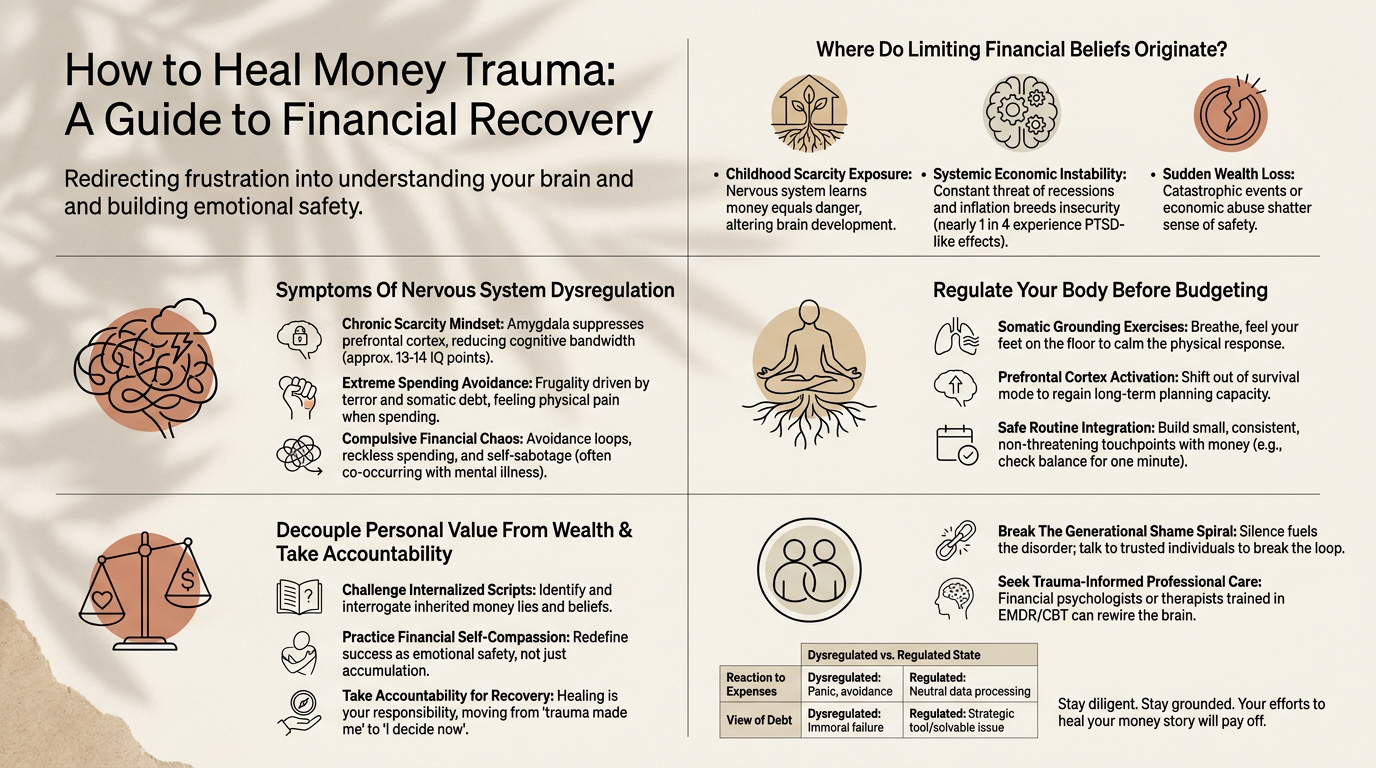
Where Do Limiting Financial Beliefs Originate?
Limiting beliefs don’t simply fall from the sky: they’re forged.
They are created as a result of intense past experiences and environments where safety was never guaranteed.
If your relationship with money is broken, does that mean you are inherently flawed?
Of course not. Instead, you need to look backward to understand the origin of the fear.
Childhood Scarcity Exposure
Our early financial experiences dictate our adult reality more than we want to admit.
When you grow up watching adults panic over bills or experiencing intense financial enmeshment, your nervous system learns that money equals danger.
Those early adverse childhood experiences actually alter brain development, ultimately causing long-term economic outcomes like reduced lifetime earnings regardless of your family’s original socioeconomic background.
Furthermore, that childhood financial strain translates directly into elevated clinical anxiety scores when we finally reach adulthood.
Systemic Economic Instability
Sometimes the threat isn’t buried in the past. It’s right now.
Living through recessions, brutal layoffs, or crushing inflation keeps the body in a constant state of threat.
When nearly a third of all adults regularly feel anxious strictly due to their current financial situation, it’s clear the system itself breeds deep insecurity.
We see a distinct generational link where perceived early scarcity consistently predicts adult depressive symptoms across multiple demographics.
Sudden Wealth Loss
A sudden financial catastrophe can shatter your sense of safety overnight.
Whether it’s a medical emergency that drains your savings or surviving relational trauma, the shock is entirely visceral.
Consider how deeply financial control is weaponized.
In domestic violence cases, up to 99% of survivors experience severe economic abuse designed to enforce dependency and compliance.
That loss of power leaves a lasting mark.
Symptoms Of Nervous System Dysregulation
Your body may know it is in dysregulation, especially when it comes to your debts.
Financial instability can take many forms, and they often disguise themselves as simple bad habits.
Chronic Scarcity Mindset
You could have ten thousand dollars in a secure bank account and still feel entirely broke.
That’s the amygdala taking over.
The sheer cognitive load of worrying about money suppresses the prefrontal cortex, effectively dropping your functional bandwidth by an equivalent of 13 to 14 IQ points.
You literally cannot think your way out of the panic.
Extreme Spending Avoidance
We often praise frugality. But there is a dark side to hoarding every single dollar.
Refusing to spend money out of terror isn’t financial wellbeing. It’s a severe avoidance loop.
As therapist Annie Wright points out, financial trauma creates a heavy somatic debt that mimics a constant physiological state of danger.
You feel actual physical guilt and pain just buying groceries.
Compulsive Financial Chaos
On the flip side, some people completely self-sabotage.
They rack up massive credit card bills, engage in reckless gambling, make wild refund requests, or avoid opening an email from their bank altogether.
You visit a financial website, the page loads, and you just stare at the site, caught in a tangled web of avoidance.
It’s a vicious cycle where nearly half of individuals facing severe problem debt also manage a mental illness.
Regulate Your Body Before Budgeting
You cannot spreadsheet your way out of a trauma response.
Somatic Grounding Exercises
When panic hits, your brain throws up a massive block.
It’s almost like hitting a security firewall online, where your own mind demands a way out just to access basic logic.
You have to bypass that block.
Breathe. Feel your feet on the floor. Calm the physical response before you even look at the data.
Prefrontal Cortex Activation
Once the body feels safe, the brain can finally process information.
You shift out of survival mode and regain your capacity for long-term planning.
You move away from addiction-like impulses and back into rational thought.
Safe Routine Integration
Consistency is absolutely everything.
Build small, non-threatening touchpoints with your money.
Check your balances for exactly one minute a day. Then close the app.
Build trust with yourself slowly.
Decouple Personal Value From Wealth
Your net worth is not your self worth.
Money becomes tied to your identity in insidious ways, making you feel like a failure if your bank account dips.
Challenge Internalized Scripts
We all carry hidden money scripts inherited from our past traumas.
These are the lies we tell ourselves about what we deserve.
Identify those scripts. Write them down. Then ruthlessly interrogate them.
Practice Financial Self-Compassion
Beating yourself up over a financial mistake only fuels the shame.
Recognize that higher financial worry acts as a severe risk factor for elevated clinical distress.
Give yourself grace.
Redefine Success Metrics
Success isn’t just about accumulating massive financial wealth.
It’s about establishing emotional safety and trusting your ability to survive whatever comes your way.
Those are the real financial wins.
Take Accountability For Financial Recovery
Let’s get something straight.
I have a pretty strong stance on this, and it might sting: some people treat trauma like a permanent life sentence, and then are surprised when financial healing requires actual work, agency, and being uncomfortable on purpose.
I didn’t choose what happened to me. You probably didn’t either.
But using “not my fault” as a shield to avoid responsibility keeps you broke and miserable.
Healing is our responsibility in the exact same way showing up for physical rehab is our responsibility after an accident.
I didn’t cause the injury. But I absolutely decide if I’m going to do the work.
If you’re sitting in the driver’s seat of your life, “trauma made me do it” is only half the truth.
“I’m deciding what I do now” is the other half.
And that half is where the power actually lives.
Break The Generational Shame Spiral
Silence is the ultimate enemy of financial security.
The more we hide our money disorders, the stronger they get.
Sadly, 83% of adults face high financial stress, forcing the majority to avoid or delay mental health treatment simply due to out-of-pocket costs.
It creates a paralyzing loop.
You might desperately need financial assistance but feel too much shame to ask.
We see individuals with exceptionally low accrued liquid assets facing double the odds of screening positive for anxiety and depression.
Break the silence. Talk to a trusted friend. Join a support community.
Stop letting the shame fester in the dark.
Seek Trauma-Informed Professional Care
Sometimes a podcast isn’t enough.
You don’t need to read a dense academic textbook to know when you’re in over your head.
If your money anxiety is ruining your relationships, you need a financial psychologist or a trauma therapist.
Even the mainstream finance world is waking up to this reality, with formal psychology and therapy training now becoming a requirement for wealth professionals.
Therapies like EMDR or trauma-informed CBT can literally rewire your brain.
As financial trauma researcher dr joi k madison often highlights, the connection between our past and our wallet is undeniable.
Why Do Symptoms Surface Years Later?
You might be wondering why you’re suddenly terrified of money at age thirty-five when you’ve been working since you were sixteen.
Because the mind is annoyingly efficient at survival.
Sometimes symptoms show up late because you initially had coping mechanisms and structure that kept the trauma from fully breaking through.
Then you get a new job. Or you have a kid. Or the economy shifts.
Suddenly, those old survival strategies no longer fit.
The brain basically waits for the “right conditions” to process something that used to be too dangerous to touch.
It can be real and still be dormant.
But the reality is, 74% of professionals will skip necessary time off and delay personal well-being actions out of sheer economic fear.
Don’t wait until the wheels fall off.
FAQ
In the domain of personal finance, behavior speaks louder than spreadsheets.
Here are the core behaviors that differentiate a regulated financial state from a deeply dysregulated one.
| State | Reaction to Expenses | View of Debt | Financial Conversations |
|---|---|---|---|
| Dysregulated | Panic, physical nausea, avoidance | Immoral failure, pure doom | Defensive, secretive, highly shameful |
| Regulated | Neutral data processing | Strategic tool or solvable issue | Open, curious, boundary-driven |
If you find yourself constantly living in the dysregulated column, your body is sounding an alarm.
- Is trauma the root of all my money problems? No. I’m not buying the grand-unifying theory that trauma explains every bounced check. Real life is infinitely messier. Sometimes it’s untreated anxiety, sometimes it’s terrible systemic environments, and sometimes you just made a bad investment. Trauma is often involved, but insisting it’s the only cause freezes your growth because it turns every problem into “well, I can’t help that.”
- Can I fix this financial behavior on my own? Awareness is step one. But true nervous system regulation often requires external support. Knowing the ins and outs of your own triggers takes time, patience, and often professional guidance.
Conclusion
Building a secure relationship with money takes grit.
It requires ripping off the band-aid and looking at the ugly truth of your past experiences.
There are absolutely no shortcuts.
Google is more than happy to show you a thousand different “get rich quick” schemes, but none of them will actually heal your nervous system.
If anything, it just poisons your financial well further.
You have to put in the reps.
Keep going. Keep breathing. If your money story is broken, figure out exactly why and do what you can to fix it.
Stay diligent. Stay grounded. Stay honest with yourself.
Your efforts will pay off.