
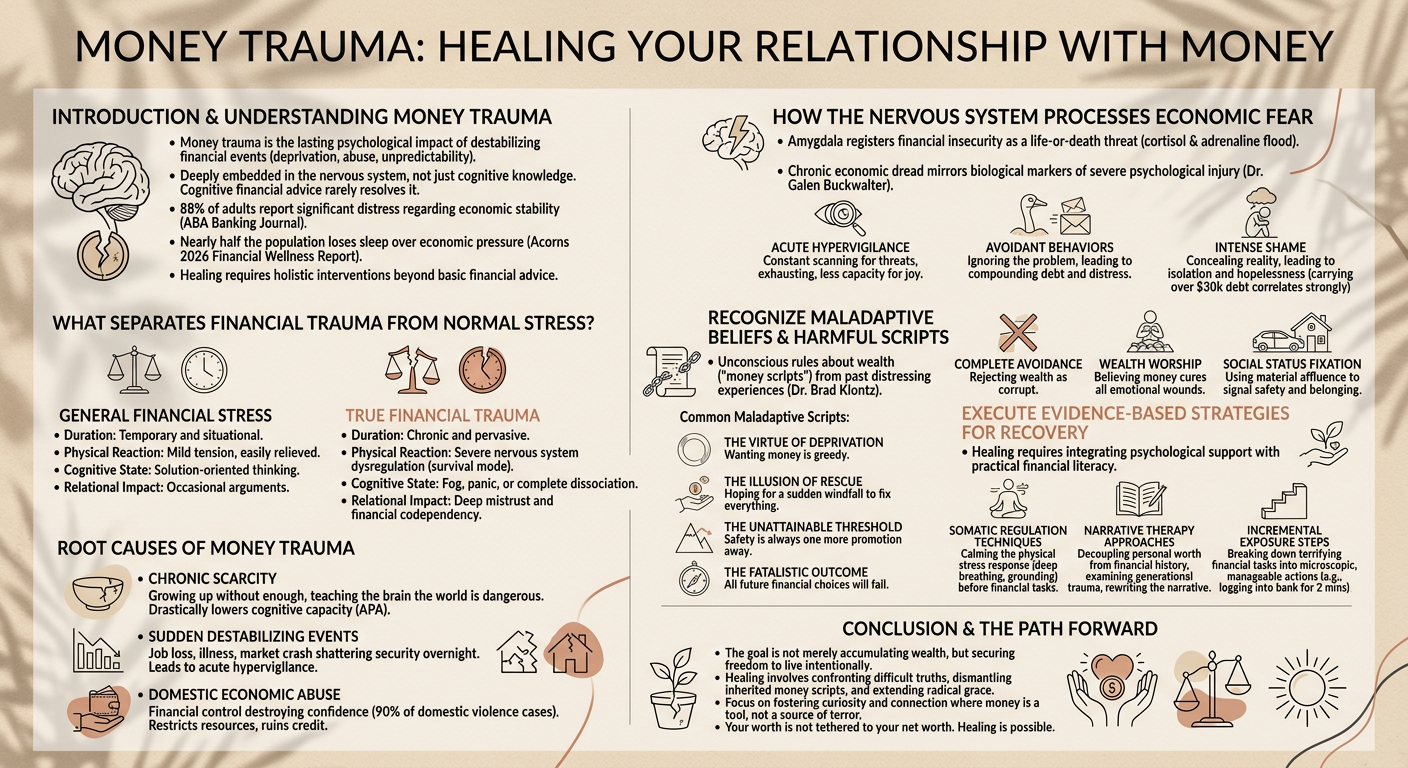
Introduction
Money trauma is the lasting psychological and physiological impact of destabilizing financial events, such as deprivation, economic unpredictability, or abuse. Recent metrics from the ABA Banking Journal reveal that a staggering 88 percent of adults report significant distress regarding their economic stability. Distress barely captures the reality. True trauma embeds itself deeply within the nervous system rather than the intellect. Cognitive financial knowledge alone rarely resolves the resulting anxiety or behavioral loops. People can memorize budgeting spreadsheets and recite compound interest formulas perfectly. Their bodies still brace for a catastrophic impact every time the grocery bill rings up.
Society demands relentless upward mobility. The cultural script dictates constantly upgrading the house, securing the next promotion, and accumulating assets. Individuals are repeatedly told that more wealth equates to greater safety. The reality betrays a much messier truth. When people experience intense financial fear, their baseline biology shifts. The Acorns 2026 Financial Wellness Report notes that nearly half of the population loses sleep over economic pressure, quietly eroding their capacity for connection and joy. Healing this wound requires moving beyond basic financial advice and addressing the very real physiological scars left behind by systemic pressure and personal loss. The focus must shift toward holistic evidence-based interventions that nurture long-term psychological safety.
What Separates Financial Trauma From Normal Stress?
Stress is an adaptive response to a temporary problem. Trauma is an injury that alters how a person perceives the world permanently. When a standard financial mistake occurs, a healthy response involves analyzing the error and adjusting behavior. When a financial trauma response is triggered, the brain bypasses logic entirely. The body perceives a threat to its sheer survival.
|
Feature |
General Financial Stress |
True Financial Trauma |
|---|---|---|
|
Duration |
Temporary and situational |
Chronic and pervasive |
|
Physical Reaction |
Mild tension, easily relieved |
Severe nervous system dysregulation |
|
Cognitive State |
Solution-oriented thinking |
Fog, panic, or complete dissociation |
|
Relational Impact |
Occasional arguments |
Deep mistrust and financial codependency |
Chronic Scarcity
Growing up without enough resources leaves a permanent imprint. Childhood scarcity teaches a young brain that the world is inherently dangerous and unpredictable. Systemic poverty forces individuals to operate constantly in survival mode. The American Psychological Association has extensively documented how this specific type of scarcity mindset drastically lowers cognitive capacity. People trapped in this environment are not making poor choices because they lack intelligence. They are making survival-based financial decisions with an overloaded cognitive processing system. Every dollar spent feels like a potential misstep that could lead to ruin.
Sudden Destabilizing Events
Sometimes the ground vanishes without warning. A sudden job loss, an unexpected medical illness, or a catastrophic market crash can shatter a person’s sense of security overnight. This type of traumatic event severely destabilizes a person’s psychological foundation. Every subsequent financial decision is then processed through that compromised framework. Individuals who experience sudden financial catastrophe often develop acute hypervigilance, constantly waiting for the next disaster to strike. They might hoard cash or refuse to make any investments, paralyzed by the fear of losing money again.
Domestic Economic Abuse
Economic control is a highly effective tool for subjugation. Over 90 percent of domestic violence cases involve some form of financial control, completely destroying a partner’s financial confidence. Experts like Dr. Judy Postmus have highlighted how economically controlling behaviors restrict resources, forcing victims into dependency. Perpetrators might ruin credit scores, hide assets, or sabotage employment opportunities. Economic abuse recovery requires immense resilience, as survivors must essentially rebuild their entire financial identity from scratch while simultaneously processing deep relational trauma.
How The Nervous System Processes Economic Fear
The human body cannot easily distinguish between a physical predator and a zero-balance bank account. The amygdala registers severe financial insecurity as a life-or-death scenario, flooding the body with cortisol and adrenaline. PTSD researcher Dr. Galen Buckwalter has mapped how chronic economic dread mirrors the biological markers of severe psychological injury. The stress response system remains perpetually activated. Over time, this constant state of alarm leads to profound physical exhaustion and negative thought patterns that are notoriously difficult to break.
Acute Hypervigilance
A hypervigilant individual operates like a watchman anticipating an attack. They might check their bank balances a dozen times a day. A minor fluctuation in the stock market triggers a full-blown panic attack. This protective behavior is exhausting. The brain allocates massive amounts of energy toward scanning the environment for financial threats, leaving very little capacity for creativity, curiosity, or meaningful connection.
Avoidant Behaviors
Some nervous systems respond to overwhelming fear by shutting down entirely. Financial avoidance manifests in unopened mail, neglected tax returns, and a flat refusal to engage in money conversations. The individual convinces themselves that ignoring the problem will make the terror dissipate. Avoidance behaviors provide temporary relief but guarantee long-term consequences. The debt grows. The penalties compound. The underlying distress intensifies in the shadows.
Intense Shame
Money shame operates as a toxic, silent emotion that makes people hide their reality from those they love most. A survey by Beyond Finance and Talker Research published in the NY Post details how carrying over $30,000 in debt correlates strongly with hopelessness and profound embarrassment. People will go to extraordinary lengths to conceal their financial struggles, projecting an image of financial success while drowning internally. This intense humiliation breeds isolation, making recovery exponentially harder.
Recognize Maladaptive Beliefs And Harmful Scripts
Psychologists categorize the unconscious rules people follow about wealth as “money scripts.” Dr. Brad Klontz emphasizes that these maladaptive beliefs often stem directly from past distressing experiences. Identifying these hidden narratives is the first crucial step toward establishing clarity.
Common maladaptive scripts include:
-
The Virtue of Deprivation: Believing that wanting money is inherently greedy, leading to chronic under-earning.
-
The Illusion of Rescue: Hoping that a sudden windfall or a wealthy partner will magically fix all past financial experiences.
-
The Unattainable Threshold: The conviction that safety is always just one more promotion or bonus away, ensuring the person never actually feels secure.
-
The Fatalistic Outcome: Assuming that because past financial situations ended poorly, all future financial choices are destined to fail.
Complete Avoidance
Rejecting wealth entirely is often a trauma response disguised as moral superiority. People operating under this script view money as fundamentally corrupt. They unconsciously sabotage lucrative opportunities, refuse to negotiate salaries, and avoid any form of financial planning. This complete avoidance ensures they remain in a state of financial instability, ironically keeping them tethered to the very stress they are trying to escape.
Wealth Worship
The opposite end of the spectrum is the belief that money cures all emotional wounds. Individuals suffering from wealth worship hoard resources to fill an internal void. They believe that if they just accumulate enough finances, the pain of their past will finally vanish. Sadly, the goalpost constantly shifts. No amount of wealth can regulate a dysregulated nervous system.
Social Status Fixation
In highly competitive environments, money easily becomes the language used to determine human worth. Money status drives people to purchase homes they cannot afford and cars that stretch their credit to the absolute limit. This fixation is an attempt to buy belonging. The individual uses material affluence to signal safety to the tribe, terrified that looking poor equates to being outcast.
Execute Evidence-Based Strategies For Financial Recovery
Healing demands a compassionate, multidisciplinary approach. Finding actionable ways to heal money trauma requires integrating psychological support with practical financial literacy. Mental health professionals who specialize in financial therapy understand that an individual must feel safe before they can balance a budget.
Somatic Regulation Techniques
Before an individual can look at their debt securely, their body must feel anchored. Somatic regulation techniques focus on calming the physical stress response. Practices like deep breathing, grounding exercises, and mindfulness allow the body to process fear without spiraling into panic. A financial therapist might spend several sessions simply helping a client learn to breathe while holding a bank statement, teaching the nervous system that the piece of paper is not a literal weapon.
Narrative Therapy Approaches
Humans are storytelling creatures. Narrative therapy helps individuals decouple their personal worth from their financial history. By examining the generational trauma passed down through their family, a person can begin to see their financial behaviors not as personal failures, but as inherited coping mechanisms. Unpacking these stories provides the necessary distance to rewrite the narrative. They move from being a victim of their past to an active participant in their financial future.
Incremental Exposure Steps
Treating financial anxiety requires slow, deliberate movement. Incremental exposure steps involve breaking down terrifying financial tasks into microscopic, manageable actions. Instead of tackling a mountain of debt in one weekend, a person might simply agree to log into their bank account for exactly two minutes. The next week, they might categorize three transactions. Small, repeated exposures build resilience and demonstrate to the brain that engagement does not equal destruction.
Break Behavioral Loops And Stop Resource Sabotage
Trauma loops repeat until they are consciously interrupted. A person might engage in compulsive saving, hoarding every penny while denying themselves basic comforts, only to eventually snap and engage in massive binge spending. Others might turn to gambling, chasing the biochemical rush of risk to distract from their underlying numbness. Breaking the cycle of intergenerational trauma requires immense courage. It involves pausing in the space between the emotional trigger and the financial action. Instead of acting out the trauma response, the individual learns to sit with the discomfort. Utilizing professional therapeutic support allows individuals to dismantle these ingrained habits and replace them with intentional, life-affirming choices.
How Does Economic Exploitation Affect Relational Trust?
When someone has been financially exploited by a partner or family member, their capacity to trust is fundamentally fractured. Economic exploitation teaches a person that intimacy is dangerous and that vulnerability leads to ruin. Financial therapy for couples becomes essential in these scenarios. Partners must learn to navigate financial codependency and rebuild transparency. The betrayed individual needs undeniable proof that their resources are safe, while both partners must commit to establishing clear boundaries. Rebuilding this trust takes time, requiring both parties to prioritize psychological safety over being “right” about the budget.
FAQ
What exactly does a financial therapist do? A financial therapist bridges the gap between mental health counseling and financial advice. They hold clinical degrees and help clients uncover the emotional roots of their money disorders, utilizing therapeutic modalities to change financial behavior from the inside out.
Is financial trauma an official clinical diagnosis? While “financial trauma” is not a standalone diagnosis in the DSM-5, the symptoms frequently fall under the umbrella of Post-Traumatic Stress Disorder (PTSD), acute anxiety, or adjustment disorders. The physiological impact is highly recognized by trauma researchers and finance experts alike.
Can childhood poverty affect my earning potential as an adult? Yes. Childhood scarcity can hardwire the brain for short-term survival thinking, making long-term financial planning feel unnatural. However, with targeted therapy and empowerment strategies, individuals can rewire these pathways and achieve sustainable financial success.
Conclusion
Understanding the deep roots of financial trauma is the first step toward reclaiming autonomy. The journey from scarcity to spaciousness is rarely linear. It involves confronting difficult truths, dismantling inherited money scripts, and extending radical grace toward past mistakes. The goal is not merely accumulating wealth for the sake of status. The true objective is securing the freedom to live intentionally, fostering curiosity, and cultivating a life where money serves as a tool for connection rather than a source of terror. Healing is possible, and it begins the moment an individual decides their worth is no longer tethered to their net worth.