
Last updated on June 30, 2026
Introduction
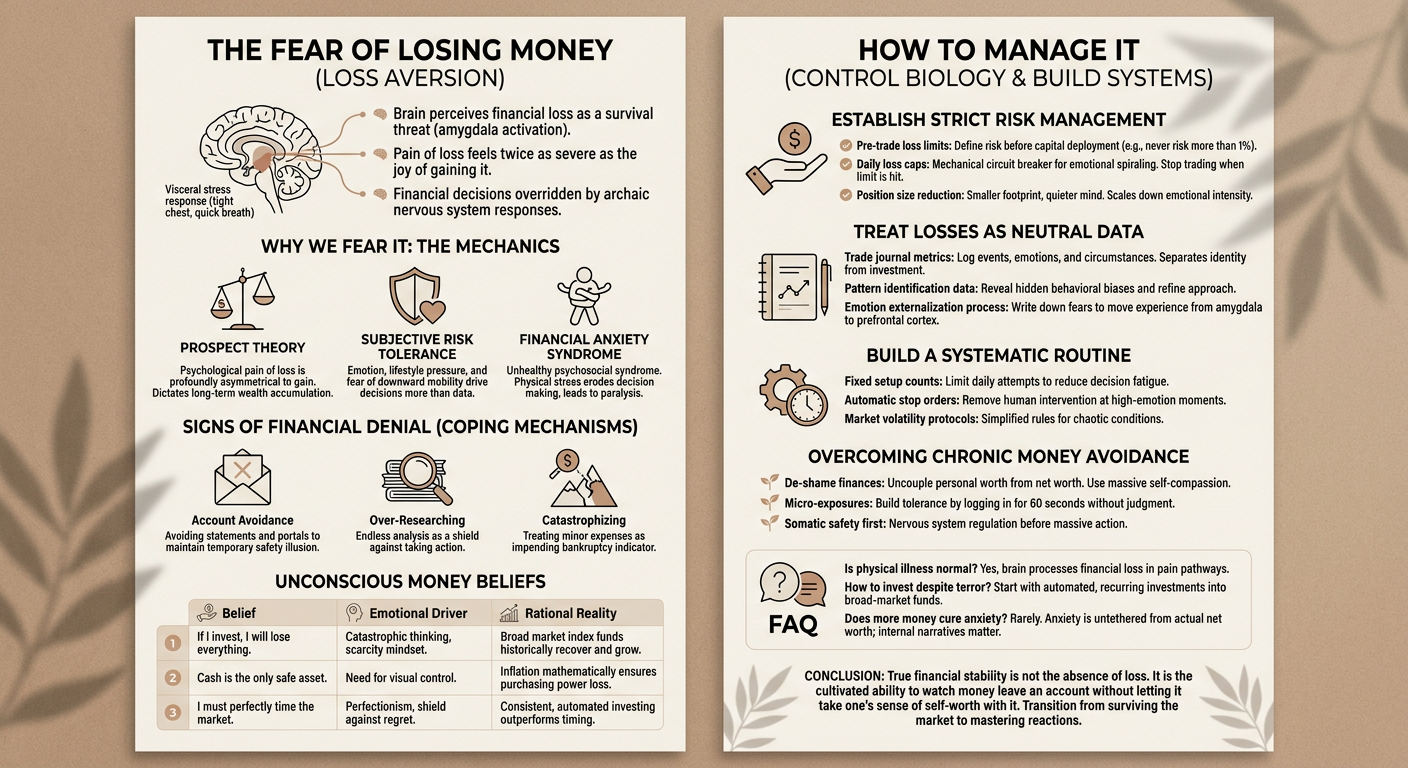
Strategic financial planning relies on the objective maximization of capital growth and the systematic mitigation of market volatility. This standard corporate doctrine sounds perfectly reasonable in a boardroom. It completely falls apart when an investor watches a $15,000 portfolio drop to $8,000 in a single Tuesday morning correction. The primary answer to why this happens is a biological and psychological response known as loss aversion, where the brain perceives financial deficits as an immediate threat to survival, causing the pain of losing money to feel twice as severe as the joy of gaining it. The chest tightens. The breath shortens. That physiological reaction is not a math problem.
The fear of losing money operates entirely outside the boundaries of logic. People do not behave like spreadsheets. They behave like humans desperately trying to survive a perceived threat to their future. Financial decisions are routinely overridden by an archaic nervous system that interprets a stock market dip the same way it interprets a physical predator.
Why do people fear financial loss so intensely?
Prospect Theory concept
The framework of loss aversion explains why making a poor financial decision feels uniquely devastating. The psychological pain of losing funds is profoundly asymmetrical to the joy of making an equivalent gain. When an individual loses a hundred dollars, the misery vastly outweighs the happiness of finding that same amount. This behavioural bias heavily dictates future purchasing power and long-term wealth accumulation. Biological data confirms this phenomenon. Brain scans reveal that the amygdala physically reacts to financial loss, turning abstract market movements into visceral, bodily pain. It is not a metaphor. It is biology.
Subjective risk tolerance
Objective numbers rarely match the subjective experience of risk. An individual’s risk profile is heavily dictated by this deep-seated fear rather than their daily budgets or actual cash reserves. A professional might earn a massive salary yet feel entirely paralyzed by the prospect of investing because the perceived threat of a sudden wealth loss feels catastrophic. Even young, educated investors who fail to overcome financial biases routinely make choices based on emotion rather than data. Money in this context carries emotional weight. It carries the pressure of maintaining a specific lifestyle, securing property, and avoiding the stigma of downward mobility.
Financial anxiety syndrome
Clinical psychologists classify intense fear regarding personal finances as an unhealthy psychosocial syndrome. This financial anxiety manifests physically and erodes the capacity for higher-order decision making. People experiencing this level of stress often fall into a state of paralysis. They experience severe investing anxiety that keeps them holding depreciating cash instead of building a robust portfolio. The emotional weight of money translates into a profound sense of inadequacy, deeply rooted in the nervous system rather than a lack of financial literacy.
Recognize the hidden signs of financial denial
Financial denial rarely looks like outright panic. It usually disguises itself as procrastination, hyper-responsibility, or sudden changes in behaviour. When the nervous system is overwhelmed by the perceived threat of financial ruin, it deploys defense mechanisms to artificially regulate the body’s stress response. Recognizing these signs is the first step toward dismantling the behavioral biases that erode wealth over time.
- Account Avoidance: Individuals stop logging into their investment portals, ignore credit cards, and refuse to open mail from brokerages to maintain a temporary illusion of safety.
- Over-Researching Without Action: A person might spend hundreds of hours analyzing property markets or mutual funds, using the endless accumulation of knowledge as a shield against actually deploying capital.
- Catastrophizing Minor Expenses: The brain begins treating a small increase in the price of daily living essentials as an indicator of impending bankruptcy, completely losing perspective on overall net worth.
Account avoidance behavior
People experiencing intense loss aversion often adopt coping mechanisms that look suspiciously like apathy but are actually survival responses. They stop looking at the numbers. Avoiding bank accounts does not stop inflation from eroding savings. It merely delays the inevitable confrontation with reality. This avoidance creates compounding debt and amplifies the underlying psychological pain because the unknown is always more terrifying than a quantified deficit.
Premature asset liquidation
The market dips. Panic sets in. The investor sells everything to prevent further losses. This is the disposition effect in action, where individuals sell winning investments too early to secure a small gain, yet hold onto losing investments indefinitely to avoid realizing a loss. The fear of losing money leads directly to very bad decisions. They sabotage their future wealth because the immediate psychological relief of selling feels better than sitting in the discomfort of temporary market volatility. They stay in bad situations and avoid investing to dodge the emotional fallout of being wrong.
Unconscious money beliefs
Money is never just money. It is an intricate web of personal history and intergenerational identity. An individual’s money personality is deeply intertwined with deeply embedded scarcity mindsets formed during early experiences. These unconscious beliefs dictate that wealth is fleeting and disaster is always imminent. When individuals attempt to navigate career shifts or investments, they must often conquer common transition fears that stem from these old narratives rather than current market realities.
| Unconscious Money Belief | Emotional Driver | Rational Market Reality |
|---|---|---|
| “If I invest, I will lose everything.” | Catastrophic thinking tied to childhood scarcity. | Broad market index funds historically recover and grow over long time horizons. |
| “Cash is the only safe asset.” | Need for immediate visual control over resources. | Inflation mathematically guarantees the loss of purchasing power over time. |
| “I must perfectly time the market.” | Perfectionism acting as a shield against regret. | Consistent, automated investing outperforms reactionary market timing. |
Establish strict risk management to control biology
Pre-trade loss limits
Stop pretending fear is a reliable signal. Fear is biology. It is not an accurate predictor of market behavior. The most effective way to calm the nervous system is to pre-commit to strict risk limits before any capital is deployed. When an investor explicitly defines that they will never risk more than one percent of their total assets on a single financial decision, the thought of losing money stops feeling like an existential threat. It becomes a disciplined choice.
Daily loss caps
Human brains are not equipped to handle sustained periods of high-stakes financial stress. Implementing a daily loss cap acts as a mechanical circuit breaker for emotional spiraling. If the daily limit is hit, the session ends. No exceptions. This strategy preserves option value and prevents evere financial drawdowns. The fear of ruin fades because the danger zone is clearly demarcated. The individual retains absolute control over their exposure.
Position size reduction
A smaller footprint in the market directly correlates to a quieter mind. Reducing position sizes scales down the emotional intensity of the investment. It transforms a terrifying financial challenge into a manageable experiment. This is how one institutionalizes their approach, removing the frantic energy of needing to be right and replacing it with the calm execution of a mathematical edge.
Treat inevitable market losses as neutral data
Trade journal metrics
Every single losing financial decision provides crucial information. It is data about a specific edge, not a verdict on intelligence or worth. Keeping a detailed log of what happened, what emotions were present, and what the specific circumstances were allows an investor to separate their identity from their investments. The journaling itself lowers anxiety. It converts an ambiguous sense of dread into hard, reviewable metrics.
Pattern identification data
Over time, tracking these metrics reveals behavioural biases that would otherwise remain hidden. Perhaps an investor consistently over-trades during volatile morning sessions or tightens their stop losses too aggressively after a minor drawdown. Recognizing these patterns allows for structural adjustments. The goal is not perfection. The market relentlessly punishes perfectionists. Those paralyzed by a fear of failure will inevitably freeze when the market demands decisive action.
Emotion externalization process
Writing down the psychological pain of a loss moves the experience out of the amygdala and into the prefrontal cortex. It externalizes the fear. It turns abstract panic into concrete, actionable tweaks. When a person articulates their fear of failure on paper, the emotional charge dissipates. They begin to see their financial journey as a continuous process of refinement rather than a high-stakes test of their personal value.
Build a systematic routine to eliminate emotional choices
Fixed setup counts
A reliable routine does not depend on intuition. It relies on predetermined criteria. By limiting the number of times they will attempt a specific setup per day, an investor reduces the cognitive load of constant decision making. They act on clear, repeatable criteria rather than dithering between too many uncertain signals.
Automatic stop orders
Willpower depletes. Technology does not. Placing automatic stop orders immediately after entering a position removes human intervention at the exact moment when emotions run highest. The decision to exit a losing position is made logically, in advance, rather than frantically in the heat of the moment.
Market volatility protocols
High volatility requires simplified rules. When the market behaves erratically, complex strategies break down and fear takes over. Having a compact rule set specifically designed for chaotic market conditions forces an investor to trade fewer setups and focus only on the highest probability opportunities.
What distinguishes rational caution from emotional fear?
Rational caution operates from a foundation of evidence and defined limits, whereas emotional fear operates from a place of perceived survival threat. When a professional reviews their portfolio and decides to rebalance their assets because current inflation rates threaten their future purchasing power, they are exercising rational caution. They are looking at the math, assessing the landscape, and making a calculated adjustment to preserve resources.
Emotional fear feels entirely different in the body. It is the frantic, compulsive urge to liquidate investments simply because a financial news headline predicted a recession. It is the persistent, gnawing anxiety that keeps a person awake at night, convinced that they will never have enough money regardless of their actual net worth. The Inner O.S. is essentially short-circuiting. Rational caution accepts that risks exist and prepares for them. Emotional fear demands absolute certainty in a world where certainty is a myth, often leading to total inaction or highly destructive financial choices. The distinction lies in the origin of the impulse: one comes from the prefrontal cortex analyzing data, while the other comes from the primitive brain screaming for safety.
How do you overcome chronic money avoidance?
Overcoming chronic money avoidance requires a gentle, systemic dismantling of the shame associated with finances. It is impossible to shame someone into financial literacy. The journey begins by uncoupling personal worth from net worth, recognizing that past financial decisions are merely events that occurred, not permanent character defects. To stop your fear of spending money or looking at debt, an individual must introduce massive amounts of self-compassion into their daily routine.
This often starts with micro-exposures. Logging into a bank account for exactly sixty seconds, without making any changes or judgments, begins to build tolerance in the nervous system. Over time, these brief exposures accumulate. The individual learns to sit with the discomfort of their financial reality without disassociating. Building wealth is fundamentally an act of regulating the nervous system. As the psychological safety around money increases, the individual can slowly begin to implement budgets, consult advisors, and make proactive choices about their future wealth without the overwhelming influence of historical trauma dictating their every move.
Figures like Tony Robbins often talk about visualizing a compelling future. Tony emphasizes massive action. But if an individual’s nervous system is trapped in a scarcity loop, those words fall utterly flat.
Tony Robbins seminars might ignite temporary motivation, but real change requires somatic safety first. The work of Tony and others is ineffective until the body feels safe enough to process the concept of wealth without equating it to a survival threat.
FAQ
Is it normal to feel physically ill when losing money? Yes. Research shows the brain processes financial loss in the same neural pathways it uses to process physical pain. The amygdala activates, flooding the body with stress hormones. It is a biological response, not a sign of weakness.
How can someone invest when they are terrified of market crashes? They must start by completely eliminating the need for discretionary choices. Setting up automated, recurring investments into broad-market index funds removes the burden of timing the market. The money moves quietly in the background before the brain has a chance to panic.
Does having more money cure financial anxiety? Oddly enough, it rarely does. Financial anxiety is untethered from actual net worth. An individual with ten million dollars can experience the exact same visceral terror of going broke as someone with a thousand dollars if their internal narratives about scarcity remain unaddressed.
Conclusion
Everyone is obsessed with maximizing returns. Very few are talking about the immense psychological toll of constantly managing risk. The financial industry sells the illusion that building wealth is a purely mathematical endeavor, completely ignoring the messy, volatile human beings executing the trades. Scaling a portfolio is meaningless if the process destroys a person’s peace of mind. True financial stability is not the absence of loss. It is the cultivated ability to watch money leave an account without letting it take one’s sense of self-worth with it. When an investor finally stops fighting their biology and starts building systems to accommodate their inherent behavioural biases, the fear of losing money stops ruling their life. They transition from merely surviving the market to actually mastering their own reactions to it.