
Last updated on July 16, 2026
Introduction
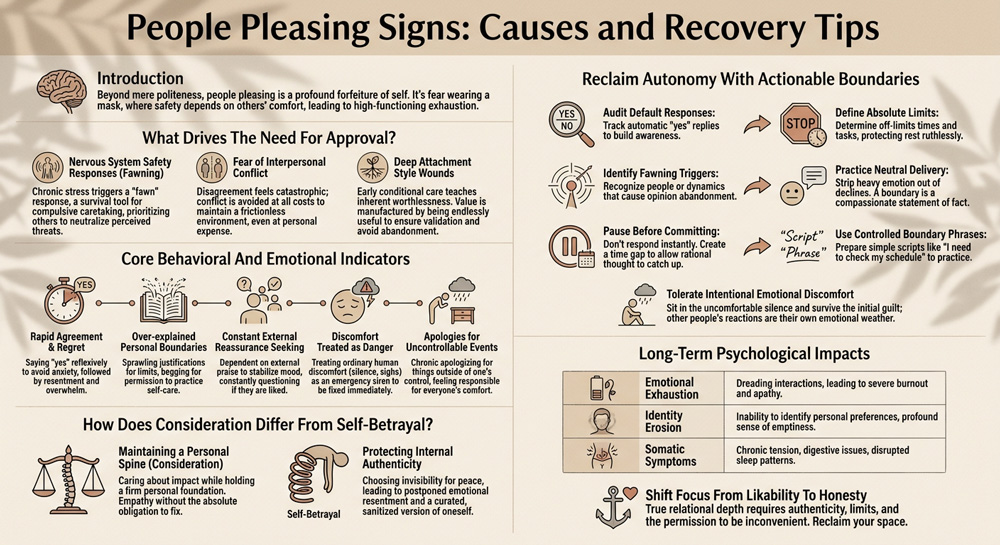
People are routinely praised for being agreeable. An employee nods in endless meetings, holds back their thoughts and takes on the emotions of those around them. Most individuals call this being nice. Honestly, observing this from a clinical lens, it looks more like fear wearing a very polite mask. The reality of people pleasing behavior goes far beyond mere politeness; it is a profound forfeiture of self. A person’s nervous system has fundamentally learned that their physical or emotional safety depends entirely on the comfort of others. They manage the feelings of their friends or colleagues instead of owning their own needs, trying to earn their place in the room as if they are perpetually paying rent for their existence.
What Drives The Need For Approval?
Nervous system safety responses
When an individual experiences chronic stress, the body does not simply resort to fighting or fleeing. Sometimes it fawns. The British Psychological Society notes that recognizing this fawning trauma response reveals a hypervigilant state where compulsive caretaking becomes a primary survival tool. A person continuously scans their environment, reading micro-expressions and adjusting their personality to neutralize any perceived threats. The instinct isn’t to connect. The instinct is to survive the interaction.
Fear of interpersonal conflict
Disagreement feels like a catastrophic event to a chronic pleaser. The desire to maintain a pristine, frictionless environment completely overrides any internal wishes they might hold. This is a massive, systemic issue. Nearly half of adults report routinely agreeing to things simply to dodge an argument, a statistic highlighted in a recent Psychology Today overview defining key behavioral traits associated with this mindset. Conflict represents a relational rupture. For someone lacking a solid internal baseline, that rupture feels unsurvivable.
Deep attachment style wounds
Humans learn the parameters of love in their earliest years. If care was highly conditional, perhaps if a child was praised solely for being good or staying out of the way, they quickly internalize that their inherent worth is zero. They must manufacture value by being endlessly useful. Early childhood dynamics heavily dictate how adults seek validation, shaping this ingrained habit where emotional dependency frequently replaces a secure, holistic connection.
Avoidance of potential abandonment
At the end of the day, people pleasers operate under a constant terror of being left behind. If they dare to have desires, if they assert limits, the underlying dread is that others will deem them too much trouble and walk away entirely. They surrender their preferences to ensure everyone else stays.
Core Behavioral And Emotional Indicators
How does this actually manifest in daily life? It rarely looks like outright misery. It usually looks like high-functioning exhaustion. Signs of People Pleasing You Should Not Ignore Today often hide in plain sight.
Rapid agreement and regret
Someone might say sure before their brain even processes a request. The commitment leaves their lips instantly, a reflex driven by anxiety rather than a genuine preference. Ten minutes later, they stare at their calendar, drowning in resentment and wondering why they agreed to organize a community event when their mental health is already running on fumes.
Over-explained personal boundaries
When an individual finally attempts to set a limit, they tend to drown it in context. They cannot simply state that they are unavailable. They offer a sprawling, desperate thesis on their schedule, essentially begging for permission to hold the boundary. This represents an attempt to soften the blow, ensuring no one is disappointed by their attempts at self care.
Constant external reassurance seeking
Some individuals chase validation like it is oxygen. Are they mad at me? Did I say that wrong? Is this fine? These questions pepper their internal dialogue and their conversations. They cannot trust their own perception of reality unless someone else signs off on it, heavily relying on external praise to stabilize their shifting mood.
Discomfort treated as danger
A silent room feels terrifying. A heavy sigh from a husband or a close friend sends them into a cognitive spiral. They treat ordinary human discomfort as an emergency siren, rushing to fix the emotion in the space instead of stepping back and just letting it exist naturally.
Apologies for uncontrollable events
A person might apologize to the furniture when they bump into it. They say sorry when it rains on a group outing. Chronic apologizing for things entirely outside of one’s control is a hallmark sign that they feel responsible for the entire world’s comfort.
How Does Consideration Differ From Self-Betrayal?
People often conflate pleasing behaviors with kindness. That is a convenient narrative used to justify the profound exhaustion. True consideration involves caring about the impact of an action while maintaining a firm personal spine. People-pleasing behavior is surrendering that spine entirely to avoid making an impact at all.
Maintaining a personal spine
Kindness does not require anyone to become a someone who consistently puts their own needs aside. A person can hold deep empathy for someone’s struggle without assuming the absolute obligation to fix it. A healthy individual operates from a place of caring about others while simultaneously caring about themselves. The pleaser operates from a place of prioritizing others because they are terrified.
Caring about mutual impact
Authentic relationships thrive on mutuality and clarity. When a person bends constantly to accommodate others, they actually deprive everyone of a real relationship. They offer a curated, sanitized version of a person. True relational depth requires a little bit of friction and a lot of honesty.
Protecting internal authenticity
If an individual is always trying to be the easy person, they are basically choosing invisibility for the sake of peace. That peace is entirely fabricated. Real healing demands a commitment to internal truth, even when it inevitably inconveniences everyone who has grown accustomed to endless accommodations.
Preventing postponed emotional resentment
Resentment is merely postponed honesty. An individual keeps a silent score in their head, cataloging all the sacrifices made for friends, secretly furious that nobody notices they are drowning. But they never asked for a life raft. They simply trained people to think their needs were optional.
Reclaim Autonomy With Actionable Boundaries
Recovery is not a mystical awakening. It is a gritty, unglamorous muscle-memory practice. An individual must slowly retrain their biological responses through evidence-based repetition.
-
Audit default responses: Track how many times someone says yes automatically in a given week. Awareness is the crucial prerequisite for any behavioral change.
-
Define absolute limits: Determine the specific times, topics, or tasks that are off-limits. If weekends are meant for rest and resilience building, they must be protected ruthlessly.
-
Identify fawning triggers: Notice which specific individuals or power dynamics cause a person to abandon their own opinions. Recognizing these patterns allows them to prepare for the inevitable discomfort.
-
Practice neutral delivery: Strip the heavy emotion out of declines. A boundary is not a negotiation; it is a clear, compassionate statement of fact.
Pause before committing
Do not respond immediately. The urge to reply instantly is driven by the fawning instinct. Saying that they need to check their schedule and get back to someone creates a tiny pocket of time. This space allows the rational mind to catch up with a panicked nervous system, fostering real curiosity about what is actually desired.
Use controlled boundary phrases
No one needs to deliver a perfect, eloquent speech. Keeping a few controlled phrases ready is highly effective. They can’t do that, but they can help with something else. They are not feeling up for it today. A different plan is needed to make this work. Practice these words until they feel less foreign on the lips.
Tolerate intentional emotional discomfort
This is often the hardest part of the work. When a boundary is set, the other person might be openly disappointed. Let them. Their reaction is their own emotional weather; it is not an emergency that requires rescuing. An individual must learn to sit in the uncomfortable silence and survive the initial guilt.
Release responsibility for others
No one is the appointed manager of another adult’s feelings. If a colleague is overwhelmed, support can be offered without taking over the work entirely. Reclaiming autonomy means trusting that other individuals possess the resilience to handle their own disappointments and struggles.
What Are The Long-Term Psychological Impacts?
Living as a human chameleon carries severe consequences for mental health. This is not just a quirky personality trait; it is a fast track to profound emotional ruin. Chronic suppression of genuine feelings actively degrades psychological resilience over time. Research frequently explores the workplace dynamic of people-pleasing, often pointing to a staggering 55% higher risk of burnout due to emotional labor.
When individuals constantly prioritize others, they sever the vital connection to their own internal signals. They forget what they actually enjoy. They lose sight of their own goals and desires. This deep alienation often culminates in lingering depression and crippling anxiety. The sheer volume of energy required to constantly monitor and manage the moods of everyone around leaves absolutely nothing for their own life. It is a slow, quiet depletion masked as generosity. If one looks closely at the signs of unhealthy perfectionism, they will almost always find a people pleaser at the core, desperate to execute flawlessly just to secure a fleeting moment of approval.
|
Psychological Impact |
Manifestation in Daily Life |
Long-Term Consequence |
|---|---|---|
|
Emotional Exhaustion |
Waking up already dreading the day’s interactions and obligations. |
Severe burnout, apathy, and the inability to engage in meaningful work or relationships. |
|
Identity Erosion |
Inability to answer simple questions about personal preferences or desires. |
Profound sense of emptiness, depression, and living a life dictated entirely by others. |
|
Somatic Symptoms |
Chronic tension headaches, digestive issues, and disrupted sleep patterns. |
Physical deterioration and increased vulnerability to stress-related illness. |
Shift Focus From Likability To Honesty
Many therapeutic professionals argue that it is far better to be a little less smooth and a lot more honest. The version of a person that keeps everyone happy is usually deeply exhausted. Healing means learning that an individual can survive being misunderstood, disliked, or criticized, and still remain a fundamentally decent human being capable of immense growth.
Likability is a trap. It is a moving target dictated by the chaotic whims of the crowd. Honesty, however, is a solid foundation. When someone speaks their truth clearly and compassionately, they attract the people who actually want a mutual relationship with them, not just the raw utility they provide. It is a radical act of empowerment to let people be mad while remaining perfectly okay.
FAQ
Is being a people pleaser a mental illness? No, it is not an official clinical diagnosis. It is an ingrained behavioral pattern and a coping mechanism, often deeply tied to underlying anxiety, unaddressed trauma, or insecure attachment dynamics.
Can therapy actually help with this? Evidence-based therapy provides actionable tools to map the nervous system and practice boundary-setting in a highly safe environment. It systematically builds long-term resilience rather than offering a temporary patch.
How does someone stop feeling guilty when they say no? They generally do not stop feeling it immediately. The guilt will be present initially because they are actively breaking an ingrained habit. They simply have to tolerate the feeling until the brain organically learns that saying no does not result in immediate abandonment.
Conclusion
Individuals must stop treating their own needs as an inconvenience. The compulsion to constantly manage everyone’s feelings is a heavy, unnecessary armor adopted to survive environments that did not know how to adequately hold space for them. Everyone is allowed to take up room. They are allowed to disappoint people. True relational depth and psychological safety can only exist when all parties bring their authentic selves to the table, limits, boundaries, and all. The next time the urge to reflexively agree arises, taking a deliberate breath and letting the uncomfortable silence hang in the air can provide the exact permission needed to finally be beautifully inconvenient.