
Last updated on September 14, 2026
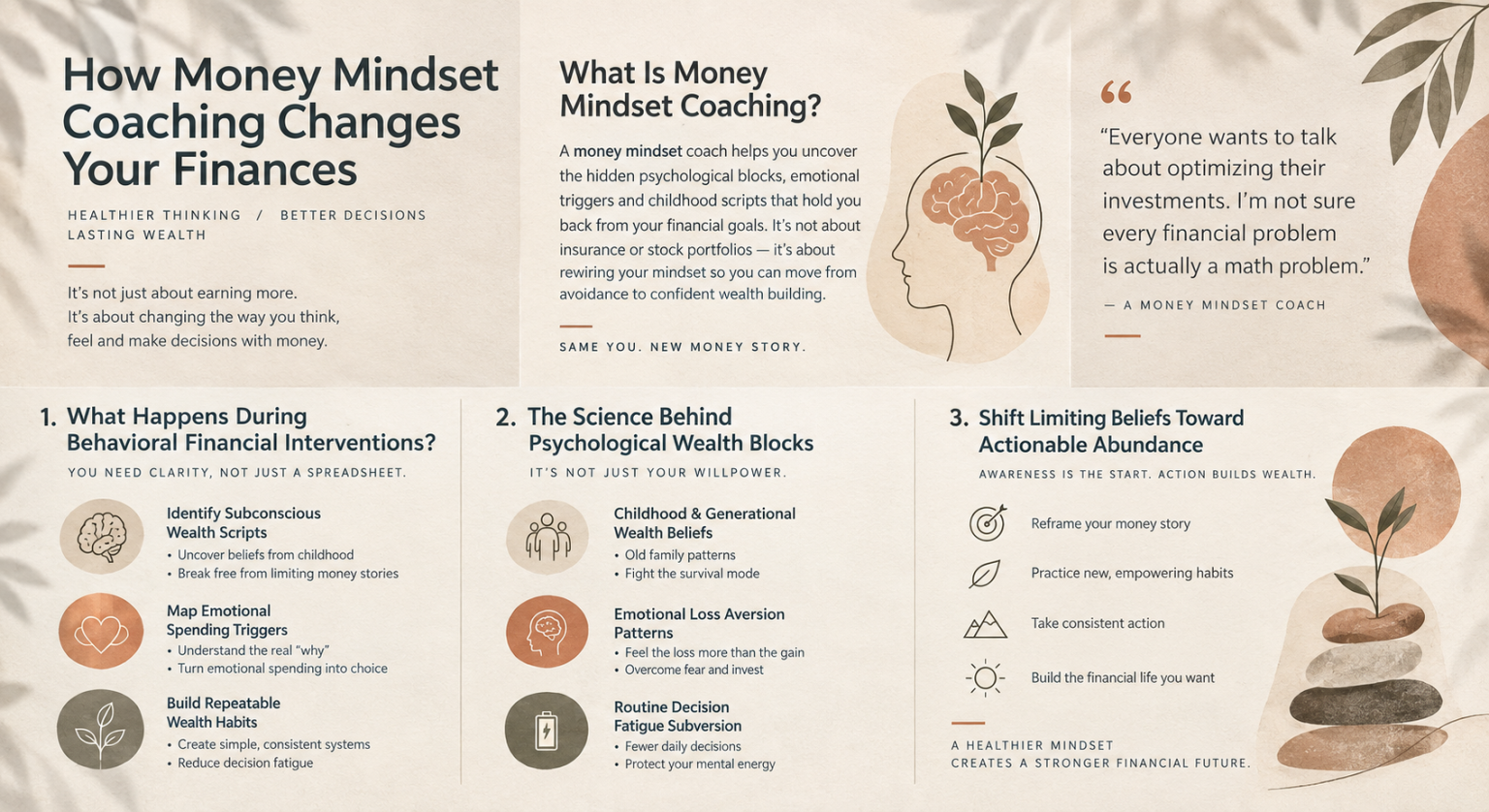
At its core, a money mindset coach bridges the gap between your finances and your psychology. They do not sell insurance or manage stock portfolios. Instead, this specialized intervention focuses entirely on uncovering the invisible psychological blocks, emotional triggers, and childhood scripts that cause you to hold yourself back your own financial reality. By rewiring these unconscious patterns through evidence-based methods, you naturally transition from chronic avoidance to confident wealth accumulation.
Everyone wants to talk about optimizing their investments. I’m not sure every financial problem is actually a math problem.
Last month, a client sat across from me in my office, recounting a promotion she had just turned down. More money, more authority. She didn’t decline it because she wasn’t capable. She declined it because stepping into that tax bracket felt fundamentally unsafe. We live in a culture obsessed with upgrading. From the HDB flat to the private condo to the Good Class Bungalow. The relentless grind. It is a heavy, unspoken script. Yet over seven in ten adults report that financial matters trigger significant anxiety in their daily lives. We are chasing a number, hoping the number will heal a wound that money did not inherently cause.
This is where the right guidance steps in. The approach isn’t about staring at a vision board. It is about untangling your self-worth from your net worth.
What Happens During Behavioral Financial Interventions?
You do not need another spreadsheet. You need clarity. When you step into a coaching program or a dedicated money bootcamp, the work is visceral. We bypass the surface-level math and dig straight into the “Inner O.S.” running the show.
Identify Subconscious Wealth Scripts
The human brain is a brilliant, terrifying archive. Long before you ever swiped a credit card, you learned how to interact with capital by watching the adults around you. We call these money scripts. They are the core unconscious financial beliefs developed in childhood that quietly dictate every adult decision you make. Maybe you learned that wealth makes people greedy. Maybe you learned that money is scarce and must be hoarded. Uncovering these scripts is the first, non-negotiable step toward holistic growth.
Map Emotional Spending Triggers
Money is rarely just money. It can be a proxy for power, survival, or love. When a coach sits down with you, they map the exact moments your emotions take over your spending. You don’t order delivery four nights a week because you lack culinary skills. You do it because you are exhausted, and spending $40 feels like buying back a sliver of your own autonomy. Once you understand the emotional payoff, you can begin the process of real financial recovery.
Build Repeatable Wealth Habits
Motivation is highly unreliable. Systems are not. In sports, when a team runs a “finding space to attack” session, the goal isn’t to look flashy for the cameras. The goal is to drill concrete patterns, timing, and coordinated runs until they become second nature. It reduces decision fatigue. The same applies to your financial journey. A good life coach helps you build repeatable, unsexy wealth habits that execute automatically, regardless of your mood.
The Science Behind Psychological Wealth Blocks
We like to believe we are deeply rational creatures. We are not. Behavioral economics proves time and again that our financial decisions are saturated in cognitive bias.
Childhood Generational Wealth Beliefs
If you grew up in a household where the primary breadwinner was constantly on edge, your nervous system learned to associate financial discussions with danger. It is not just a passing thought. It is a deeply ingrained response tied to older generational narratives. You cannot out-earn a nervous system that is trapped in survival mode.
Emotional Loss Aversion Patterns
Human beings feel the pain of losing a dollar twice as intensely as the joy of gaining one. This is loss aversion. It keeps smart people paralyzed. You leave cash rotting in a low-yield savings account because the unconscious fear of losing your capital eclipses the logical need to invest. Recognizing this cognitive trap is half the battle.
Routine Decision Fatigue Subversion
Every choice you make drains a finite reservoir of mental energy. By 5:00 PM, corporate professionals are running on fumes. This is when impulse buys happen. This is when budgets die. Structuring your financial life to require fewer daily decisions is a masterclass in mental fitness.
Shift Limiting Beliefs Toward Actionable Abundance
Awareness without action is just a neat party trick. To actually change your trajectory, you have to move from theory to practice. Here is how that transition looks.
-
You must stop avoiding the numbers. Avoidance breeds monsters. Pull your bank statements. Face the reality of your debt without judgment.
-
You must separate your identity from your income. A bad investment does not mean you are a bad person. It is just data.
-
You must cultivate a beginner’s mind. Curiosity is the antidote to fear. When you approach your money story with curiosity instead of criticism, the tension dissolves.
Audit Your Current Accounts
You cannot navigate out of the woods if you refuse to look at the map. Start by utilizing a standardized framework to objectively measure your financial health, stripping away the emotion. Look at the raw data. Where is the money going?
Reframe Negative Wealth Narratives
Catch the thoughts as they happen. “I will never get out of debt” is a story. “I am currently paying down my liabilities while learning new wealth strategies” is a fact. The nuance matters. Words create worlds.
Implement Structured Accountability Systems
Consider professional sports . When a franchise completely overhauls its coaching staff, it isn’t just a PR stunt. It changes how the team conceptualizes discipline and clock management. The vibe shifts toward accountability and fewer ego trips. Real-world parallel: you might hit a rough patch as you adjust to the new system, but the payoff comes when you stop freelancing and start executing the game plan. You need that exact same external accountability for your life goals.
Financial Planners Versus Behavioral Wealth Mentors
It is incredibly easy to confuse these two professions. They operate in the same universe but speak entirely different languages.
|
Professional Focus |
Financial Planner |
Behavioral Wealth Mentor |
|---|---|---|
|
Primary Goal |
Asset allocation, tax strategy, and portfolio growth. |
Rewiring limiting beliefs and modifying behavioral responses to wealth. |
|
Toolbox used |
Mutual funds, bonds, spreadsheets, and market analysis. |
Cognitive-behavioral techniques, active listening, and somatic awareness. |
|
Measures of Success |
Percentage yield and net worth increases. |
Reduced financial anxiety, better communication, and mindful spending. |
Focus On Product Recommendations
Planners are mechanics. They look under the hood of your portfolio and recommend the right index funds to get you to retirement. They assume you will rationally follow their advice.
Focus On Psychological Triggers
Coaches understand that most people may not follow logical advice because money is nuanced. A comprehensive meta-analysis of financial interventions shows that addressing these psychological aspects correlates directly with higher self-control and a massively improved quality of life.
Variations In Industry Regulation
Financial planners are heavily regulated. They hold licenses. The coaching industry, however, is the Wild West. Anyone with a Wi-Fi connection and a podcast can call themselves an expert. You have to be deeply discerning.
Systemic Flaws Within Unregulated Mentorship Programs
Let’s be brutally honest. There is a certain toxic positivity that plagues the modern manifestation community.
There is an entire subculture of internet gurus peddling the idea that if you just “think abundantly,” the universe will drop a million dollars into your lap. This completely ignores systemic economic realities. Inflation is real. Wage stagnation is real. You cannot out-mindset systemic disadvantage. A truly trauma-informed money mindset coach does not gaslight you into ignoring reality. They help you build resilience and capacity within that reality. Beware of any program that promises effortless success without acknowledging the very real socio-economic friction we all live in.
Verify Credentials Before Hiring A Professional
Do not hand over your psychological safety to an amateur. If you are looking to hire someone, look for substance over slick marketing.
I often recommend looking at how a coach was trained. A practitioner who has completed rigorous, evidence-based coursework—self-paced modules that are practical rather than purely theoretical—is infinitely more valuable than someone flashing a weekend retreat certificate. The data backs this up: the vast majority of clients place immense value on formal professional credentials when selecting a practitioner. Ask about their supervision. Ask what modalities they use. If they get defensive, walk away.
Will A Better Attitude Actually Erase Debt?
No. A positive attitude, in isolation, pays exactly zero bills. The bank does not accept high vibrations as a mortgage payment.
But here is what actually happens. When you strip away the panic, the avoidance, and the scarcity mindset, you finally have the bandwidth to look at your financial situation objectively. You start making strategic, compassionate decisions. You negotiate that salary bump because you finally believe you are worth it. You stop hemorrhaging cash on things that don’t matter. The internal shift creates the external behavior, and the behavior is what ultimately builds the wealth. Businesses know this; it’s why enterprise-level coaching cultures frequently yield monumental returns on investment and massive cost savings. It works for corporations, and it works for your personal balance sheet.
FAQ
What exactly is a money block? It is an unconscious belief that prevents you from earning, saving, or investing. If you subconsciously believe wealthy people are corrupt, your brain will protect your moral identity by ensuring you never become wealthy.
How long does it take to see results? It depends on how deep the conditioning goes. Unlearning three decades of financial trauma does not happen in a 45-minute workshop. It requires sustained, intentional effort over months.
Can this help my marriage? Absolutely. Most relationship conflicts are just two different money beliefs. Understanding your partner’s financial blueprint creates immense empathy and structural empowerment within the home.
Conclusion
We spend so much of our lives optimizing for output. More hours, more hustle, more scale. But true financial peace isn’t found in relentless accumulation. It is found in spaciousness.
When you do the quiet, unglamorous work of understanding exactly what a money mindset coach does, you begin to view capital differently. It stops being a measure of your personal value and simply becomes a tool. A tool to buy back your time. A tool to nurture the people you love. A tool to finally sit down, breathe, and realize that you are already enough. And frankly, that realization is worth more than any number on a screen.