
Introduction
In the contemporary landscape of clinical practice, mental health professionals continually evaluate emerging therapeutic modalities designed to optimize patient outcomes and alleviate psychological distress. Accelerated resolution therapy has increasingly garnered attention within behavioral therapy circles as a viable intervention for persistent trauma responses. For clinicians and researchers alike, implementing an effective treatment protocol requires rigorous evaluation of primary studies and a foundational understanding of how specific mental health conditions respond to targeted interventions.
Why do so many of us spend years in psychotherapy, essentially spinning our wheels while rehashing the same painful memories?
It can feel incredibly frustrating when you are not seeing a return on your emotional investment.
Many patients walk into a therapist’s office, talk, and sometimes leave feeling just as overwhelmed by their generalized anxiety as when they arrived. Overcoming that persistent mental hurdle can feel like confronting what feels like an insurmountable challenge.
You might assume that emotional healing simply takes decades.
But does it have to?
Perhaps not.
It is time to take your mental health intervention strategy out of the endless conversational loop and try something that actively targets the nervous system.
What Drives The Rapid Memory Modification Technique?
Honestly? I get why there is considerable enthusiasm around this modality particular resolution therapy.
A lot of the “this changed my life in three sessions” reaction is mostly about how intense and deeply safe it feels inside the room with the practitioner. From what I see across patient experiences and clinical trials, the approach addresses a specific combination of needs effectively.
You finally feel understood. Plus, you are actually doing something tangible with the memory rather than just circling it in therapy limbo.
Neural Response Restructure
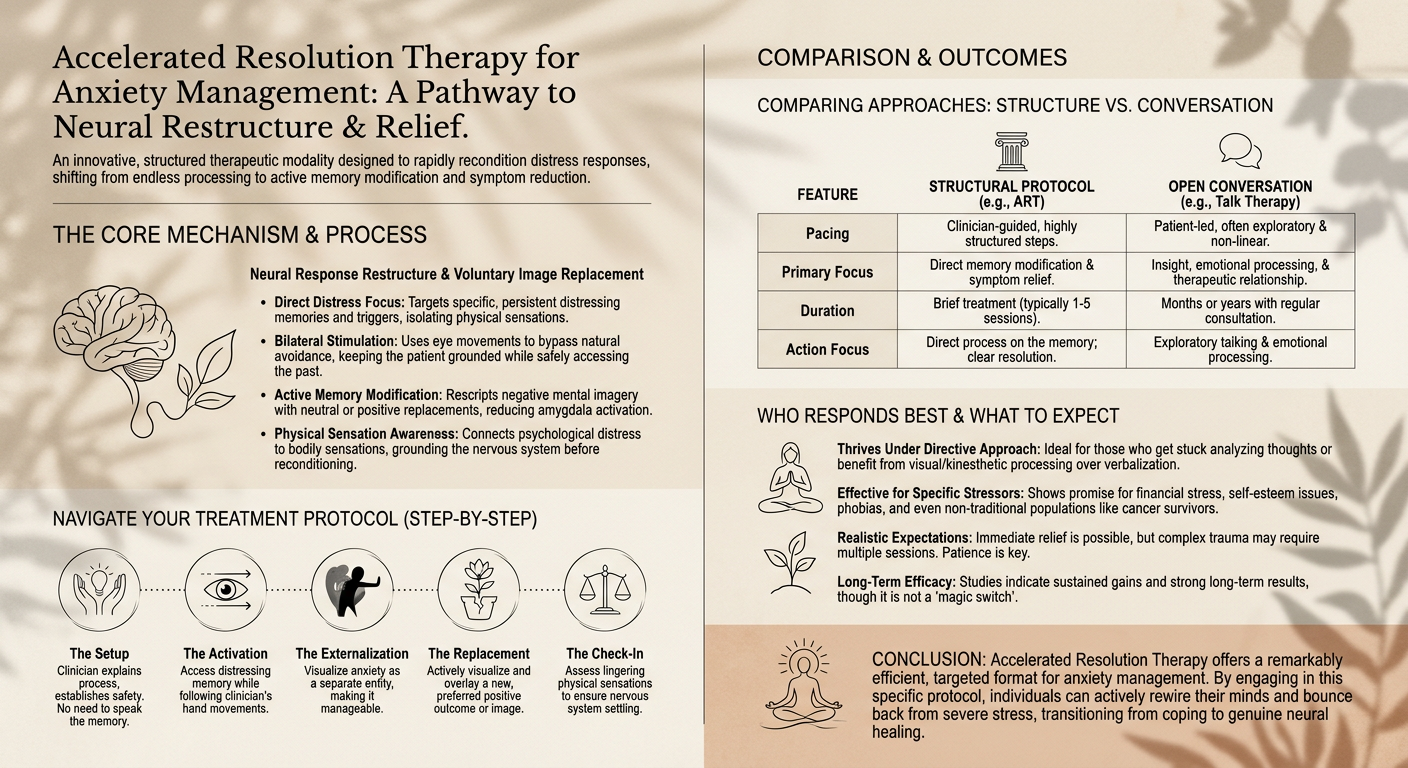
Accelerated resolution therapy is basically a structured way to take a distressing memory and recondition how your brain reacts to it.
You are not just talking. You are actively restructuring the neural response.
There is genuine research support backing this up. A recent 2024 systematic review finding significant symptom reduction highlights high treatment acceptability for anxiety, depression, and severe stress. The science points toward measurable shifts in how the brain processes fear.
Specific Distress Focus
Instead of vaguely complaining about your anxiety disorder for an hour, the clinician guides you to notice distressing moments that still surface.
- Identifying the precise memory or trigger that initiates the panic response.
- Isolating the physical sensations that accompany the psychological distress.
- Applying bilateral stimulation to disrupt the habitual emotional impact.
This directness cuts through the noise. It tells your brain, “We are working on the problem right now.”
Concrete Safety Pathways
When patients finally secure a new neural imprint, it can feel like they just turned down the volume on a radio that had been blaring in the background since childhood.
This gives the nervous system a concrete safety pathway. It is a similar principle found in effective alternative PTSD treatments you should know about, where the goal is to shift the body out of a constant state of hyperarousal.
How Do Bilateral Movements Recondition Fear Pathways?
Dozens of traditional therapy sessions can pass before you even scratch the surface of a core trauma.
Why?
Because the human brain naturally avoids pain. As researchers and clinicians uncover new ways to map the mind, we adapt our therapeutic practices accordingly to raise the standard of care.
Bilateral eye movements help bypass that natural avoidance. They keep the patient grounded in the present while the brain safely accesses the past.
Voluntary Image Replacement
Here is where things get highly specific.
The mechanism of voluntary image replacement, which reduces anxiety by re-scripting negative mental imagery, lessens amygdala activation significantly. You literally replace the distressing visual in your mind with a neutral or positive one.
For a detailed breakdown of this technique, you can review this clinical source on how voluntary image replacement works in practice to manage severe stress in just a few sessions.
It is not erasing the fact that an event happened. It is neutralizing the image so it ceases to produce an involuntary fear response in daily life.
Physical Sensation Awareness
We often forget that anxiety is intensely physical.
During a treatment session, the therapist continually asks the patient to check in with their body.
If you are dealing with a racing heart or a tight chest, recognizing those sensations is critical. This mirrors the physiological grounding techniques used in driving anxiety treatment: therapy and self-help strategies designed to rewire nervous system responses. You have to calm the body before you can convince the mind that it is safe.
Emotional Charge Reduction
The most consistent theme in patient reports is the sheer speed of emotional charge reduction.
People describe the therapy experience as if the memory suddenly “moves.” Suddenly they can talk about what used to floor them without the automatic fear response.
And the data supports this. A study showing similar or better results for anxiety and depression compared to standard front line therapy reveals incredibly high response rates.
Compare Structural Protocols Against Open Conversation Methods
Some therapeutic approaches let you wander. Accelerated resolution therapy puts you on a track.
To understand the difference, consider how structural protocols stack up against traditional open-ended counseling.
| Feature | Open Conversation (e.g., Talk Therapy) | Structural Protocol (e.g., Resolution Therapy) |
|---|---|---|
| Pacing | Patient-led, often exploratory and non-linear. | Clinician-guided, highly structured steps. |
| Primary Focus | Insight, emotional processing, and therapeutic relationship. | Direct memory modification and symptom relief. |
| Duration | Can last months or years with regular consultation. | Typically a brief treatment spanning one to five sessions. |
Direct Action Focus
My guess is that this structured model reduces the usual therapy friction.
You are not just talking about the trauma. You are doing a process to the memory. The structure is unyielding, which ironically provides immense freedom for the patient.
Clear Problem Resolution
With brief psychodynamic therapy or standard cognitive behavioral therapy, the finish line can seem blurry.
With this targeted intervention, the goal is clear problem resolution. You target an image. You process the sensations. You replace the image.
It is clinical psychology stripped of its typical ambiguity.
Lower Treatment Friction
When a therapy intervention has strict boundaries, patient autonomy actually increases. You know exactly what is expected of you in the room.
This lower treatment friction explains why this approach is highly effective for specialized stress scenarios. Whether a patient is seeking therapy for artist burnout to reclaim creative fire or addressing deep-seated phobias, a clear framework prevents them from getting lost in their own heads.
Navigate Your Treatment Protocol Step By Step
You cannot always expect a new therapy to completely fix your life from the word “go.”
Remember that mental health recovery represents a marathon. Even a rapid intervention requires diligence.
If you decide to engage with a counseling center group offering this resolution therapy training, here is generally what the therapeutic process looks like:
- The Setup: The therapist explains the process, ensuring you understand that you do not even have to speak the memory out loud if you prefer not to.
- The Activation: You bring up the distressing memory while following the clinician’s hand movements with your eyes.
- The Externalization: The clinician may ask you to visualize the anxiety as a separate entity. This specific technique of externalizing anxiety as a “monster” makes the psychological distress much more manageable.
- The Replacement: You actively visualize a new, preferred outcome or image to overlay onto the original memory.
- The Check-In: The session concludes by assessing any lingering physical sensations to ensure the nervous system has settled.
By focusing on these deliberate steps, you ensure more revenue for your emotional well-being with less conversational legwork.
Who Responds Best To Targeted Emotional Work?
Certain patients thrive under a directive approach.
If you are the type of person who easily gets stuck analyzing your own thoughts, an intervention that demands visual, auditory or kinesthetic processing over verbal or talk processing can be incredibly liberating.
We see this frequently with patients navigating complex financial stress. Individuals looking into how to heal money trauma often find that a structured protocol prevents them from spiraling into shame-based narratives.
Similarly, those dealing with severe self-esteem issues might benefit from this over traditional counseling. Much like the targeted nature of therapy for shame: multichannel eye movement integration, this modality bypasses the verbal defenses we build to protect our egos.
It is also showing promise in non-traditional populations. For instance, a recent pilot study demonstrating significant anxiety reduction in cancer survivors highlights how versatile this targeted emotional work can be.
What Happens If Immediate Relief Does Not Occur?
Here is the part I would strongly warn people about based on my own honest bias.
If you go into an accelerated treatment expecting it to erase your trauma like flipping a light switch, you are setting yourself up for disappointment.
Complex trauma responses do not resolve on a uniform timeline.
Some patients will absolutely feel immediate relief. Others may need multiple treatment sessions. Complex trauma responses require patience.
If the immediate relief does not occur, do not assume the therapy is entirely broken.
Yes, it is understandable to feel discouraged when immediate relief does not follow we want from our mental health efforts.
But that does not mean you should let your treatment fail out of frustration. That “I am improving, but I will likely need a few more sessions” tone shows up in many primary studies and patient experiences. I like that realism.
Google clinicaltrialsgov and you will find plenty of research designs indicating that while the therapy is fast, it is not magic. A compilation of peer-reviewed publications showing sustained effectiveness proves the long-term value, even if it takes a few extra weeks to get there.
If something feels stuck, figure out why and do what you can to work through it with your mental health professional.
FAQ
Is this approach similar to other behavioral therapies? It shares structural similarities with other visual and exposure-based interventions. However, its strict reliance on voluntary image replacement sets it apart from standard cognitive processing therapy.
Can it be used alongside other treatments? Absolutely. Many clinicians integrate it with existing plans. For example, when evaluating ABA therapy for autism and anxiety, practitioners might suggest additional interventions to handle specific traumatic stress components alongside regular behavioral therapy.
Does the anxiety come back? Studies indicate strong long-term efficacy. Transparent study results showing gains maintained six months after treatment suggest that the reconditioning holds up quite well over time.
Conclusion
There is no single key to mental health success.
The American Psychological Association notes that various therapeutic modalities work best when tailored to the individual.
Accelerated resolution therapy represents a lot of hard work packaged into a remarkably efficient format. There are no shortcuts to true healing, but there are certainly smarter ways to navigate the terrain.
You have the opportunity to bounce back from severe stress. It just takes the right clinical environment, a willingness to engage in the specific protocol, and the patience to let your brain complete the deeper neurological processing.
Stay diligent. Your efforts to rewire your mind will pay off.