
Last updated on August 26, 2026
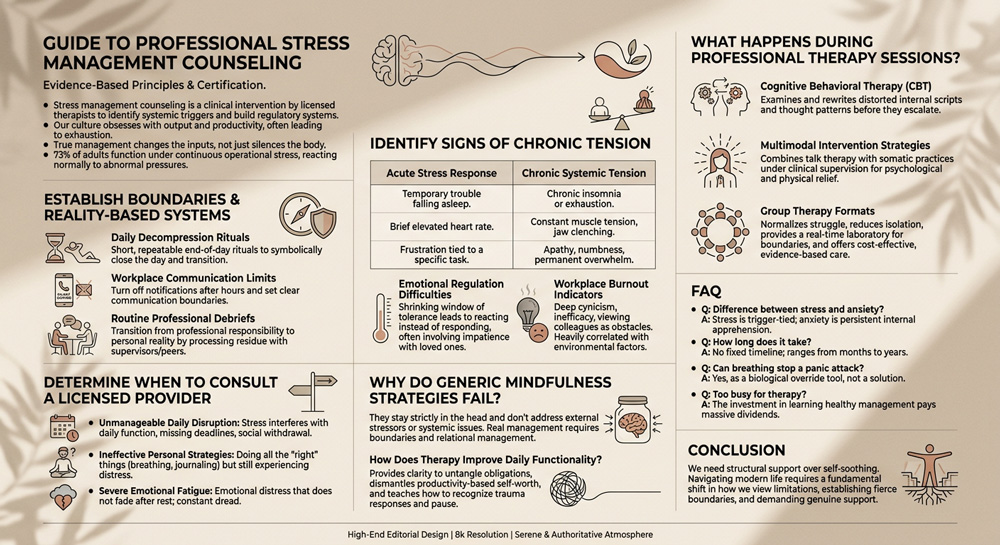
Stress management counseling is an evidence-based clinical intervention where a licensed therapist helps you identify systemic triggers and build reality-based systems to regulate your nervous system. That is the clinical reality. Here is the human one. We live in a culture obsessed with output. We optimize our mornings. We track our sleep. We measure our productivity. When the weight of all that doing becomes too much, we are handed a meditation app and told to just breathe.
It is exhausting. You cannot willpower your way into calm when your daily environment is fundamentally chaotic. Treating regulation like a quick fix to get back to work faster misses the point entirely. The reality is that the staggering 73 percent of adults functioning under continuous operational stress are not failing at life. They are reacting normally to abnormal pressures. Real stress management is not about silencing your body so you can endure more abuse. It is about changing the inputs.
What Happens During Professional Therapy Sessions?
Therapy is not just venting. Venting feels good for ten minutes but rarely changes the underlying architecture of your daily life. Professional counseling steps beyond simple stress reduction to address the mechanisms keeping you stuck in a state of high alert.
Cognitive Behavioral Therapy
Cognitive behavioral therapy consistently proves itself superior to unguided self-help. It does not ask you to pretend everything is fine. Cognitive restructuring examines the script running in the background of your mind. If your job requires you to stay perfectly regulated while other people throw their crises at you all day, your brain learns to treat everything as a threat. A therapist helps you locate those distorted internal scripts and rewrite them before they escalate into an acute anxiety disorder.
Multimodal Intervention Strategies
Humans are complicated. Our interventions need to be equally nuanced. Relying solely on talking is rarely enough when your nervous system is vibrating at a high frequency. Clinical consensus shows that personalized care works best. This means combining talk therapy with somatic practices. Working on building emotional awareness under clinical supervision ensures that you are treating both the psychological burden and the physical symptoms.
Group Therapy Formats
We heal in community. Isolation makes everything heavier. Group therapy formats offer incredibly high utility, especially in high-pressure environments like corporate offices or rigorous academic programs. Hearing someone else articulate the exact emotional distress you have been hiding brings immediate relief.
-
It normalizes the struggle and removes the quiet shame of feeling overwhelmed.
-
It provides a real-time laboratory for practicing boundaries with others.
-
It directly reduces the reality that high societal and relational loneliness multiplies risks for clinical anxiety.
-
It offers cost-effective access to evidence-based care.
Establish Boundaries and Reality-Based Systems
If your environment is contributing to ongoing stress, breathing exercises are basically a temporary response to an ongoing concern. I see this constantly with corporate professionals and new parents. Real relief requires operational changes.
Daily Decompression Rituals
Therapists who stay grounded treat nervous system regulation as maintenance. It is not another task on your busy schedule. You need planned decompression that is actually built into your workflow. Short, boring, repeatable resets work best. Create a consistent end-of-day ritual to symbolically close the day. Your brain starts expecting the transition instead of fighting it. When that ritual is missing, stress feels like it has no off switch.
Workplace Communication Limits
The “always on” feeling people describe is a direct result of blurred boundaries. You are essentially training your body to treat stress as background noise. Setting limits on workplace communication is terrifying but necessary. Turn off notifications after hours. Stop answering non-urgent emails on Sundays. If you do not create a boundary, the constant influx of demands will negatively affect your mental well-being.
Routine Professional Debriefs
If you work in a helping profession, you need a place to put the emotional residue after a tough shift. You cannot just absorb a client crisis and then go grocery shopping like nothing happened. Routine debriefs with a supervisor or peer group act as a supportive mechanism for processing workplace stress. They transition you from professional responsibility back to personal reality.
Identify Signs of Chronic Tension
Most people do not realize they are in crisis until their body forces them to stop. We are conditioned to ignore the warning signs in the name of resilience.
Physical Exhaustion Symptoms
Your biology keeps a meticulous ledger of your emotional state. The endocrinological cascade is entirely predictable. Chronic elevation of your internal alarm system impairs immune and digestive tissues over time. You might experience recurring headaches, muscle stiffness, or relentless fatigue. These are not signs of weakness. They are clear biological metrics betraying a system under prolonged attack.
|
Assessment Area |
Acute Stress Response |
Chronic Systemic Tension |
|---|---|---|
|
Sleep Patterns |
Temporary trouble falling asleep before a big event. |
Chronic insomnia or waking up exhausted after a full night. |
|
Physical Sensations |
Brief elevated heart rate during a stressful situation. |
Constant muscle tension, jaw clenching, and digestive issues. |
|
Emotional State |
Frustration directly tied to a specific task. |
Apathy, numbness, or feeling permanently overwhelmed. |
Emotional Regulation Difficulties
When you are running on empty, your window of tolerance shrinks to nothing. You stop responding and start reacting. Recent metrics show that 60 percent of heavily stressed individuals lose patience with family and loved ones due to external tensions. If you find yourself snapping at your kids or dreading conversations with friends, your coping mechanisms are failing.
Workplace Burnout Indicators
Burnout is not just feeling tired on a Friday. It is a deep cynicism toward your work and a profound sense of inefficacy. You start viewing clients, patients, or colleagues as obstacles rather than humans. This overlaps heavily with clinical depression. The data points heavily toward environment. In fact, research indicates staggering odds ratios correlating workplace harassment directly to severe burnout. It is a systemic failure, not a personal one.
Determine When to Consult a Licensed Provider
There is a distinct difference between having a bad week and living in a state of chronic stress. Knowing when to escalate your care is a critical skill.
Unmanageable Daily Disruption
If your stress levels are actively interfering with your ability to function, it is time to seek therapy. This means missing deadlines, avoiding social contact, or relying on unhealthy behaviors to get through the day. Widespread data indicates a baseline prevalence of severe sleep disruption and deeply lowered motivation across stressed populations. When your daily life feels impossible, you need professional intervention.
Ineffective Personal Strategies
Maybe you tried the breathing techniques. Maybe you bought the stress journal. Maybe you even tried progressive muscle relaxation. If you are doing all the “right” things and still experiencing panic attacks, your personal strategies are ineffective. A stress management therapist has the clinical vocabulary to help you pivot to more robust, evidence-based practices.
Severe Emotional Fatigue
Emotional distress that does not fade after a weekend of rest requires attention. If you feel a constant, heavy dread in your chest on Sunday afternoons, your body is telling you something vital. Do not wait for a full breakdown to seek a caring professional.
Why Do Generic Mindfulness Strategies Fail?
I am biased against the “just do yoga” vibe when it is presented as the ultimate solution. Sometimes taking a deep breath helps. But treating generic mindfulness as a cure-all is fundamentally flawed. If your job demands 60 hours a week and your boss is abusive, mindfulness is just teaching you to quietly tolerate the intolerable.
The strategies fail because they stay strictly in your head. They do not address the external stressors. Real stress management needs to include boundaries and relational management. It involves looking at the structures of your life and having the courage to say no.
How Does Therapy Improve Daily Functionality?
Therapy gives you clarity. It helps you untangle the massive knot of obligations, fears, and expectations so you can actually see what is in front of you. A good therapist will not just tell you to practice gratitude. They will work with you to dismantle the belief that your worth is tied to your productivity.
Therapy options that focus on cognitive techniques care about how you process reality. You learn to recognize when your body is entering a trauma response. You learn to pause. That pause is where your power lives. It is the space between a stressful experience and your reaction to it. Expanding that space changes everything.
Can Environmental Changes Reduce Daily Anxiety?
Absolutely. Changing the inputs changes the outputs. You cannot heal in the exact same environment that broke you. Sometimes the most evidence-based holistic care you can receive is permission to quit a toxic job.
We know that supervisor support and structural organizational fixes heavily mitigate severe emotional exhaustion. If you do not have that support, your anxiety will remain high regardless of how many relaxation skills you learn. Environmental changes remove the constant threat, allowing your nervous system to finally return to a more regulated state and rest.
FAQ
What is the difference between stress and an anxiety disorder? Stress is typically tied to an external trigger. A looming deadline. A difficult conversation. Anxiety is persistent internal apprehension that lingers long after the stressful events have passed.
How long does stress counseling usually take? There is no fixed timeline. Some people find immense relief in a few months of targeted cognitive restructuring. Others engage in therapy for years as a form of ongoing mental maintenance.
Can breathing really stop a panic attack? Yes, but context matters. Purposeful breath work forces your body out of the sympathetic nervous system’s fight-or-flight mode. It is a biological override. But it is a tool for the moment, not a solution for the underlying cause.
What if I feel too busy to start therapy? If you are too busy to address your health, your body will eventually mandate a break. The time investment in learning healthy ways to manage your capacity pays massive dividends in your overall vitality.
Conclusion
We are completely over-indexed on self-soothing and entirely under-indexed on structural support. The relentless pursuit of optimizing our way out of pain only drives us deeper into isolation. Navigating modern life requires more than just a positive mindset and a handful of relaxation techniques. It requires a fundamental shift in how we view our own human limitations. You are not a machine built for infinite scaling. When you finally allow yourself the spaciousness to step back, establish fierce boundaries, and demand genuine support, the chronic tension begins to become more manageable.